Exam 4 Study Guide
Study these flashcardsFree · spaced repetition · iPhone, Android, Mac & web
All cards
1
Weathering
The breaking down or dissolving of minerals on the surface of Earth.
2
Erosion
Geological process in which Earth materials are worn away and transported by natural forces.
3
Deposition
The dropping of sediment in a new place.
4
Density
Physical property. Amount of matter an object has to its volume. How tightly packed molecules are.
5
Malleability
The ability to be pounded into thing sheets or movable. Refers to the ability of a material to be hammered or pressed into thin sheets without breaking.
6
Ductility
The physical property of the metal which means if we pull the metal it's going to stretch rather than break. The ability to be drawn or pulled into a wire.
7
Solubility
The ability to dissolve in another.
8
State of Matter
The physical form in which a substance exists at room temperature such as a solid, liquid, or gas.
9
Thermal Conductivity
The ability to transfer thermal energy from one area to another
10
Thermal Energy
Of a substane depends on its temperature and the quantity of particles that it contains
11
Heat
Is the flow of thermal energy from a hotter object to a colder one.
12
Hurricane
A storm with violent winds.
13
Typhoon
A tropical storm in the region of the Indian or Western Pacific Ocean.
14
Scientific Article
A technical document that shares scientific knowledge with a specific audience.
15
Abstract
A brief summary of a scientific paper that gives an overview.
16
Be able to explain the diffences among weathering, erosion, and deposition.
Weathering is where rocks and minerals are broken down by the elements of nature into smaller pieces. Erosion is the movement of broken-down, weathered rock from place to place, and deposition means the laying down, or depositing, of broken rock.
17
How do dirt, leaves, grass, and trees affect weathering, Erosion, and Deposition?
Grass and Trees have roots that can prevent erosion by holding onto soil and rocks. They slow down the rate of erosion, and sometimes even cause deposition. These plants help keep the soil in place. On the other hand dirt and leaves are more susceptible to weathering, erosion and deposition. They increase the amount.
18
What are the 5 types of erosion? Give an example of each one.
Physical Erosion - Wind blowing sand
Water Erosion - The river moving sediments
Wind Erosion - Wind storm made dunes
Glacial Erosion - The Glacier made / shaped a valley
Chemical Erosion - The acid rain dissolving minerals
Water Erosion - The river moving sediments
Wind Erosion - Wind storm made dunes
Glacial Erosion - The Glacier made / shaped a valley
Chemical Erosion - The acid rain dissolving minerals
19
How can we control erosion better
We can control erosiont better with plants, wind breakers, and buffers, etc.
20
What is the difference between physical and chemical changes?
The difference between physical and chemical changes is that chemical is a process where a substance transforms into new form. While physical is a change in form like shape and size.
21
What are the 5 signs of a Chemical Change? Give an example for each one.
Odor Production: The bread smells wonderful
Change in Temperature: Exothermic "hot tea" Indothermic "putting ice in your water"
Changein Color: "I am dyeing my hair"
Evolution of a gas (formation of bubbles): "boiling water"
Precipitate (formation of a solid): "Adding vinegar and milk makes cottage cheese"
Change in Temperature: Exothermic "hot tea" Indothermic "putting ice in your water"
Changein Color: "I am dyeing my hair"
Evolution of a gas (formation of bubbles): "boiling water"
Precipitate (formation of a solid): "Adding vinegar and milk makes cottage cheese"
22
Draw a diagram of the following, and define each term: conduction, convection, and radiation
Conduction: is a procedure where heat is transferred between objects through physical contact.
Convection: is the type of heat transmission where there is an energy transform within the fluid.
Radiation: refers to the process by which heat is transferred between things without direct physical touch.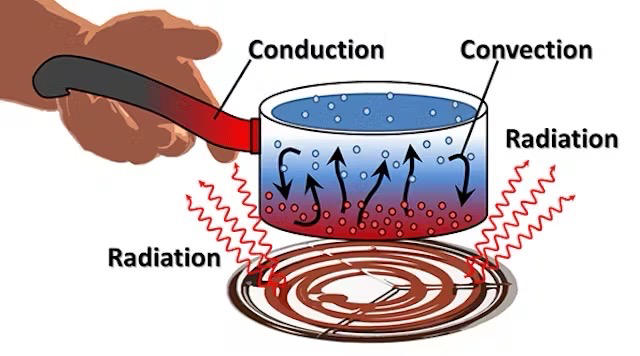
Convection: is the type of heat transmission where there is an energy transform within the fluid.
Radiation: refers to the process by which heat is transferred between things without direct physical touch.
23
Drought
Long period of time of dry weather increasing flood risk
24
Flood
An overflow of large water beyond normal confinds which help travel nutrients
25
Tornados
A whirling cloud that usually last for 30 seconds to 1 hour
26
Hurricanes
A tropical cyclone in the Atlantic Ocean accompanied by high winds and lightling
27
Volcanes
Causes massive polution in to the atmosphere. But leads to island creation.
28
Wildfires
Cause pollution, econsystem lost etc. But a big help in deforrestation.
29
Earthquake
Shift of the earth's tectonic plates which releases a large amount of energy.
30
Tsunamis
A giant wave of water causes by large disturbances in the ocean, such as under water earthquake.
31
Asteroids
A flying rock from outerspace which causes huge craters on the earth's surface.
32
What chemical changes occur during Natural Disasters?
Chemical changes occur during Natural Disaster is burning from wildfires and volcanoes.
33
What physical changes occur during Natural Disaters?
The physical changes that occur during natural disasters is breaking down of materials such as flood, asteroids etc.
34
Which Natural Disaster is the largest threat to biodiversity?
Hurricane
35
What are the parts of a scientific article? Define each one.
Title: Brief summary of the research. States what the article is about.
Authors: Who wrote the article, who did the research.
Abstract: Summarizes the whole article.
Introduction: Establishes the context for the research: the area in which the research takes place, the research problem, the importance of the research, and the guiding question or hypothesis.
Materials and Methods: Describes the research procedure.
Results: Only data, reports the outcomes of the research procedure.
Discussion: Interprets the results, explaining them and comparing them to the results of other experiments.
Conclusion: Focuses the reader on what is important about the research, its contribution to the larger area of study.
References: Lists the sources used in the article.
Literature cited: Crediting the resource you research and additional information
Authors: Who wrote the article, who did the research.
Abstract: Summarizes the whole article.
Introduction: Establishes the context for the research: the area in which the research takes place, the research problem, the importance of the research, and the guiding question or hypothesis.
Materials and Methods: Describes the research procedure.
Results: Only data, reports the outcomes of the research procedure.
Discussion: Interprets the results, explaining them and comparing them to the results of other experiments.
Conclusion: Focuses the reader on what is important about the research, its contribution to the larger area of study.
References: Lists the sources used in the article.
Literature cited: Crediting the resource you research and additional information