ua: Vectors
Study these flashcardsFree · spaced repetition · iPhone, Android, Mac & web
All cards
1
What is a vector?
A matrix with only one column is called acolumn vector, or simply a vector.
2
What does it mean to view vectors in $\mathbb{R}^n$ as n-tuples?
It means that a vector in $\mathbb{R}^n$ is represented as an ordered list of n real numbers, written as $(u_1, ..., u_n)$
3
What is a zero vectior?
The vector whose entries are all zero is called thezero vectorand is denoted by0.
(The number of entries in0will be clear from the context.)
(The number of entries in0will be clear from the context.)
4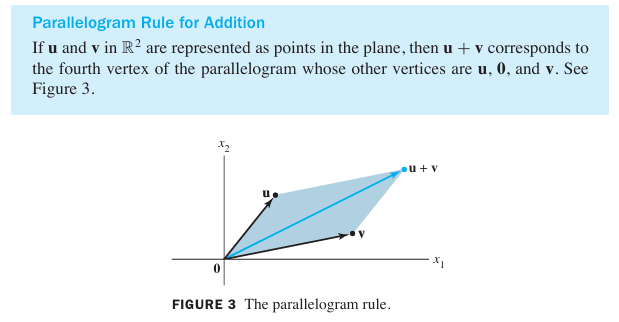
Explain Parallelogram Rule for Addition
5
What is vector addition?
Vector addition is an operation on vectors in $\mathbb{R}^n$ where corresponding components are added, and it satisfies $u+v=v+u$.
6
What is the associative property of vector addition?
The associative property of vector addition states that $(u+v)+w=u+(v+w)$ for all $u,v,w\in\mathbb{R}^n$.
7
What is the additive identity in $\mathbb{R}^n$?
The additive identity is the zero vector $0$, which satisfies $u+0=0+u=u$ for all $u\in\mathbb{R}^n$.
8
What is the additive inverse of a vector?
The additive inverse of a vector $u$ is $-u$, and it satisfies $u+(-u)=0$.
9
What is the distributive property of scalar multiplication over vector addition?
For any scalar $c$ and vectors $u,v\in\mathbb{R}^n$, scalar multiplication satisfies $c(u+v)=cu+cv$.
10
What is the distributive property of scalar multiplication over scalar addition?
For any scalars $c,d$ and vector $u\in\mathbb{R}^n$, $(c+d)u=cu+du$.
11
What is the associative property of scalar multiplication?
For any scalars $c,d$ and vector $u\in\mathbb{R}^n$, scalar multiplication satisfies $c(du)=(cd)u$.
12
What is the multiplicative identity property for scalar multiplication?
The multiplicative identity property states that $1u=u$ for all $u\in\mathbb{R}^n$.