ua: Systems of linear equations
Study these flashcardsFree · spaced repetition · iPhone, Android, Mac & web
All cards
1
What is a linear equation?
A linear equation in the variables $x_1...x_n$ is an equation that can be written in the form $a_1x_1 + a_2x_2 + ... + a_nx_n = b$ where $b, a_1, \ldots, a_n \in \mathbb{R}$ (or $\mathbb{C}$), and $n \in \mathbb{N}^+.$
2
What is a system of linear equations?
A system of linear equations (or a linear system) is a collection of one or more linear equations involving the same variables.
3
What is a solution of a system?
Asolution of the system is a list $(s_1, ..., s_n)$ of numbers that makes each equation a true statement when the values $s_1...s_n$ are substituted for $x_1...x_n$ respectively.
4
What is a solution set?
The set of all possible solutions is called the solution set of the linear system.
5
When are two linear systems equivalent?
Two linear systems are called equivalent if they have the same solution set.
6
When does a system of linear equation have no solutions?
When graphs are parallel and distinct (never intersect).
7
When does a system of linear equation have exactly one solution?
When the graphs intersect in exactly one point, there are no free variables.
8
When does a system of linear equation have infinitely many solutions?
When the graphs overlap completely (same line), there is at least one free variable.
9
What is a consistent system of linear equations?
A system that has one or inifinitely many solutions.
10
What is an inconsistent system of linear equations?
A system that has no solutions.
11
What is a matrix?
A matrix is a rectangular array $A = (a_{ij}) \in \mathbb{R}^{m \times n} \quad (\text{or } \mathbb{C}^{m \times n})$, where $a_{ij}$ is the entry in row $i$ and column $j$.
12
What is the coefficient matrix of a linear system?
The matrix formed by the coefficients of the variables, aligned in columns.
13
What is the augmented matrix of a linear system?
The matrix consisting of the coefficient matrix with an additional column containing the constants from the right sides of the equations.
14
How is the size of a matrix written?
As m × n, where m is the number of rows and n is the number of columns ($m,n \in \mathbb{N}^+$)
15
Explain elementary row oprations
1. (Row replacement) Replace one row by the sum of itself and a multiple of another row (“Add to one row a multiple of another row.”)
2. (Row swapping) Interchange two rows.
3. (Scalar multiplication) Multiply all entries in a row by a nonzero constant.
2. (Row swapping) Interchange two rows.
3. (Scalar multiplication) Multiply all entries in a row by a nonzero constant.
16
What does it mean for two matrices to be row equivalent?
Two matrices are calledrow equivalentif there
is a sequence of elementary row operations that transforms one matrix into the other.
is a sequence of elementary row operations that transforms one matrix into the other.
17
What is the consequence of two augmented matrices being row equivalent?
The corresponding linear systems have the same solution set, since elementary row operations preserve solutions.
18
What is a pivot (in a matrix)?
A pivot is the first nonzero entry in a row of a matrix that is in row echelon (triangular) form. It is also called a leading entry.
The column containing a pivot is called a pivot column, and the variable corresponding to that column is a pivot variable (or leading variable).
Variables that are not pivot variables are called free variables.
The column containing a pivot is called a pivot column, and the variable corresponding to that column is a pivot variable (or leading variable).
Variables that are not pivot variables are called free variables.
19
How can we determine the number of solutions of a linear system from the triangular (echelon) form of its augmented matrix?
Look at the rows of the triangular augmented matrix.
- If there is a row with all zeros on the left and a nonzero number on the right, the system has no solution.
- If the system is consistent, count the number of pivot (leading) variables.
- If every variable is a pivot (no free variables), the system has exactly one solution.
- If there are fewer pivots than variables (at least one free variable), the system has infinitely many solutions.
- If there is a row with all zeros on the left and a nonzero number on the right, the system has no solution.
- If the system is consistent, count the number of pivot (leading) variables.
- If every variable is a pivot (no free variables), the system has exactly one solution.
- If there are fewer pivots than variables (at least one free variable), the system has infinitely many solutions.
20
What properties does a rectangular matrix need to have to be in echelon or row echelon form?
1. All nonzero rows are above any rows of all zeros.
2. Each leading entry of a row is in a column to the right of the leading entry of
the row above it.
3. All entries in a column below a leading entry are zeros.
2. Each leading entry of a row is in a column to the right of the leading entry of
the row above it.
3. All entries in a column below a leading entry are zeros.
21
When is a matrix in reduced row echelon form?
When it is in row echelon form and also satisfies:
1. The leading entry in each nonzero row is 1.
2. Each leading 1 is the only nonzero entry in its column.
1. The leading entry in each nonzero row is 1.
2. Each leading 1 is the only nonzero entry in its column.
22
State theorem: Uniqueness of the Reduced Echelon Form (REF)/
Each matrix is row equivalent to one and only one reduced echelon matrix.
(Any nonzero matrix may berow reduced(that is,transformed by elementary row operations) into more than one matrix in echelon form,using different sequences of row operations.However,the reduced echelon form one obtains from a matrix is unique.)
(Any nonzero matrix may berow reduced(that is,transformed by elementary row operations) into more than one matrix in echelon form,using different sequences of row operations.However,the reduced echelon form one obtains from a matrix is unique.)
23
Describe steps of the Row Reduction Algorithm.
Start with the augmented matrix of the linear system.
Use elementary row operations to move any rows with all zeros to the bottom of the matrix.
Working from left to right, choose the leftmost column that contains a nonzero entry and use it to create a pivot.
If necessary, swap rows to bring a nonzero entry into the pivot position.
Scale the pivot row so that the pivot equals 1.
Use row replacement operations to make all entries below the pivot zero.
Repeat this process for each subsequent row and column until the matrix is in row echelon form.
(Optional, for reduced row echelon form) Continue by using row operations to make all entries above each pivot zero.
This process transforms the matrix into echelon form (or reduced row echelon form) while preserving the solution set of the system.
Use elementary row operations to move any rows with all zeros to the bottom of the matrix.
Working from left to right, choose the leftmost column that contains a nonzero entry and use it to create a pivot.
If necessary, swap rows to bring a nonzero entry into the pivot position.
Scale the pivot row so that the pivot equals 1.
Use row replacement operations to make all entries below the pivot zero.
Repeat this process for each subsequent row and column until the matrix is in row echelon form.
(Optional, for reduced row echelon form) Continue by using row operations to make all entries above each pivot zero.
This process transforms the matrix into echelon form (or reduced row echelon form) while preserving the solution set of the system.
24
State theorem: Existence and Uniqueness
A linear system is consistent if and only if the rightmost column of the augmented matrix is not a pivot column—that is, if and only if an echelon form of the augmented matrix has no row of the form
$[0 ... 0 b]$ with $b$ nonzero
If a linear system is consistent, then the solution set contains either (i) a unique solution, when there are no free variables,or (ii) infinitely many solutions, when there is at least one free variable.
$[0 ... 0 b]$ with $b$ nonzero
If a linear system is consistent, then the solution set contains either (i) a unique solution, when there are no free variables,or (ii) infinitely many solutions, when there is at least one free variable.
25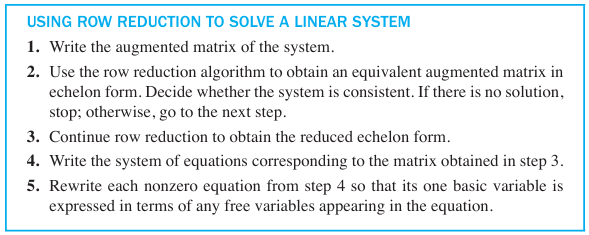
How to use row reduction to solve a linear system?