All cards
1
Know the different types of therapeutic diets
Therapeutic diets are ordered by person's primary care provider
• Soft, mechanical or pureed
• Liquid (HT, NTPT)
• Sodium-restricted [NAS (htn, kidney failure)]
• Carbohydrate-controlled or diabetic CCHO (diabetic)
• Calorie-restricted (immobility)
• "Heart Healthy" (CARDIAC)
• High-protein (wounds)
• Soft, mechanical or pureed
• Liquid (HT, NTPT)
• Sodium-restricted [NAS (htn, kidney failure)]
• Carbohydrate-controlled or diabetic CCHO (diabetic)
• Calorie-restricted (immobility)
• "Heart Healthy" (CARDIAC)
• High-protein (wounds)
2
What does NAS stand for?
NAS = "no-added salt"
This happens with sodium restricted diets
This happens with sodium restricted diets
3
Define malnutrition
Failure to take in enough of the right kind of nutrients to stay healthy
4
The risk factors that contribute to malnutrition in the elderly
Difficulty swallowing
-Eating possibly difficult for a person receiving healthcare
-May require a great deal of physical effort to eat
-Person may be embarrassed about needing help
-Physical conditions (such as pain or nausea), emotional factors (such as
depression or loneliness), and the side effects of medications and
treatments can all negatively impact a person's appetite
-Eating possibly difficult for a person receiving healthcare
-May require a great deal of physical effort to eat
-Person may be embarrassed about needing help
-Physical conditions (such as pain or nausea), emotional factors (such as
depression or loneliness), and the side effects of medications and
treatments can all negatively impact a person's appetite
5
What to look for when checking a patient's tray before serving it
-Check the name on the meal tray
-Check the diet to make sure it is the correct one for the person
-Help the person to eat shortly after delivering the meal
-Assist with opening cartons, cutting up food or identifying location of items
as needed
-Encourage use of assistive devices to promote independence
-Check the diet to make sure it is the correct one for the person
-Help the person to eat shortly after delivering the meal
-Assist with opening cartons, cutting up food or identifying location of items
as needed
-Encourage use of assistive devices to promote independence
6
Why is it important for residents to wear their glasses and hearing aids at meal time
7
IN what position should the resident be in while eating in bed?
Fowler's position
8
Where should you be seated when feeding the resident with weak / paralyzed arm?
Facing and feeding her on her stronger side
9
What foods are considered fluids
Fruits and vegetables have high water content. Soups, ice cream, and gelatin.
10
Define dehydration
Too little fluids in the body
11
How to describe the location of foods on a plate using clock method
Monitoring of food intake
Estimate how much of total meal person ate
Report and record intake
Report intake of less than 70% to nurse
Estimate how much of total meal person ate
Report and record intake
Report intake of less than 70% to nurse
12
What position should the resident be in who is receiving enteral nutrition
Enteral nutrition is also known as tube feeding. Fowler's position
13
Define colostomy
A part of the large intestine or colon that is attached to the stoma (opening).
14
Define condom catheter
A condom-like device that is placed over a man's penis and is connected by tubing to a drainage bag to collect urine ; used in the management of incontinence
15
Define constipation
Difficult elimination of dry / hard feces
16
Define defecation
The elimination of solid waste from the body
17
Define diarrhea
The frequent passage of loose, watery feces
18
Define enema
The introduction of fluid into the bowel through the anus to remove feces from the bowels
19
Define fecal impaction
A serious form of constipation that occurs when constipation is not relieved and feces build up in the bowel until the bowel is almost completely blocked
20
Define feces
Solid body waste
21
Define graduate
A pitcher-like device used for measuring fluids.
22
Define incontinence
The inability to control the release of urine / feces
23
Define indwelling urinary catheter
a small tube inserted through the urethra into the bladder that is left in place to drain urine from the bladder on a continuous basis
24
Define laxative
Medication that is taken orally to produce bowel movement
25
Define ostomy appliance
A pouch that is worn on the outside of the body, over a stoma, to collect feces / urine
26
Define stoma
A surgically created opening made in the abdominal wall to allow the elimination of waste
27
Define urination
the elimination of liquid waste from the body
28
Define urine
liquid body waste
29
Define voiding
Passage of urine; urination
30
When should a resident use a commode?
When the person is able to get out of bed but not able to transfer the distance to the bathroom
31
What are the different styles of bed pans
Standard bedpan: narrow end pointing toward person's feet
Fracture pan: narrow end pointing toward person's head
Fracture pan: narrow end pointing toward person's head
32
What are the factors that lead to incontinence
-Normal structural changes such as a decrease in muscle tone and
elasticity
-Acute conditions such as urinary tract infection or diarrhea
-Certain medications
-Conditions such as confusion or dementia that affect the person's ability
to interpret the sensation of needing to use the bathroom, and/or perform
the tasks needed to use the bathroom
-Conditions such as arthritis that limit a person's mobility
-Brain, spinal cord or nerve damage that prevents the sensation of the
urge to go
-Muscle weakness that normally prevents the involuntary release of urine
or feces
elasticity
-Acute conditions such as urinary tract infection or diarrhea
-Certain medications
-Conditions such as confusion or dementia that affect the person's ability
to interpret the sensation of needing to use the bathroom, and/or perform
the tasks needed to use the bathroom
-Conditions such as arthritis that limit a person's mobility
-Brain, spinal cord or nerve damage that prevents the sensation of the
urge to go
-Muscle weakness that normally prevents the involuntary release of urine
or feces
33
What are the common signs and symptoms of UTI in the elderly?
-Pain or burning sensation when urinating
-Frequent and often urgent need to urinate
-Ability to pass only a small amount of urine, despite feeling the need to
urinate
-Cloudy, dark-yellow and possibly foul-smelling urine
-Mucus or blood in the urine
-Fever
-New unusual behaviors in a person with dementia
-Changes in mental status (especially in older people)
-Frequent and often urgent need to urinate
-Ability to pass only a small amount of urine, despite feeling the need to
urinate
-Cloudy, dark-yellow and possibly foul-smelling urine
-Mucus or blood in the urine
-Fever
-New unusual behaviors in a person with dementia
-Changes in mental status (especially in older people)
34
What are the factors that contribute to constipation?
• Immobility
• Inadequate fluid intake
• Inadequate fiber intake
• Disruptions in person's normal bowel elimination pattern
• Changes in diet
• Aging
• Certain medications
• Inadequate fluid intake
• Inadequate fiber intake
• Disruptions in person's normal bowel elimination pattern
• Changes in diet
• Aging
• Certain medications
35
What is the difference between fecal impaction and constipation
Fecal impaction: more serious form of constipation occurring when
constipation not relieved; feces continue to build up until bowel
almost completely blocked
constipation not relieved; feces continue to build up until bowel
almost completely blocked
36
When observing urinary elimination, what are some of the reportable signs there could be a problem?
The amount of fluids lost is NOT equal to amount of fluids taken in
37
What is the proper position of the urinary catheter bags while in bed?
Keep the tubing lower than the person's bladder and the urine drainage bag lower than the tubing. Secure tubing with tape or strap to the top of the person's thigh.
38
The urinary drainage bag goes above or below the bladder?
Below the bladder
39
What type of container is used to empty the urinary drainage bag into?
The graduate container
40
Give the reasons why an ostomy device may be necessary?
- All or part of the bowel is surgically removed
-Person who had their bladder removed
-Person who had their bladder removed
41
Define pain threshold
Point at which person becomes aware of the pain
42
Define pain tolerance
Highest level of discomfort a person is willing to experience before seeking action to relieve it
43
Define acute pain
Pain that occurs suddenly with injury, with illness or from surgery; last less than 6 months and lessens as tissues heal
44
Define chronic pain
Pain that lasts more than 6 months
45
What is the difference between chronic and acute pain?
One lasts more than another.
46
Is pain a subjective / objective observation and why?
Pain is a subjective observation because it can't be directly observed by those who are not experiencing it
47
What are the common nonverbal expressions of pain with dementia
Wincing, grimacing, frowning or a worried facial expression
Rocking, pacing, restlessness
Rubbing the painful body part
Guarding (protecting) the painful body part
Moaning or crying
Resisting care
Aggressive behaviors (especially in response to attempts to give care)
Wakefulness
Loss of appetite
Rocking, pacing, restlessness
Rubbing the painful body part
Guarding (protecting) the painful body part
Moaning or crying
Resisting care
Aggressive behaviors (especially in response to attempts to give care)
Wakefulness
Loss of appetite
48
What are the elements necessary to mention when reporting pain
Facts to report:
Location
Characteristics
Intensity or level
Frequency
Location
Characteristics
Intensity or level
Frequency
49
Name the non-medication interventions that a CNA can use to assist in relieving pain
Icepacks and heatpacks
50
How often should the skin be inspected when receiving hot / cold compress
Check skin every 5 minutes. May reapply in 1 hour.
51
Why do we need to rate a person’s pain intensity on a scale?
To communicate the intensity of the pain
52
Define admission
A person's formal entry into the healthcare setting
53
Define baseline
The intial measurements that are taken to be compared with measurements taken later on
54
Define discharge
a person's formal release from the healthcare setting where he or she is currently receiving care
55
Define discharge planning
a process that involves identifying the person'’s ongoing care needs and making arrangments to have those needs met after the person leaves the facility
56
Define temporary transfer
movement of a resident of a nursing home or a home health client may to another type of healthcare facility to receive care for an acute medical contion; expection that the person will return to the nursing home or to own home after receiving treatment for the acute medical condition
57
Define terminal cleaning
process of cleaning and disinfecting a room and its equipment in preparation for someone new
58
Define transfer
movement of a person from one part of a facility to another
59
Define arthritis
a condition that causes joints to become inflamed, swollen, stiff, and painful
60
Which of the six principles is the focus principle when providing care to a patient with osteoporosis and why?
Safety because their bones are very fragile and brittle
61
What is a wound
an injury to the skin that often results in a break in the skin surface from either cutting the skin (surgical inceision), tearing (separation / ripping away of skin layers), puncturing the skin (trauma / stab wound), or prolonged pressure (damage to skin layers cause a break)
62
What are the 3 types of wounds
Open wound, closed wound, and existing wound?
63
What is a TIA?
A transient ischemic attack or mini-stroke.
64
Which department in the hospital is responsible for caring for cancer patients?
Oncology
65
Why is it important to use only the skin products recommended by the licensed nurse when caring for the skin of a patient receiving radiation therapy
To reduce further trauma or infection. The skin is already dry and sensitive from radiation therapy.
66
When is it permissible to wear 2 pairs of gloves with a patient
When the patient is recieving chemotherapy
67
What are the difference between age-related memory impairments vs mild cognitive impairment
Age-related memory impairment
-Forgetfulness but no interference with daily life
-Result of gradual loss of brain cells and decrease in brain chemicals
Mild cognitive impairment
-Problems worse than age-related memory impairment
-Noticeable to others but no interference with daily life
-Some remain stable without experiencing further decline
-Regular exercise and control of blood pressure can help prevent
progression
-All people with this condition are at increased risk for developing
dementia
-Forgetfulness but no interference with daily life
-Result of gradual loss of brain cells and decrease in brain chemicals
Mild cognitive impairment
-Problems worse than age-related memory impairment
-Noticeable to others but no interference with daily life
-Some remain stable without experiencing further decline
-Regular exercise and control of blood pressure can help prevent
progression
-All people with this condition are at increased risk for developing
dementia
68
Define dementia
Group of symptoms occurring with a progressive decline in memory
and thinking
and thinking
69
Is dementia a specific disease
Dementia is not a specific disease rather there are many types of dementia.
70
What are the 4 types of dementia
Alzheimer's disease, Vascular Dementia, Mixed Dementia, and Parkinson's Dementia
71
What are the stages of dementia and its characteristics
-Early: changes occur gradually and may not be immediately noticeable to others
• Person completes ADLs and IADLs
• Possibly misinterpreted as normal changes of aging
• Person can often cover up their symptoms
• Social interactions become more challenging
• Person may forget to take medicines or pay bills
• If they drive, it is likely still safe
-Middle: symptoms worsen making it apparent that something is wrong
• Person's perceptions and understanding of the world change significantly
• ADLs and IADLs are affected
• Personality changes
• Safety becomes a priority
• Caring for the person at home becomes increasingly difficult for family and
friends
• Additional in-home or community support needed; consider admission to a
more supportive or assisted-living environment
• Typically the longest stage
-Late: significant decline; person becomes physically dependent on others for all aspect of care, needing round-the-clock support
• High risk for complications
• Problems with nutrition and fluid balance
• Language skills continue to decline
Physical condition progressively declines
• Care is directed toward promoting comfort at the end of life and supporting a
peaceful death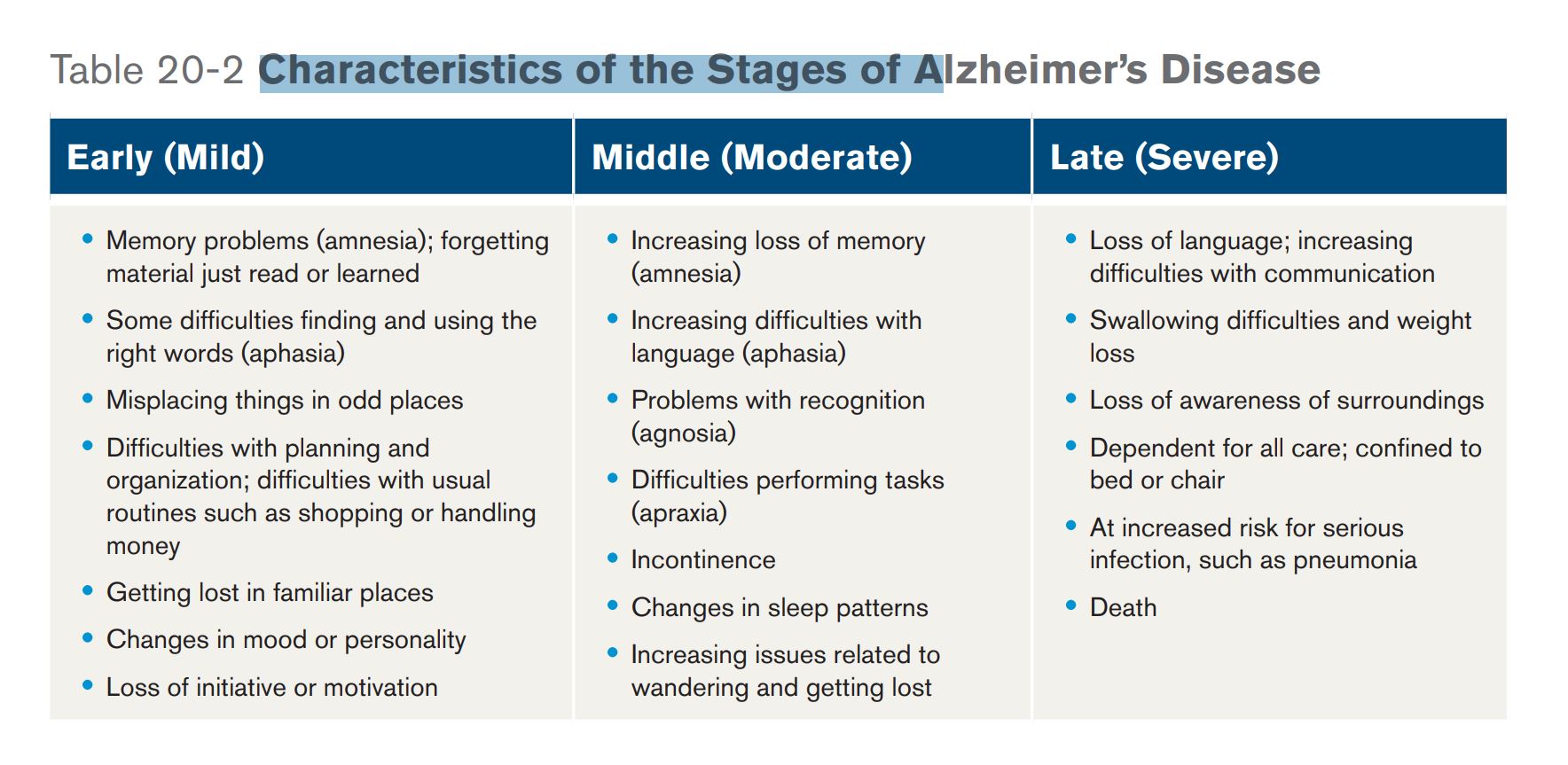
• Person completes ADLs and IADLs
• Possibly misinterpreted as normal changes of aging
• Person can often cover up their symptoms
• Social interactions become more challenging
• Person may forget to take medicines or pay bills
• If they drive, it is likely still safe
-Middle: symptoms worsen making it apparent that something is wrong
• Person's perceptions and understanding of the world change significantly
• ADLs and IADLs are affected
• Personality changes
• Safety becomes a priority
• Caring for the person at home becomes increasingly difficult for family and
friends
• Additional in-home or community support needed; consider admission to a
more supportive or assisted-living environment
• Typically the longest stage
-Late: significant decline; person becomes physically dependent on others for all aspect of care, needing round-the-clock support
• High risk for complications
• Problems with nutrition and fluid balance
• Language skills continue to decline
Physical condition progressively declines
• Care is directed toward promoting comfort at the end of life and supporting a
peaceful death
72
Define delirium
Rapid onset of change in cognition—occurring within a few days or even hours
-Related to chemical changes in the body
-Usually reversible
-Related to chemical changes in the body
-Usually reversible
73
Name the common causes of delirium
Often the first sign ot an infection
Other common causes include medications and their side effects,
lack of fluids, low blood sugar, lack of sleep, constipation,
metabolic changes, pain, major health issues (e.g., heart attack)
and changes in the person's environment
Number one underlying risk factor is dementia
Other common causes include medications and their side effects,
lack of fluids, low blood sugar, lack of sleep, constipation,
metabolic changes, pain, major health issues (e.g., heart attack)
and changes in the person's environment
Number one underlying risk factor is dementia
74
What are the signs and symptoms of delirium
Hallucinations
Inability to recognize familiar people
Extreme restlessness
Loss of short-term memory
Wandering
Inability to concentrate
Lethargy
Inability to recognize familiar people
Extreme restlessness
Loss of short-term memory
Wandering
Inability to concentrate
Lethargy
75
Can a person suffering from dementia develop delirium
Yes
76
What are the 4A'’s of dementia
-Memory (amnesia, from the Greek words meaning
without memory)
-Communication (aphasia, from the Greek words
meaning without speech)
-Senses (agnosia, from the Greek words meaning
without knowing)
- Tasks (apraxia, from the Greek words meaning
without doing) || notes:Amnesia: Problem with memory loss
Aphasia: Problem with communication resulting from damage ot the brian from injury / disease
Agnosia: Problem with the senses that causes inability to use the five senses to identiy an objet / family member. Unable to recognize pain
Apraxia: Problems with completing tasks. Inable to perform steps necessary to complete a task.
without memory)
-Communication (aphasia, from the Greek words
meaning without speech)
-Senses (agnosia, from the Greek words meaning
without knowing)
- Tasks (apraxia, from the Greek words meaning
without doing) || notes:Amnesia: Problem with memory loss
Aphasia: Problem with communication resulting from damage ot the brian from injury / disease
Agnosia: Problem with the senses that causes inability to use the five senses to identiy an objet / family member. Unable to recognize pain
Apraxia: Problems with completing tasks. Inable to perform steps necessary to complete a task.
77
What is validation therapy
Validation therapy: communication technique where caregiver responds to
how the person is feeling or what the person believes to be true
how the person is feeling or what the person believes to be true
78
What stage of dementia are challenging behaviors associated with
Most often in middle stage of dementia
Commonly expressions of the person's fear and frustration
Wandering and pacing, hoarding, resisting care, inappropriate
sexual behaviors and sundowning
Commonly expressions of the person's fear and frustration
Wandering and pacing, hoarding, resisting care, inappropriate
sexual behaviors and sundowning
79
What is a catastrophic reaction
Catastrophic reaction: intense emotional and behavioral outburst
over a seemingly small event
over a seemingly small event
80
What are some of the triggers for challenging behaviors
Facts based on observations
Detection of pattern for recurrence of behavior
Pain often a trigger
Detection of pattern for recurrence of behavior
Pain often a trigger
81
Know the suggestions for managing the following behaviors
82
What is the proper response to aggressive behaviors
Stop what you are doing and step back from the person. Refocus on the person and alter your approach to restore calm. Because the person is upset, respond with concern and comfort. If possible, leave the person alone for a few minutes. You may try to distract the person with another activity or change the topic and tone of the conversation to something pleasant. If the distraction isn't working, stop, leave the area and report your observation to the nurse.
83
How do you communicate with a person who has dementia
Person as the focus, not the task
Be social first, rather than clinical
Minimize distractions
Adjust lighting
Avoid startling the person
Face person and use slow, clear speech with simple words and positively
worded sentences
Use gestures to help convey meaning
Be social first, rather than clinical
Minimize distractions
Adjust lighting
Avoid startling the person
Face person and use slow, clear speech with simple words and positively
worded sentences
Use gestures to help convey meaning
84
Define bereavement care
Bereavement care is care that is provided for people who are grieving after a person dies
85
Define comfort (supportive) care
Care that will make person more comfortable but not prolong life
-Oxygen therapy
-Pain medication
-Personal care
-Palliative care: care to relieve uncomfortable symptoms without curing
disease causing the symptoms
-Oxygen therapy
-Pain medication
-Personal care
-Palliative care: care to relieve uncomfortable symptoms without curing
disease causing the symptoms
86
Deifne DNR order
Do-not-resuscitate (DNR) order: specifies the person's wishes for no life
sustaining treatments or treatments that prolong life
sustaining treatments or treatments that prolong life
87
Define grief
Intense sadness that occurs as a result of loss.
88
Define hospice
Hospice: model of care focusing on providing comfort care and
supporting families during the end-of-life period
supporting families during the end-of-life period
89
Define life-sustaining treatments
Treatments that will prolong life, such as cardiopulmonary resuscitation (CPR) or mechanical ventilation
90
Define palliative care
-Palliative care: care to relieve uncomfortable symptoms without curing
disease causing the symptoms
disease causing the symptoms
91
Define postmortem care
Postmortem care: cleaning, positioning and identifying the body
-Washing the body and changing the clothing and linens
-Positioning the body properly
• Rigor mortis (stiffening of muscles)
• Discoloration of skin due to pooling
-Washing the body and changing the clothing and linens
-Positioning the body properly
• Rigor mortis (stiffening of muscles)
• Discoloration of skin due to pooling
92
Define rigor mortis
Stiffening of muscles
93
Define shroud
The body, after death, may be wrapped in a cloth covering called a shroud.
94
Define terminal illness
Illnesses for which there is no treatment and that are expected to lead to the person's death
95
What is hospice
Hospice: model of care focusing on providing comfort care and
supporting families during the end-of-life period
supporting families during the end-of-life period
96
What are the core beliefs of hospice
• Dying is a normal and expected part of the life cycle
• No separation of dying person from family and other support systems
• Care addresses person's and family's physical, emotional, social and
spiritual needs
• Care seeks to relieve pain and other distressing symptoms
• Help the person to die with dignity, honoring the person's preferences for
end-of-life care
• Support to family after person has died
• No separation of dying person from family and other support systems
• Care addresses person's and family's physical, emotional, social and
spiritual needs
• Care seeks to relieve pain and other distressing symptoms
• Help the person to die with dignity, honoring the person's preferences for
end-of-life care
• Support to family after person has died
97
Before you provide end of life care what must a caregiver address, and how does a caregiver do this
Common caregiver concerns:
-What to say if person or family wants to talk about death
-Fear that person will die in caregiver's presence
-Worries aboug ability to handle emotional stress of losing people
-Fears related to caring for a deceased person's body
-What to say if person or family wants to talk about death
-Fear that person will die in caregiver's presence
-Worries aboug ability to handle emotional stress of losing people
-Fears related to caring for a deceased person's body
98
What are the factors that can influence a person's feelings about death
99
Know the common emotions a person may experience during the end of life
-Grief
-Sadness
-Fears related to death and dying
• Fear of the unknown
• Fear of dying alone
• Fear of experiencing pain
-Anger
-Denial
-Hope
-Acceptance
-Sadness
-Fears related to death and dying
• Fear of the unknown
• Fear of dying alone
• Fear of experiencing pain
-Anger
-Denial
-Hope
-Acceptance
100
What is the most important thing a caregiver can do to help the dying person to cope with sadness?
The ability to be a good listener
101
What is the most important skill to possess when providing end of life care?
102
What are some of the physical conditions a person can experience during the end of life
103
Know some of the ways a CNA can provide physical comfort to the patient during end of life
-Pain—most common and feared symptom
• Some assume uncontrolled pain is a normal part of the dying process
• Some daily tasks may be associated with pain
• Report concerns related to pain to the nurse so relief can be obtained
-Shortness of breath
• Proper positioning
• Fans
• Relaxation and special breathing techniques
• Oxygen therapy and medications (if severe)
-Digestive problems: use of medications to manage nausea, vomiting and
constipation
• Assist with repositioning according to the person's care plan
• Provide frequent skin care
• Provide frequent mouth care
•Report need for other comfort measures as appropriate
•Maintain a comfortable environment
•Provide privacy when providing care
• Some assume uncontrolled pain is a normal part of the dying process
• Some daily tasks may be associated with pain
• Report concerns related to pain to the nurse so relief can be obtained
-Shortness of breath
• Proper positioning
• Fans
• Relaxation and special breathing techniques
• Oxygen therapy and medications (if severe)
-Digestive problems: use of medications to manage nausea, vomiting and
constipation
• Assist with repositioning according to the person's care plan
• Provide frequent skin care
• Provide frequent mouth care
•Report need for other comfort measures as appropriate
•Maintain a comfortable environment
•Provide privacy when providing care
104
Know the signs of approaching death
-Rapid, weak or irregular pulse
-Decreased blood pressure
-Cool, moist and pale skin
-Coolness and mottling of hands and feet
-Incontinence
-Periods of increased, shallow respiration followed by periods of
decreased respiration
-A gargling sound with breathing
-Loss of, or a drifting in and out of, consciousness
-Loss of movement
-Loss of the ability to communicate
-Decreased blood pressure
-Cool, moist and pale skin
-Coolness and mottling of hands and feet
-Incontinence
-Periods of increased, shallow respiration followed by periods of
decreased respiration
-A gargling sound with breathing
-Loss of, or a drifting in and out of, consciousness
-Loss of movement
-Loss of the ability to communicate
105
Know that you need to adapt care to meet a child's stage of development and primary fears when providing care to children
106
Caring for children is family centered. What does family centered care mean?
Emphasis on a working relationship between healthcare providers and family
•24-hour open visitation
•Sibling involvement
•Family conferences
•Family presence during procedures
•Family participation in decision making
•24-hour open visitation
•Sibling involvement
•Family conferences
•Family presence during procedures
•Family participation in decision making
107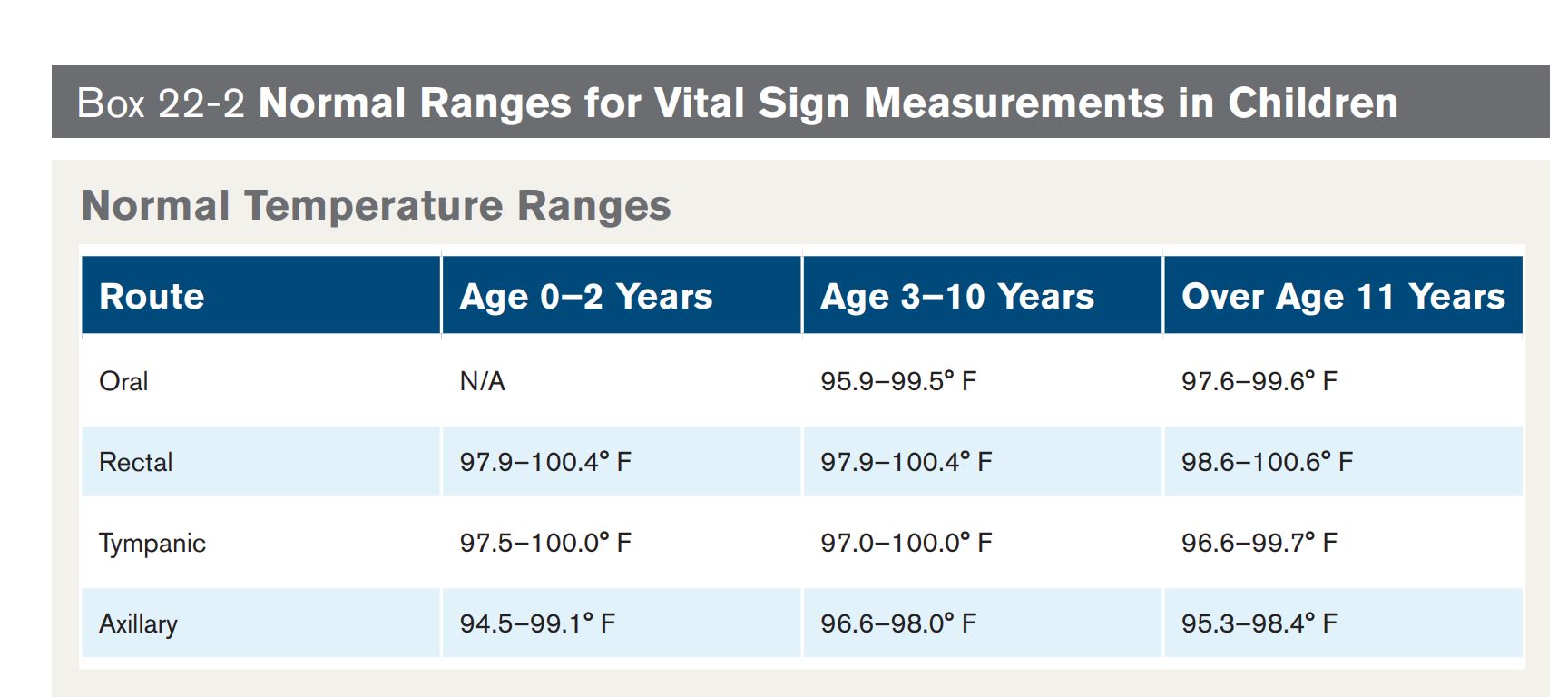
What are the normal temperature ranges for ages 0-2, 3-10, 11 and up. (Pay close attention to the tympanic ranges)
108
Define abandonment
Withdrawal of one's support or help from another person, despite having the responsibility to provide this support / help
109
Define homebound
adjective used to describe a person who is unable to leave his or her home without assistance
110
What causes dementia patients to become angry / upset?
Triggers, you want to remove triggers
111
When providing care, what should you do be doing so that
they don't feel uncomfortable?
they don't feel uncomfortable?
explain the steps and why
112
How do you log in expensive items?
Log it but don't assign in expensive value. Keep it vague
113
Bathing your patient, how much does does the water temp
has to be
has to be
100-105 but if kid than 95-100
114
If theres a open cut, sore, pressure injuries, what are they
labeled as?
labeled as?
Wounds
115
When doing pericare what are the two important thing?
infection control and privacy (?)
116
What can you do to a dying patient
be a good listener, and provide emotional support
117
patient has hypertension and kidney disease, what diet
would the doctor order?
would the doctor order?
no sodium diet
118
what do you do with a patient that is confused / lost?
take them to a familiar place / objects they are familiar
with
with
119
patient who are unconscious, how much oral care must be done
every two hours
120
patient has osteoporosis what 6 principle of care is
important
important
safety, don't want their bones to break
121
what do you need to check before changing the sheets on
the bed
the bed
check for belongings
122
what can you do to protect the dentures while cleaning
line the sink with a towel / washcloth so if you drop the
dentures they don't break because they are very expensive
to replace
dentures they don't break because they are very expensive
to replace
123
if you see a dementia patient running around wild what
are they most likely doing
are they most likely doing
looking for the bathroom
124
patient is complaining about pain, what are some things to
ask about
ask about
frequency, intensity, location of pain
125
patient is complaining about pain what do you do?
report to your nurse
126
if theres new clothing added into the nursing home what
should you do?
should you do?
it should have been logged into the logging sheet so now
all it needs to do is be labeled
all it needs to do is be labeled
127
patient is being discharged, what should you do?
check for everythin in the bed
128
who cleans and remake the bed?
environmental services
129
what are the signs of a patient dying in hospice
they have cold and mottling hands
130
Can you leave the patient? What if the patient is late?
What if you finish your job early?
What if you finish your job early?
You can not leave early before the time allotted because
that is considered patient abandonment
that is considered patient abandonment
131
dementia patient is made because you put something in
the wrong place. What kind of reaction is this
the wrong place. What kind of reaction is this
catastrophic reaction
132
If a patient gives you a hundred, what can you do
You can't take it however theres a loophole and if they put
it in an envelope then you can take it because you are
allowed to take an envelope
it in an envelope then you can take it because you are
allowed to take an envelope
133
If there is a patient choking, what should be the first thing
you can do
you can do
call for help then back blows and abdominal thrusts