Nervous System | HAP | MIDTERM
Study these flashcardsFree · spaced repetition · iPhone, Android, Mac & web
All cards
1
Which of the following is NOT a function of the nervous system?
- Filter out nutrients
- Recieve sensory input
- Maintain homeostasis
- Motor Function
2
What are the two divisions of the nervous system?
- Central and Peripheral NS
- Afferent and Efferent NS
- Main and Sensory NS
- Primary and Secondary NS
3
This includes the brain and spinal cord
- Peripheral Nervous System
- Central Nervous System
4
Includes cranial and spinal nerves, and sensory receptors
- Central Nervous System
- Peripheral Nervous System
5
Recieves action potentials from receptors
- Motor (Afferent) Division
- Sensory ( Afferent) Division
6
Send action potentials from CNS to organs and glands
- Motor (Afferent) Division
- Sensory ( Afferent) Division
7
The following are true about neurons EXCEPT?
- Pea-shaped cell that flows in the sella turcica
- Fundamental units of the nervous system
- Do not undergo cell division
- Recieves stimuli, conduct action potentials to effector organs
8
These are supporting cells for nourishment and protection, also undergoes through cell division which may cause brain tumor
- Microglia
- Schwann cells
- Neuroglia
- Ependymal cells
9
Immune cells of the CNS
- Oligodendocytes
- Astrocytes
- Ependymal cells
- Microglia
10
Star-shaped; contribute with the blood brain barrier.
- Microglia
- Oligodendocytes
- Ependymal cells
- Astrocytes
11
cell processes FORM myelin sheaths around the axons or enclosed unmyelinated axons in the CNS
- Oligodendocytes
- Ependymal cells
- Microglia
- Schwann cells
12
FORM the myelin sheath around axons or enclose unmyelinated axons in the PNS
- Astrocytes
- Oligodendocytes
- Schwann cells
- Ependymal cells
13
Consists of bundles of parallel axons and their myelin sheaths
- White Matter
- Gray Matter
14
consists of groups of neuron cell bodies and their dendrites
- Gray Matter
- White Matter
15
There are a total of 31 pair of spinal nerves consisting of 15 sensory neurons, 9 motor neurons, and 7 mixed neurons
- False
- True
16
There are three plexuses that categorize them where nerves come together and seperate namely cervical, brachial, and lumbosacral plexus. Which of these spinal nerves do not belong to any plexuses
- T2-T11
- L1-S4
- C5-T1
- C1-C4
17
Connects the spinal cord to the remainder of the brain
- Brainstem
- Cerebrum
- Diencephalon
- Cerebellum
18
Critical damage in this part of the brain could cause death more than the other areas
- Cerebrum
- Brainstem
- Cerebellum
- Diencephalon
19
Functional bridge between cerebrum and cerebellum
- Medulla Oblangata
- Pons
- Midbrain
20
The most inferior portion of the brainstem and is continuous with the spinal cord
- Medulla Oblangata
- Midbrain
- Pons
21
The smallest region of the brainstem
- Medulla Oblangata
- Pons
- Midbrain
22
Regulates the ff.
¤ heart rate and blood vessel diameter
¤ breathing
¤ swallowing
¤ vomiting
¤ coughing
¤ sneezing
¤ balance
¤ coordination
¤ heart rate and blood vessel diameter
¤ breathing
¤ swallowing
¤ vomiting
¤ coughing
¤ sneezing
¤ balance
¤ coordination
- Midbrain
- Medulla Oblangata
- Pons
23
The dorsal part consists of four mounds, called colliculi
- Medulla Oblangata
- Pons
- Midbrain
24
Regulates the ff.
¤ breathing
¤ swallowing
¤ balance
¤ chewing
¤ salivation
¤ breathing
¤ swallowing
¤ balance
¤ chewing
¤ salivation
- Pons
- Midbrain
- Medulla Oblangata
25
Called the "little brain"
- Cerebellum
- Diencephalon
- Cerebrum
- Brainstem
26
Internally, consists of gray matter and white nerve tracts
- Cerebellum
- Cerebrum
- Brainstem
- Diencephalon
27
Thalamus and Hypothalamus are its main components
- Brainstem
- Cerebrum
- Diencephalon
- Cerebellum
28
Largest part of the brain
- Cerebrum
- Diencephalon
- Cerebellum
- Brainstem
29
Influences mood and registers uncomfortable perception of pain
- Thalamus
- Hypothalamus
30
Sensations such as sexual pleasure, rage, fear, and relaxation after a meal
- Hypothalamus
- Thalamus
31
Plays a major role in controlling the secretion of hormones from the pituitary gland
- Thalamus
- Hypothalamus
32
Functions in receiving and perceiving VISUAL input
- Temporal Lobe
- Occipital Lobe
- Frontal Lobe
- Parietal Lobe
33
In the control of:
¤ voluntary motor functions
¤ motivation
¤ mood
¤ voluntary motor functions
¤ motivation
¤ mood
- Frontal Lobe
- Occipital Lobe
- Parietal Lobe
- Temporal Lobe
34
Involved in olfactory, auditory sensations, memory, and abstract thought/judgement
- Parietal Lobe
- Occipital Lobe
- Frontal Lobe
- Temporal Lobe
35
Choose the correct labelling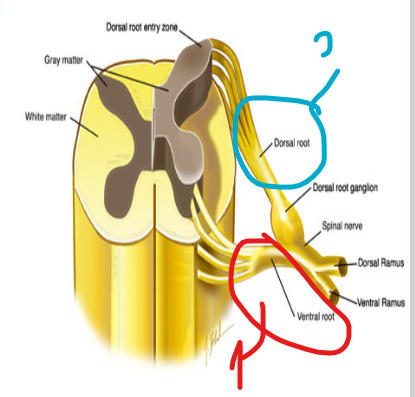
- Blue/Dorsal root: Motor | Red/Ventral root: Sensory
- Blue/Dorsal root: Sensory | Red/Ventral root: Motor
36
principal center for receiving and consciously perceiving most sensory information , such as touch, pain, temperature
- Temporal Lobe
- Occipital Lobe
- Parietal Lobe
- Frontal Lobe