BIO 265 Unit 3
Study these flashcardsFree · spaced repetition · iPhone, Android, Mac & web
All cards
1
form of DNA is characterized by a right-handed helix with 10 base pairs per turn?
B Form DNA
2
RNA can only form a double helix for a few hundred base pairs. Why?
Since RNA is single stranded, the ribose prevent the ds(Double stranded)DNA from forming after 100-150 base pairs
3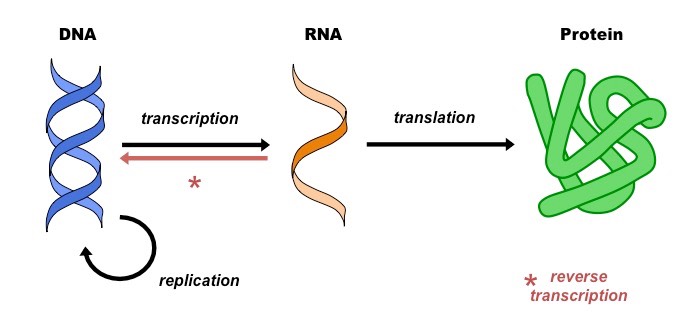
the central dogma of molecular biology
4
the importance of the central dogma of molecular biology
Because it tells us that self-replicating DNA transcripts for mRNA and that translates into proteins
5
DNA polymerase enzymes can only synthesize new DNA in the __’ to __’ direction.
5' to 3' (-OH end)
6
During DNA replication, which strand of the parental DNA serves as the template strand
The 3' to 5' strand (Phosphate group)
7
which strand contains Okazaki fragments
lagging strand
8
Which protein binds to the origin of replication
dnaA
9
enzyme does most of the synthesis of new DNA strands during DNA replication
DNA Pol III
10
enzyme removes RNA primers and replaces them with DNA nucleotides
DNA Pol I
11
enzyme can connect a 5’ end to a 3’ end in a DNA molecule, sealing gaps in its backbone
Ligase
12
This protein unwinds and separates the helix of DNA one base pair at a time
Helicase
13
enzyme moves in front of the replication forks and relieves supercoiling
DNA Gyrase
14
enzyme synthesizes RNA primers during DNA replication
DNA Primase
15
exonuclease activity
cutting RNA nucleotide out of the ends of DNA strands
16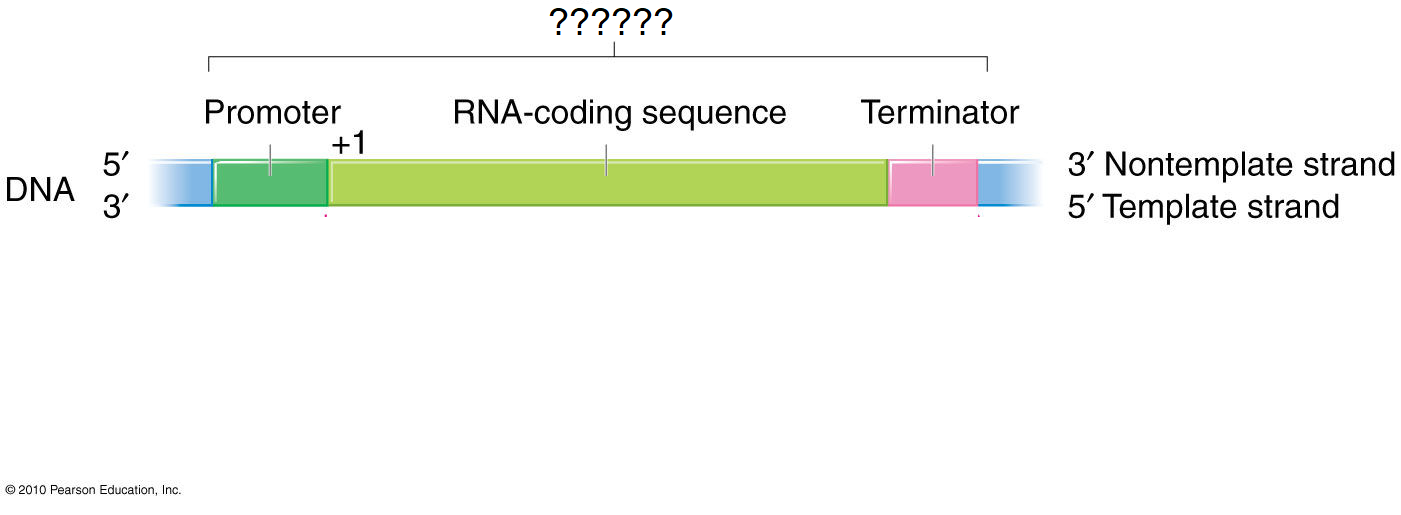
gene
17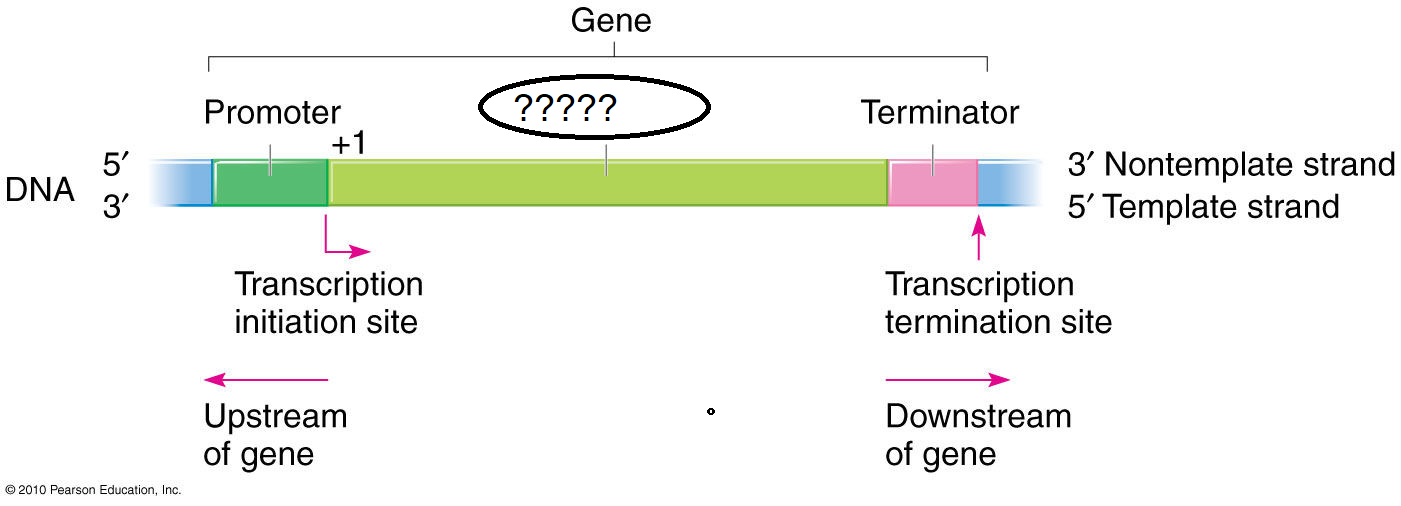
coding region
18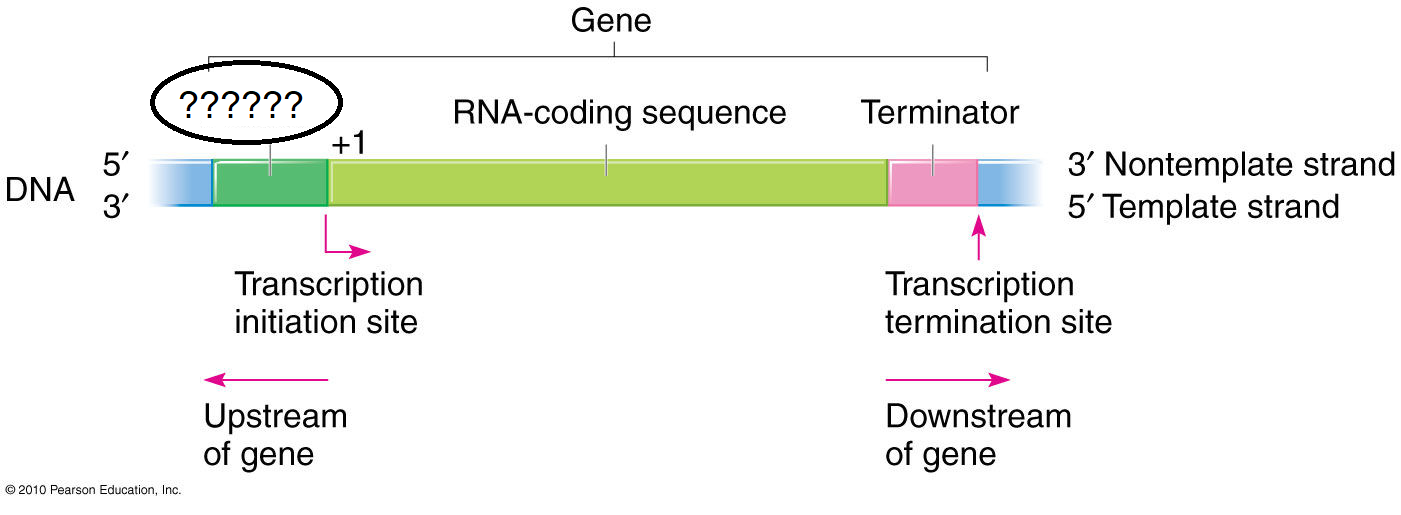
promoter
19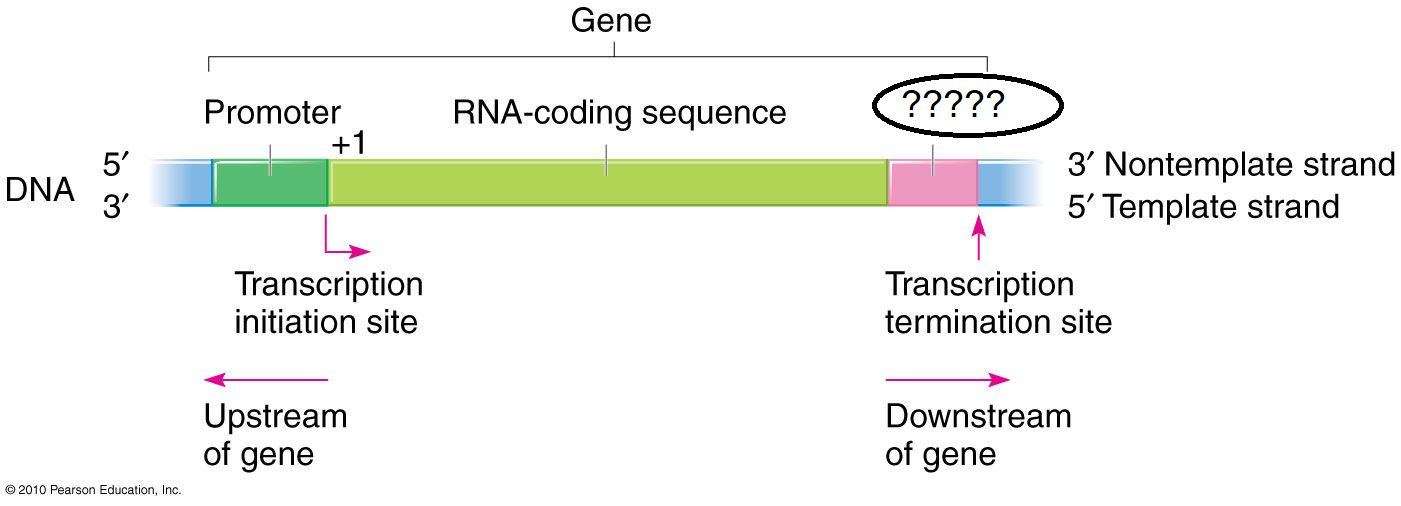
terminator
20
which stage of transcription does RNA polymerase bind to the promoter of a gene
initiation
21
DNA coding pair
A and T; C & G
22
RNA Coding pair
A & U; C & G
23
RNA polymerase can only synthesize mRNA in the __’ to __’ direction
5' to 3'
24
During transcription, which strand of DNA serves as the template strand?
Single strand 3' to 5' DNA
25
During transcription, what protein assists RNA polymerase with promoter recognition
σ (Sigma) factor
26
This enzyme “reads” the coding region of a gene and synthesizes complementary mRNA
RNA Polymerase
27
What sequence in mRNA is complementary to the anticodon of a tRNA
Condon of mRNA
28
During which process are codons recognized by the ribosome
Translation
29
Anti codon UAC
Codon AUG
30
What are the requirements for initiation of translation
tRNA, mRNA, and ribosome
31
Molecule of translation contains the anticodon
Aminoacyl tRNA
32
During initiation of translation, which tRNA binding site on the ribosome does the initiator tRNA bind to?
P-Site of tRNA
33
Empty tRNA molecules exit the ribosome from which binding site
E Site
34
2 chemical “languages” are being translated during translation of mRNA
Nucleotides of D/RNA to Amino Acids of proteins
35
What advantage does simultaneous transcription and translation give bacteria when compared to a eukaryotic cell?
Allows for fast replication and expression
36
Bacterial operons include multiple genes under the control of a single
promoter
37
Repressor proteins bind to operons at their
operator
38
Which gene of the lac operon codes for beta-galactosidase, the enzyme that hydrolyzes lactose?
lacZ
39
type of mutation in DNA results in a premature STOP codon in mRNA
nonsense mutation
40
type of mutation results in multiple changed codons in mRNA downstream from the mutation point
frameshift
41
type of mutation in DNA results in a changed amino acid in a protein
missense
42
The development of resistance to penicillin by E. coli is an example of what evolutionary process?
natural selection
43
kind of plasmid contains one or more antibiotic resistance genes
R-plasmids (resistance)
44
forms of horizontal gene transfer discussed in lecture
transformation, conjugation, and transduction
45
Is mitosis a form of horizontal or vertical gene transfer
veritcal gene transfer
46
Why is mitosis a vertical gene transfer
because the daughter cells gets genetical material inhiereted from parent cell
47
process can introduce new genetic material into a bacterial chromosome
genetic recombination
48
role F+ cells play in conjugation
they are donor cells since they have F Factor to donate
49
if a bacterium is described as “competent”, which form of horizontal gene transfer is this bacterium capable of performing
transformation
50
If a plasmid contains a tra region, then what type of plasmid is it?
F Plasmid
51
Does a transducing phage contain viral and bacterial DNA
Depends
52
An F+ cell is introduced into a culture of F- cells. Predict what will happen to the F- cells over the next 48 hours
conjugation will occur so F- cells become F+ cells
53
the process of conjugation pt. 1
F+ connects F- using F pilus and then pilus leaves
54
the process of conjugation pt. 2
Two cells connect so their cytoplasms can join.
55
the process of conjugation pt. 3
F factor copies itself and trasnfers into F-, converting into F+
56
the process of conjugation pt. 4
2 F+ cells separate
57
the process of transformation pt. 1
Donor cell explodes releasing its DNA.
58
the process of transformation pt. 2
Component recipient cell expresses DNA receptor on surface so that it grabs naked DNA and uptakes it
59
the process of transformation pt. 3
Inside DNA is recombined with recipient chromosome
60
transducing phage produced by generalized transduction
It only contains bacterial DNA
61
phage produced by specialized transduction?
contains bacterial and viral DNA
62
Which kinds of horizontal gene transfer require the DNA donor to die?
transformation and transduction
63
medical uses of biotechnology
Diagnostic testing, precision medicine, subunit vaccines, and therapeutic protien
64
Diagnostic Testing
Testing for covid, hiv, etc
65
precision medicine
treatments for cancer
66
subunit vaccines
HPV and hepatitis B
67
therapeutic protein production
HGH and insulin
68
agricultural uses of recombinant DNA technology.
Herbacide tolerance, pest resistance, improved nutritional value, and impossible food production
69
what way are restriction endonucleases restricted
By the cut sites
70
How are “sticky ends” left by restriction endonucleases useful to geneticiststhree propertied of a good cloning vector.
Since they can be used to combine genes from different organisms
71
enzyme that can synthesize a cDNA from an mRNA template
Reverse transcriptase (RT)
72
What determines how quickly a fragment of DNA moves during gel electrophoresis
fragment size so the smaller the size is the faster itll be and slower when it is larger.
73
Why is it important to use the same restriction enzyme for cutting both the DNA sequence of interest and the cloning vector?
Because using restriction enzymes makes complementary staggered end sequences on both sequences of interest so the cloning vector which makes recombination happen spontaneously
74
three properties of a good cloning vector
Must have multple cloning sites, must have a selectable marker, and must contain a second genetic marker
75
Having multiple cloing sites allows for what
More options for restriction enzyme cut sequences
76
Having selectable markers means
only cells that contain the cloning vector will survive on the growth medium
77
Having a second genetic marker means
Detect successful insertion of the sequence of interest into the cloning vector.
78
natural role of CRISPR in a bacterial cell
Immune memory for bacteria
79
biggest advantage of next generation sequencing versus traditional method
speed
80
ways high-throughput sequencing has changed genetic research
makes obtaining gene sequence faster and cheaper
81
purpose of the polymerase chain reaction
Amplify the amount of DNA so we can have multiple copies