BIO 265 Unit 1
Study these flashcardsFree · spaced repetition · iPhone, Android, Mac & web
All cards
1
Why is a tick not a microbe?
Because they are big enough to be seen with the naked eye without tools
2
Which type of microbe is made up of only protein and nucleic acid?
Viruses
3
Are there any photosynthetic fungi?
No
4
Can viruses reproduce without first infecting a cell?
No
5
Which group of microorganisms has a cell wall which has peptidoglycan?
Bacteria
6
How to properly write a bacterial name
Genus first then species
7
When we type a bacterial name we do what?
italicize it
8
When we handwrite a bacterial name we do what?
We underline it
9
what order do we write the bacterial name
Genus -> Species
10
What do we do with the genus
Capitalize the first letter
11
what do we do with the species name
Always lowercase
12
When do we abbreviate the bacterial name
After the first time it was written
13
Which researcher sealed boiled broth in flask to try and disprove spontaneous generation? Some argued that he had sealed out the "life force" needed for S.G. to occur.
Lazzaro Spallanzani
14
Which researcher tried to prove the existence of spontaneous generation by demonstrating that boiled beef broth spoils when exposed to air?
John T. Needham
15
Which researcher was the first to disprove spontaneous generation by showing that only flies produce maggots?
Francesco Redi
16
Which researcher used swan-necked flasks & beef broth to disprove the spontaneous generation of microscopic organism?
Louis Pasteur
17
How does pasteurization help to prevent spoilage of wine, milk, and other foods?
Since it kills microbe that would cause it because it rapidly heats and cools before it reaches boiling point
18
Which scientist experimental steps are still used today to establish causation between a microbe and a disease?
Robert Koch's postulates
19
Which researcher was the first scientist to show that a bacterium can cause disease by discovering the causative agent of anthrax to be a bacillus?
Robert Koch
20
Correct order of Koch postulates
1. Identify suspected pathogen in infected individuals 2. Isolate & grow suspected pathogen in lab 3. Infect healthy host & demonstrate disease 4. Re-isolate the suspected pathogen from the new host
21
1st step of Koch's postulates
Identify suspected pathogen in infected individuals
22
2nd step of Koch's postulates
Isolate & grow suspected pathogen in lab
23
3rd step of Koch's postulates
Infect healthy host & demonstrate disease (not ethical)
24
4th step of Koch's postulates
Re-isolate the suspected pathogen from the new host
25
Which researcher invented vaccination, long before anyone understood how or why it worked?
Edward Jenner
26
Which investigator developed vaccination as a replacement for variolation?
Edward Jenner
27
Which researcher use of phenol as a disinfectant during surgery improved the survival of his patients?
Joseph Lister
28
Which researcher noticed that fungi could produce toxins that prevent the growth of bacteria?
Alexander Fleming
29
Which researcher was the first doctor to show that washing hands between patients can improve patient survival?
Ignaz Semmelweis
30
An organism characterized by having cells containing membrane-bound DNA.
Eukaryote
31
An organism characterized by having a cell lacking a membrane-bound nucleus.
Prokaryote
32
Identify the correct matching of shapes, based on the scientific names: Bacillus species
Rod
33
Identify the correct matching of shapes, based on the scientific names: Staphylococcus species
spherical
34
Cells that lack a nucleus
Prokaryotic cells
35
What kind of bacterial arrangement is this? 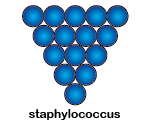
Bacterium with staphylococcal arrangement
36
Simple Diffusion
Small molecules diffuse directly across membrane like water, gas, and non-charged atoms
37
Facilitated diffusion
transport proteins needed because it diffuses large & charged molecules
38
Which kind of transport moves molecules from lesser to greater concentration (against the gradient)?
Active transport
39
Which type of membrane transport involves ATP?
Active
40
What is the energy source when E. Coli uses group translocation to transport glucose to cytoplasm
Phosphoenolpyruvate (PEP)
41
Which type of active transport uses PEP as its source of high-energy phosphate
Group Translocation
42
Two components of peptidoglycan
NAM and NAG
43
NAG
N-acteylglucosamine
44
NAM
N-acetlymuramic acid
45
What molecule located outside the outer membrane of the gram-negative bacteria contains lipid A?
Lipopolysaccharide (LPS)
46
What is the usefulness of the o-specific polysaccharide of Lipopolysaccharide (LPS)?
It helps identify strains within a species
47
Which component of lipopolysaccharide is known as endotoxin
Lipid A
48
Which step of the gram stain procedure, if done wrong, can result in gram negative cells appearing as gram positive?
De colorizing and specifically if we under-de colorize
49
Gram-Postive cell walls
Monoderm (thick & extends from the cell membrane), have no outer membrane and have teichoic and lipoteichoic acids
50
Components inside a gram-positive cell wall
Peptidoglycan, teichoic acid, and lipoteichoic acid
51
Teichoic Acid
negatively charged, cation storage (Ca2-) and antigenic
52
Lipoteichoic acid
anchors wall to membrane
53
Gram-Negative cell wall
Diderm, has an outer membrane, and has LPS
54
Components of outer membrane in a Gram-negative cell wall
porins, lipoproteins, and lipopolysaccharides (LPS)
55
What is Lipid A
Imunogenic
56
Immunogenic are know for what
triggers for fever and shock
57
How does a glycocalyx act like an invsibility cloak
It hides microbes from immune cells since it is made up of carbohydrates and immune cells ignore carbs
58
Which kind of glycocalyx is loosely bound to the cell wall
Slime Layer
59
Which form of glycocalyx easily sloughs off?
Slime Layer
60
Do bacteria use fimbriae for movement
No it is the flagellum that does movement.
61
What does the fimbriae do
Ropes to the bacteria to surface
62
Which bacterial structure contains flagellin
the filament of flagella
63
Which kind of taxis involves bacteria moving toward or away from a light source
Photo Taxis
64
When a bacterium is tumbling, what direction is its flagellum rotating
clockwise rotation
65
Crest;tuft
lophotrichous
66
on both sides
amphitrichous
67
all around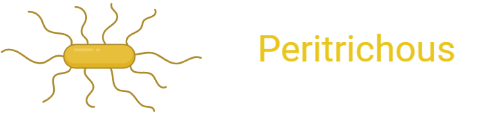
peritrichous
68
Which protein of the flagellum controls the direction of rotation
fli protien
69
what is the function of the MOT protein of the bacterial flagellum
Allows H+ to move through MOT channel into cytoplasm which allows flagellum to rotate because of the rings rotating
70
the proton motive force relies on the production of a gradient of what ion
H+
71
How many protons must cross the membrane for a single rotation of a flagellum
1000 H+
72
If the proton motive force were eliminated, what effect would that have on the flagella of a bacterium?
Flagella would stop rotating since the power source would be gone
73
What term is used to describe the collection of all genes in the nucleoid
chromosomes
74
What shape is a typical bacterial nucleoid
circular
75
what kind of genes are carried by plasmids
non-essential genes and sometimes genes that give bacteria survival benefits under certian enviroments like antibiotic resistance genes
76
size of a small subunit in eukaryotic
40s
77
size of a small subunit in prokaryotic
30s
78
size of a large subunit in eukaryotic
60s
79
size of a large subunit in prokaryotic
50s
80
size of a complete ribosome in eurkaryotic
80s
81
Size of a complete ribosome in prokaryotic
70s
82
How do eukaryotic ribosomes differ from prokaryotic ribosomes
Eukaroytic ribosomes are larger since they are 80s while the prokaryotic are smaller since they are 70s
83
What bacterial endospores make them difficult to disinfect
Low water content makes makes it harder to destroy endospores since their thick protective spore coat help it resist physical and chemical destruction
84
What term describes the destruction of most microorganisms and viruses on nonliving tissues
disinfection
85
What method of sterilization is most appropriate for medical and laboratory supplies that can tolerate heat and moisture
autoclave
86
what method of sterilization is most appropriate for water-sensitive materials ala powders, oils, and metals
dry heat
87
what method of microbial control is used for disinfection of baby bottles
boiling
88
what method of microbial control is used for sterilization of inoculating loops
incineration
89
what term describes the destruction of all microorganisms and viruses in or on an object
sterilization
90
what term describes the reduction in the number of microorganisms and viruses, particularly potential pathogens, on living tissues
antisepsis
91
what term describes the removal of microbes by mechanical means
degerming ala Hand-washing
92
what term refers to an enviromental or procedure free of pathogenic contaminants
aseptic
93
what process results in the destruction of all pathogens and most spoilage microbes in dairy products, fruit juices, beer, and wine
pasteurization
94
What are the top three most difficult microbes/microbial structures to disinfect in most to least difficult
Prion, bacterial endospores, and protozan cyst
95
What is the purpose of the vented caps on the test tubes we use in labs
Allows autoclave steam to enter the tube
96
What is the typical temperature that an autoclave must reach to sterilize
121 °C or 249.8 °F for 15 min
97
What is the typical pressure that an autoclave must reach to sterilize
15 PSI for 15 mins
98
Which method of sterilization would be most effective for sterilizing nutrient broth that doesn't contain heat-sensitive compounds such as urea
moist heat in autoclave
99
which method is best for sterilize heat-sensitive liquid medications
filtration thru .2 micrometer or smaller pore filter
100
what is the biggest disadvantage when using UV light to sterilize
Shadows prevents action hence defeating this method
101
After running through an autoclave sterilization cycle, a tube containing Bacillus stearothermophilus spores is incubated for 24 hours. After the incubation period, the tube appears yellow in color. Should the lab technician call for service on the autoclave, or is it working properly?
He should call a service on the autoclave because yellow medium means that the spores are viable and autoclave objects are not sterile
102
Why are endospores used to measure the effectiveness of autoclave sterilization?
Since they are hard to kill
103
Which group of microorganisms discussed in lecture is most susceptible to the effects of 70% alcohol rubs?
Bacteria then enveloped viruses
104
Why is a 70% solution of ethanol more effective at antisepsis than a 95% solution of ethanol?
Because it has higher contact time and needs water in order for lysis of cells to occur
105
What is the antimicrobial action of alcohol?
Denatures proteins & distrupts cytoplasmic membranes following by DNA precipating out of solution
106
What is the antimicrobial action of halogens such as iodine?
Damage proteins by denaturation
107
What is the antimicrobial action of surfactants (soaps)?
Disrupts cell membrane and denature protiens
108
What is the antimicrobial action of oxidizing agents (peroxide)?
Disrupts cell membrane & denatures proteins by oxidizing enzymes
109
Which method of sterilization discussed would be best for sterilizing both plastic petri dishes and cloth lab coats?
Ethylene oxide gas