Exam 1 v.1
Study these flashcardsFree · spaced repetition · iPhone, Android, Mac & web
All cards
1
Auriga
Circumpolar Constellation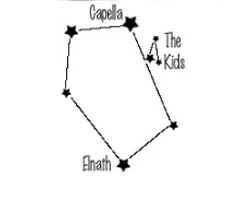
2
Camelopardalis
Circumpolar Constellation. Looks like a chair.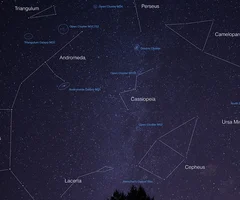
3
Cassiopeia
Circumpolar Constellation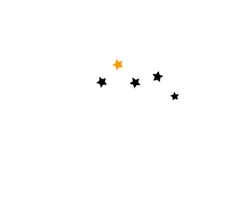
4
Cepheus
Circumpolar Constellation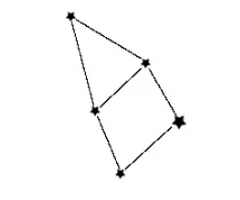
5
Draco
Circumpolar Constellation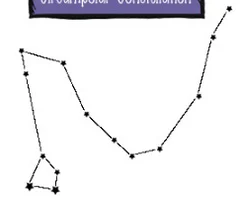
6
Lynx
Circumpolar Constellation. Looks like a cat. Long line.
7
Perseus
Circumpolar Constellation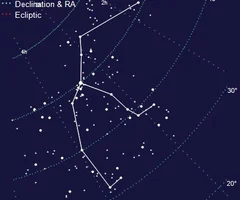
8
Ursa Major
Circumpolar Constellation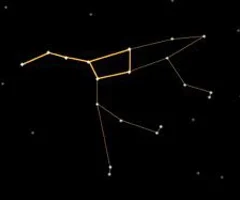
9
Ursa Minor
Circumpolar Constellation. Contains the North Star.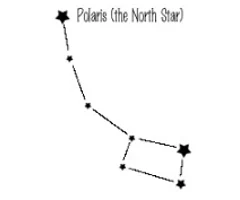
10
Circumpolar
The type of constellation that always stays visible in the sky.
11
Sirius
Brightest Star in the sky. Part of Canis Major.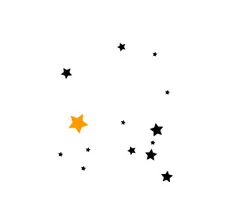
12
Arcturus
2nd Brightest Star. Part of Bootes.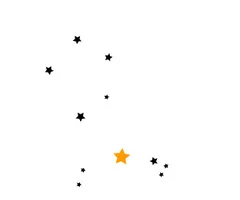
13
Vega
3rd Brightest Star. Part of Lyra.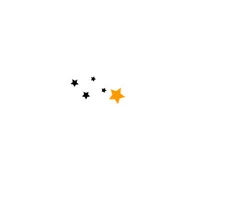
14
Capella
4th Brightest Star. Part of Auriga.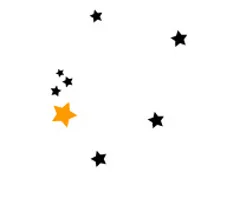
15
Rigel
5th Brightest Star. Part of Orion.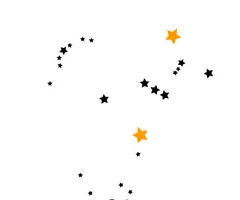
16
Celestial Sphere
Imaginary globe where Earth is at the center and provides an easy way of describing position of objects in sky.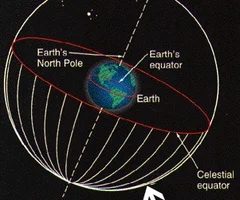
17
Ecliptic
A great circle on the celestial sphere representing the sun's apparent path across the sky during the year, so called because lunar and solar eclipses can occur only when the moon crosses it.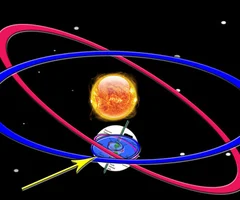
18
Celestial Pole
No matter where you are on Earth, stars appear to rotate about a point called the _____________ .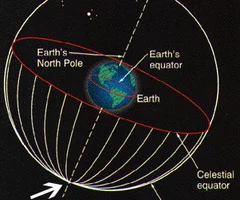
19
Right Ascension
Longitude, side to side, how far east (right), measure sun form spring (vernal) equinox, uses hours minutes and seconds. Used to measure where a star is in the sky.
20
Vernal Equinox
The day of the year that marks the beginning of spring in the northern hemisphere.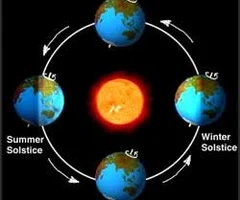
21
Declination
Measures how far north or south an object is from the celestial equator. Latitude.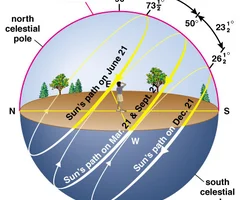
22
Counter-Clockwise
Motion of Earth on it's axis, and around the sun. Also the direction almost everything in our solar system moves.
23
Venus/Uranus
The only things in our solar system that spin Clockwise.
24
Elliptical
Type of Orbit the Earth has.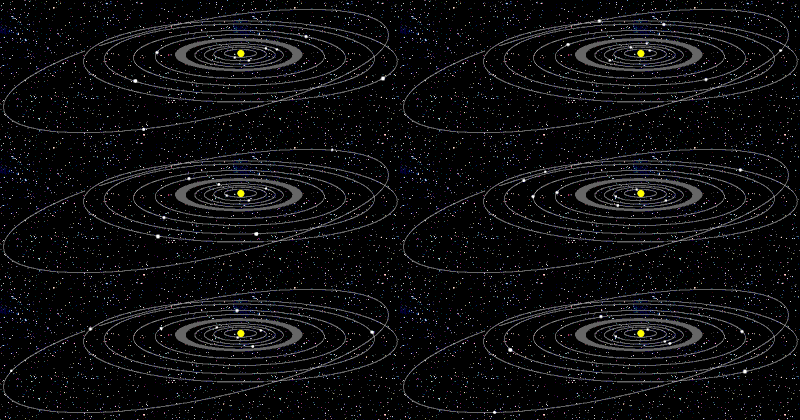
25
Perihelion
Point in Earth's orbit nearest to the sun.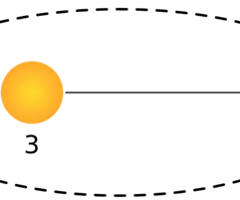
26
Aphelion
The point at which the earth is farthest from the sun.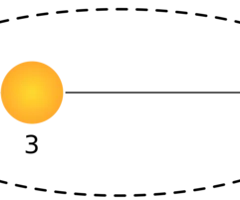
27
Pluto
Dwarf planet removed from the solar system.
28
Kuiper
Belt that Pluto is in.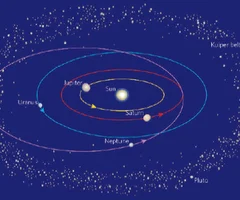
29
IAU
Decided the definition of a planet.
30
Meridian
An arc drawn between the North and South poles.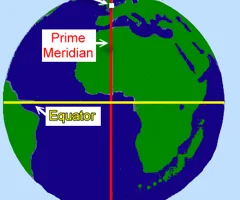
31
Galileo
He was the first person to use a telescope to observe objects in space. He discovered that planets and moons are physical bodies because of his studies of the night skies.
32
Telescope
A device built to observe distant objects by making them appear closer.
33
Merak
Sixth star in Ursa Major.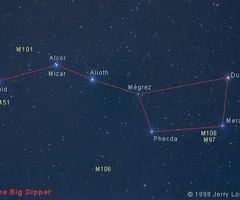
34
Dubhe
Seventh star in Ursa Major.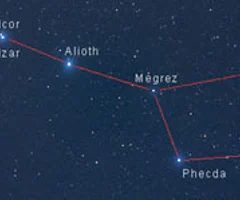
35
Asterism
A pattern of stars that is too small to be a constellation.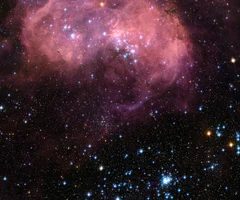
36
Polaris
North Star.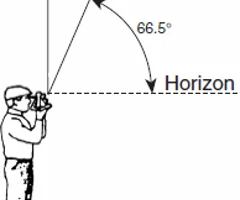
37
First Point of Aries
The point on the celestial sphere where the path of the sun crosses the celestial equator from south to north in March, marking the zero point of right ascension. Owing to precession of the equinoxes, it has moved into Pisces, and is now approaching Aquarius. Also called the "vernal equinox."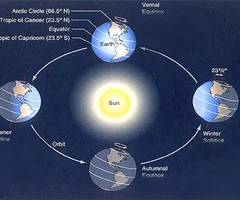
38
Andromeda
Our neighboring galaxy. It is the closest in our local group. Two times the size of the milky way.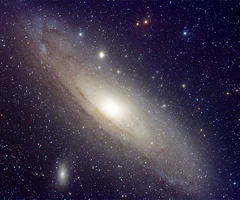
39
Lightyear
Distance light travels in a year.
40
Zenith
The highest point.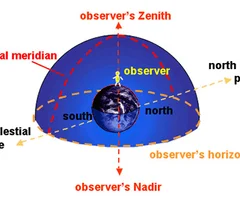
41
Nadir
The lowest point.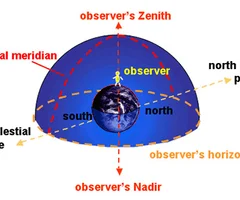
42
Kochab
Star in Ursa Minor.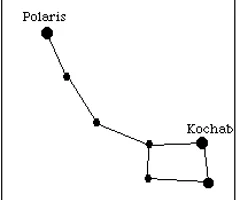
43
Ophiucus
What constellation does the Sun pass through that is NOT a sign of the zodiac?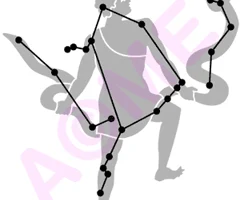
44
Canopus
2nd Brightest Star in the sky (Not just Northern Hemisphere)
45
Alpha Centauri
3rd Brightest Star in the sky (Not just northern hemisphere).