Geology Exam 3
Study these flashcardsFree · spaced repetition · iPhone, Android, Mac & web
All cards
1
Sediment
Loose fragments of rocks and minerals, shells, or mineral crystals that precipitate out of water
2
How is sediment produced?
Weathering
3
Physical (mechanical) weathering and its methods
Breaks rocks into unconnected clasts of variable size (ex. jointing, frost wedging, root wedging, and thermal expansion)
4
What can give clues as to how far the sediments traveled and how much weathering occurred? Example?
Shapes and roundness of grains. A rounder, smaller grain likely weathered for longer and/or traveled farther. And vice versa.
5
Joints
Natural cracks formed inrocks due to the expansion of a rock
6
Exfoliation occurs in?
Exposed plutons due to pressure release
7
Differential weathering
Weathering occurs faster at edges and corners of a block than on a flat face
8
Physical and chemical weathering work together to:
– Increase surface area (physical)
– Dissolve minerals and cements (chemical)
– Alter hard minerals into soft minerals (chemical)
– Dissolve minerals and cements (chemical)
– Alter hard minerals into soft minerals (chemical)
9
Soil formation
Soil forms through debris production, interaction with water, and interaction with organics. Produce unique layers, called horizons
10
Soil-Forming Factors
Climate and Vegetation. Climate includes rainfall and temperature. Vegetation can add or remove material.
11
Regolith
Loose, unconsolidated rock, mineral and glass fragments in the soil
12
Erosion
Particles of broken rock are transported
13
Which sediments would be easiest to move/take the lowest amount of water energy to transport? Example?
Smallest sediments (ex. mud)
14
Clastic/Detrital sedimentary rocks
Made of lithified sediments (rock fragments from chemical or mechanical weathering)
15
Chemical sedimentary rocks. Example?
Dissolved minerals crystallize out of solution (ex. Halite)
16
Biochemical sedimentary rocks
Made of calcite and silica-rich minerals (ex. Shells cemented together and Limestone)
Derived mostly from shells of organisms, most from the oceans, made of the carbonate mineral calcite
Derived mostly from shells of organisms, most from the oceans, made of the carbonate mineral calcite
17
Organic sedimentary rocks. Example? Depositional environment?
Plant remains (organic carbon) deposited in layers (ex. Coal and Oil Shale). Along ancient rivers and swamps.
18
Deposition
Laying down of sediment carried by wind, flowing water, the sea or ice
19
Lithification
-Transforms loose sediment into solid rock: burial increases pressure, squeezes out air and water, and compacts grains.
-Minerals (often quartz or calcite) precipitate from groundwater into pore spaces. This cement glues the loose sediments together
*Or-> Deposition, compaction, cementation
-Minerals (often quartz or calcite) precipitate from groundwater into pore spaces. This cement glues the loose sediments together
*Or-> Deposition, compaction, cementation
20
Which sedimentary rock type is best described as loose rock fragments cemented together? Examples?
Clastic (ex. Breccia and Conglomerate)
21
Conglomerate
Rounded rock clasts
22
Velocity of moving water can affect sediment size and sorting. High and low velocity? Well and poor sorted? Faster waters?
-High velocity: sediments are eroded. Low velocity: sediments are deposited
-Well sorted means grains are all the same size. Poorly sorted is a mixture
-Faster waters can carry larger sediments
-Well sorted means grains are all the same size. Poorly sorted is a mixture
-Faster waters can carry larger sediments
23
Chemical Sedimentary rocks. Example?
Form chemically, in water (ex. evaporites)
24
Bedding and Cross Bedding
Created by ripple and dune migration. Can help you
determine information on the depositional environment
determine information on the depositional environment
25
Planktonic Foraminifera and Coccolithophores
Tiny organisms that float in the ocean and their tests are deposited after death
26
Chalk
Fine-grained limestone made of tiny plankton
27
Chert. Example?
Made from shells of silica-rich marine plankton (diatoms, radiolarians) deposited on deep seafloor (ex. Flint)
28
Metamorphic rock. Factors?
Any kind of rock changed from its original form (parent rock (protolith)). Through: heat, pressure, fluids
29
Regional metamorphism. Metamorphic grade? What type of texture?
1. Occurs over wide areas, affects large volumes of rocks, and is associated with tectonic processes such as plate collision and crustal thickening (orogenic metamorphism) and ocean-floor spreading (ocean-floor metamorphism)
2. Increasing temp. and pressure
3. Foliated
2. Increasing temp. and pressure
3. Foliated
30
Folds
-Deformation causing rock layers to bend and and have a curve through tectonic compression.
-Described by the geometry of the hinge.
▪ A nonplunging fold- has a horizontal hinge.
▪ A plunging fold- has a hinge that is tilted.
-Described by the geometry of the hinge.
▪ A nonplunging fold- has a horizontal hinge.
▪ A plunging fold- has a hinge that is tilted.
31
Contact metamorphism. Metamorphic grade? What type of texture?
1. Rock minerals and texture are changed, mainly by heat, due to contact with magma
2. High temp, not as high pressure
3. Nonfoliated
2. High temp, not as high pressure
3. Nonfoliated
32
Foliation
Layering/parallel alignment of mineral crystals, often due to stress (ex. Slate, Phyllite, Schist, Gneiss). Non-foliated -> Quartzite, marble
33
Characteristics of metamorphic rocks:
1. Texture--interlocking crystals
2. Foliation--layering/parallel alignment
of mineral crystals
3. Minerals--presence of those that form
only through metamorphic processes (ex. garnet)
2. Foliation--layering/parallel alignment
of mineral crystals
3. Minerals--presence of those that form
only through metamorphic processes (ex. garnet)
34
Metamorphic grade
-Low grade (low temperatures and pressures)
-High grade (high temperatures and pressures)
-High grade (high temperatures and pressures)
35
Recrystallization
Change in size and shape of minerals, but mineral type stays the same
36
Shock Metamorphism
Extremely high pressures and high temperatures caused by friction and transfer of energy
37
Neocrystallization
New minerals grow that differ from those in the protolith
38
Body waves? Speed? Movements?
P and S. P arrives first, then S
1. Travel by compressing and expanding the material
parallel to the wave-travel direction, traveling through solids, liquids, and gases.
2. Travel by moving material back and forth, perpendicular to the wave-travel direction. S-waves are slower than P-waves, and they travel only through solids, never liquids or gases.
1. Travel by compressing and expanding the material
parallel to the wave-travel direction, traveling through solids, liquids, and gases.
2. Travel by moving material back and forth, perpendicular to the wave-travel direction. S-waves are slower than P-waves, and they travel only through solids, never liquids or gases.
39
Surface waves? Speed? Movement?
L and R. L arrives first, then R
Surface waves travel along Earth's exterior and are the slowest and most destructive
1. L-waves (Love waves) move the ground back and forth like a writhing snake.
2. R-waves (Rayleigh waves) are P-waves that intersect the land surface. They cause the ground to ripple up and down like water.
Surface waves travel along Earth's exterior and are the slowest and most destructive
1. L-waves (Love waves) move the ground back and forth like a writhing snake.
2. R-waves (Rayleigh waves) are P-waves that intersect the land surface. They cause the ground to ripple up and down like water.
40
Fault
A break in the rocks of Earth’s crust or mantle, along which rocks have moved past each other
41
Thrust Fault. Example?
Special kind of reverse fault that has a lower angle slope (dip). It’s a common fault compressional mountain belts
42
Strike-Slip Fault
One block slides laterally past the other block. The fault itself is vertical, but motion is horizontal
43
Earthquake. How does energy move?
Vibration of Earth produced by the rapid release of energy when rocks grind against each other (at a fault).
As seismic waves
As seismic waves
44
Seismographs
Instruments that record ground motion.
45
Locating the Epicenter
P-wave and S-wave arrival times can be graphed. A travel-time curve plots the increasing delay in arrivals. The time gap yields distance to the epicenter.
1. Data from three or more stations pinpoints the epicenter.
2. The distance is drawn as a radius from each station, creating a circle of equidistant points.
3. Circles around three or more stations will intersect at a point. The point of intersection is the epicenter.
1. Data from three or more stations pinpoints the epicenter.
2. The distance is drawn as a radius from each station, creating a circle of equidistant points.
3. Circles around three or more stations will intersect at a point. The point of intersection is the epicenter.
46
Amplitude
Measurement of the amount of energy transferred by a wave.
47
Magnitude
A measurement of size based on the maximum amplitude of seismograph waves OR amount of ground motion measured on a
seismograph
seismograph
48
Intensity
Severity of damage and human perception
49
Moment magnitude scale
Uses many seismic waves’ amplitudes, and the amount of displacement along the fault—most accurate
50
Liquifaction
Unconsolidated soil and sediment that has a lot of water in it will liquefy due to the vibrations within the water (like quicksand)
51
Tsunamis
Waves caused by undersea volcanoes, earthquakes, and landslides
52
Earthquake hazards
Ground shaking, Ground lifting, Liquefaction, Tsunamis
53
Principle of Lateral Continuity
Rock layers erode but match across valleys
54
Principle of Original Horizontality
States that mostsedimentary rocks are deposited in horizontal beds
55
Principle of Superposition
Layers of rock are superimposed, or laid down one on top of another. The oldest rock strata will be on the bottom and the youngest at the top.
56
Isotopes
Atoms that have different #s of neutrons in the nucleus; materials that keep track of time
Parent isotopes (unstable)
Daughter isotopes (stable)
Parent isotopes (unstable)
Daughter isotopes (stable)
57
Principle of Cross-Cutting Relations
Helps to determine the reletive ages of rocks (sedimentary or igneous) that have been tilted or folded, or rocks (metamorphic or igneous) that wren't originally formed in horizontal layers (ex. Magma can cut through sedimentary rocks and form new rocks).
58
Elastic Deformation
Return to their original shape and size
59
Ductile Deformation
Causes rock to deform by flowing and folding; occurs at higher T and P conditions; does not return to their original shape
60
Brittle Deformation
Occurs in the shallower crust; Results in rocks being broken apart, causing a loss of coherence; Rocks break by fracturing.
61
Anticline
A fold that looks like an arch. The limbs dip out and away from the hinge.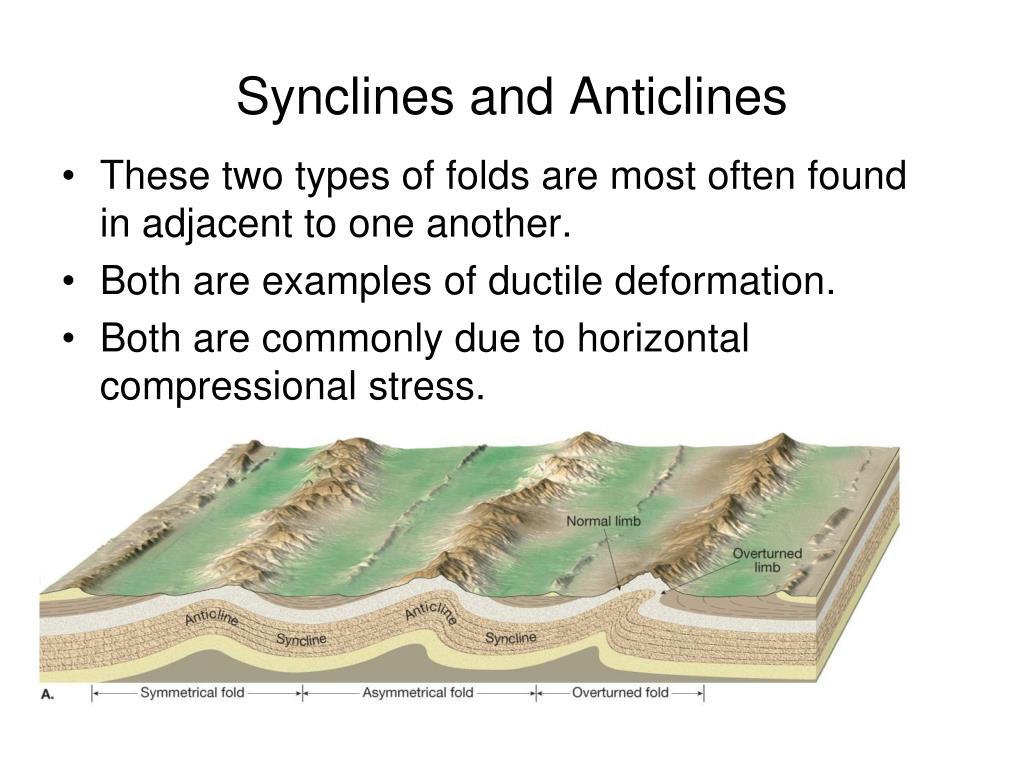
62
Types of stress? How do they work?
Compression- takes place when an object is squeezed.
Tension- occurs when the ends of an object are pulled apart, which stretches and thins the material.
Shear- develops when surfaces slide past one another.
Pressure- occurs when an object feels the same stress on all sides.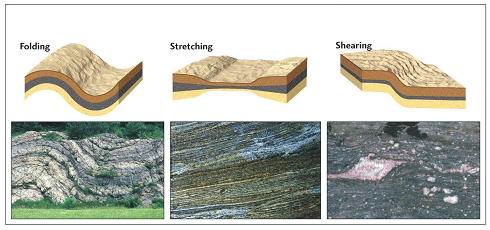
Tension- occurs when the ends of an object are pulled apart, which stretches and thins the material.
Shear- develops when surfaces slide past one another.
Pressure- occurs when an object feels the same stress on all sides.
63
Syncline
A fold that opens upward like a trough. The limbs dip inward and toward the hinge.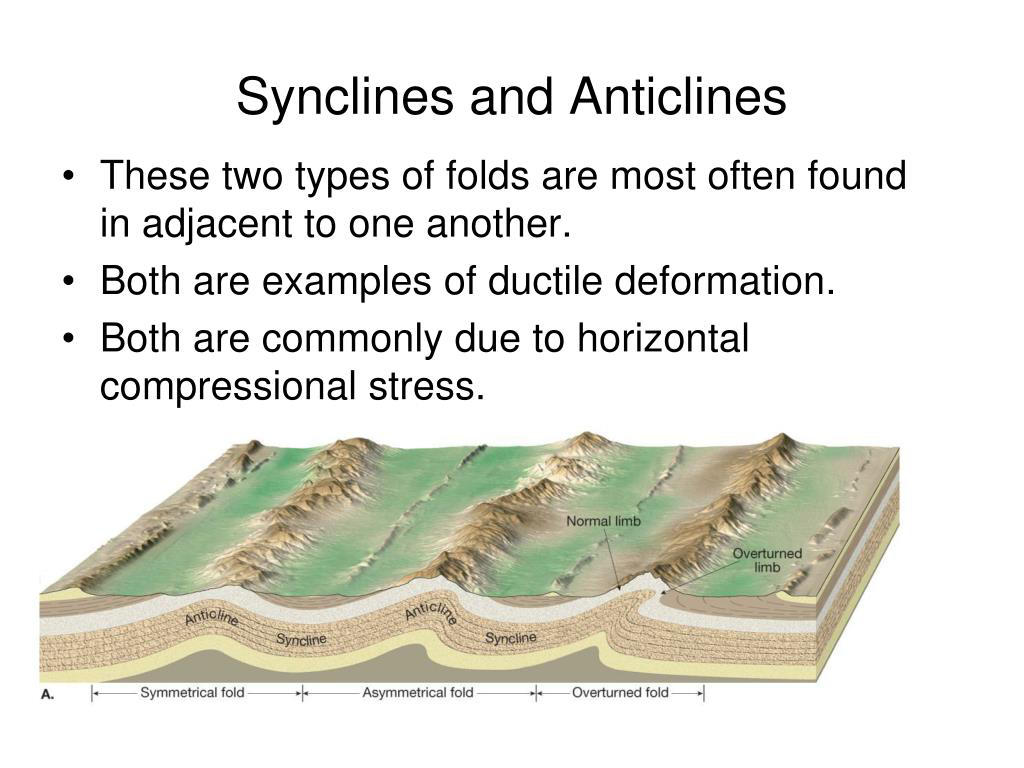
64
Veins
Fractures filled with minerals
65
Deformation
Processes that fault and fold rocks Rocks were originally horizontal – folded later
66
What is this?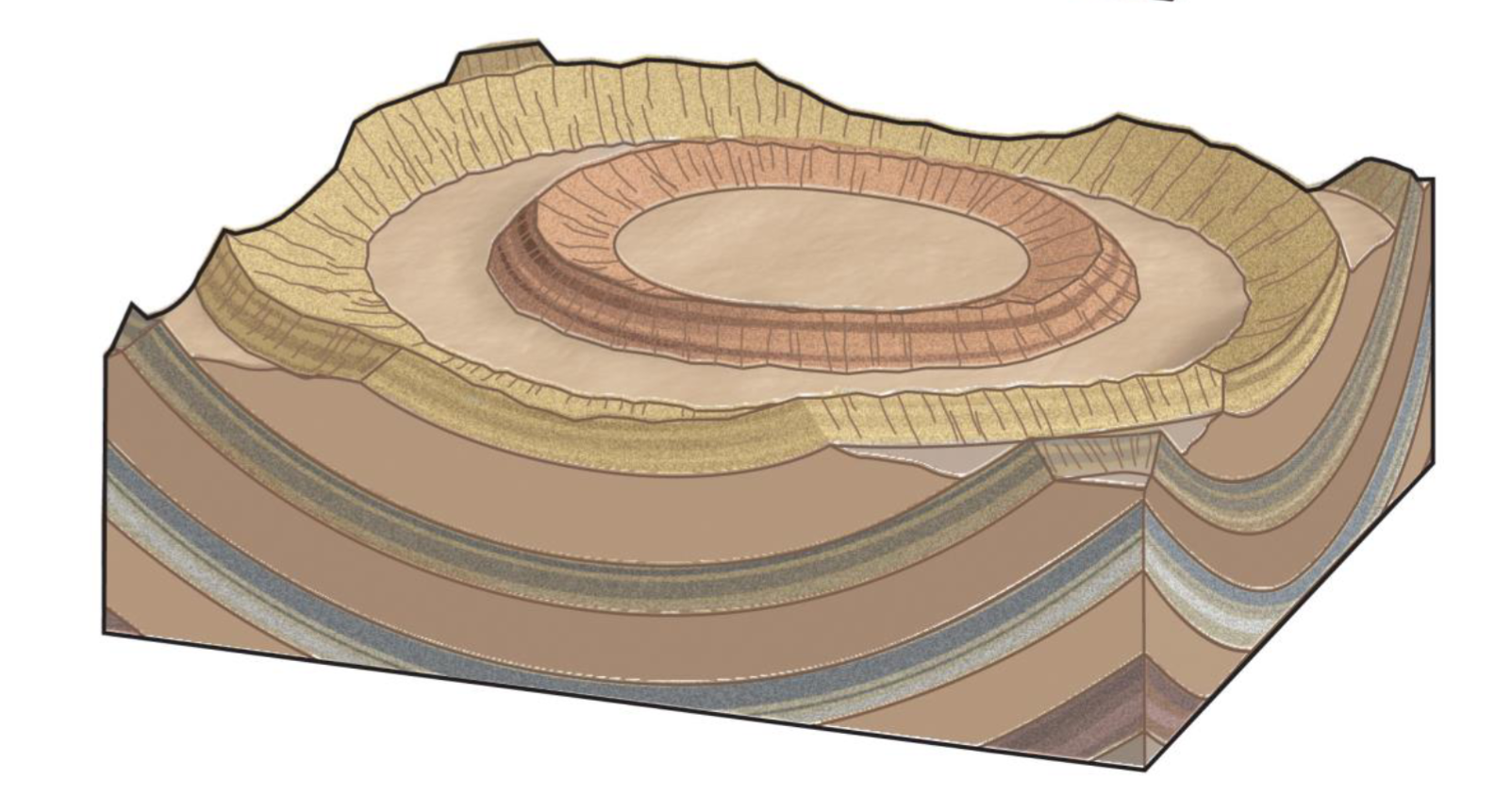
Basin- a fold shaped like an upright bowl.
67
What is this?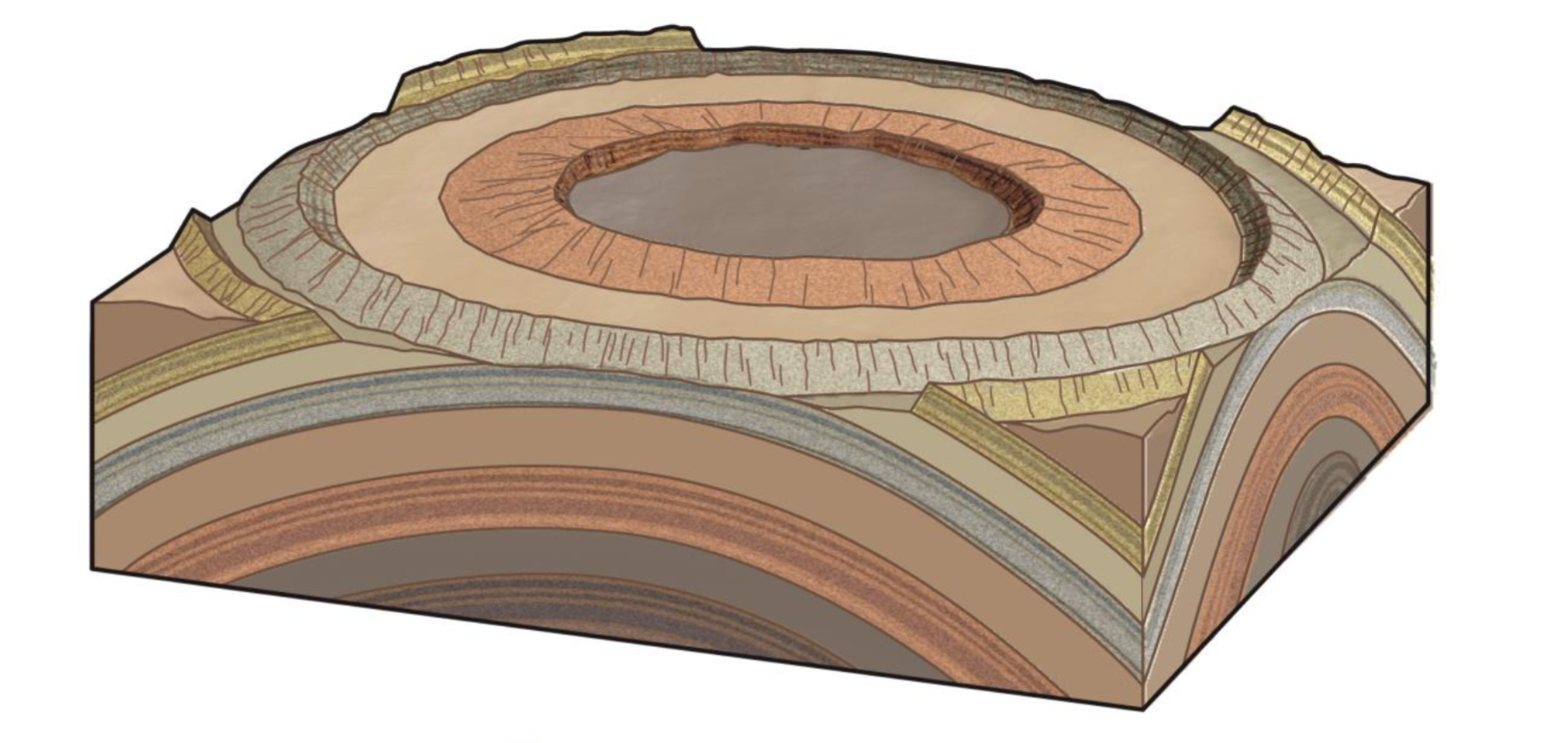
Dome- a fold with the appearance of an overturned bowl.
68
Principle of Inclusions
The inclusions must have been formed before they became part of another rock,therefore must be older than the intrusion or sedimentary rocks that encloses them (ex. xenoliths).
69
Conformable
Beds in a continous sequence
70
Unconformity
A contact indicating a gap in geologic record 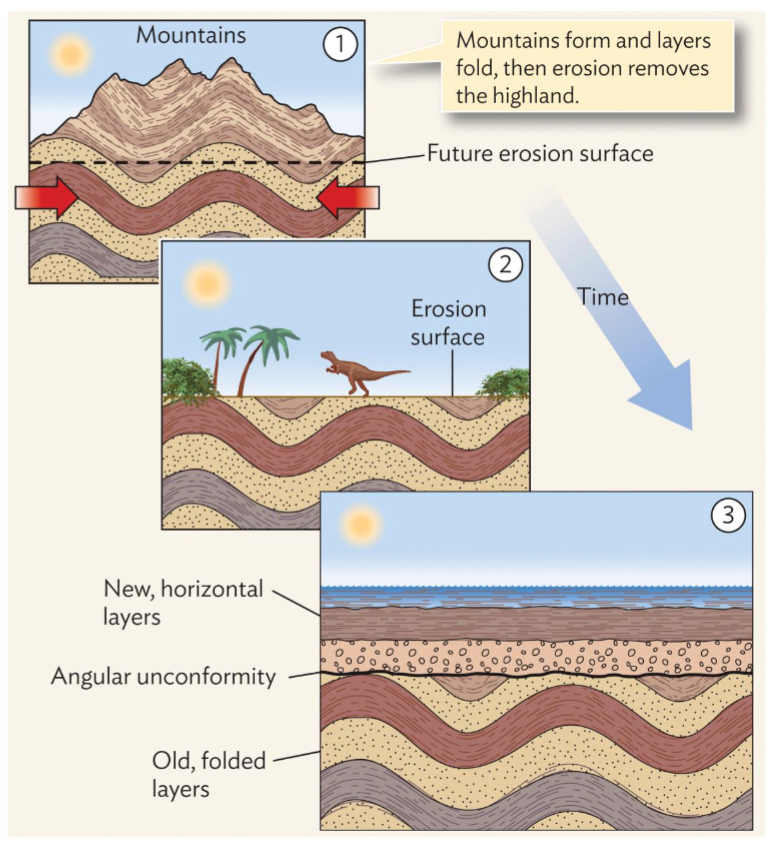
71
Angular unconformity
Foms when rocks are titled or folded, eroded, and covered by younger horizontal strata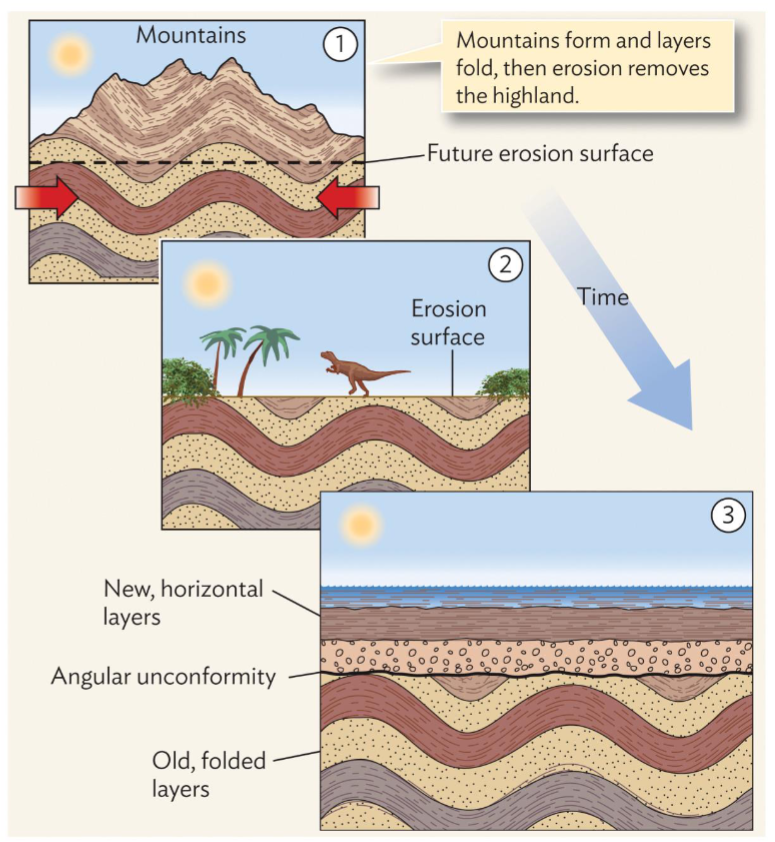
72
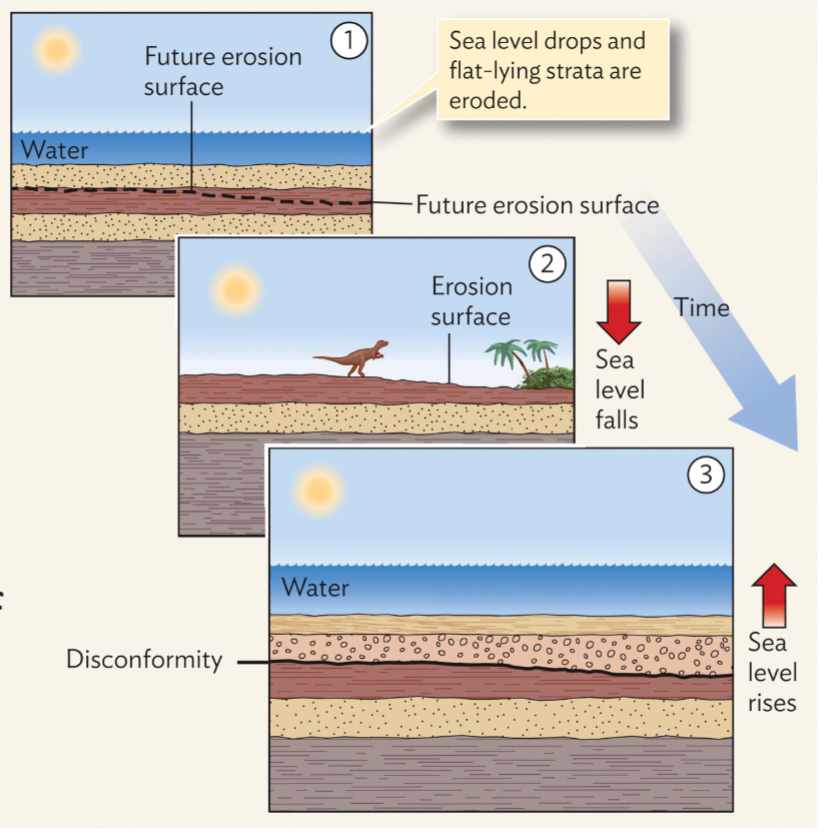
Disconformity
Form when a sequence of sedimentary rock is deposited and remins horizontal, undergoes erosion if sea level drops, and later is covered by new sedimentary rock when the rea is once again submerged