Estuarine Ecology Exam 1
Study these flashcardsFree · spaced repetition · iPhone, Android, Mac & web
All cards
1
What is Ecology? Answer should include a detailed description of population ecology, community ecology, and ecosystem ecology.
Ecology assesses organism-organism and organism-environment interactions.
Population ecology characterizes distribution, abundance, and demography of individuals within a species.
Community ecology characterizes interactions among populations of multiple species.
Ecosystem ecology characterizes interactions among organisms and the environment, including the transformation and flux of energy and matter.
Population ecology characterizes distribution, abundance, and demography of individuals within a species.
Community ecology characterizes interactions among populations of multiple species.
Ecosystem ecology characterizes interactions among organisms and the environment, including the transformation and flux of energy and matter.
2
Biosphere
The global ecological system made up of all living organisms
3
What is an estuary? Describe four different types of estuaries, focusing on their geological origins and physical characteristics. What global change process, occurring within the last 17,000 years, has been instrumental in the formation of all modern estuaries?
An estuary is a semienclosed coastal body of water where river water mixes with ocean water (may or may not be tidal).
Fjord- Rising sea floods a glacier-carved valley (U-shaped and deep); may have a 'morainal sill' near the mouth (ex. Glacier Bay, Alaska)
Drowned-river valley- River carves an estuary through a valley; flooded by rising sea level and ocean enters the valley (river-borne sediments may forma delta inside). Usually relatively shallow with a branching shoreline.
Tectonic- Formed along coastlines; a basin produced by crustal movement or faulting that becomes connected to the sea
Bar-built- Longshore currents form a sand spit, sand bar, or barrier island across an embayment.
Fjord- Rising sea floods a glacier-carved valley (U-shaped and deep); may have a 'morainal sill' near the mouth (ex. Glacier Bay, Alaska)
Drowned-river valley- River carves an estuary through a valley; flooded by rising sea level and ocean enters the valley (river-borne sediments may forma delta inside). Usually relatively shallow with a branching shoreline.
Tectonic- Formed along coastlines; a basin produced by crustal movement or faulting that becomes connected to the sea
Bar-built- Longshore currents form a sand spit, sand bar, or barrier island across an embayment.
4
Biotic Zonation
Occurence of distinctly different communities of species in different parts of the environment
5
Describe three abiotic gradients that might be encountered within an estuary and describe a realistic biotic zonation pattern that could be associated with each gradient.
Thermocline (temperature), halocline (salinity), and nutricline (nutrients).
6
What is biogeography? Describe a biogeographical pattern that one would see in a global study of estuaries, and explain how that pattern arose.
Biogeography is the study of the geographical distribution of organisms and the processes producing those distributions.
A global estuarine pattern is the predominance of mangroves in warm tropical and subtropical intertidal environments and saltmarsh vegetation at cooler temperate latitudes. This is due to temperature helping set the mangrove range limits.
A global estuarine pattern is the predominance of mangroves in warm tropical and subtropical intertidal environments and saltmarsh vegetation at cooler temperate latitudes. This is due to temperature helping set the mangrove range limits.
7
Describe three ways that physical factors have been used to define estuaries and give a pro and con for each of those ways.
Three physical approaches are salinity, basin form and ocean connection, and tidal or hydrodynamic influence. Salinity identifies freshwater–seawater mixing and is biologically relevant, but it fluctuates and can exclude tidal freshwater or hypersaline reaches. Geomorphology identifies a partly enclosed coastal basin and its origin, but physical boundaries can be ambiguous and exclude offshore plumes. Tidal influence or circulation identifies exchange processes that transport water and materials, but weakly tidal seas and intermittently closed lagoons do not fit a simple universal rule.
8
Consider each of these these four “special cases” and explain why you think it should or should not be considered an estuary.
a. Plumes of reduced salinity water extending well out onto the continental shelf, as around the mouths of large rivers like the Mississippi and the Amazon.
b. Coastal lagoons with long residence times and little freshwater input that may become hypersaline during dry periods, such as Texas and Mexico’s Laguna Madre.
c. Mixing zones with saltmarshes where freshwater rivers enter Utah’s hypersaline Great Salt Lake.
d. The lower reaches of coastal plain rivers, where the water is fresh but rises and falls with the daily tides.
a. Plumes of reduced salinity water extending well out onto the continental shelf, as around the mouths of large rivers like the Mississippi and the Amazon.
b. Coastal lagoons with long residence times and little freshwater input that may become hypersaline during dry periods, such as Texas and Mexico’s Laguna Madre.
c. Mixing zones with saltmarshes where freshwater rivers enter Utah’s hypersaline Great Salt Lake.
d. The lower reaches of coastal plain rivers, where the water is fresh but rises and falls with the daily tides.
a. include it as a functional extension of the estuarine mixing system, while recognizing that it falls outside the strict “partly enclosed” coastal-basin definition.
b. include it under a broader estuarine definition because it is a coastal transition basin exchanging with the sea; acknowledge that it may fail the strict freshwater-dilution requirement during dry periods.
c. do not classify it as a coastal marine estuary under the course’s conventional definition because it has no connection to the ocean. It is a useful ecological analogue of a salinity-mixing zone.
d. include it as the tidal freshwater portion of the estuarine system because tidal water-level changes and transport processes extend upstream beyond the salt intrusion.
b. include it under a broader estuarine definition because it is a coastal transition basin exchanging with the sea; acknowledge that it may fail the strict freshwater-dilution requirement during dry periods.
c. do not classify it as a coastal marine estuary under the course’s conventional definition because it has no connection to the ocean. It is a useful ecological analogue of a salinity-mixing zone.
d. include it as the tidal freshwater portion of the estuarine system because tidal water-level changes and transport processes extend upstream beyond the salt intrusion.
9
What does “brackish” mean? Would you consider all brackish waters on earth to be estuarine, and if not, which brackish waters would you not consider to be estuaries, and why?
Brackish water has a salinity between freshwater and normal seawater; a mixture of both.
No, because “Brackish” describes water chemistry; “estuary” describes a type of connected physical and ecological system. You therefore cannot identify an estuary from salinity alone.
No, because “Brackish” describes water chemistry; “estuary” describes a type of connected physical and ecological system. You therefore cannot identify an estuary from salinity alone.
10
What is a weir? How can weirs disrupt estuarine habitat? Give an example of a weir or similar structure in southwest Florida and explain how it affects the adjecent estuary.
A weir is a barrier across a waterway over which water can pass, commonly used to control water level or discharge.
Weirs and similar dams can interrupt animal movement, alter the quantity and timing of freshwater and sediment delivery, limit upstream tidal or saline influence, and change habitat salinity.
The S-79, the W. P. Franklin Lock and Dam, on the Caloosahatchee regulates downstream freshwater flow, affecting salinity, flushing, and habitat in the river and estuary.
Weirs and similar dams can interrupt animal movement, alter the quantity and timing of freshwater and sediment delivery, limit upstream tidal or saline influence, and change habitat salinity.
The S-79, the W. P. Franklin Lock and Dam, on the Caloosahatchee regulates downstream freshwater flow, affecting salinity, flushing, and habitat in the river and estuary.
11
Explain the fundamental difficulty and dilemma of trying to define parts of a continuum, but provide a defense of why we should still go to the trouble of attempting to do so when it comes to estuaries.
A continuum is the concept that biological communities, ecosystems, and environmental changes vary continuously along gradients rather than existing as strict, isolated, and discrete units.
A continuum changes gradually and isn't descrete, so dividing it into named categories requires boundaries that may be arbitrary or overlapping. However, definitions help scientists communicate, compare systems, design sampling, monitor change, and establish workable management or protection boundaries.
A continuum changes gradually and isn't descrete, so dividing it into named categories requires boundaries that may be arbitrary or overlapping. However, definitions help scientists communicate, compare systems, design sampling, monitor change, and establish workable management or protection boundaries.
12
What are intermittent estuaries, and in what parts of the world would you expect to find them, and why?
Intermittent estuaries alternate between being open to the sea and being closed by a sand barrier. They are common on seasonally dry coasts, including parts of South Africa and Australia.
13
Define the terms watershed, catchment, drainage basin, and drainage divide, noting any differences in how the terms are used in the US versus the rest of the world.
A watershed is a topographical (drainage) divide that separates catchments (all parts of the terrestrial landscape can be divided into watersheds). In common U.S. usage, watershed means the drainage area.
A drainage divide can also be known as the topographic boundary separating adjacent drainage areas.
Drainage basin/catchment is an area of land that drains water and suspended/dissolved materials into a particular receiving water body.
A drainage divide can also be known as the topographic boundary separating adjacent drainage areas.
Drainage basin/catchment is an area of land that drains water and suspended/dissolved materials into a particular receiving water body.
14
Diagram the typical pattern of multicellular species richness in an estuary as a function of mean salinity, separately indicating the contributions of freshwater, marine, and estuarine-specialist species. At what point along the the salinity gradient is total species richness lowest, and why?
Most freshwater and marine organisms are specialized for conditions near their respective end of the gradient. Intermediate salinities, often combined with substantial temporal fluctuation, exclude many of both groups. Fewer species have the physiological tolerances and life histories needed for that transition zone. This is a schematic version of the lecture’s multicellular/macrobenthic pattern, not measured counts or a claim that all groups behave identically. The lecture specifically notes that protists can show a different Baltic diversity pattern.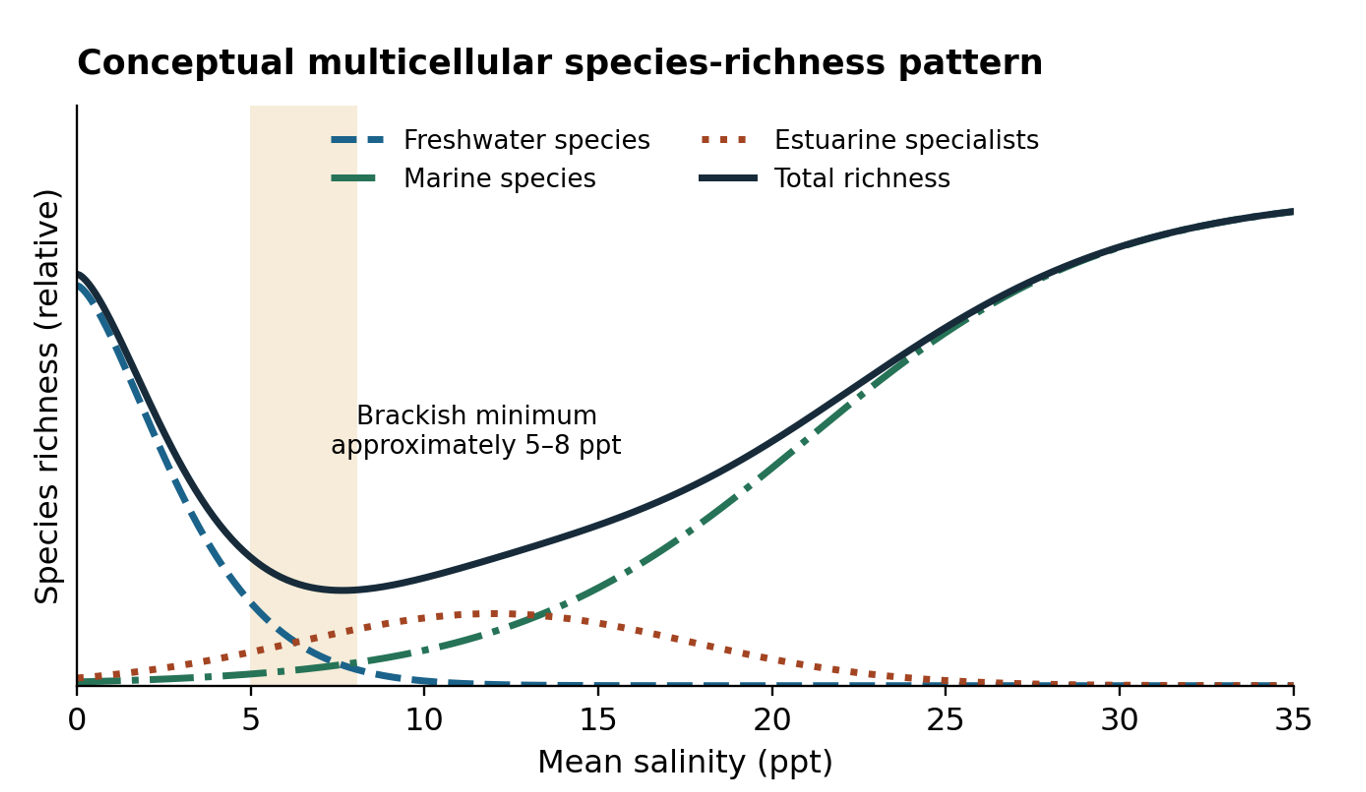
15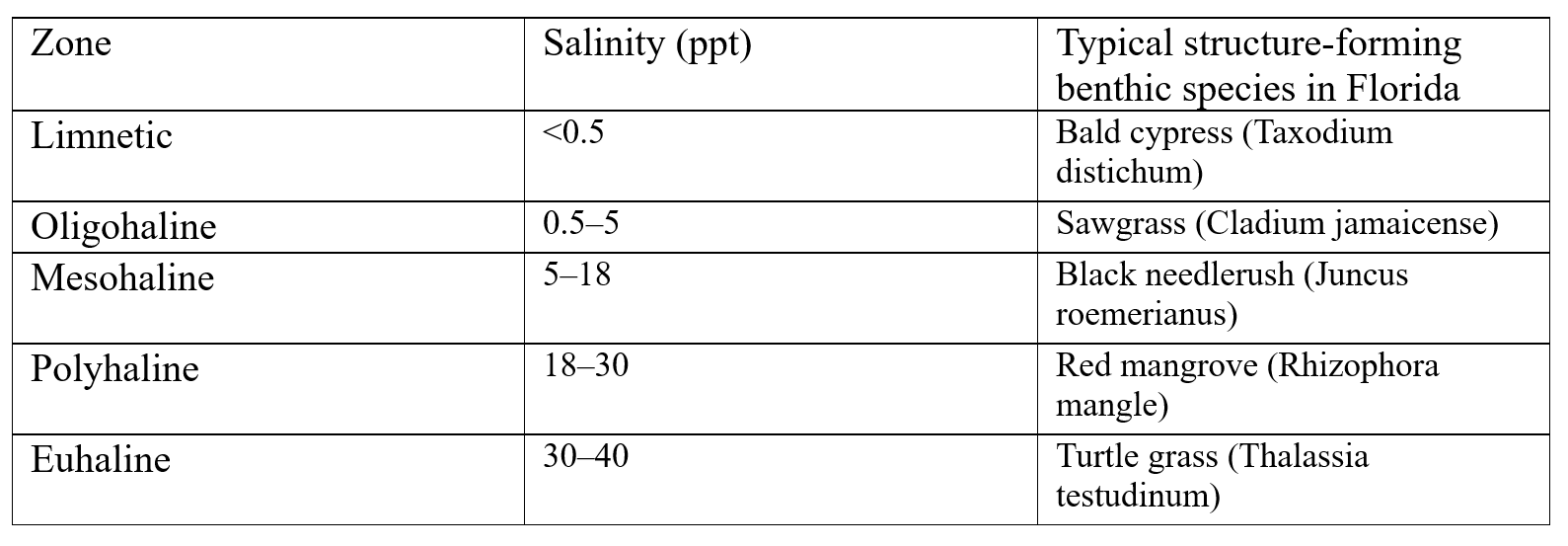
Give the approximate salinity ranges and an example of a structure-forming benthic species that would be characteristics of each of the zones in the Venice system for the classification of marine waters: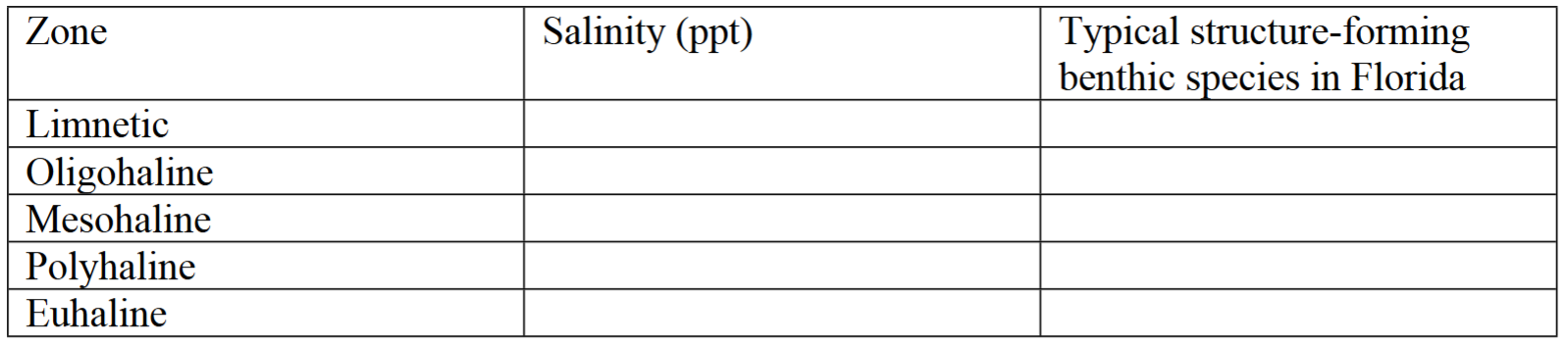
16
Explain what a “tidal prism” is. Explain how the residence time of an estuary scales with the size of the tidal prism, all else being equal. Explain how total basin volume and at least one other factor (besides tidal prism) also influence residence time in estuaries.
The tidal prism is the volume of water entering an estuary on the flood tide, approximately the volume difference between high and low tide.
The residence time shortens because a larger tidal prism exchanges a greater fraction of the basin’s water per tide.
Total basin volume is directly proportional to residence time. A larger basin volume means more water must be displaced or flushed out before it is completely replaced. And river inflow is inversely proportional to residence time. High freshwater input pushes water downstream at a faster rate, accelerating the flushing process and shortening the residence time.
The residence time shortens because a larger tidal prism exchanges a greater fraction of the basin’s water per tide.
Total basin volume is directly proportional to residence time. A larger basin volume means more water must be displaced or flushed out before it is completely replaced. And river inflow is inversely proportional to residence time. High freshwater input pushes water downstream at a faster rate, accelerating the flushing process and shortening the residence time.
17
What is tidal range? What are the tidal ranges (in meters) associated with the terms microtidal, mesotidal, and macrotidal? What is the typical tidal range of an estuary in southwest Florida, and which tidal range category does that place southwest Florida estuaries?
Tidal range is the vertical difference between high and low water.
Microtidal: less than 2 m. Mesotidal: 2–4 m. Macrotidal: greater than 4 m.
Southwest Florida estuaries generally are microtidal, with typical ranges around approximately 0.4 m.
Microtidal: less than 2 m. Mesotidal: 2–4 m. Macrotidal: greater than 4 m.
Southwest Florida estuaries generally are microtidal, with typical ranges around approximately 0.4 m.
18
The figure below represents the distribution of salinity in psu (lines) and temperature (color) in the Caloosahatchee River and estuary in August 2008. Describe the pattern you see and identify the major physical factors responsible.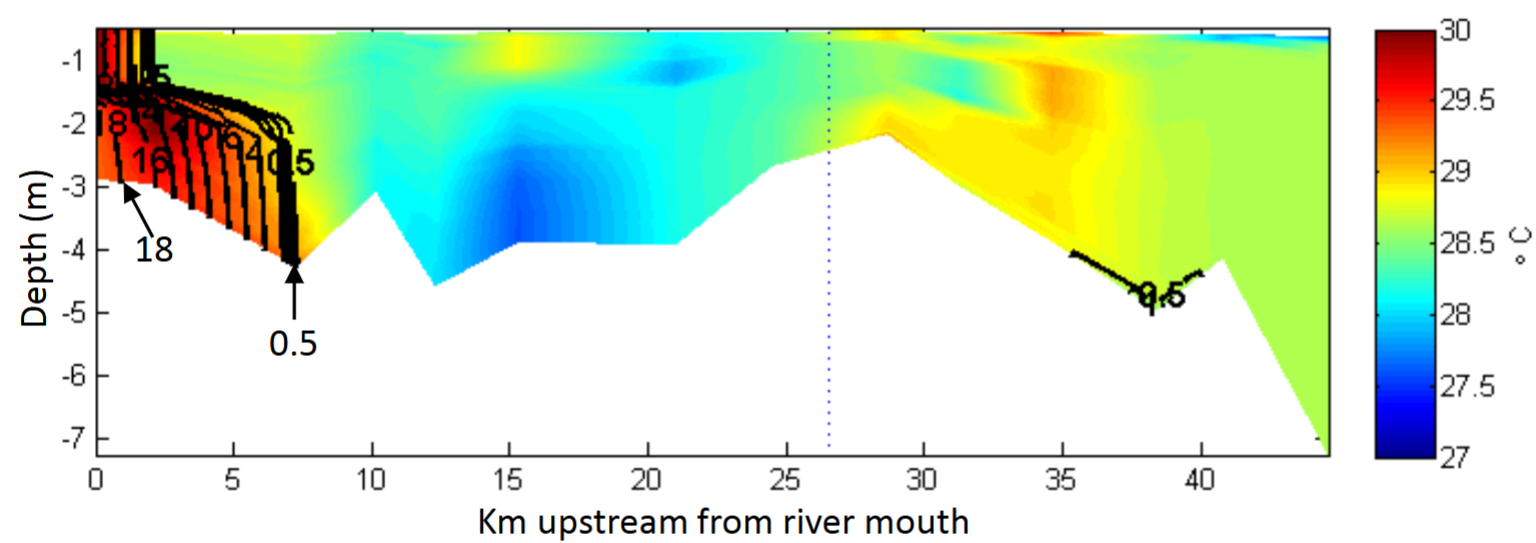
Salinity is highest near the river mouth and toward the bottom, with water near 18 psu close to the mouth and a rapid upstream decrease. Much of the upstream river is very fresh, with the main salt intrusion confined to the lower estuary. Temperature spans roughly 27–30°C and is patchy: the mouth and some shallower upstream areas are warmer, while a deeper midriver area near 15 km is cooler. Freshwater discharge, denser seawater entering below it, tidal mixing, bathymetry, and uneven heating and advection explain the main patterns.
19
Nitrogen is an important macronutrient for estuarine ecosystems. Identify the sources and sinks of nitrogen in estuaries as well as the processes by which it is regenerated and again made available to primary producers. Discuss what is meant by nutrient limitation and explain why estuaries are often considered nitrogen limited.
Sources: Weathering/ runoff, decomposition (mineralization), point source, N₂ fixation, atmosphere
Sinks: Export, burial, denitrification (microbial conversion to N₂), anammox (anaerobic ammonium oxidation)
Decomposition and excretion regenerate ammonium, and nitrification converts ammonium to nitrite and nitrate.
Nutrient limitation is when a nutrient supply is insufficient relative to biological demand. Estuaries are often nitrogen limited because of high demand, constraints on nitrogen fixation, and high denitrification rates.
Sinks: Export, burial, denitrification (microbial conversion to N₂), anammox (anaerobic ammonium oxidation)
Decomposition and excretion regenerate ammonium, and nitrification converts ammonium to nitrite and nitrate.
Nutrient limitation is when a nutrient supply is insufficient relative to biological demand. Estuaries are often nitrogen limited because of high demand, constraints on nitrogen fixation, and high denitrification rates.
20
Provide examples of negative and positive impacts that sea level rise may have on estuaries and describe the processes involved.
Negative impacts: Saltwater intrusion, wetland submersion, altered tidal dynamics, increased stress on species
Positive impacts: Improved water exchange, increased carbon sequestration capacity, landward migration
Positive impacts: Improved water exchange, increased carbon sequestration capacity, landward migration
21
Freshwater inflow influences primary production in estuaries. Identify and discuss the major processes linking freshwater inflow to phytoplankton abundance and distribution.
Freshwater inflow can increase phytoplankton by delivering nutrients and cells and by strengthening stratification that keeps cells in a lighted surface layer.
It can decrease production by adding suspended sediment and CDOM that reduce light, diluting populations, or flushing cells out faster than they grow. It also changes salinity and therefore which species can survive
It can decrease production by adding suspended sediment and CDOM that reduce light, diluting populations, or flushing cells out faster than they grow. It also changes salinity and therefore which species can survive
22
The authors describe maximum phytoplankton production in temperate estuaries often occurring in spring. Why? When would you expect maximum phytoplankton production in south Florida estuaries?
In temperate estuaries, maximum phytoplankton production frequently occurs during the spring due to a combination of high nutrient availability, increasing sunlight, and water column stabilization.
23
Seagrasses are quite sensitive to ambient conditions and nutrient loading, including eutrophication. Discuss the various processes by which increased freshwater inflow can affect seagrass production. Can seagrasses be successful in oligotrophic (low nutrient) waters? Explain your answer.
Freshwater inflow changes seagrass production through salinity, light, nutrients, and physical disturbance. Excessive dilution can stress marine seagrasses; sediment and CDOM reduce light; nutrients can stimulate seagrass growth when limiting but can also stimulate shading phytoplankton and epiphytes; strong flows can disturb beds.
Seagrasses can succeed in oligotrophic waters because roots and rhizomes obtain nutrients from sediment even when the overlying water contains few nutrients, while clear water supplies sufficient light.
Seagrasses can succeed in oligotrophic waters because roots and rhizomes obtain nutrients from sediment even when the overlying water contains few nutrients, while clear water supplies sufficient light.
24
As part of your thesis research, you have been collecting different species of diatoms in the Caloosahatchee River and Estuary and determining their half-saturation coefficients (Km) with respect to ammonium (NH4+) in the laboratory with the following results: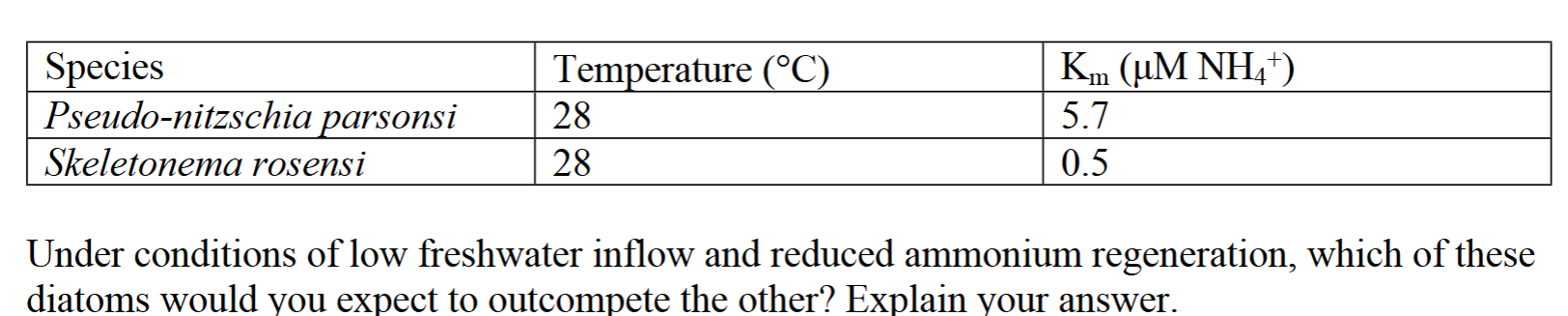
Skeletonema rosensi should have the advantage when ammonium is scarce
25
Explain the factors that lead to the deposition of fine sediments in some portions of some estuaries.
Fine sediments accumulate where water movement is weak enough for particles to settle and remain on the bed. Flocculation of fine clay particles into larger aggregates settle faster and residual circulation, convergence, and tidal asymmetry can retain fine particles near an estuarine turbidity maximum (ETM). Sheltered geomorphology and vegetation can also trap fine sediments.
26
Estuaries typically have high secondary production. What are the two broad categories of organic matter sources that contribute to this high production? What are three possible specific organic matter sources that contribute to high estuarine production, and which broad category does each fall into? Include at least one specific source within each broad category.
Allochthonos- Organic matter originated outside the estuary
Autochthonos- Organic matter orginated inside the estuary
Allochthonos- Terrestrial detritus swept down rivers, marine plankton swept in with the tides
Autochthonos-Estuarine phytoplankton, benthic microalgae, estuarine macrophytes
Autochthonos- Organic matter orginated inside the estuary
Allochthonos- Terrestrial detritus swept down rivers, marine plankton swept in with the tides
Autochthonos-Estuarine phytoplankton, benthic microalgae, estuarine macrophytes
27
Part a) Draw a drowned river valley estuary as seen from above. Label the ocean, the mouth of the estuary, the middle of the estuary, the head of the estuary, and the river.
Part b) Draw and label a graph in which the x axis indicates location in the estuary, starting in the river and going to the ocean, and the y axis indicates mean salinity. Complete the graph by plotting mean salinity versus location in the estuary.
Part c) Draw and label a graph in which the x axis indicates location in the estuary, starting in the river and going to the ocean, and the y axis indicates salinity range. Complete the graph by plotting salinity range versus location in the estuary.
Part d) Based on your graphs, which part of the estuary is likely to be the most stressful / challenging for life?
Part b) Draw and label a graph in which the x axis indicates location in the estuary, starting in the river and going to the ocean, and the y axis indicates mean salinity. Complete the graph by plotting mean salinity versus location in the estuary.
Part c) Draw and label a graph in which the x axis indicates location in the estuary, starting in the river and going to the ocean, and the y axis indicates salinity range. Complete the graph by plotting salinity range versus location in the estuary.
Part d) Based on your graphs, which part of the estuary is likely to be the most stressful / challenging for life?
The diagram shows a flooded, branching river valley connected to the ocean. b. Mean salinity generally increases from the river and head toward the mouth and ocean. c. Salinity range is usually small near the freshwater and ocean end members and greatest in the intermediate mixing region. d. The middle estuary is often especially challenging because organisms experience large salinity fluctuations as tides and freshwater flow move the mixing zone.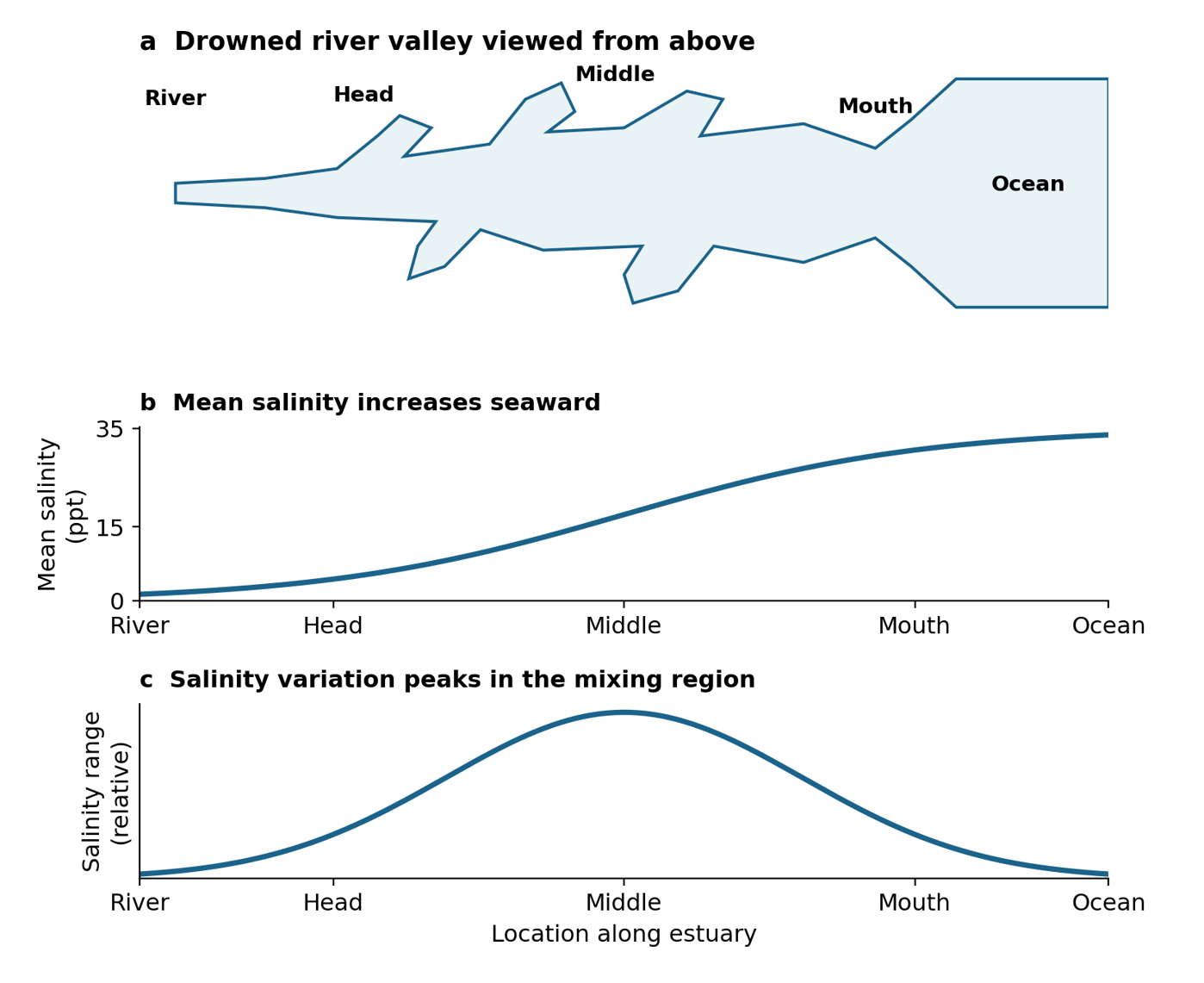
28
Part a) Was the sea level higher or lower 17,000 years ago? How much higher or lower was it, in meters? What type of sea level change process is mainly responsible for the global difference between 17,000 years ago and the present? Include the general term for this type of sea level change, and describe two specific mechanisms for it.
Part b) Current sea level change varies from place to place. What type of sea level change process is responsible for these regional differences? Include both the general term for this type of sea level change, and describe a specific mechanism. Hint: There is more than one possible correct answer for the specific mechanism.
Part b) Current sea level change varies from place to place. What type of sea level change process is responsible for these regional differences? Include both the general term for this type of sea level change, and describe a specific mechanism. Hint: There is more than one possible correct answer for the specific mechanism.
Part a) The sea level was lower, ~130 m lower. Postglacial land-ice melt was the main cause- mechanims are melting land ice, which adds water to the ocean, and thermal expansion, which increases the volume of seawater as it warms.
Part b) Isostatic land movement produces regional changes in sea level relative to the land. For example, land formerly depressed by an ice sheet can rebound after the ice melts, causing relative sea level to fall or rise more slowly locally. Subsiding land experiences a faster relative rise.
Part b) Isostatic land movement produces regional changes in sea level relative to the land. For example, land formerly depressed by an ice sheet can rebound after the ice melts, causing relative sea level to fall or rise more slowly locally. Subsiding land experiences a faster relative rise.
29
What is estuarine circulation? What drives it? Illustrate your answer by drawing on top of the cross-sectional diagram of an estuary provided below. Use arrows to indicate water movement and use shading or isohaline lines to indicate salinity patterns. How might an estuarine organism exploit the estuarine circulation to facilitate its ontogenetic habitat shifts? 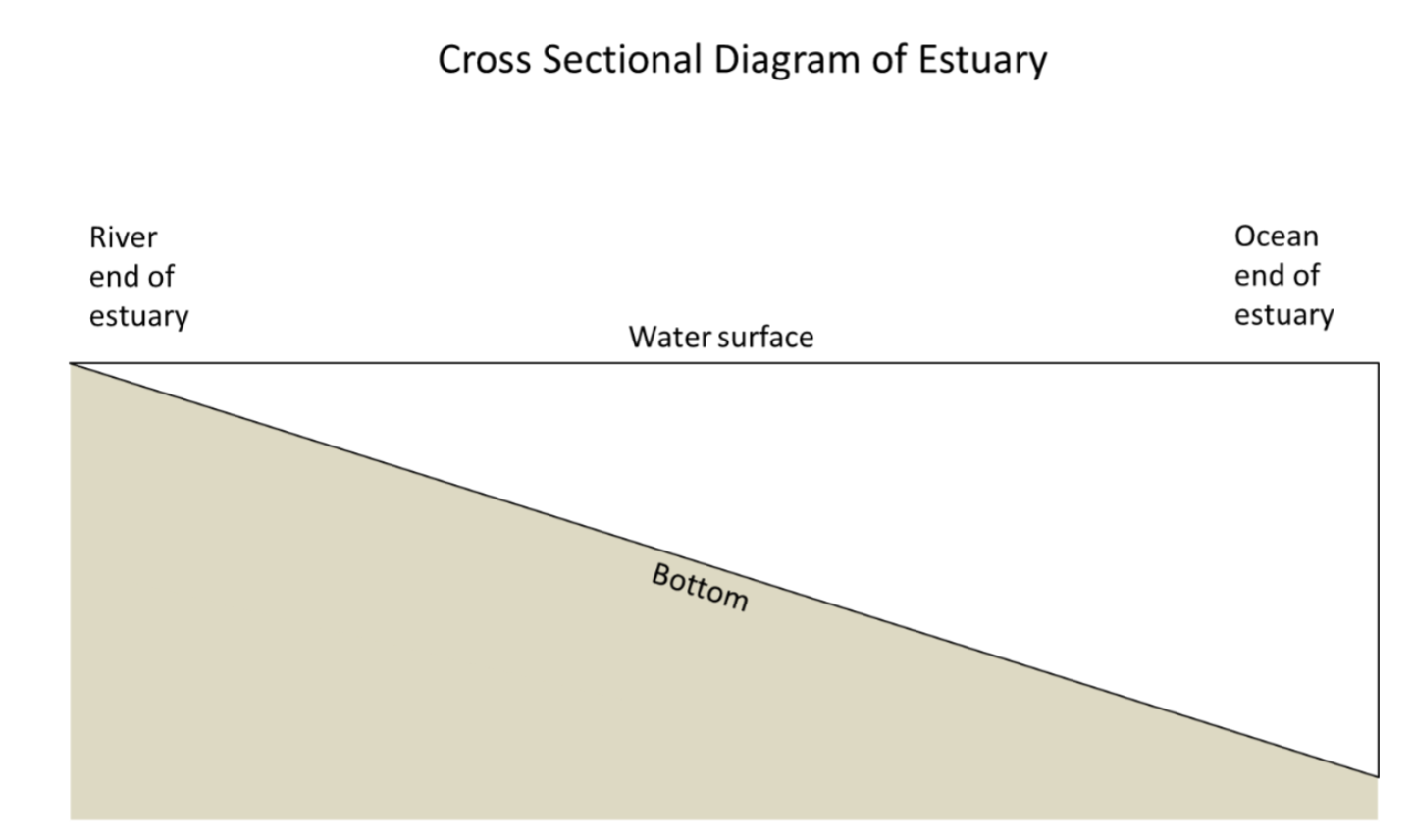
Estuarine circulation is the exchange flow driven by density differences where fresh and salty ocean water meets/mixes.
Freshwater input creates a horizontal density gradient and associated pressure forces; gravity and mixing produce the exchange.
An organism can exploit this flow by occupying surface water when exporting larvae and deeper water when moving juveniles landward toward nursery habitat.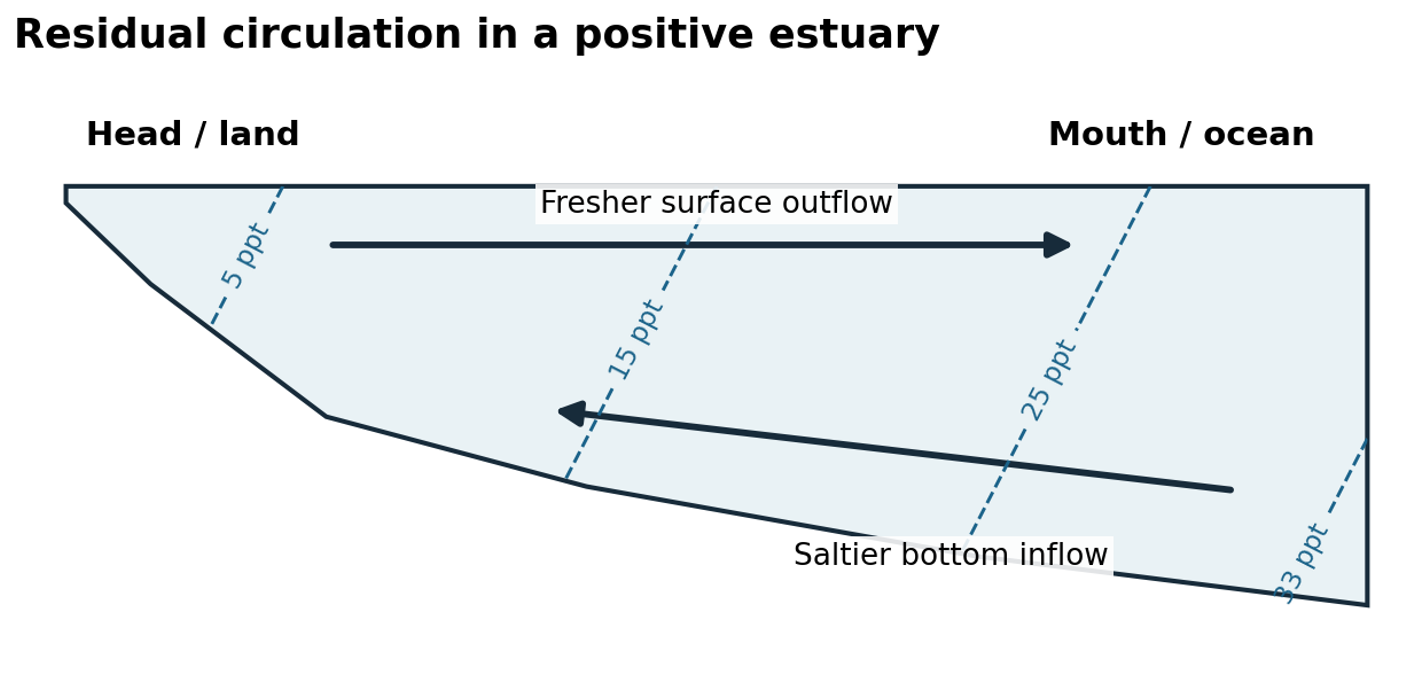
Freshwater input creates a horizontal density gradient and associated pressure forces; gravity and mixing produce the exchange.
An organism can exploit this flow by occupying surface water when exporting larvae and deeper water when moving juveniles landward toward nursery habitat.
30
Explain the difference between positive, negative, and neutral estuaries. Draw isohaline lines indicating salinity and arrows indicating residual circulation patterns for each type of estuary, using the templates provided.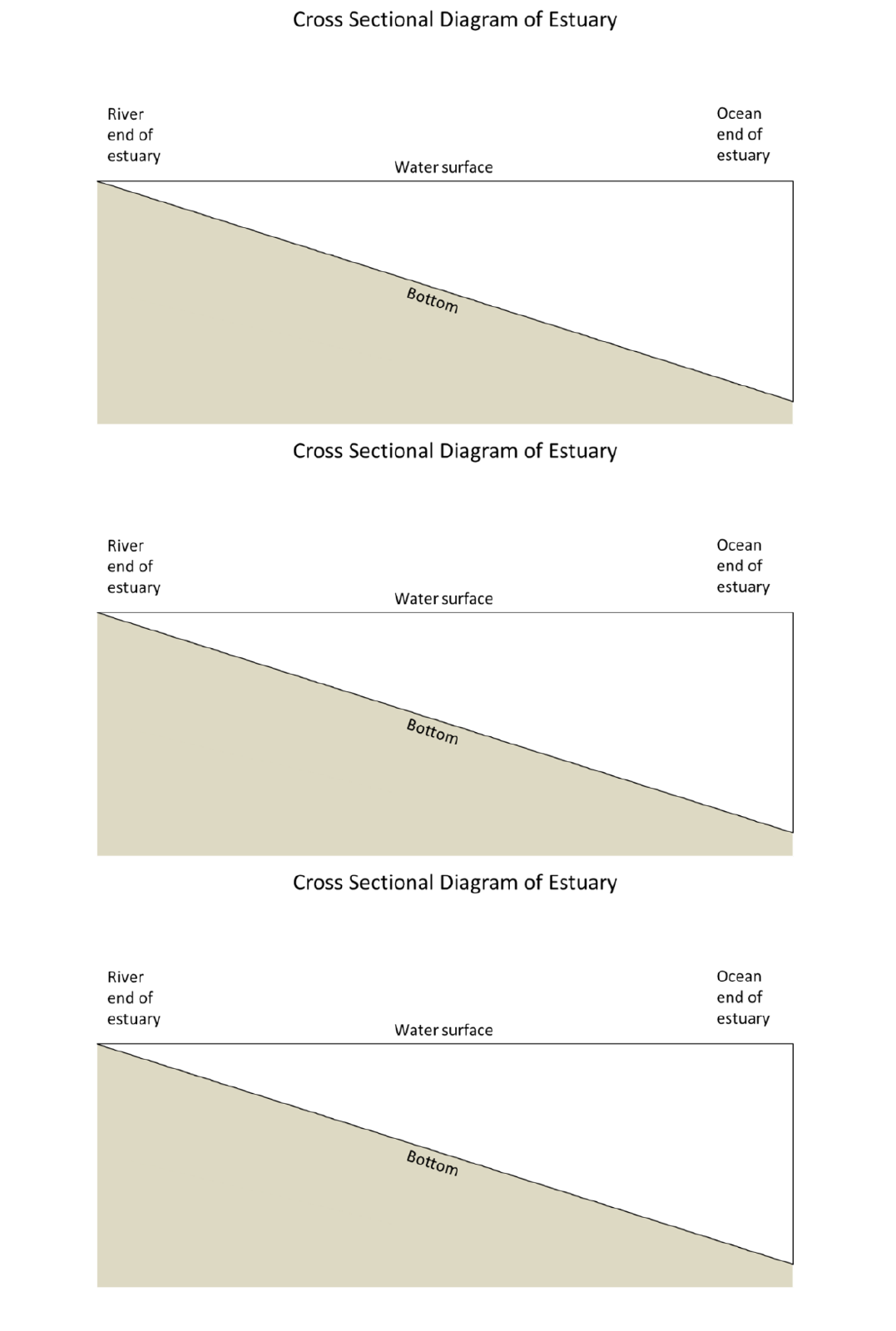
A positive estuary has freshwater inputs greater than evaporative loss.
A negative/inverse estuary Hypersaline was flows out along bottom, while lighter, less salty ocean water flows in near surface.
A neutral estuary are where freshwater inflow and evaporation rates are roughly equal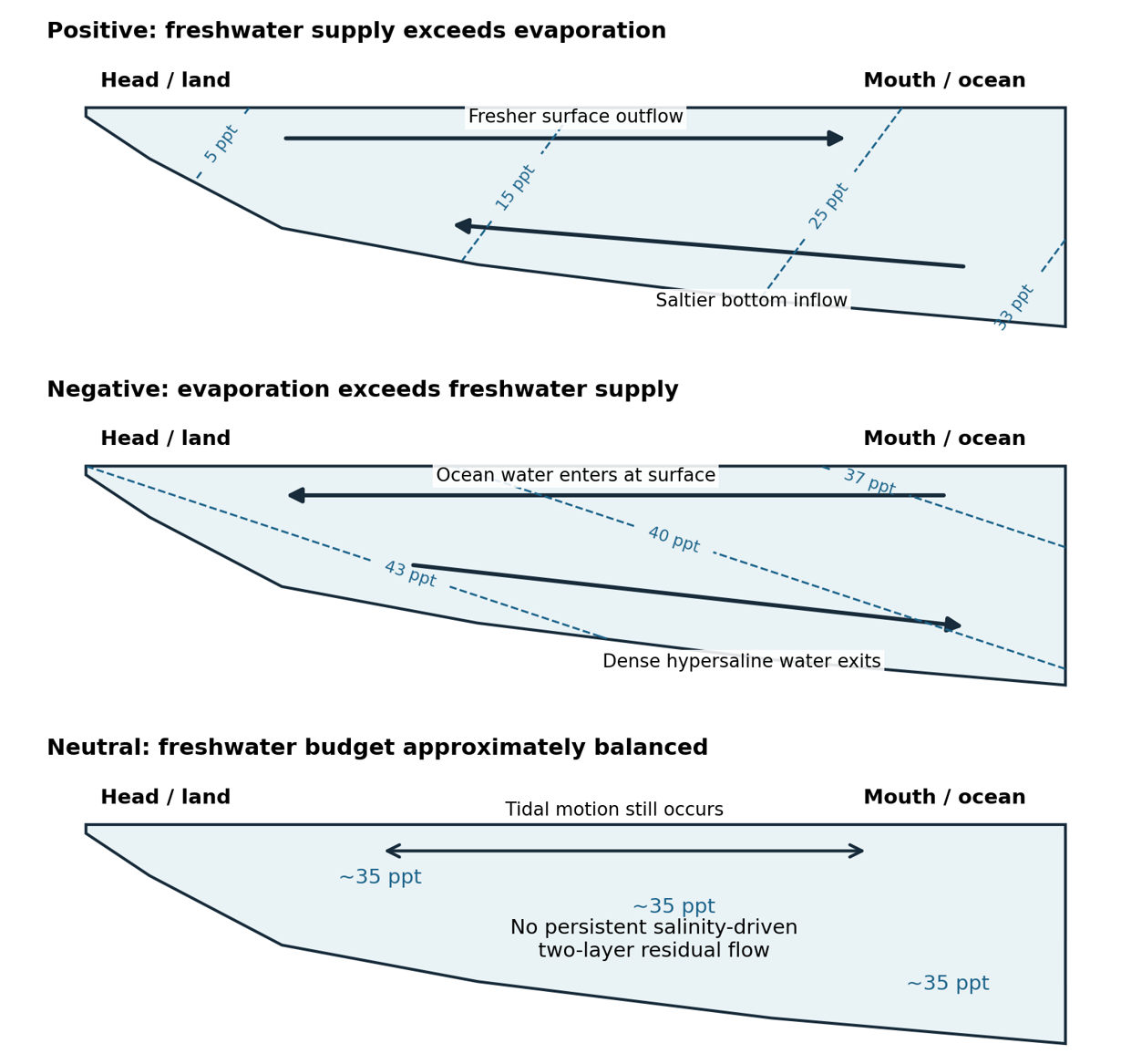
A negative/inverse estuary Hypersaline was flows out along bottom, while lighter, less salty ocean water flows in near surface.
A neutral estuary are where freshwater inflow and evaporation rates are roughly equal
31
How does the availability of oxygen change with increasing depth beneath the sediment in an estuary? What are two oxidized compounds microbes may use as alternative electron acceptors where oxygen is depleted, and what are the corresponding reduced compounds produced by these types of microbial respiration? How is the vertical gradient of oxygen availability changed by increasing organic matter inputs to the sediment? Describe the change in the gradient as well as the biological mechanism behind the change.
Oxygen generally decreases with depth into estuarine sediment and can be exhausted within a shallow surface layer.
Two alternative electron acceptors and their reduced products are nitrate (NO₃⁻) → nitrogen gas (N₂) through denitrification, and sulfate (SO₄²⁻) → sulfide, including H₂S, through sulfate reduction.
Greater organic-matter input stimulates microbial respiration, increases oxygen demand, and makes oxygen disappear closer to the surface, producing a thinner oxygenated layer and generally a steeper near-surface decline.
Two alternative electron acceptors and their reduced products are nitrate (NO₃⁻) → nitrogen gas (N₂) through denitrification, and sulfate (SO₄²⁻) → sulfide, including H₂S, through sulfate reduction.
Greater organic-matter input stimulates microbial respiration, increases oxygen demand, and makes oxygen disappear closer to the surface, producing a thinner oxygenated layer and generally a steeper near-surface decline.
32
What is the Baltic Sea and where is it? How is it different from a typical estuary? Do the Baltic Sea’s differences make it more or less stressful an environment for stenohaline species? (1pt for more or less stressful, 1pt for describing what a stenohaline species is.) What are the consequences of the Baltic Sea’s differences in terms of species ranges and the overlap in ranges of typically marine and typically freshwater organisms?
The Baltic Sea is a large brackish sea in northern Europe between Scandinavia and mainland Europe, connected to the North Sea through narrow straits.
It has a much larger spatial salinity gradient and very weak tides, so salinity at a location fluctuates less over the tidal cycle.
This can make conditions less stressful for stenohaline species, which tolerate only a narrow salinity range.
Stenohaline species are good with one salinity of water (i.e. pure salt/fresh).
Marine and freshwater species can extend farther into the brackish transition and overlap more than in a strongly fluctuating estuary.
It has a much larger spatial salinity gradient and very weak tides, so salinity at a location fluctuates less over the tidal cycle.
This can make conditions less stressful for stenohaline species, which tolerate only a narrow salinity range.
Stenohaline species are good with one salinity of water (i.e. pure salt/fresh).
Marine and freshwater species can extend farther into the brackish transition and overlap more than in a strongly fluctuating estuary.
33
Name the 3 salinity variants.
Fresh (0 ppt), Normal (35 ppt), Hypersaline (40+ ppt)
34
What is hypersalinity and approximately what range or threshold of salinity in ppt does it refer to? What attributes of climate and estuary morphology would likely lead to hypersalinity? Give an example of an estuary in the United States where hypersalinity often occurs. Name a fish tolerant of hypersaline conditions, an intertebrate tolerant of hypersaline conditions, and a bird that may feed on the hypersalinity-adapted invertebrate. Illustrate one of those organisms to the best of your ability.
Hypersalinity means salinity above normal seawater, usually greater than 40 ppt.
It is favored by a hot, dry climate, evaporation exceeding freshwater input, shallow water, restricted exchange with the ocean, and long retention.
Laguna Madre in Texas is one of only a handful of hypersaline negative estuaries in the world; significantly saltier than the ocean because evaporation rates greatly exceed freshwater inflow and rainfall.
Memorable organisms are the sheepshead minnow (Cyprinodon variegatus), brine shrimp (Artemia spp.), and the American avocet (Recurvirostra americana), which may eat brine shrimp in saline wetlands.
It is favored by a hot, dry climate, evaporation exceeding freshwater input, shallow water, restricted exchange with the ocean, and long retention.
Laguna Madre in Texas is one of only a handful of hypersaline negative estuaries in the world; significantly saltier than the ocean because evaporation rates greatly exceed freshwater inflow and rainfall.
Memorable organisms are the sheepshead minnow (Cyprinodon variegatus), brine shrimp (Artemia spp.), and the American avocet (Recurvirostra americana), which may eat brine shrimp in saline wetlands.
35
What are two approaches to dealing with living in water that has a salinity different from the salinity of one’s body? (2pts for the names of each type of salinity coping strategy, 2pts for the description of each type of salinity coping strategy) Hint: I’m asking for two general strategies for dealing with salinity differences- I’m not asking for the specific strategies for dealing with fresh water versus salty water.
Give an example of an organism that uses the first strategy. Give an example of an organism that uses the second strategy. What might be an advantage or disadvantage of one strategy versus the other?
Give an example of an organism that uses the first strategy. Give an example of an organism that uses the second strategy. What might be an advantage or disadvantage of one strategy versus the other?
Osmoregulation- Organisms actively control and maintain a constant internal salinity, regardless of the salinity of the surrounding water (ex. salmon).
Osmoconforming- Organisms match their internal body fluid salinity to the salinity of their external environment (ex. many marine bivalves and worms).
Regulation costs energy but stabilizes the internal environment. Conformation reduces the bulk osmotic gradient but requires cells to tolerate or adjust to changing conditions.
Osmoconforming- Organisms match their internal body fluid salinity to the salinity of their external environment (ex. many marine bivalves and worms).
Regulation costs energy but stabilizes the internal environment. Conformation reduces the bulk osmotic gradient but requires cells to tolerate or adjust to changing conditions.
36
What does it mean to be hyperosmotic? Would being hyperosmotic be more likely to be a problem for a freshwater organism or a saltwater organism? What would happen to a hyperosmotic organism if it didn’t actively osmoregulate? What are some ways that hyperosmotic organisms osmoregulate to avoid the consequences of being hyperosmotic? Give an example of hyperosmotic organism that actively osmoregulates. Draw it.
Hyperosmotic- Organism is saltier than water, tending to soak up water and expand, and needs to expel urine or dump freshwater consistently.
Hyposmotic- Water is saltier than organism and gets sucked out; has to drink all the time and expels very salty urine.
Without regulation, water would enter by osmosis and salts would be lost, disrupting cells and potentially causing swelling.
Ex. A juvenile Chinook salmon in freshwater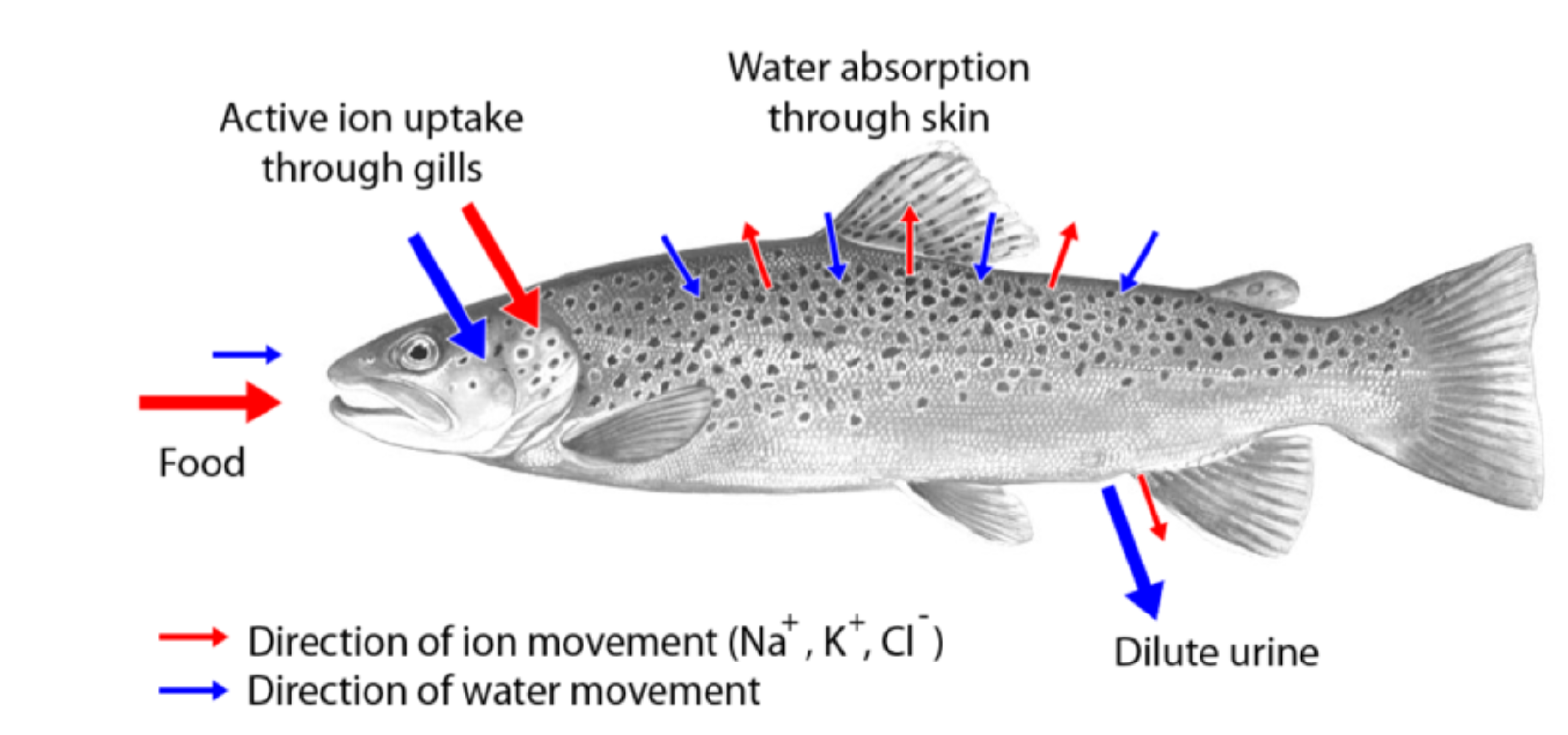
Hyposmotic- Water is saltier than organism and gets sucked out; has to drink all the time and expels very salty urine.
Without regulation, water would enter by osmosis and salts would be lost, disrupting cells and potentially causing swelling.
Ex. A juvenile Chinook salmon in freshwater
37
Define anadromy and catadromy. Give a specific example of an anadromous species and a catadromous species. For ONE of those species (either the catadromous one or the anadromous one) describe its life cycle, including where it is born, where it lives most of its adult life, where it spawns, and whether it is semelparous or iteroparous.
Catadrmous- species that spawn and have babies in saltwater (ex. American eel (Anguilla rostrata))
Andromous- Species where babies are spawned in fresh or brackish water in saltwater (ex. Chinook salmon (Oncorhynchus tshawytscha))
Chinook salmon hatch in freshwater, migrate through estuaries to the ocean, spend most of their adult growth period at sea, and return to freshwater to spawn. They are semelparous: they reproduce once and then die.
Andromous- Species where babies are spawned in fresh or brackish water in saltwater (ex. Chinook salmon (Oncorhynchus tshawytscha))
Chinook salmon hatch in freshwater, migrate through estuaries to the ocean, spend most of their adult growth period at sea, and return to freshwater to spawn. They are semelparous: they reproduce once and then die.
38
What are some of the possible advantages of a migratory life history strategy (choose either anadromy or catadromy) versus a non-migratory life history strategy? Your answer should describe ontogenetic shifts in an organism’s biology and ecological interactions, and the benefits that it may receive by occupying different habitats at different ontogenetic phases. What are two of the possible disadvantages or costs of the migratory life history strategy you described?
For an anadromous Chinook salmon, migration lets different life stages use habitats suited to their changing size, diet, physiology, and reproductive needs. Small juveniles use freshwater and estuarine rearing habitat for food and cover. As they grow and develop seawater tolerance, they move into marine feeding habitat, where larger prey can support substantial growth. Adults return to freshwater spawning habitat suitable for eggs and early development.
Two costs are energy spent on movement and physiological adjustment, and mortality risk during migration, including predation and barriers.
Two costs are energy spent on movement and physiological adjustment, and mortality risk during migration, including predation and barriers.
39
What are otoliths? How can they be used to track the age and growth rate of fishes? What is a euryhaline fish? How can otoliths be used to track the ontogenetic habitat shifts of euryhaline fishes?
Otolith- calcium-carbonate ear stones in fishes, involved in balance and hearing.
Growth increments can be counted to estimate age, and the spacing of increments can help reconstruct growth rate when the time represented by each increment is known.
Euryhaline- A species tolerant of a broad salinity range but may be sensitive as juveniles.
The chemical composition of successive otolith layers, such as strontium relative to calcium (Sr:Ca), can record changes between freshwater, estuarine, and marine habitats through its life.
Growth increments can be counted to estimate age, and the spacing of increments can help reconstruct growth rate when the time represented by each increment is known.
Euryhaline- A species tolerant of a broad salinity range but may be sensitive as juveniles.
The chemical composition of successive otolith layers, such as strontium relative to calcium (Sr:Ca), can record changes between freshwater, estuarine, and marine habitats through its life.
40
What is detritus? Name two allochthonous sources of detritus and two autochthonous sources of detritus to estuarine ecosystems. What happens to detritus over time? Your answer should contrast labile versus refractory organic matter, and should include a definition of CDOM and how it relates to detritus.
Detritus- dead organic material and associated fragments.
Two allochthonous sources are upland leaves delivered by rivers and dead marine plankton imported from offshore.
Two autochthonous sources are dead estuarine phytoplankton and seagrass litter produced in the estuary.
Detritus is fragmented, consumed, leached, and decomposed. Labile material is used and broken down relatively quickly; refractory material resists decomposition and persists longer.
CDOM, colored dissolved organic matter, is the light-absorbing fraction of dissolved organic matter, some of which is released or formed during detritus decomposition.
Two allochthonous sources are upland leaves delivered by rivers and dead marine plankton imported from offshore.
Two autochthonous sources are dead estuarine phytoplankton and seagrass litter produced in the estuary.
Detritus is fragmented, consumed, leached, and decomposed. Labile material is used and broken down relatively quickly; refractory material resists decomposition and persists longer.
CDOM, colored dissolved organic matter, is the light-absorbing fraction of dissolved organic matter, some of which is released or formed during detritus decomposition.
41
What does CDOM stand for? How can you tell, just by looking, whether or not there is a lot of CDOM in the water? Why does CDOM make CDOM-rich water look the way it does? Explain your answer in terms of wavelengths of light absorbed and reflected by CDOM. What are the two colors / wavelengths of light absorbed most readily by the photosynthetic pigment Chl a? Hint: You’ll have to study your notes from the unit on primary production. Based on that, what consequences might CDOM-rich water have for the
photosynthesis and growth of seagrasses in the estuarine environment?
photosynthesis and growth of seagrasses in the estuarine environment?
CDOM = colored dissolved organic matter. High concentrations often give water a yellow-brown or tea-colored appearance. CDOM preferentially absorbs short wavelengths, especially ultraviolet and blue light, so the remaining transmitted and backscattered light is relatively richer in longer yellow-to-red wavelengths.
Chlorophyll a absorbs strongly in the blue, about 430 nm, and red, about 665 nm. CDOM removes usable blue light and reduces overall light penetration, which can lower seagrass photosynthesis, growth, and maximum depth of occurrence.
Chlorophyll a absorbs strongly in the blue, about 430 nm, and red, about 665 nm. CDOM removes usable blue light and reduces overall light penetration, which can lower seagrass photosynthesis, growth, and maximum depth of occurrence.
42
What is seagrass? When did seagrasses evolve (either how many million years ago or in what geological time period)? What are three differences between seagrass and seaweed (aka macroalgae)? Is seagrass a type of grass?
Seagrasses are submerged marine flowering vascular plants with true roots, stems or rhizomes, and leaves, adapted to completing their life cycle in saline water.
Seagrasses evolved from terrestrial flowering plants approximately 100 million years ago, during the Cretaceous. Three differences from seaweeds are: seagrasses have true roots rather than holdfasts; they have vascular transport tissues rather than an algal thallus; and they reproduce using flowers and seeds rather than algal reproductive structures. Seagrasses are not true grasses in the grass family Poaceae.
Seagrasses evolved from terrestrial flowering plants approximately 100 million years ago, during the Cretaceous. Three differences from seaweeds are: seagrasses have true roots rather than holdfasts; they have vascular transport tissues rather than an algal thallus; and they reproduce using flowers and seeds rather than algal reproductive structures. Seagrasses are not true grasses in the grass family Poaceae.
43
What are two ecological advantages seagrasses have over macroalgae, based on seagrasses’ evolutionary origins, morphology, and physiology? What are two ecological advantages macroalgae have over seagrasses, based on macroalgae’s evolutionary origins, morphology and physiology? Based on your answers above, in what habitats and under what abiotic conditions would you expect seagrasses or macroalgae to dominate, respectively?
Two seagrass advantages are root access to sediment nutrients and rhizomes that anchor plants, store reserves, and allow clonal spread or regrowth.
Two macroalgal advantages are attachment to hard surfaces without needing rootable sediment and, in many opportunistic species, rapid nutrient uptake and growth through a relatively simple body with a high surface area relative to volume.
Seagrasses often dominate clear, shallow, soft-bottom habitats with adequate sediment nutrients.
Macroalgae can dominate rocky bottoms and, for fast-growing forms, nutrient-enriched conditions; some groups also occupy lower-light habitats below seagrass depth limits.
Two macroalgal advantages are attachment to hard surfaces without needing rootable sediment and, in many opportunistic species, rapid nutrient uptake and growth through a relatively simple body with a high surface area relative to volume.
Seagrasses often dominate clear, shallow, soft-bottom habitats with adequate sediment nutrients.
Macroalgae can dominate rocky bottoms and, for fast-growing forms, nutrient-enriched conditions; some groups also occupy lower-light habitats below seagrass depth limits.
44
Name three animals that consume seagrass directly, and a species of seagrass named after each of those animals. Name two aspects of seagrasses that make them resistant or
resilient to direct grazing.
resilient to direct grazing.
Three direct consumers and their associated seagrass names are green sea turtle → turtle grass (Thalassia testudinum), manatee → manatee grass (Syringodium filiforme), and wigeon duck → wigeon grass (Ruppia maritima).
Two traits that support resilience to grazing are rapid replacement of leaves and persistent belowground rhizomes with stored reserves that support regrowth and clonal expansion.
Two traits that support resilience to grazing are rapid replacement of leaves and persistent belowground rhizomes with stored reserves that support regrowth and clonal expansion.
45
Part a) Describe three components of the underwater environment that reduce the amount of light reaching seagrass blades. Part b) Describe two light-blocking
components of the underwater environment that may be increased by anthropogenic nutrient enrichment. These may or may not be among the three components you
described in part a. Part c) Describe how one of the light-blocking components from part b might be subject to “top-down” control by mesograzers.
components of the underwater environment that may be increased by anthropogenic nutrient enrichment. These may or may not be among the three components you
described in part a. Part c) Describe how one of the light-blocking components from part b might be subject to “top-down” control by mesograzers.
a. Suspended mineral sediment scatters and absorbs light; CDOM absorbs light, especially blue wavelengths; and phytoplankton absorbs and scatters light in the water column.
b. Nutrient enrichment can increase phytoplankton and epiphytic algae on seagrass blades, both of which shade the plant.
c. Mesograzers can eat epiphytes, reducing the coating on blades and increasing the light available to seagrass. That consumer control is a top-down effect.
b. Nutrient enrichment can increase phytoplankton and epiphytic algae on seagrass blades, both of which shade the plant.
c. Mesograzers can eat epiphytes, reducing the coating on blades and increasing the light available to seagrass. That consumer control is a top-down effect.
46
Describe five beneficial ecological functions of seagrasses. (2pts each- 1 point for listing the benefit, 1 point for describing how seagrass provides it.)
1. Nursery habitat: blades and rhizomes provide refuge and feeding surfaces for juvenile fishes and invertebrates.
2. Food-web support: living seagrass, associated algae, and seagrass detritus supply food directly or through microbes and consumers.
3. Sediment stabilization and clarity: roots bind sediment and the canopy slows water, reducing erosion and trapping particles.
4. Nutrient cycling: plants and associated microbes take up, store, transform, and recycle nutrients.
5. Carbon storage: plant production and trapped organic matter can accumulate and be buried in meadow sediments.
2. Food-web support: living seagrass, associated algae, and seagrass detritus supply food directly or through microbes and consumers.
3. Sediment stabilization and clarity: roots bind sediment and the canopy slows water, reducing erosion and trapping particles.
4. Nutrient cycling: plants and associated microbes take up, store, transform, and recycle nutrients.
5. Carbon storage: plant production and trapped organic matter can accumulate and be buried in meadow sediments.
47
Describe a “bottom-up” connection from seagrass to animals. Describe a “top-down” connection from animals to seagrass. Describe and draw a trophic cascade that could occur in seagrass beds.
A bottom-up connection is seagrass production and structure supporting animal abundance through food, epiphyte habitat, detritus, and refuge. A top-down connection is mesograzers eating epiphytic algae and thereby improving light for seagrass.
One possible cascade is: more predatory fish → fewer mesograzers → more epiphytes → less light → less seagrass growth.
One possible cascade is: more predatory fish → fewer mesograzers → more epiphytes → less light → less seagrass growth.
48
What are mesograzers, and how might their effects in seagrass ecosystems differ from the effects of megagrazers like sea turtles and manatees? Describe two ways that scientists have studied grazing effects in seagrass ecosystems. Describe a logistical challenge associated with studying grazing effects on seagrasses.
Mesograzers are small grazing animals such as amphipods, isopods, and small gastropods; many remove epiphytic algae and indirectly benefit seagrass.
Megagrazers, including turtles and manatees, consume seagrass tissue directly and can reduce standing plant biomass and alter detrital supply.
Two study approaches are controlled mesocosm experiments, manipulating grazer treatments and measuring algae and seagrass responses, and field comparisons of grazed and ungrazed meadows, measuring plant or detrital differences. A logistical challenge is controlling grazing in moving water without also changing flow, light, or other consumers.
Megagrazers, including turtles and manatees, consume seagrass tissue directly and can reduce standing plant biomass and alter detrital supply.
Two study approaches are controlled mesocosm experiments, manipulating grazer treatments and measuring algae and seagrass responses, and field comparisons of grazed and ungrazed meadows, measuring plant or detrital differences. A logistical challenge is controlling grazing in moving water without also changing flow, light, or other consumers.
49
In the Mississippi River Delta region around New Orleans, the river used to frequently overflow its banks. People living in the area didn’t like having their houses flooded out, so the government channelized the river and made flood control devices to vent the silty floodwaters straight out into the Gulf of Mexico. Since then, the coastal saltmarshes of Lousiana have been disappearing. Why? Hint: Your answer should include isostatic sea level rise.
The flood-control system prevents sediment-rich river water from spreading across and building up the delta marshes. Meanwhile, the delta continues to subside: sediment loading can depress the crust through isostatic adjustment, and sediment compaction adds further sinking.
This creates relative sea-level rise at the marsh surface. Without enough new sediment and organic accumulation to match that rise, marshes flood more deeply, erode, and convert to open water.
This creates relative sea-level rise at the marsh surface. Without enough new sediment and organic accumulation to match that rise, marshes flood more deeply, erode, and convert to open water.
50
How are marine pelagic ecosystems different from land ecosystems in terms of plant biomass, plant size, plant production, and the ratio of animal biomass to plant biomass. Are all marine ecosystems similar to pelagic ecosystems in these regards, or are there some marine ecosystems that are more similar to terrestrial ecosystems? If the latter, what types of marine ecosystems ARE more like terrestrial ecosystems, and why?
Marine pelagic systems usually have small producers, low standing plant biomass, rapid producer turnover, and a comparatively high animal-to-plant biomass ratio.
Terrestrial systems commonly have large, long-lived plants, high standing plant biomass, slower turnover per unit plant biomass, and a lower animal-to-plant biomass ratio.
Total primary production per unit area varies and can overlap; small standing biomass does not imply low annual production.
Marine macrophyte habitats—seagrass beds, kelp forests, saltmarshes, and mangrove forests—are more terrestrial-like because large attached producers accumulate substantial persistent biomass.
Terrestrial systems commonly have large, long-lived plants, high standing plant biomass, slower turnover per unit plant biomass, and a lower animal-to-plant biomass ratio.
Total primary production per unit area varies and can overlap; small standing biomass does not imply low annual production.
Marine macrophyte habitats—seagrass beds, kelp forests, saltmarshes, and mangrove forests—are more terrestrial-like because large attached producers accumulate substantial persistent biomass.
51
What is an ecological niche? (2pts) What did the famous ecologist Hutchinson mean in the 1950s when he talked about “niche space” being an “n-dimensional hypervolume?”
Why might biogenic structured habitats (e.g., seagrass beds, mangroves, kelp beds, coral reefs) be able to support a greater variety of species than homogeneous, unstructured habitats? Explain your answer in terms of available niche space.
Why might biogenic structured habitats (e.g., seagrass beds, mangroves, kelp beds, coral reefs) be able to support a greater variety of species than homogeneous, unstructured habitats? Explain your answer in terms of available niche space.
An ecological niche is the set of environmental conditions and resources under which a species can survive, grow, and reproduce, including its ecological interactions. Hutchinson’s n-dimensional hypervolume represents that niche using one axis for each relevant factor, such as temperature, salinity, oxygen, or food availability. Structured habitats provide more combinations of surfaces, shelter, food, flow, and light, creating more opportunities for niche differentiation and coexistence.
52
Why do saltmarshes tend to have high primary production but low plant species diversity? Moving from the offshore boundary of a marsh to the inshore border with the terrestrial environment, where would you find the highest and lowest primary production and plant diversity?
Saltmarshes can have high primary production because tidal exchange and sediment processes supply nutrients to productive plants, while salinity, waterlogging, low sediment oxygen, and sometimes extreme temperatures exclude many plant species. In the lecture’s shore-to-upland model, production is highest near the seaward or tidal-creek margin, and lowest in a hypersaline barren mid-marsh pan. Plant diversity is highest toward the inshore terrestrial transition and lowest in the barren pan.
53
What are three beneficial ecosystem functions of saltmarshes? What are two anthropogenic threats to saltmarshes? Include one direct threat and one indirect threat.
Three functions are nursery and feeding habitat, because marsh structure shelters juvenile animals and supports their prey;
food-web support, because plant litter enters detrital and microbial pathways;
and shoreline stabilization, because roots bind sediment and stems slow water and reduce erosion.
A direct anthropogenic threat is filling or draining marsh for development. An indirect threat is human-driven sea-level rise, especially where roads or seawalls prevent landward migration.
food-web support, because plant litter enters detrital and microbial pathways;
and shoreline stabilization, because roots bind sediment and stems slow water and reduce erosion.
A direct anthropogenic threat is filling or draining marsh for development. An indirect threat is human-driven sea-level rise, especially where roads or seawalls prevent landward migration.
54
How does most saltmarsh primary production enter the estuarine foodweb? Hint: It’s not via direct consumption of saltmarsh primary production by herbivores.
Most saltmarsh production enters the food web through the detrital pathway: marsh plants senesce and shed litter, fungi and bacteria colonize and decompose it, detritivores consume the material and associated microbes, and predators eat those consumers. Direct herbivory occurs but is not the dominant pathway emphasized for this question.
55
What is the theory of biodiversity and ecosystem function (BD-EF), and what does it predict will happen as biodiversity of natural ecosystems is reduced by anthropogenic
extinctions? Describe two mechanisms by which a greater number of a species in an area might enhance ecosystem functions such as primary or secondary productivity.
extinctions? Describe two mechanisms by which a greater number of a species in an area might enhance ecosystem functions such as primary or secondary productivity.
Biodiversity–ecosystem function (BD-EF) theory links the variety and identity of species to processes such as production, resource use, nutrient cycling, and stability. It predicts that species loss generally reduces ecosystem functioning or makes it less reliable, although the effect depends on which species are lost and the conditions. Two mechanisms are complementarity, in which species use different resources or facilitate one another, and the selection or sampling effect, in which a more diverse assemblage has a greater chance of containing a species that performs a function especially well.
56
Part a) Define “Polyphyletic.” Part b) Is “mangroves” a polyphyletic grouping of species? Briefly explain why or why not. Part c) List two specific adaptations that help mangroves grow, survive, or reproduce in the marine environment. Part d) Assume that these two adaptations are found in all mangrove species, but that the terrestrial ancestor or ancestors of mangroves did not have such adaptations. Based on your answer for part b, what are the implications for how many times these adaptations evolved?
a. Polyphyletic describes a grouping assembled from multiple evolutionary lineages rather than one exclusive ancestral lineage and its descendants.
b. Yes: “mangroves” groups salt-tolerant intertidal trees and shrubs from several plant families by their ecology and adaptations.
c. Two adaptations are aerial root structures that improve oxygen supply and mechanisms for tolerating salt, such as root exclusion or leaf salt secretion.
d. Under the question’s assumption that the terrestrial ancestors lacked these traits, similar adaptations evolved independently in multiple lineages—convergent evolution.
b. Yes: “mangroves” groups salt-tolerant intertidal trees and shrubs from several plant families by their ecology and adaptations.
c. Two adaptations are aerial root structures that improve oxygen supply and mechanisms for tolerating salt, such as root exclusion or leaf salt secretion.
d. Under the question’s assumption that the terrestrial ancestors lacked these traits, similar adaptations evolved independently in multiple lineages—convergent evolution.
57
Part a) Describe three beneficial ecosystem functions of mangroves. Part b) Describe one serious anthropogenic threat to mangroves. Part c) Give an example of a shallow-water marine ecosystem that could be indirectly harmed by the loss of nearby mangroves. Part d) Explain the mechanisms by which the loss of mangroves would harm the ecosystem you referred to in part c.
a. Mangroves provide nursery habitat through complex roots and shelter; food-web support through litter, microbes, algae, and associated prey; and shoreline stabilization and sediment retention through roots that bind sediment and slow water.
b. A major direct threat is clearing and filling for coastal development or aquaculture.
c. Nearby seagrass beds can be harmed indirectly.
d. Loss of mangroves can increase erosion and sediment or nutrient delivery, causing turbidity and algal shading, while also removing connected nursery and feeding habitat.
b. A major direct threat is clearing and filling for coastal development or aquaculture.
c. Nearby seagrass beds can be harmed indirectly.
d. Loss of mangroves can increase erosion and sediment or nutrient delivery, causing turbidity and algal shading, while also removing connected nursery and feeding habitat.
58
Part a) What are two major stressors that mangroves have to deal with in order to live in the marine intertidal environment? Part b) Explain why each of these two stressors is a stressor, i.e. explain the mechanism or mechanisms by which it interferes with a plant’s ability to survive and grow. Describe two ways that mangroves have evolved to deal with each of the two stressors you listed in part a.
Two stressors are salinity and oxygen-poor, waterlogged sediment. Salinity makes water uptake difficult through osmotic effects and can cause toxic ion accumulation. Mangroves cope through salt exclusion at roots and, in species such as black mangroves, salt secretion by leaf glands. Waterlogging slows gas diffusion and microbial respiration consumes oxygen, limiting root aerobic respiration and ATP supply; reduced compounds such as sulfide can add toxicity. Mangroves cope through aerial roots with gas-exchange openings and internal air spaces that transport oxygen to submerged root tissues.
59
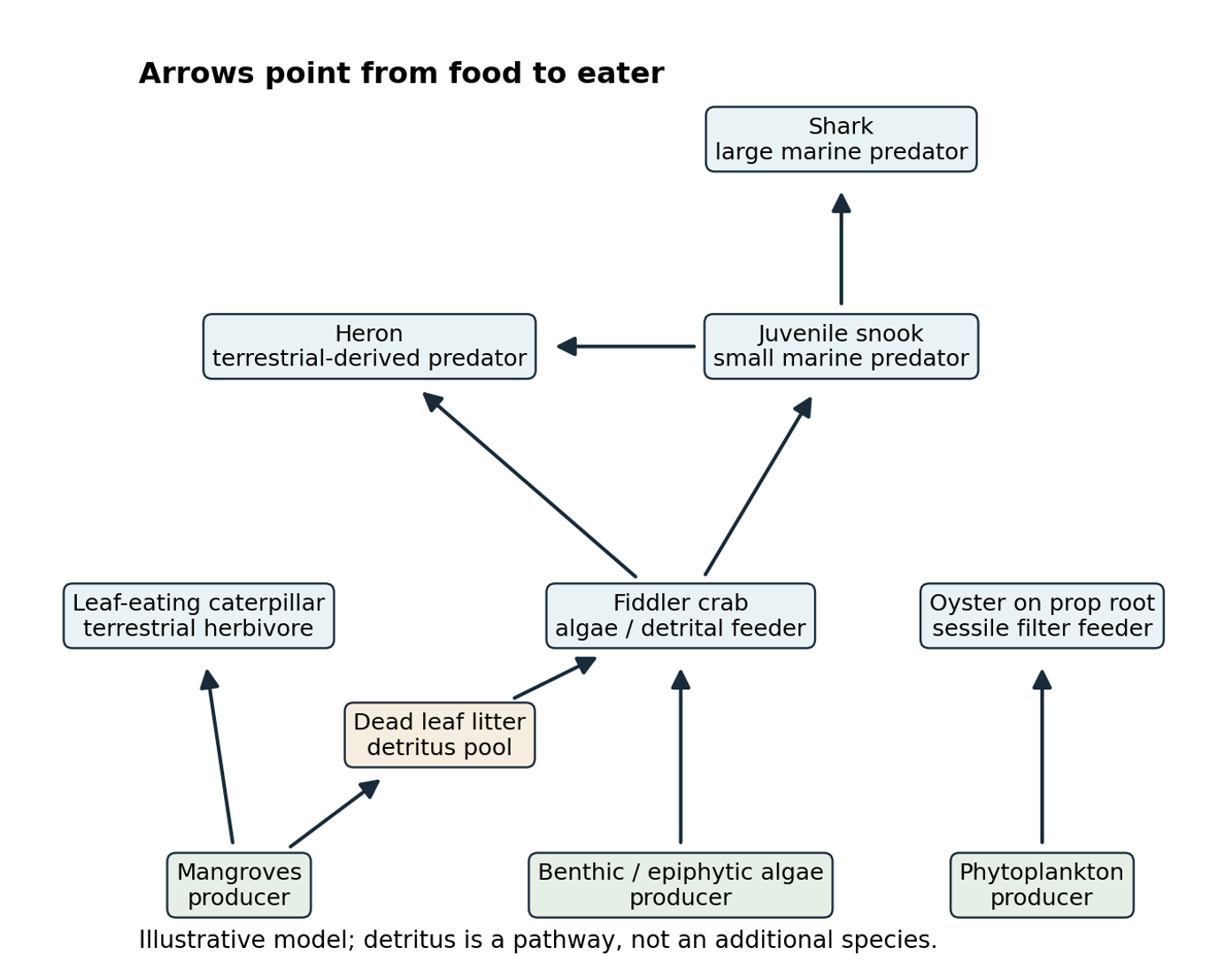
Draw a possible food-web for a mangrove ecosystem. Your food web should include at least: three types of primary producer (hint: two types of primary producer should
NOT be mangroves), one sessile organism in the prop-root fouling community, one herbivore or detritovore of terrestrial origins, one herbivore or detritovore of marine origins, one predator or omnivore of terrestrial origins, one small predator or omnivore of marine origins, one large predator of either marine or terrestrial origin. Indicate trophic connections appropriately with arrows leading from the food source to the thing(s) that eats it. I won’t penalize you for including additional types of organisms in the food web.
NOT be mangroves), one sessile organism in the prop-root fouling community, one herbivore or detritovore of terrestrial origins, one herbivore or detritovore of marine origins, one predator or omnivore of terrestrial origins, one small predator or omnivore of marine origins, one large predator of either marine or terrestrial origin. Indicate trophic connections appropriately with arrows leading from the food source to the thing(s) that eats it. I won’t penalize you for including additional types of organisms in the food web.
Use mangroves, phytoplankton, and benthic or epiphytic algae as three producers; an oyster as a sessile prop-root filter feeder; a leaf-eating caterpillar as a terrestrial herbivore; a fiddler crab as a marine-derived algal/detrital consumer; a heron as a terrestrial-derived predator; a small predatory fish, such as a juvenile snook, as a small marine consumer; and a shark as a large marine predator. Arrows must point from food to eater. Mangrove litter also supplies a detritus pool.