Geology Exam 2
Study these flashcardsFree · spaced repetition · iPhone, Android, Mac & web
All cards
1
What are the 5 things something has to have in order to be a mineral?
Solid, inorganic, crystalline structure, naturally occuring, certain/specific chemical composition
2
Crystal form
Atoms arranged in a specific 3-D pattern (crystal lattice)
3
What are rocks and how are they classified?
Solid, naturally occuring aggregation of one or more minerals. Classified by its origin (environment).
4
3 rock types and how are they made? Diagram the rock cycle.
Metamorphic rock- Form when pre-existing rocks change character due to a change in temperature and/or pressure conditions.
Sedimentary rock- Form by cementation or precipitation.
Igneous rock-Forms from molten material.
Sedimentary rock- Form by cementation or precipitation.
Igneous rock-Forms from molten material.
5
Difference between a mineral and a rock?
Minerals have an organized sructure and are of a certain chemical composition. Rocks can be "randomly" oriented and usually contain more than 1 mineral.
6
Biomineralization and examples
Organisms extract ions from the water to make mineral crystals (ex. Corals create aragonite (CaCO3); oysters create calcite (CaCO3))
7
What is a unit cell?
Simplest repeating unit in a crystal
8
How do minerals form?
Salt water evaporation, where magma is cooling, where rock is undergoing metamorphosis, and participating out of groundwater
9
Examples of how and where minerals form and an example of a mineral that could form in that way
1. Supersaturation or the precipitation of crystals in water (ex. halite (table salt))
2. Crystalizing in a melt of lava or magma (ex. feldspar, olivine)
2. Crystalizing in a melt of lava or magma (ex. feldspar, olivine)
10
What are abundant elements in the crust? Which mineral group is most abundant?
Silicon and oxygen; Silicates
11
What properties of minerals can help us identify them?
1. Streak
2. Color (can vary though)
3. Crystal habit/form/structure
4. Cleavage
5. Specific gravity
6. Special properties
7. Hardness
8. Fracture
9. Feel/texture
10. Luster
2. Color (can vary though)
3. Crystal habit/form/structure
4. Cleavage
5. Specific gravity
6. Special properties
7. Hardness
8. Fracture
9. Feel/texture
10. Luster
12
What is cleavage?
Mineral’s tendency to break along flat surfaces, due to planes of weakness in the crystal
13
What is hardeness?
Resistance to scratching based on the strength of a mineral's chemical bonds
14
What is luster?
How the light is reflected (ex. pearly, metallic, vitreous)
15
What is streak?
Mineral’s color in powdered form
16
What is specific gravity?
Density of the mineral compared to the density of water
17
What is crystal form/structure/habitl
Natural distinctive shape of a mineral; based on how a mineral grows
18
Are diamonds forever, or do they degrade?
Diamonds degrade (very slowly) at the surface since they are unstable
19
Lava vs. Magma
Above ground; Underground
20
Extrusive vs. Intrusive
Cools at Earth’s surface; Cools underground
21
Sources of heat from Earth’s interior?
Remnant heat from formation of Earth, Ongoing heat generation (Decay of radioactive elements)
22
Where does magma form? What causes it to form?
1. Areas of partial melting in the crust or mantle
2. Decompression/Pressure release, Flux Melting/Volatile addition, Heat transfer
2. Decompression/Pressure release, Flux Melting/Volatile addition, Heat transfer
23
Decompression/Pressure Release and where can it occur?
Pressure is lowered, but it’s still hot underground so a melt forms (ex. continental rifts, and divergent-plate boundaries).
24
Flux Melting and where can it occur?
Volatiles lower the melting of hot rock as subduction carries volatiles down into the mantle, melting rock (ex. subduction zone)
25
Heat Transfer and where can it occur?
Rising magma carries heat with it, raising temperature in nearby crust rock, which then melts (ex. hot spot).
26
What can vary lava composition?
Volcano type
27
Why do melts vary?
The source rock dictates melt composition, and can be varried. Spectrum between which minerals are in the melt.
28
Mafic minerals and examples. Characteristics?
Silica tetrahedrons bonded to iron, magnesium, and/or calcium (ex. olivine, pyroxene, amphibole, and biotite)
1. Generally dark colored and more dense
2. Common in oceanic rocks (Ocean crust is mafic)
3. Higher melting temperatures
1. Generally dark colored and more dense
2. Common in oceanic rocks (Ocean crust is mafic)
3. Higher melting temperatures
29
Felsic minerals and examples. Characteristics?
Silica tetrahedrons bonded to aluminum, potassium, and/or sodium (ex. Quartz, Muscovite mica, Orthoclase feldspar)
1. Generally light colored and less dense
2.Common in continental rocks (Continental crust is felsic)
3. Lower melting temperatures
1. Generally light colored and less dense
2.Common in continental rocks (Continental crust is felsic)
3. Lower melting temperatures
30
What composition is the mantle?
Ultramafic
31
What happens first during melt formation? Which type melts first, felsic or mafic?
Partial melting happens first: not all of the rock melts
Felsic minerals melt at a lower temp, so may start to melt first
Felsic minerals melt at a lower temp, so may start to melt first
32
Assimilation
Magma melts surrounding rocks, incorporating them into the magma and altering the chemistry of the magma
33
Fractional Crystallization
As melt cools, mafic minerals crystallize first and fall out of the magma; felsic minerals crystallize last.
34
According to the Bowen’s reaction series, which statement is most correct?
- With decreasing temperature, melts become more mafic
- With decreasing temperature, melts become more felsic
- With decreasing temperature, melts become less fractionated
- With decreasing temperature, melts do not change
35
Xenoliths
Blocks that fall into a magma chamber and do not completely melt and are carried by the melt
36
Why do intrusive rocks have large crystals and extrusive rocks have tiny crystals?
Lose heat slowly = big crystals. Magma takes longer to cool, so mineral crystals have time to grow larger
Cool rapidly = small crystals
Cool rapidly = small crystals
37
How, why, and where do pillow lavas form?
1. When eruptions occur underwater, particularly when there is a relatively low eruption rate
2. Blobs of basalt cooled rapidly by quenching in water as more lava continues to inflate
2. Blobs of basalt cooled rapidly by quenching in water as more lava continues to inflate
38
How are igneous rocks themselves classified and named?
Composition or magma/lava which it formed from
39
Importance of minerals
Industrial use, ore, gems, building blocks of the earth
40
Igneous rock textures
1. pyroclastic
2. phaneritic
3. aphanitic
4. vesicular
5. glassy
2. phaneritic
3. aphanitic
4. vesicular
5. glassy
41
What are pyroclasts?
1. Avalanche of hot rock, gas, and ash (500-1000C)
2. Can burn and cover everything in ash (when it cools, it can form tuff rocks)
3. common at composite volcanoes
4. Pompeii
2. Can burn and cover everything in ash (when it cools, it can form tuff rocks)
3. common at composite volcanoes
4. Pompeii
42
Tephra
Volcanic ash and pieces of rock (forms rock called Tuff)
43
Lahars and how they're caused. Debris avalanche and how they're caused. Why are they dangerous? Where are they most common?
1. Mud, rock, water slides of huge volumes caused by by melting snow and ice or water. Can also form from pyroclastic flows when extremely hot, flowing rock debris erodes, mixes with, and melts snow and ice as it travel rapidly down steep slopes.
2. Chaotic masses of rock, soil, ice, and what ever debris is entrained into the flow.
3. These are deadly because they happen quickly and can cover everything in their paths with rocks and other materials from the volcano.
4. Common at composite volcanoes
2. Chaotic masses of rock, soil, ice, and what ever debris is entrained into the flow.
3. These are deadly because they happen quickly and can cover everything in their paths with rocks and other materials from the volcano.
4. Common at composite volcanoes
44
a. Dike? b. Sill?
a. Sheet-like intrusive rock body that follows layering in surrounding rocks [horizontal]
45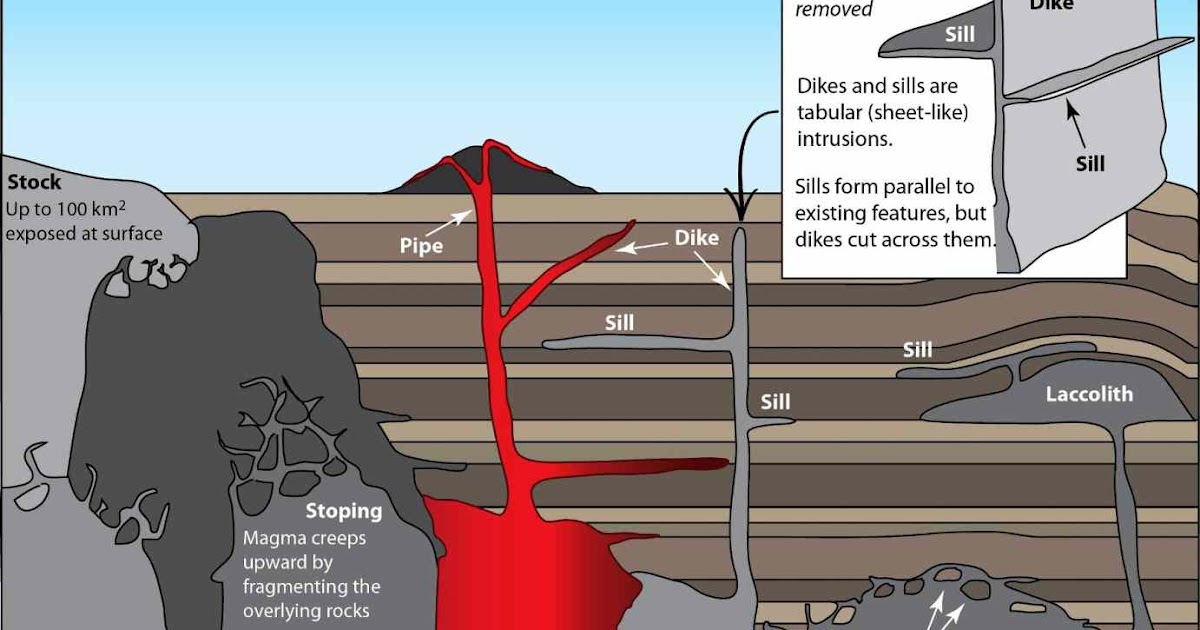
Image occlusion: name the hidden labels
46
Image occlusion: name the hidden labels
47
Dike
Sheet-like intrusive rock body that cuts across layering in surrounding rocks [vertical]
48
Crater vs. Caldera. Why are there often lakes in them?
Bowl-shaped depression atop a volcano; A large depression formed when a volcano erupts and collapses (bigger than crater)
Fill over time to become lakes
Fill over time to become lakes
49
What types of materials and gases come out of volcanoes?
Pyroclasts (volcanic blocks and bombs), ash, and gas (ex. CO2, volatiles, and water vapor)
50
Viscosity. How is the visocsity affected by temperature and composition?
1. Resistance to flow
2. More silica=more viscous (felsic). Less silica=less viscous (mafic)
2. More silica=more viscous (felsic). Less silica=less viscous (mafic)
51
Types of volcanoes with examples. Which are most dangerous? Which are biggest?
1. Shield Volcano (ex. Mauna Kea, Hawaii), Strato/Composite Volcano, Cinder Cone (ex. Cinder Cone in San Francisco
Volcanic Field, Arizona)
2. Stratovolcano/composite Volcano (ex. Mt. St. Helens)
3. Shield Volcano
Volcanic Field, Arizona)
2. Stratovolcano/composite Volcano (ex. Mt. St. Helens)
3. Shield Volcano
52
How does type of lava (viscosity, mineral composition, and volatiles) effect the shape of the volcano?
If a volcano produces very fluid lava (low in the compound SiO2, or silica), the magma flows a long distance before it cools, making a flat, shield-shaped volcano. If the volcano produces very sticky magma (high in silica) it tends to have an explosive eruptive style that includes lava, pyroclastic flows, and ash
53
Volcanic hazards
1. Lava flows
2. Lahars
3. Pyroclastic flows
4. Ash (Tephra)
5. Earthquakes
6. Volcanic gases (can cause acid rain)
2. Lahars
3. Pyroclastic flows
4. Ash (Tephra)
5. Earthquakes
6. Volcanic gases (can cause acid rain)
54
Strato/Composite Volcanos. Draw it.
1. Medium size
2. Viscous lava
3. Felsic/intermdeiate (high silica)
4. Cooler sometimes
5. Explosive sometimes
6. Thousands of years
2. Viscous lava
3. Felsic/intermdeiate (high silica)
4. Cooler sometimes
5. Explosive sometimes
6. Thousands of years
55
Cinder Cone. Draw it.
1. Leat dangerous, smallest
2. Cinders (gravel sized lava bombs)
3. Usually produced in days/weeks during 1 eruption
2. Cinders (gravel sized lava bombs)
3. Usually produced in days/weeks during 1 eruption
56
Shield Volcano. Draw it.
1. Biggest, tallest, widest
2. Low viscosity (easy flow)
3. Mafic (low silica)
4. Effusive
5. Thousands of years
2. Low viscosity (easy flow)
3. Mafic (low silica)
4. Effusive
5. Thousands of years
57
Effusive vs. Explosive
Effusive eruptions involve the outpouring of basaltic magma that is relatively low in viscosity and in gas content.
Explosive eruptions generally involve magma that is more viscous and has a higher gas content.
Explosive eruptions generally involve magma that is more viscous and has a higher gas content.
58
Where are volcanoes found?
Most along tectonic plate boundaries, some near hotspots
59
What are volatiles and how do they effect lava?
Promote magma buoyancy, accelerating ascent and modulating eruptive dynamics
60
Volcanic Ash. Why is this dangerous to people and animals?
1. Like tiny particles of silica or volcanic glass that can travel in the atmosphere very far from the eruption site
2. Create eye and upper airway irritation, cause minor to major damage to vehicles and buildings, contaminate water supplies, disrupt sewage and electrical systems, and damage or kill vegetation
2. Create eye and upper airway irritation, cause minor to major damage to vehicles and buildings, contaminate water supplies, disrupt sewage and electrical systems, and damage or kill vegetation
61
Lava Flows
Streams of molten rock usually slow speed; Most common Hawaiian hazard
62
Mt St. Helens, Washington State, USA
1. Stratovolcano in Skamania County, Washington
2. Large eruption was in 1980; predictedby noticing thousands of small earthquakes, venting steam, and a growing bulge protruding 450 feet (137 m) indicated that magma was rising in the volcano.
3. Volcanic hazards: A high-speed blast leveled millions of trees and ripped soil from bedrock. The eruption fed a towering plume of ash for more than nine hours, and winds carried the ash hundreds of miles away. Lahars (volcanic mudflows) carried large boulders and logs, which destroyed forests, bridges, roads and buildings.
4. Forests were obliterated and rivers followed new courses. More than 150 new lakes and ponds were formed, and existing lakes filled with sediment, flooding their banks
2. Large eruption was in 1980; predictedby noticing thousands of small earthquakes, venting steam, and a growing bulge protruding 450 feet (137 m) indicated that magma was rising in the volcano.
3. Volcanic hazards: A high-speed blast leveled millions of trees and ripped soil from bedrock. The eruption fed a towering plume of ash for more than nine hours, and winds carried the ash hundreds of miles away. Lahars (volcanic mudflows) carried large boulders and logs, which destroyed forests, bridges, roads and buildings.
4. Forests were obliterated and rivers followed new courses. More than 150 new lakes and ponds were formed, and existing lakes filled with sediment, flooding their banks
63
Erosion
Geological process in which earthen materials are worn away and transported by natural forces such as wind or water
64
Weathering
The breaking down or dissolving of rocks and minerals on Earths surface (ex. sunlight, water)
65
Chemical Weathering and examples
Changes the molecular structure of rocks and soil (dissolution, hydrolosis, and oxidation) (ex. dissolution of calcite in water)
66
Physical Weathering and examples
Process that breaks rocks apart without changing their chemical composition (root wedging, frost wedging, abrasion)