Perception: Human, Animal, and Machine
Study these flashcardsFree · spaced repetition · iPhone, Android, Mac & web
All cards
1
Perception
everything that allows sensory signals to be used for inference about the properties of objects and events in the world
2
Visualization
a pictorial representation of data or concepts, intended to convey information or aid in decision making
3
Sensation
when sensory receptors detect sensory information/ neural response to a change in the environment
4
Sensory receptor
specialized neurons that respond to certain types of stimuli
5
vision
sight
6
audition
hearing
7
olfaction
smell
8
gustation
taste
9
somatosensation
touch
10
vestibular sense
balance
11
proprioception
body position
12
kinestethia
movement
13
nociception
pain
14
thermoception
temperature
15
bottom-up processing
perception built on sensory input/stimulus driven responses; sensation
16
top-down processing
processes that alter sensory responses based on knowledge of the situation/context
17
adaptation
decreased response to a stimulus after repetition
ie:ticking clock
ie:ticking clock
18
attention
neural processes that prioritize certain stimuli over other
ie: tuning out background music
ie: tuning out background music
19
pareidolia
situations in which someone sees a pattern or image of something that does not exist
20
Umwelt
the surroundings a creature perceives from whatever information is available from its senses
21
perceptual priming
earlier stimuli can influence the likelihood of a similar perceptual response to later stimuli, regardless of accuracy
22
Light
electromagnetic radiation that interacts with photoreceptors in our eyes 400-700 nm wavelength
23
Electromagnetic Radiation
sinusoidal electric and magnetic fields that are orthogonal to each other, out of phase, and propogated through a vacuum
24
Photon
smallest amount of light generated
25
Rod Photoreceptor
Photoreceptor responsible for night vision, more light sensitive, with lower visual sharpness
26
Cone Photoreceptor
Photoreceptor responsible for day vision, less light sensitive, with higher visual sharpness, as well as color vision (3 opsins determine color by wavelength of light, red, blue, green)
27
Cornea
Nerve ending for pain, touch, temperature, 80% of eyes focusing, but inflexible
28
Sclera
Hard outer eye layer
29
Aqueous Humor
Low viscosity fluid between cornea and lens
30
Iris
Muscular colored tissue around the pupil
31
Pupil
Hole through which light enters the eye
32
Lens
Flexible layer responsible for 20% of eyes focusing
33
Ciliary muscle
Muscle that changes the curvature of the lens
34
Vitreous Humor
high viscosity fluid filling the eyeball
35
Retina
sheet of photoreceptors in the back of the eye
36
Fovea
where light lands on the retina, no photoreceptors, optimized put for acute vision (reading)
37
Pigment Epithelium
pigmented layer of cells behind the retina that replenishes colored eye pigments
38
Myopia
nearsightedness, objects at a distance blur, caused by abnormal elongation of the eye, placing the refractive corneal image to fall in front of the photoreceptors so that the retinal "image" is blurry, or the optics are too strong, treatment of a concave (-) lens
39
Hyperopia
farsightedness, close up objects blur, caused by an abnormal shortening of the eye, placing the refractive corneal image behind the photoreceptors so that the retinal "image" is blurry, or the optics are too weak, treatment of a convex (+) lens
40
Presbyopia:
refractive error that is associated with age, worsening ability to focuse up close, caused by the lens hardening , treatment of a bifocal lens for those with refractive errors
41
Light Transduction
1. light travels through the ganglion, bipolar, and amacrine cells
2. photon is absorbed by photopigment (11-cis retinal attached to protein opsin), double bond is excited and rotates in a conformational change to all-trans retinal (200 femtoseconds)
3. electrical state of the photoreceptor changes in a graded response to the amount of photons absorbed and photopigment changed
4.neurotransmitter glutamate is restricted in a graded potential (fewer photons absorbed more glutamate transmitted to bipolar cells) (inversely proportional)
5. bipolar cells electrical state is stimulated in reflection of amount of glutamate received, graded potential of glutamate is released to retinal ganglion cells (proportional)
6. retinal ganglion cells release an action potential to the optic nerve
7. all trans retinal breaks off an opsin, rebends in pigment epithelium, rebinds to opsin in pigment epithelium layer
2. photon is absorbed by photopigment (11-cis retinal attached to protein opsin), double bond is excited and rotates in a conformational change to all-trans retinal (200 femtoseconds)
3. electrical state of the photoreceptor changes in a graded response to the amount of photons absorbed and photopigment changed
4.neurotransmitter glutamate is restricted in a graded potential (fewer photons absorbed more glutamate transmitted to bipolar cells) (inversely proportional)
5. bipolar cells electrical state is stimulated in reflection of amount of glutamate received, graded potential of glutamate is released to retinal ganglion cells (proportional)
6. retinal ganglion cells release an action potential to the optic nerve
7. all trans retinal breaks off an opsin, rebends in pigment epithelium, rebinds to opsin in pigment epithelium layer
42
Saccades
repid jerk-like movements of the eyes between fixation points, that allow smaller objects to be processed by the eye
43
Dark Adaptation
1. 5-10 minutes rods and cones gradually go to max light sensitivity (called the rod-cone break)
2. 10-30 minutes rods become more sensitive, rhodopsin build up happens to make rods most sensitive cells in the eye
3. 30 minutes 90% dark adapted eye
2. 10-30 minutes rods become more sensitive, rhodopsin build up happens to make rods most sensitive cells in the eye
3. 30 minutes 90% dark adapted eye
44
Stimuli(us)
an agent, action, or condition that elicit or accelerates a physiological or psychological process, activity, or response
45
distal stimulus
stimulus which is away from the receptor on which it acts (object in environment)
46
proximal stimulus
physical energy as it impinges on the sensory receptor
47
Regularities: physical world's dependable properties
Includes: reflectance (light reflected off a surface/amount of light hitting the surface), light tends to come from above, objects and events tend to be compact in space, moving objects obey laws of motion, etc.
48
image
contains spatial information about light emmited from a surface
49
Emmetropia
state of vision in which faraway objects are in sharp focus with the lens in a relaxed state (eyes in perfect length in relation to optic strength)
50
Ametropia
when eye fails to qualify as emmetropic, has some refractive error
51
snellen notation
fraction whose numerator is test distance and denominator is distanc at optotype can read the size (eye chart test) distance you stand at the read it/ distance the average person stands at to read it
52
fundus
part of a hollow organ furthest from its opening, pupil=opening and retina=fundus
53
degrees of visual angle
thumb at arms length is 2 degrees of the visual angle
54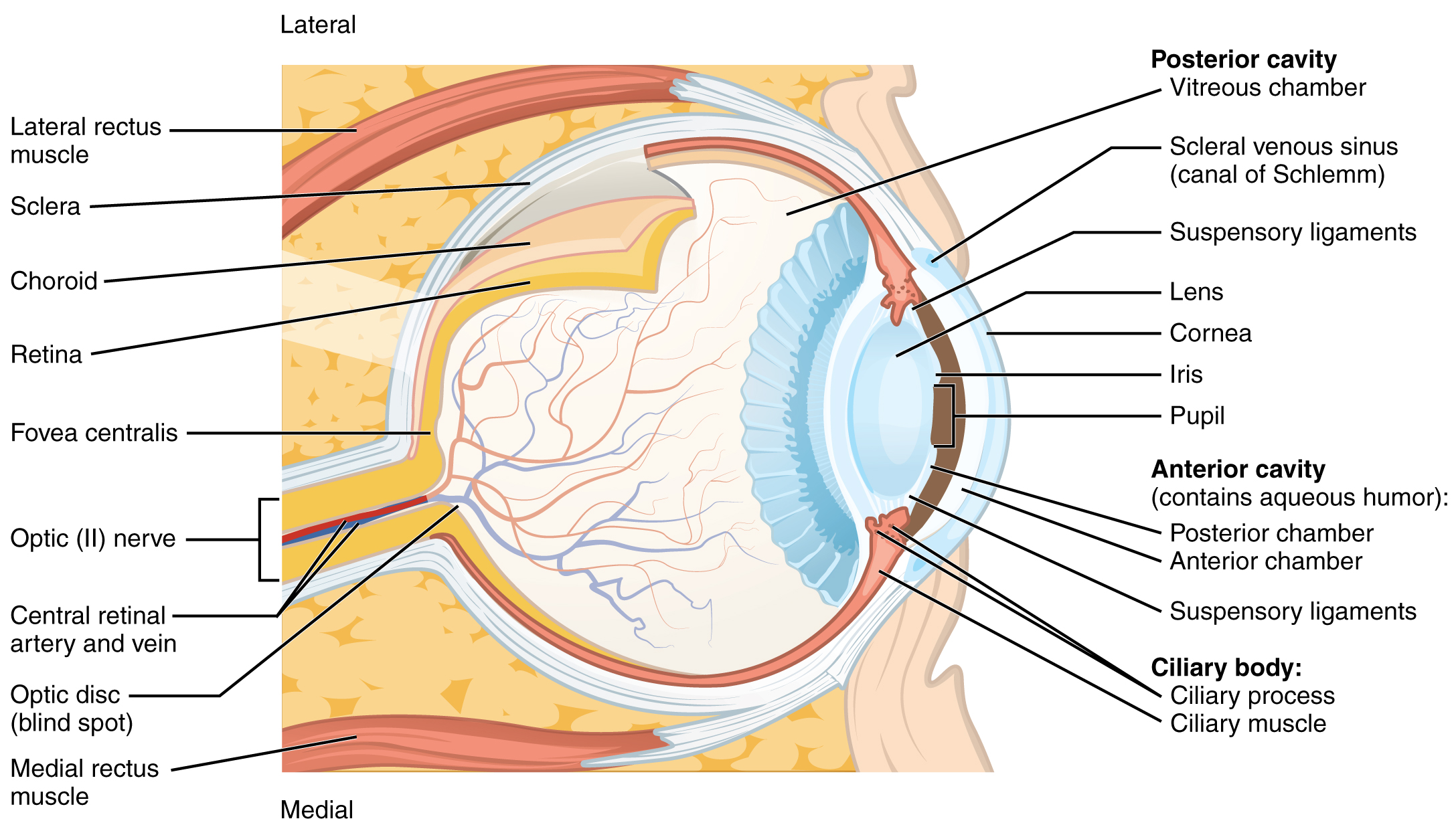
Image occlusion: name the hidden labels
55
Image occlusion: name the hidden labels
56
Image occlusion: name the hidden labels
57
Image occlusion: name the hidden labels
58
Image occlusion: name the hidden labels
59
Image occlusion: name the hidden labels
60
Image occlusion: name the hidden labels
61
Image occlusion: name the hidden labels
62
Image occlusion: name the hidden labels
63
Image occlusion: name the hidden labels
64
Image occlusion: name the hidden labels
65
Image occlusion: name the hidden labels
66
Image occlusion: name the hidden labels
67
Image occlusion: name the hidden labels
68
Image occlusion: name the hidden labels
69
Image occlusion: name the hidden labels
70
Image occlusion: name the hidden labels
71
Image occlusion: name the hidden labels
72
Image occlusion: name the hidden labels
73
Image occlusion: name the hidden labels
74
Low Vision
when the visual acquity in one's best eye is worse than 20/60 even with corrective lenses
75
Legally Blind
when the visual acquity in one's best eye is worse than 20/200 even with corrective lenses
76
Cataract
clumping or damage to the proteins in the lens that causes hardness that prevents changes in curvature of the lens, causes progressive loss of vision, reduced retinal illumintation, scattering of the light, treated with surgery in which the crystalline lens is broken inside the protein capsule, dragged out, and replaced with a plastic one with a chemical that protects against UV bleaching
77
Wet AMD
blood vessels behind the retina grow behind the macula (central part of retina allowing for fine detail vision) leading to blood flow and leakage between the neural retina and retinal pigment epithelium (rpe), or between the rpe and burch's membrane
causes rapid difficulty seeing faces, driving, or close up work, dimmness, waves on straight lines, or blank and blurry spots
early detection to treat with anti-vascular injections
causes rapid difficulty seeing faces, driving, or close up work, dimmness, waves on straight lines, or blank and blurry spots
early detection to treat with anti-vascular injections
78
Dry AMD
macula thins because of aging
signalled by pigment disruptions on fundus and yellow drusen (yellow hardened deposits)
causes gradual difficulty seeing faces, driving, or close up work, dimmness, waves on straight lines, or blank and blurry spots
experimental gene therapy
signalled by pigment disruptions on fundus and yellow drusen (yellow hardened deposits)
causes gradual difficulty seeing faces, driving, or close up work, dimmness, waves on straight lines, or blank and blurry spots
experimental gene therapy
79
Glaucoma
abnormal regulation of interocular pressure, or mechanosensitivity of ocular cells
causes optic nerve degeneration, starts with nasal peripheral vision, degeneration of the retinal ganglion cells
treated with lowering and stabilization of IOP, early detection by detecting pressure build up and preventing flow of aqueous humor
causes optic nerve degeneration, starts with nasal peripheral vision, degeneration of the retinal ganglion cells
treated with lowering and stabilization of IOP, early detection by detecting pressure build up and preventing flow of aqueous humor
80
accomodation
the eye's ability to change its focus from distat to near objects
-far: ciliary muscle relaxed, fibers taut, lens, minimum strength
-near: ciliary muscle contract, fibers slack, lens is rounded for stronger focus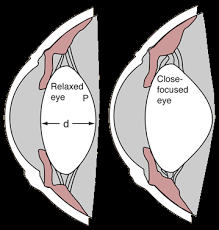
-far: ciliary muscle relaxed, fibers taut, lens, minimum strength
-near: ciliary muscle contract, fibers slack, lens is rounded for stronger focus
81
Photopigment
type of molecule that undergoes a conformational change in the presence of photons, rhodopsin (rods) melanopsin, and photopsin
82
Diabetic Retinopathy
genesis of extra blood vessels induced by poorly managed diabetes which leads to rapid vision loss
treated by prevention and management of diabetes
treated by prevention and management of diabetes
83
Sensory Substitution
process of using a different sense to replace for the lack of another (typically vision)
84
Magnocellular Cells
found in lower two layers of the lgn, one for eye
recieves information from parasol ganglion cells
processes transient, moving stimuli without regard to cone class (color blind)
recieves information from parasol ganglion cells
processes transient, moving stimuli without regard to cone class (color blind)
85
Parvocellular Cells
found in upper four layers of lgn
recieves information from midget ganglion cells
slower processing than magnocellular cells
preserves color information
recieves information from midget ganglion cells
slower processing than magnocellular cells
preserves color information
86
Koniocellular Cells
very small, includes cones
used for blue short wave, between M and P layers
used for blue short wave, between M and P layers
87
Retinopic Organization
neurons with receptive fields close together in visual space that have cell bodies close together in the cortex
spatially conserved with both simple and complex neurons
spatially conserved with both simple and complex neurons
88
Simple Neurons
neurons with separate on and off regions (on detects white bars on gray, off detects black bars on gray)
89
Complex Neurons
neurons where on and off regions are superimposed, everywhere detects both white and black bars on gray
90
Blobs
where color sensitive neurons are hoursed in columns
91
Column
group of neurons in the cortex that can be penetrated by a probe with indentical receptive fields
92
Hypercolumns
Unit containing a full set of values for all receptive field parameters
93
Superior Rectus Muscle
muscle running from the top of the eye to the orbit responsible for the eyes upward movements
94
Inferior Rectus Muscle
muscle running from the bottom of the eye to the back of the orbit responsible for the eyes downward movement
95
Lateral Rectus Muscle
muscle running from the temporal side of the eye to the back of the orbit responsible for leftward movement of the left eye and rightward movement of the right eye
96
Medial Rectus Muscle
muscle running from the nasal side of the eye to the back of the orbit responsible for rightward movement of the left eye and leftward movement of the right eye
97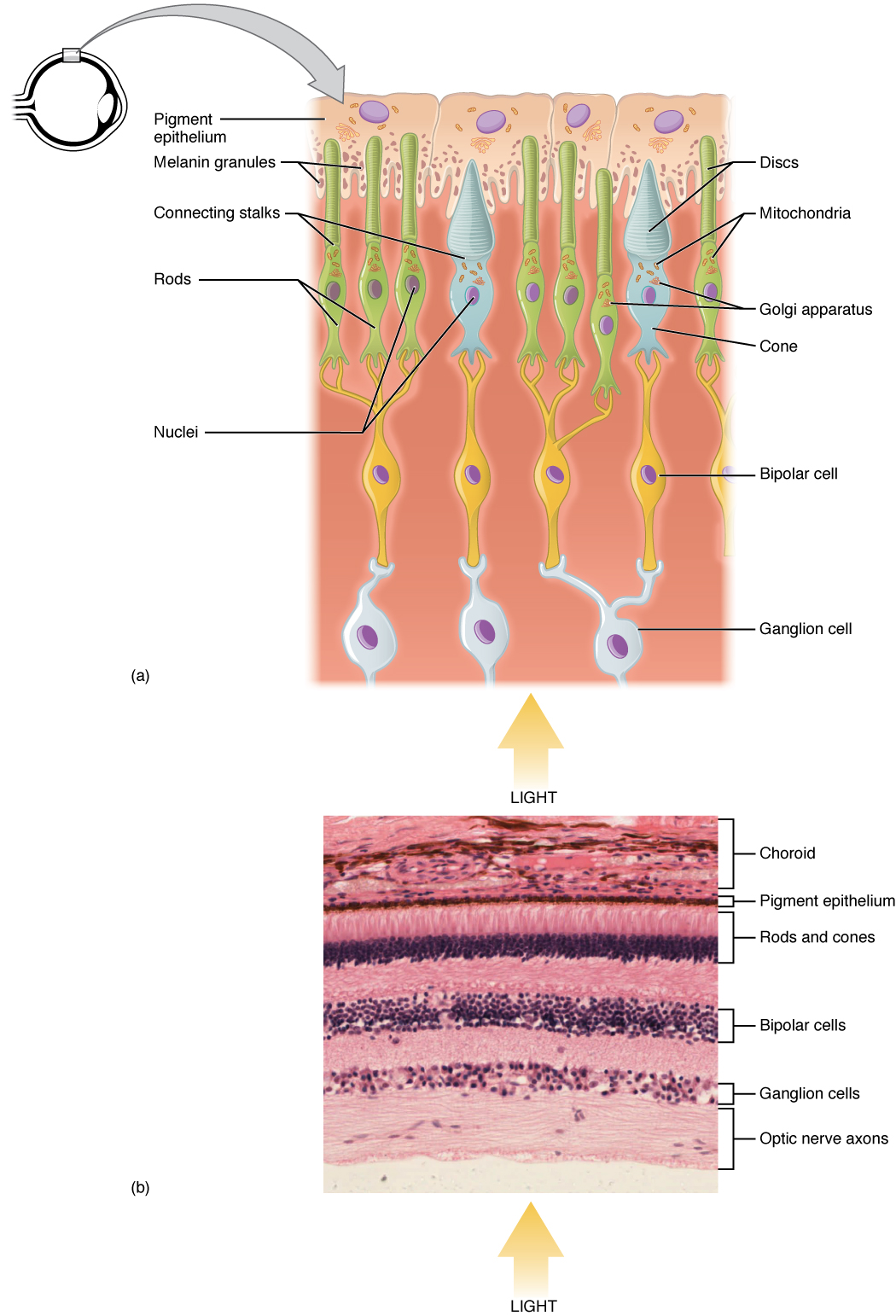
Image occlusion: name the hidden labels
98
Image occlusion: name the hidden labels
99
Image occlusion: name the hidden labels
100
Image occlusion: name the hidden labels
101
Image occlusion: name the hidden labels
102
Image occlusion: name the hidden labels
103
Image occlusion: name the hidden labels
104
Image occlusion: name the hidden labels
105
Image occlusion: name the hidden labels
106
Image occlusion: name the hidden labels
107
Image occlusion: name the hidden labels
108
Image occlusion: name the hidden labels
109
Image occlusion: name the hidden labels
110
Image occlusion: name the hidden labels
111
Image occlusion: name the hidden labels
112
Image occlusion: name the hidden labels
113
Image occlusion: name the hidden labels
114
Vernon Mountcastle
Belief: our brain is our world, and our nerves are fibers that sample the energetic orld around us with our senses, the heat, light, force, and chemical composition, the rest is logical inference
Sekuler's comment: our senses are our link to the outside world, our way of communicating, and to be percieved all real information must be processed by the sensory system and organs
Sekuler's comment: our senses are our link to the outside world, our way of communicating, and to be percieved all real information must be processed by the sensory system and organs
115
Plato's Allegory of the Cave
Belief/Takeaway: the cave is the visual, perceptive world, and is filtered through their senses
Sekuler's comment: analogous to the people in the cave, our senses filter our world view through their properties, and in order the understand the way we see we must understand what we see with
Sekuler's comment: analogous to the people in the cave, our senses filter our world view through their properties, and in order the understand the way we see we must understand what we see with
116
Jakob von Uexkull
Belief: the Umwelt : the world around, every type and individual creature inhabits its own "surroundings it percieves from whatever information is available to it through its senses
Sekuler's comment: Umwelt is defined by the structure of the species sensory equipment, its behavior and experiences, and its environment, it cannot be studied by science becuase we can never see what another sees, and no one creature's umwelt is worth anything more than another's
Sekuler's comment: Umwelt is defined by the structure of the species sensory equipment, its behavior and experiences, and its environment, it cannot be studied by science becuase we can never see what another sees, and no one creature's umwelt is worth anything more than another's
117
Professor William Romoser and Insects on Mars
Belief/Takeaway: insect like forms he identified on mars images and cited that once one clear image was found it was used to extrapolate to other images of "insects"
Sekuler's comment: this is an example of perceptual priming, where the stimuli percieved in one image is seen without accuracy in other images, and the insects are a form of pareidolia, or a figure or face found in static and mispercieved
Sekuler's comment: this is an example of perceptual priming, where the stimuli percieved in one image is seen without accuracy in other images, and the insects are a form of pareidolia, or a figure or face found in static and mispercieved
118
Rabbit Duck Image
Belief/Takeaway -->
Sekuler's comment: an example of ambiguous stimuli that be percieved multiple ways, either the duck at the left or the rabbit at the right, and an example of our inability to contradict our own perception, like rorschach test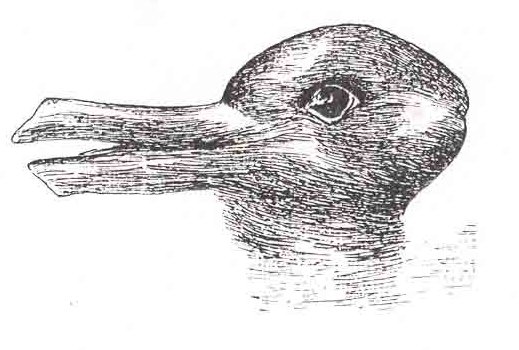
Sekuler's comment: an example of ambiguous stimuli that be percieved multiple ways, either the duck at the left or the rabbit at the right, and an example of our inability to contradict our own perception, like rorschach test
119
Helen Keller
Takeaway/Comment: example of how losing two senses affects way of life, and of sense substitution
120
Naive Realism
Belief: the physical world actually is just the way it appears to us
Sekuler's comment: entirely wrong, the world can be perceived differently by everyone, and that perception can fluctuate, and is imperfect, in perception, we are baited into thinking that perception is fast and accurate
Sekuler's comment: entirely wrong, the world can be perceived differently by everyone, and that perception can fluctuate, and is imperfect, in perception, we are baited into thinking that perception is fast and accurate
121
Laura Ryan and Martin How Great White Sharks
Study: computer mimicked great white shark vision (6-10 time less acquity than humans, very cone monochromatic) and showed videos of humans on paddle boards, humans, and seals
Conclusion: these videos were indestinguishable to shark vision, meaning shark attacks are really juts accidents
Conclusion: these videos were indestinguishable to shark vision, meaning shark attacks are really juts accidents
122
Steps to Create a Visualiation (Cycle)
1. collect the data or information about the concept
2. organize the data logically
3. think about the perception of the data
4. create the visualization
5. evaluate for any perceptive errors
6. repeat
2. organize the data logically
3. think about the perception of the data
4. create the visualization
5. evaluate for any perceptive errors
6. repeat
123
Covid Test Example
provides an accurate and easy to read visualization of viral load over days of infection
124
Covid Cases in Georgia Example
provides an inaccurate visualization of how many covid cases ocurred in the 5 counties of Georgia because the bars were ordered in non chronological order to make it seem as though cases were going down when in reality they were fluctuating throughout the months
125
Intellectual Humility
recognizing that one's knowledge is limited and one's beliefs may be incorrect
126
Impact of Intellectual Humility
can decrease polarization, extremism, and susceptibility to conspiracy theories, and is positively associated with altruism, gratitude, empathy, benevolence, and knowledge acquisition, learning, and education
127
Nihil est in intellecty quod non fuit prius in sensu
Nothing that is in the mind (the intellect) that has not first been through the sense
128
Sure M Leaney
Belief/Study: performed a study on ferrets where her rewired the optic nerve as the auditory nerve and vice versa, and was able to see that the ferrets could "see" thunder and "hear" lightning
Sekuler's comment: perception is a biological process directly and easily influenced by the structure of the sense organs
Sekuler's comment: perception is a biological process directly and easily influenced by the structure of the sense organs
129
Retinotopy
Where on the retina photons fall, which is preserved throughout the system because of its relationship to the visual field
130
Optic Nerve
the myelinated bundle of 1.25 million retinal ganglion cell axons that travel from the optic disc at the back of the eyeball to the optic chiasm
131
Optic Chiasm
site where each eye's optic nerve axons meet and are rearranged
132
Optic Tract
The name given to the very same axons that go into the optic chiasm but after they are rearranged and pass through the optic chiasm and go towards the lateral geniculate nucleus
133
Optic Radiations
the bundle of axons that is sorted through the lateral geniculate nucleus and heads toward to the primary visual cortex
134
Euclid, Plato, Aristotle, and Pythagoras Theory of Vision
A theory of extramission in which the eyes emit rays of light that give the viewer info about the color and shape of objects in front of them
135
Democritos Theory of Vision
Objects emit eidola continously that fly towards the eye and are processed the eidola becuase one or more fly into your eye, refuted by the parade example (how do the marchers keep their arrangementP and the mirror example (how do your eidola contort to come back to your eye not facing backwards? )
136
Intromission Theory of Perception
The belief that perception and seeing is based on light entering out eye
137
Extramission Theory of Perception
The belief that perception and seeing is based off something that leaves our eyes during vision
138
Alhazen (Abu Ali Mohammed Ibn Al Haytham)
a late thenth century, early eleventh century scientist who created what's known as the first theory of perception as intromission by seeing that objects are only visible under certain luminances, and that the retina of animal's eyes are damaged with prolonged sun exposure, suggesting that light rays are somehow entering the eyes and are sensed
139
Tapetum Lucidum
a shiny structure in the back of the eye behind the retina in certain species like cats and dogs that reflects light so that when photons enter the eye, ones that are not captured by the photoreceptors in the retina are reflected back through and have a chance of being captured by photoreceptors on the way out
Advantage: allows for better visual acquity in the dark, advantageous for nocturnal predators
Advantage: allows for better visual acquity in the dark, advantageous for nocturnal predators
140
Corneal Curvature
cornea is responsible for 80% of refraction of light, and has contact with the atmosphere, and is species dependent
Advantage: for fish, their corneas are very different than the properties of water (which allows them to see properly underwater) and very similar to the properties of air (which causes extreme blurring when out of water). The opposite is true for humans, our corneal properties are very different than air (which allows us to see in air) and very similar to water which causes the cornea to be unable to refract properly, more like a pane of glass than mirrors, causing blurriness.
Advantage: for fish, their corneas are very different than the properties of water (which allows them to see properly underwater) and very similar to the properties of air (which causes extreme blurring when out of water). The opposite is true for humans, our corneal properties are very different than air (which allows us to see in air) and very similar to water which causes the cornea to be unable to refract properly, more like a pane of glass than mirrors, causing blurriness.
141
Amblyopia
"lazy eye" or "strabismus" caused by an inbalance in the muscles used to move the eyes, which causes deviation between the two eyes
142
Astigmatism
when the cornea is not spherical, causing points of light to be imaged in elongated distributions, corrected with a cylindrical (non spherical) lens
143
Outer Layer of the Eye
1mm thick
functions for protection and optical power
contains cornea an sclera
cornea very transparent for light sensitivity, but also protective
sclera shell of the eye to support and maintain shape
functions for protection and optical power
contains cornea an sclera
cornea very transparent for light sensitivity, but also protective
sclera shell of the eye to support and maintain shape
144
Middle Layer of the Eye
0.2 mm thick
functions for nutrition, structural support, phagocytosis
vascular tissue
includes the choroid (blood supply), ciliary body (on the sides) , and pigmented iris (in the front)
functions for nutrition, structural support, phagocytosis
vascular tissue
includes the choroid (blood supply), ciliary body (on the sides) , and pigmented iris (in the front)
145
Inner Layer of the Eye
0.5 mm thick
functions for sensation and support, sensitivity to light, trapping photons to transform into neural signals
includes the retina, retinal pigment epithelium, neural layer
functions for sensation and support, sensitivity to light, trapping photons to transform into neural signals
includes the retina, retinal pigment epithelium, neural layer
146
Lid Function
Eyelid and conjunctiva (vascular membrane from lid to sclera) that provides lubrication
147
Blind spots in the eye
where the optic disc is (the place in whch rgcs become myelinated) no photoreceptors, and in a section of the fovea
148
Gordon Holmes
Experiment: he catalogued scotomas (bllinded sections of vision) in war veterans with localized brain damage
Discovered: cortical magnification, or the fact that the amount of tissue dedicated to the fovea (center) of the visual field than he periphery
Discovered: cortical magnification, or the fact that the amount of tissue dedicated to the fovea (center) of the visual field than he periphery
149
Cortical Magnification
A large amount of cortical tissue (in V1) is dedicated to processing information from the center of the visual feild, or the fovea
150
Horace Barlow
studied other visual areas besides v1 using computer science and the 34 face block model for colinearity and edge faces, specifically v4 for color and MT for motor (v5)
151
Frank Schaeffel
german vision scientist that studied changes in chicks eyes when wearing minus or plus lenses
when the chicks wore minus lenses, the eye grew to properly focus, and shrank to properly focus when they were wearing plus lenses
when the chicks wore minus lenses, the eye grew to properly focus, and shrank to properly focus when they were wearing plus lenses
152
David and Goliath
it was goliath, not david that would've been disadvantaged in the battle at gath, because Goliath's gigantism is associated with pituitary tumor growth, wich impinges upon the optic chiasm, causing loss of peripheral vision
153
Parasol Ganglion Cells
Classification of rgcs that are large cell bodies, combine information from many photoreceptors (low specificity), are colorblind (do not preserve cone class), and are responsible for transient, moving stimuli processing
154
Midget Ganglion Cells
Classification of rgcs that are small cell bodies with small receptive fields, do not combine information from many photoreceptors (high specificity), preserve color information, and process slower stimuli than parasol ganglion cells
155
David Hubel and Torsten Weisel
Traced out the receptive feilds of cells in the visual systems of many different animals, including cats, monkeyts, and humans, including rgc, and v1 simple and complex cells, also found that while the receptive fields of rgcs were not orientation sensitive, while simple v1 cells were, changes are a production of the convergence of receptive feilds of the prior layer
determined receptive feild cannot be solely genetically determined
Feed Forward Model
determined receptive feild cannot be solely genetically determined
Feed Forward Model
156
Blakemore and Cooper (1970)
performed the kitten experiments where they placed one group in a vertically contoured chamber and another in a horizontally contoured chamber--> determined that neurons were susceptible to changes, plasticity
157
Donald Hebb
explained blackmore's findings with the kitens by finding the fact that animals reared in abnormal conditions will have abnormally developed visual processes
and can be modified because neurons firing are connected
+hebbs learning rule
and can be modified because neurons firing are connected
+hebbs learning rule
158
Hebb's Learning Rule
simultaneous activation of cells increase synaptic strength between the cells (this strengthens the response past the breaking point if left unmitigated, lateral inhibition partially mitigates this)
159
Plastic Period
periods in which the visual system is vulnerable to abnormalities or changes in the environment (multiple periods for different facets of the visual system that develop at different time points)
160
Amblyopia
reduced visual acuity that cannot be corrected by refractive means, and is not attributable to structured or pathological ocular anomalies (brain problems) must be 20/30 or more
161
Purpose of 2nd have of Plato's Allegory
seeing is not just the pattern of light on the retina, it is dependent upon environment and knowing what is where
162
William Molyneux
17th century philosopher that proposed what would happen if a child born blind were able to see, would they be able to distinguish between forms they knew by touch by sight? influenced John Locke
163
William Cheselden
surgeon who performed a surgery on a 13 year old with congential cataracts to investigate Molyneux's question, and found that they child knew not the shape of anything or anything from another thing, even if they were very different in size, with only vision
164
Gottfried Liebniz
clarified part of the complications of Molyneux's question, stipulated that once-blind subjects have to be given names for the stimuli, so they can accurately convey what they saw
165
Ione Fine
surgeon that corrected Mike May's vision and observed that his neural responses at various stages were impaired, not his ocular power, and that his perception of depth and 3d spatial arrangement (can see occlusion, but not perspective or shading cues like the circle shaded diagram), but was extra sensitive to motion more robust under deprivation
sekuler's comment: seeing is a whole array of abilities, which depend upon different regions of the brains, and have distinct capabilities of neuroplasticity and learning
sekuler's comment: seeing is a whole array of abilities, which depend upon different regions of the brains, and have distinct capabilities of neuroplasticity and learning
166
Scoptopic Vision
vision in dim lighting, driven by rods
167
Phototopic Vision
vision in good lighting, driven by more cones than scoptopic
168
Purpose of Color Vision
color allows creatures and things to be easier to detect (sporting equipment), recognize (through memory), or even diagnose (jaundice) conditions
169
Isaac Newton
determined that objects themselves are not colored, they only appeared colored because they reflect light from particular reguons of the visible spectrum, this reflected light can induce sesnation
170
Semir Zeki
restated Newton's principles to reflect the fact that color is in the vrain, as the reflectance of different surfaces for different wavelengths of light is what , it is a construct of the brain, not the world outside
171
how to describe colors
red= a red object when seen in daylight against a gray-appearing background, evokes a sensation that most humans would call 'red'
172
Qualities of Color
Hue(category of colors, like blue, red, yellow, driven by the wavelength composition of light on the retina), Brightness(lightness of a color driven by the number of photons absorbed, the intensity of the light), Saturation(the paleness or vividness of the color, mainly driven by the purity of the light (monochromat n=means very small range of wavelengths, broadband is a large variety of wavelengths))
173
Color Rendering Index
a value out of 100 that signifies that the illuminant causes objects look the same as they would in natural daylight, or if it distorts the coloration, calculated by taking the difference between the predicted percieved color under the illuminant and the perceived color under natural light
174
RAT
reflection (the wavelengths of light reflected by a surface)
absorption (the wavelengths of light absorbed by a surface)
transmission (the wavelengths of light that pass through an option)
absorption (the wavelengths of light absorbed by a surface)
transmission (the wavelengths of light that pass through an option)
175
Boyle
the chemist and physicist that published a book on sight in which he sighted the following case study: a woman loses her sight almost completely to a blistering disease, but regains it over time, from perception of light vs darkness, to shapes and forms of even the smallest objects, but she experienced flashes in her periphery, and acquired a color deficiency so bad that she couldd not discern one object from another except by touch, proving that these elements of vision are distinct processes, but usually work in harmony
176
Farnsmouth d15 color arrangement
test to see if you can order 15 color discs in order of similarity
177
Neutral Point
the point at which (usually in a dichromatic eye) that the response to that very narrow wavelength would produce the same response as to a uniform distribution of light (white light)
178
Response Ratio
the ratio between the responses of certain cones that gives information about the wavelength of each light, reegardless of the itensity of the stimuli, eliminating the ambiguity associated with a monochromatic eye
179
Short Wavelength Cones (SWS)
cone type that is most sensitive to short wavelengths, with a peak around 420 nm, is much less sensitive, fewer, none in the fovea , on the long arm of chromosome 7, and has a different opsin
180
Medium Wavelength Cones (MWS)
cone type that is most sensitive to medium wavelengths, with a peak around 530 nm, is on chromosome x near gene for long wavelength cones
181
Long Wavelength Cones (LWS)
cone type that is most sensitive to long wavelengths, with a peak around 560 nm, is on chromosome x near gene for medium wavelength cones
182
Alber H Munsell
creator of the color sphere to describe color variation and allow for color naming and colorimetry that confounded robert louis stevenson in his writings , as well as cosmonauts
183
Cyanometer
a device with 53 swaures of varying shades of blue used to measure the sky and sea, oerhaps invented by horace-benedict de saussure
184
colorimetry
the science of measuring and defining colors in a way that matches how an average person, someone with normal color vision, would see the color
185
Uses of Color
object detection and recognition--> stop signs red, tennis balls bright yellow
scene segmentation--> uses the fact that objects are usually one color separate from other objects and background color
health and mating--> peacock tails, jaundice
scene segmentation--> uses the fact that objects are usually one color separate from other objects and background color
health and mating--> peacock tails, jaundice
186
Trichromatic Processing
cones allow us to see details as well as color, using preferential cones for red, green, and blue
187
Opponent-Process Theory
cones send information to rgcs that comput differents between red and green, blue and yellow, and black and white
188
Color Blindness
complete color deficiency, very rare, caused by being a monochromat with only rods or tbis that cause anhilation of color sensitive blobs
189
Protanopia
no LWS (red pigment) prevents comparison of red and green, makes red look darker, common in men less in women
190
Deuteranopia
no MWS (green pigment) prevents comparison of red and green, common in men less in women
191
Tritanopia
no SWS (blue pigment) prevents comparison of blue and yellow, very rare
192
Simultaneous Contrast Theory
gray looks lighter next to a black background rather than a white background becuase of center surround processing and lateral inhibition
193
Chromatic Adaptation how we perceieve in various lighting conditions
if there is alot of light in a certain of part of the visible light spectrum, adaptation supresses response from the corresponding cones to perceive the true colors
194
Local Context how we perceieve in various lighting conditions
comparison of all colors in a scene to normalize perception
195
Prior Knowledge how we percieve in various lighting conditions
what objects should be what college
196
Monocular Depth Cues
-relative height (things at distance look higher at their base)
-relative size (things at distance look smaller)
-occlusion (objects get in front of other objects)
-shadows (relative size and height)
-texture gradient (textures look finer from a distance)
-atmospheric perspective (things at a distance look hazy
-relative size (things at distance look smaller)
-occlusion (objects get in front of other objects)
-shadows (relative size and height)
-texture gradient (textures look finer from a distance)
-atmospheric perspective (things at a distance look hazy
197
Binocular Depth Cues
-disparity(subtle change in world view between each eye)
-vergence(qual movement of the eyes to a certain point)
-accomodation (focusing of the eye)
-vergence(qual movement of the eyes to a certain point)
-accomodation (focusing of the eye)
198
Strabismus
when both eyes do not converge so there are two images being processed by the brain, leads to amblyopia
199
Amblyopia
poor vision in one eye, causing the brain to shut that eye down
200
Binocular Rivalry
when one image is being seen by both eyes that oscillate between the two images and in each instant one is dominant and one is supressed, or there are two different images one from each eye and they are combined and one becomes dominant
201
Positive Afterimage
where an optical illusion causes a phantom retinal impression of a previously present stimulus in accurate colors
202
Negative Afterimage
where an optical illusion causes a phantom retinal impression of a previously present stimulus in complementary colors
203
Protanamalous
when recombination of OPN1LW and OPN1MW (due to 98% identical amino acids encoded) results in an abnormal LWS that has a spectral sensitivity that is shifted toward the spectral sensitivity of the MWS
204
Deuteranomalous
when recombination of OPN1LW and OPN1MW (due to 98% identical amino acids encoded) results in an abnormal MWS that has a spectral sensitivity that is shifted toward the spectral sensitivity of the LWS
205
Tetrachromacy
Occurs when a female has a father that is protanomalous or deuteranomalous and a normal mother leading to four photopigments (one normal LWS and MWS, one normal SWS, and one abnormal LWS or MWS depending on the deficiency of the father), most of the time the abnormal photopigment is nonfunctional (painter with this claimed she could see 100 million colors)
206
John Dalton
First paper published about color deficiency in 1798, thought his own color deficiency was due to oil drops that occluded his red green vision when it was actually his cone ratio
207
Jay Nitz
contributed to why a woman with four photopigments often doesnt have super vision, gave mice a human lws cone and saw that they developed "normal" human vision
208
Metamers
part of newton's discoveries, when two stimuli that are different phyusically are the same perceptualy, the human eye has millions of these becuase any combination of wavelengths can produce the same response from the three types of cones
209
Fine Spatial Scale
same as high spatial frequency, the spatial scale that processes fine details, processed by neurons that have small, high acuity receptive feilds, such as those in the fovea, but also everywhere by neurons with small receptive feilds
210
Middle Spatial Scale
same as middle spatial frequency, the spatial scale that processes medium details, processed by neurons with medium sized receptive feilds, such as those around the fovea, but also everywhere by neurons with medium receptive feilds
211
Coarse Spatial Scale
same as low spatial frequency, the spatial scale that processes coarse details, processed by neurons with large recpetive feidls, such as those in the periphery, but also everywhere by neurons with large receptive feilds
212
Helmholtz
unconscious inference, invented the opthalmascope, measure nervous impulse velocity, studied sound, four generations from Sekuler
213
Max Wertheimer
appartent motion (flashes of light very fast to show difference between succession and simultaneous) , one of the 3 big gestlat guildlines contributors
214
Gestalt Elements of Organization Proximity
objects that are closer in distance together tend to be of the same object perceptually, can bias the perception to group individual parts together
215
Gestalt Elements of Organization Similarity
objects that tend to be similar in lightness, size, orientation, or other characteristics also tend to be of the same perceptual object
216
Gestalt Elements of Organization Form Closure
objects that tend to enclose the same space also tend to be of the same perceptual object, even with a gap in the form an object can be identified
217
Gestalt Elements of Organization Continuation/Smoothness
objects that tend to have the same relative orientation or contours also tend to be of the same perceptual object, the more the segments are differnet however, the more difficult they are to identify as part of the same perceptual object (two snakes example)
218
Wolfgang Kohler and Richard Held
thought that the reason Gestalt principles held true were becuase the electrical currents in the brain mimic those in the gestalt principles, false, they were not aware of the underlying physiology
219
Efficient Coding Hypothesis Santiago Ramon y Cajal
performance on tasks require neural responses, which are limited by energy
stable environments mean there is a probability of stimuli
efficiency of the neural system is constrained by the number of neurons devoted to processing that stimuli, neural connections develop in accordance to these
stable environments mean there is a probability of stimuli
efficiency of the neural system is constrained by the number of neurons devoted to processing that stimuli, neural connections develop in accordance to these
220
Bill Geisler's
placed a dot on a natural image and asked human subjects to trace the contour it belonged to
was able to distinguish orientation and proximity rules from that
created patterns of lines of different orientations and proximities and gave them to computers to identify the longest contour
gave those patterns to human subjects to do the same task
responses were very similar, proving that humans do use those two rules
was able to distinguish orientation and proximity rules from that
created patterns of lines of different orientations and proximities and gave them to computers to identify the longest contour
gave those patterns to human subjects to do the same task
responses were very similar, proving that humans do use those two rules
221
Gestalt Principles School of Thought
early 20th century idea that composites are able to be broken down into parts, so objects appear the way they do due to the relationships between their parts, so decomposing them destroys the underlying form
222
Why the Gestalt Principles are not laws
example of dots and xs, some of the principles work against others in context, like if you were to place the dot and x closer together, it takes more time to trace the line for continuation, the proximity works against the continuation principle
223
Symmetry property
the tendency for those parts of an object centered on an axis to be very similar in shape, color, texture, across the axis
224
Flow of Visual Processing
-location and orientation are derived
-isurfaces and depth planes form through higher inferential processing, a priori concepts allows one of the pssible configurations to be chosen
-isurfaces and depth planes form through higher inferential processing, a priori concepts allows one of the pssible configurations to be chosen
225
Egon Brunswick and Joe Kamiya
had the idea that the reason physiological proceses can use apriori concepts is because of the statistics of the natural world influencing the patterns neurons are specializied to process
226
Bayesian Decision Theory
probabilities can represent the chances of a proposition , and that its rules can be used to say something about the future probabilities Pr(ObjectI Image)=[Pr(ImageI Object)*Pr(Object)]/Pr(Image)
227
Evoked Response Potential (ERP)
the uptake in response with a different stimulus after multiple repetitions of a similar stimulus, increases with the number of repetitions of the original stimulus
228
Oliver Sacks Color Blind Painter
-age 65 suffers a concussion in a car accident, which leaves him unable to read for a few days, however now he has extremely sharp distance vision and is completely color blind, everything is black and white
-his symptoms followed a period of transeint amnesia, in which he was confused and unable to read for 5 days, suspected stroke
-the colors had real meaning to him an abstract painter
-knew the names of colors, but could not physically or mentally see the, and experience tonal incongruity, his contrast between shades is increased, shilouettes are sharper
-created a room in shades of gray that was meant to convey what he had been experiencing to others
-lost synesthesia, could see colors with music and now cannot
-yarn test yeilded a gray tonal scale, where white oddly enough looks dingy gray
-turns out his secondary visual cortices were damaged, mainly V4, the blobs and stripes leading to V4 from V1 and V2, possibly due to carbon monoxide poisoning
-used dark green glasses for clarity
-his symptoms followed a period of transeint amnesia, in which he was confused and unable to read for 5 days, suspected stroke
-the colors had real meaning to him an abstract painter
-knew the names of colors, but could not physically or mentally see the, and experience tonal incongruity, his contrast between shades is increased, shilouettes are sharper
-created a room in shades of gray that was meant to convey what he had been experiencing to others
-lost synesthesia, could see colors with music and now cannot
-yarn test yeilded a gray tonal scale, where white oddly enough looks dingy gray
-turns out his secondary visual cortices were damaged, mainly V4, the blobs and stripes leading to V4 from V1 and V2, possibly due to carbon monoxide poisoning
-used dark green glasses for clarity
229
Cerebral Achromatopsia
total color blindness caused by brain damage, not ocular damage
230
Alexia
inability to read
231
Isihara Color Dot Plate
color test where dots of subtly differentiatied colors are arranged in a circle with a hidden form (number or letter) is in the center, easy for a person with normal color vision, not so for someome with color deficiencies
232
Color Agnosia
when a color deficient patient can identify the names of colors, but cannot apply those names to typical objects
233
Coloranomia
when a color deficient patient can identify colors to typical objects, but not the names of the colors themselves
234
First Case that Determined achromatopsia could result from brain damage Louis Verrey
60 yr old woman suffered a stroke in the left occipital lobe, resulting in the right half of her visual feild being completely devoid of colour, theorized fusiform and ligual gyri were responsible for color vision
235
Clerk Maxwell
One of Helmholtz' partners, specialized in color mixing and primary colors, created the color top that when spun yeilded gray, and a three axis diagram of color synthesis , and created color photography using color filters overlayed on top of a camera for black and white photos
236
Edwin Land
evolved Maxwell's ideas, invented instant Land camera and polaroid, split beam camera to take two black and white photos with a red and greeen filter that allowed for a full color photo
237
Blindsight
when the visual field contralateral to brain damage can still have some artificial "sight" or processing of visual information
238
koniocellular layer
layer of the lgn that recieves information from non-m-non-p ganglion in the intralaminar regions
239
Riddoch Syndrome Blindsight Cases
cases where patients with scotomas can detect moving stimuli inside that scotoma, somewhat explained in the activation of +hMT with moving stimuli
240
Imaginative Completion Erganzung
hemianopia patients can fill in visual stimuli over blind sections of visual field, possibly because it activates the extrastriate visual cortex in +hMT. +hMT takes the functioning of V1 in these patients, with the blood oxygenation level dependent signal is decreased with motion coherence
241
Blindsight
v1 damaged patients can move their eyes toward stimuli in their blind spots, could be caused by the intact connections from the lgn other than to v1, to the pulvinar or +hMT
242
action blindsight
when a hemianopic can locate targets by saccades or pointing
243
Key Culture Sensitive Perceptual Variables
likely visual objects, memory of targeted objects, task demands, selective attention, action, learning
244
Task Demands Culture and Perception
the demands and standards a certain culture places on itsmembers that can cause brain changes (like string players) or their eyes
245
Moken people
a tribe in thailand that can dive up to fifteen meters below the sea to retrieve food, and still see twice as well as age matched european children because their pupils can constrict maximally and their accomodation is at maximum, resulting in an increased depth of feild and refractive power that combats the similarity betwen cornea and water
246
Visual Illusions Culture and Perception
researchers use induced perceptual errors in the form of geometric visual ilusions to test to see if incorrect hypotheses can influence the perceptual landscape
247
Change Blindness
when a stimulus changes without the observer noticing
248
Miyamoto et al Culture and Perception
to study how habits of attention form differently in different cultures, they
-first studied the differences in japanese and US cities, with japanese cities having more objects overall
-american and japanese subjects were primed with images of either city, and then something would change (either the central object or osmething in the surround)
-Results: japanese subjects more likely to spot a change in a surround object (long term attention setting), both groups were better at noticing a change in the many object environment primer (modulated short term attention change)
-first studied the differences in japanese and US cities, with japanese cities having more objects overall
-american and japanese subjects were primed with images of either city, and then something would change (either the central object or osmething in the surround)
-Results: japanese subjects more likely to spot a change in a surround object (long term attention setting), both groups were better at noticing a change in the many object environment primer (modulated short term attention change)
249
Himba Study many authors
himba tribe live in zambia and namibia, with very sparse imagery, study done to study brightness contrast
-3 groups, european, himba raised in regulat environment, himba raised in urban environment
-results: traditional himba showed increase contrast response, while urban himba and europeans showed similar
-meaning urbanize environments create great global image recollection, as the surround light is more integrated, while rural himba environments caused a very local image recollection
-3 groups, european, himba raised in regulat environment, himba raised in urban environment
-results: traditional himba showed increase contrast response, while urban himba and europeans showed similar
-meaning urbanize environments create great global image recollection, as the surround light is more integrated, while rural himba environments caused a very local image recollection
250
brightness contrast effect
when the brightness of a certain perceptual object is influenced by the brightness of surrounding objects
251
Himba Study caparos complementary
- four groups, traditional himba, urbanized himba, urban english, urban japanese are given the ebbinghaus illusion (disc in center same size, one has small discos around it, another has large discs around it)
-as urbanization increased, so did the ability to correctly judge the size of the two discs
-however results of these are very iffy, perception is much more complicated than that
-as urbanization increased, so did the ability to correctly judge the size of the two discs
-however results of these are very iffy, perception is much more complicated than that
252
Differences in color language
-german people were more likely to say "yellow" than orange to stop lights, becuase their stoplights are yellow, while dutch with orange stoplights were not
-
-
253
Influences on Color Vision
-ocular media like the lens can be altered by dietary carotenoids and uv damage that results in less mid wavelength light from passing through to the photoreceptors
254
Whorf's formulation
language does not determine cognition but modulated how cognitive information is used, in color vision
255
Winawer Et. Al Laguage and Color Vision
-two groups, english and russian participants asked to match blue sqaures with language boundaries (siniy and gluboy)
-while russian people were able to make the distinction, english people just say blue to all,
-follow up study: while the spatial boundary diminished, the distinction dissapeared for english speakers, they were more likely to say light or dark blue in correspondence with the russian distinction
-while russian people were able to make the distinction, english people just say blue to all,
-follow up study: while the spatial boundary diminished, the distinction dissapeared for english speakers, they were more likely to say light or dark blue in correspondence with the russian distinction
256
apparent motion
the fact that things like tv and movies is nopt actuall motion, the use of repeated flashes of of about 24 fps to produce the iollusoon of a moving figure
257
Additive Color Mixing
color mixing in which the distribution of wavelegths that resemble "blue, green, and red" are added together to elicit the same distribution as something like yellow, purple, aqua, or orange that stimulates the corresponding cones with a distribution that elicits that color, tends towards white, common with light
258
Subtractive Color Mixing
color mixing in which the distribution of wavelenghts that resemble "blue, red, yellow" that cancels out part of the distribution that recieved by photoreceptors, tends towards black, common with paint and printers
259
Multiple Object Tracking
trackinf multiple objects positions by takinf snbapshots of positions over time, deteriorates with aging, kindergartners
260
Biomotion
Johansen set up people with twelve lights on the joints, and people were able to distinguish different motion, throwing, catching, sad walking, dancing
261
akinetopsia
motion blindness, damage sustained to mt+ usually a cva, like in the first case discovered by zeki of a woman who lost all motion perception and saw the world in flashes that popped in and out of existence
262
Netflix Knows
-perceptual brain often works similarly to the computer prediction of future word to type, it registered the data of what is and is not typed and uses it to make better predictions in the future
-netflix's algorithm takes into account many variables in personal aspects of their users lives, but also use the watch lists to predict future recommendations. THose watch lists are skewed to recommend more similarly to the more recent titles watched, but at the same time preserves the impact of their previous preferences
-netflix's algorithm takes into account many variables in personal aspects of their users lives, but also use the watch lists to predict future recommendations. THose watch lists are skewed to recommend more similarly to the more recent titles watched, but at the same time preserves the impact of their previous preferences
263
stability-plasticity dillema
like netflix's algorithm, the human mind walks a tightrope of not forgetting all of the previous experiences while taking in and processing new information
264
Entrenchment
when the brain processes what has already been learned and prioritizes it to the point that the new information has minimal effect
265
Cortical Magnification
the number of neurons that are responsible for processing the visual stimulus of a given size given where it lies on the retina and the ciaul feild. The fovea makes up a very small portion of the retina and the viual field, and yet a large amount of neurons are used to process information from the fovea, while less are used to process information from th perphery
266
Is that Mona Lisa Smiling
-high spatial frequencies are processed from the central gaze, in the fovea, and the visual cortex devotes alot of neuronal activity to processing foveal information
-meanwhile, the periphery, an eccentricity from the central gaze of 3 degrees or more, tends to process only low spatial frequencies
-Under a low spatial frequency filter, Mona Lisa's smile looks very cheerful, the shadows on the corners of her mouth are exagerrated, therefore, if that portion od the paintain is placed in the periphery of vision, a smile is clear
-under a high spatial frequency filter, Mona Lisa's smile looks non-existent, the shapes of her lips is much straighter and more apparent, therefore, if that porton of the painting is placed in the center of vision, a smile is not clear
-meanwhile, the periphery, an eccentricity from the central gaze of 3 degrees or more, tends to process only low spatial frequencies
-Under a low spatial frequency filter, Mona Lisa's smile looks very cheerful, the shadows on the corners of her mouth are exagerrated, therefore, if that portion od the paintain is placed in the periphery of vision, a smile is clear
-under a high spatial frequency filter, Mona Lisa's smile looks non-existent, the shapes of her lips is much straighter and more apparent, therefore, if that porton of the painting is placed in the center of vision, a smile is not clear
267
Super Recognizers
-Super reognizer: someone who never forgets a face, even if they see it once and then again years later, someone who can deduce a profile even just be getting a frontal snap shot, including children, other ethnicities and races, and even with only eyes (pandemic)
-2 percent of population
-unusual spikes of activity when they see a face they recognize, higher baseline
-unseful in police work like Andrew Pope who correctly identified 2,000 suspects, but in the US people arent being screened and tested that way, especially in riot situations, super recognizer identified many while the computer software only did one
-2 percent of population
-unusual spikes of activity when they see a face they recognize, higher baseline
-unseful in police work like Andrew Pope who correctly identified 2,000 suspects, but in the US people arent being screened and tested that way, especially in riot situations, super recognizer identified many while the computer software only did one
268
Prosopagnosia Oliver Sacks
-describes his inability to recognize faces except of Jonathan and Eric his best friends by their defining features, red hair and bushy eyebrows. Also poor sense of direction, had to take the same route or he would be lost , espcially out of context like his psychiatrist, or his house when on a walk with his nephew, the route to his work, not recognizing his assistant Kate, saying excuse me to his own reflection, or mistaking a person in a window as his reflection, Francisco the artist he intereviewed and couldn't describe
-both him and one brother have prosopagnosia: the inability to recognize faces even when they are familiar, other two brothers and father do not have it, mother may
-Jane Goodall had mild case, unable to recognize chimps she wasn't close with, as well as unfamiliar people, she had to "look for a mole"
-Man who mistook his wife for a hat--> could not recognize faces, expressions, categorize objects, or places, recieves a letter fomr Anne F. saying she can recognize voices like a super recognizer, but not her own husbands face in unfamiliar contexts, has no topographical map of space
-both him and one brother have prosopagnosia: the inability to recognize faces even when they are familiar, other two brothers and father do not have it, mother may
-Jane Goodall had mild case, unable to recognize chimps she wasn't close with, as well as unfamiliar people, she had to "look for a mole"
-Man who mistook his wife for a hat--> could not recognize faces, expressions, categorize objects, or places, recieves a letter fomr Anne F. saying she can recognize voices like a super recognizer, but not her own husbands face in unfamiliar contexts, has no topographical map of space
269
hierarchy of visual processing
detection, discrimination, recognition, identification