Lec 5 - Ch6.5
Study these flashcardsFree · spaced repetition · iPhone, Android, Mac & web
All cards
1
How does Tetrad Analysis confirm recombination occuring at the four strand stage?
shows that in tetrads, two of the four chromatids contain a combination of genetic material from both parental strands, indicating a crossover event between homologous chromosomes
2
Explain how we know that DNA breaks and rejoins during recombination (3)
- Genetic material is exchanged between homologous chromosomes
- creates hybrid DNA strands
- Rejoining occurs at specific points during the process
- creates hybrid DNA strands
- Rejoining occurs at specific points during the process
3
What experiment shows DNA molecules break and rejoin during recombination
- Meselson and Weigle infected E coli with heavy and light isotopes of N
- Heavy is AB and light is ab
- Results show Ab with mostly heavy DNA which supports hypothesis
- Heavy is AB and light is ab
- Results show Ab with mostly heavy DNA which supports hypothesis
4
List out the steps of Recombination
1. Double strand break formation
2. Resection
3. Strand Invasion
4. Double Holliday Junction
5. Branch Migration
6. Holliday Junction Resolution
2. Resection
3. Strand Invasion
4. Double Holliday Junction
5. Branch Migration
6. Holliday Junction Resolution
5
Step 1: Double Strand break formation
Spo11 protein breaks phosphodiester bonds of BOTH strands of ONE chromatid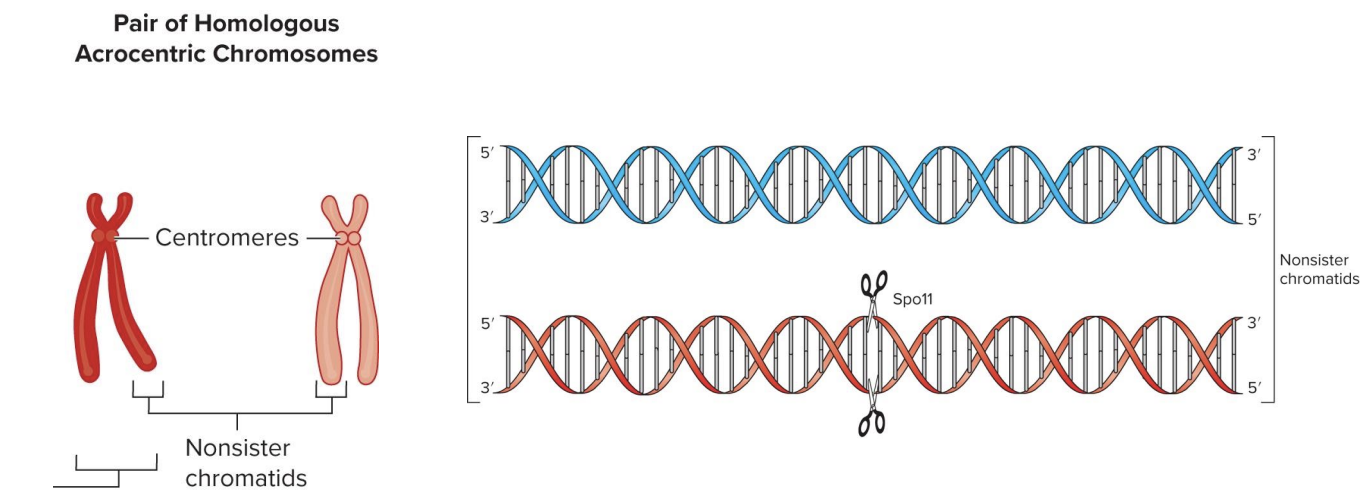
6
Step 2: Resection
5′ ends of each broken strand are degraded by an EXONUCLEASE to create 3′ single-stranded tails
7
Step 3: Strand Invasion
- Dmc1 helps one single-strand tail invade a non-sister chromatid and forms stable heteroduplex
- Displacement loop (D-loop) from invaded chromatid is stabilized by single-strand binding protein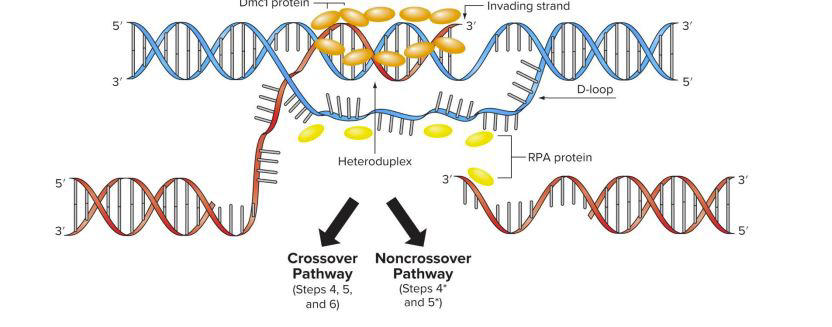
- Displacement loop (D-loop) from invaded chromatid is stabilized by single-strand binding protein
8
Step 4: Double Holliday Junction
- D-loop and other 3′ tail form a second heteroduplex
- DNA synthesis replaces the DNA degraded during formation of the 3′ tails
- DNA ligase reseals the DNA backbones
- DNA synthesis replaces the DNA degraded during formation of the 3′ tails
- DNA ligase reseals the DNA backbones
9
Step 5: Branch Migration
Heteroduplex region of both DNA molecules is lengthened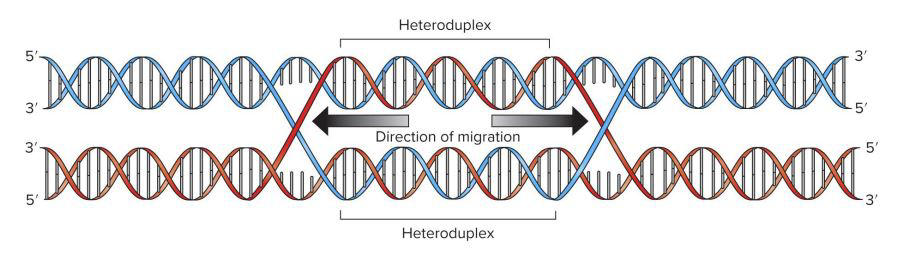
10
Step 6: Holliday junction Resolution
Holliday junctions are resolved by resolvase and ligase
11
why recombination events do not always result in crossing-over
- Invading strand is lengthened by DNA synthesis using blue strand as template
- Anticrossover helicase disentangles the invading strand from the nonsister chromatid preventing Holliday junction formation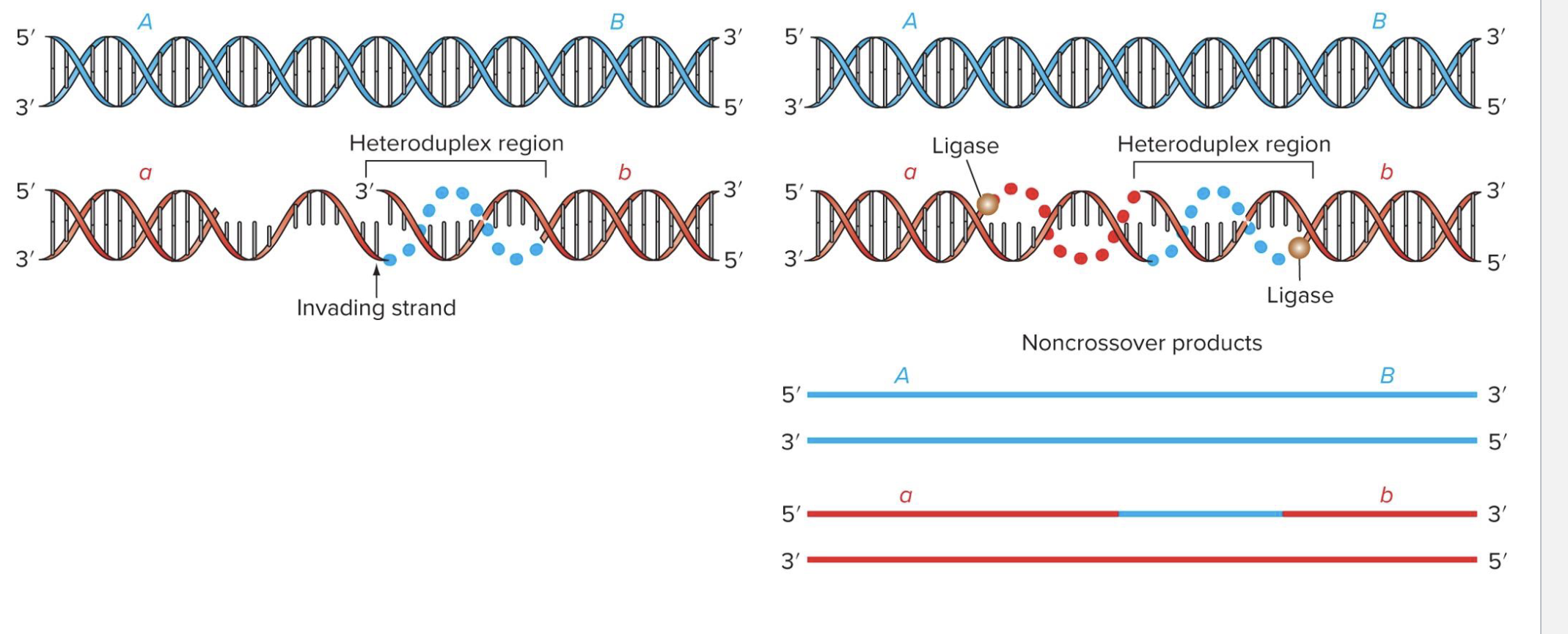
- Anticrossover helicase disentangles the invading strand from the nonsister chromatid preventing Holliday junction formation
12
What happens during mismatching in heteroduplexes? How is it resolved?
- Two strands of DNA don’t break and rejoin at the same location
- DNA repair enzymes eliminate mismatches and gene conversion occurs.
- DNA repair enzymes eliminate mismatches and gene conversion occurs.
13
Gene conversion
the physical change of one allele in a heterozygote to the other