The Rise of Abstraction: Expressionism and Primitivism
Study these flashcardsFree · spaced repetition · iPhone, Android, Mac & web
All cards
1
Symbolism
The “painting of ideas”, Symbolism stressed feeling and
evocation over definition and fact and emphasized the
power of suggestion.
evocation over definition and fact and emphasized the
power of suggestion.
2
Expressionism
a style of painting, music, or drama in which the artist or writer seeks to express emotional experience rather than impressions of the external world.
3
Primitivism
he appreciation and imitation of cultural products and practices perceived to be “primitive,” or at an earlier stage of a supposed common scale of human development.
4
style of Post-Impressionism. It depicts a scene of Breton women in prayer, juxtaposed with a vision of Jacob wrestling with an angel, rendered in bold colors and simplified forms characteristic of Gauguin's innovative style.
Paul Gauguin, Vision After the Sermon, Pont-Aven,
Brittany, 1888. Oil on canvas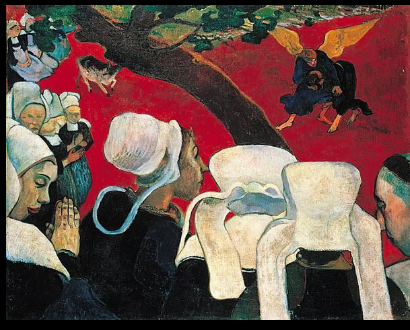
Brittany, 1888. Oil on canvas
5
exploration of symbolism and primitivism, combining elements of Post-Impressionism and the emerging Symbolist movement. The sculpture depicts a stylized figure with simplified features, emphasizing the spiritual and mystical aspects of the subject matter.
Paul Gauguin, Idol with Pearl, wood, 1892.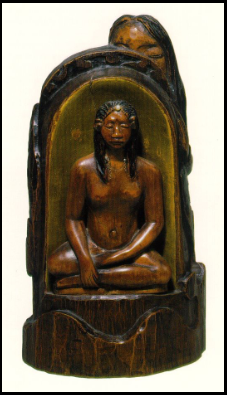
6
exemplifies the artist's distinctive Post-Impressionist style. The artwork depicts a scene from Tahitian mythology, featuring bold colors, simplified forms, and a dreamlike atmosphere characteristic of Gauguin's exploration of exoticism and symbolism.
Paul Gauguin, Te Aa No Areois
(The Seed of Areoi), 1892. Oil on
Burlap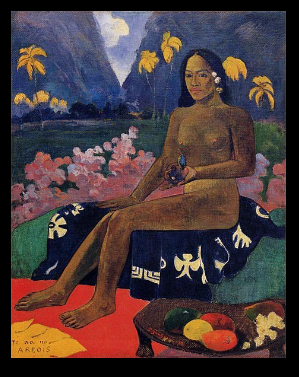
(The Seed of Areoi), 1892. Oil on
Burlap
7
what are some similarities and differences between Paul Gauguin, Te Aa No Areois
(The Seed of Areoi), 1892. Oil on Burlap and Paul Gauguin, Idol with Pearl, wood, 1892.
(The Seed of Areoi), 1892. Oil on Burlap and Paul Gauguin, Idol with Pearl, wood, 1892.
Both "Te Aa No Areois (The Seed of Areoi)" and "Idol with Pearl" are works by Paul Gauguin from the same year, 1892, and both reflect his interest in exoticism and symbolism. However, while "Te Aa No Areois" is an oil painting on burlap, depicting figures from Polynesian mythology with bold colors and flat forms, "Idol with Pearl" is a wooden sculpture, representing a stylized human figure with a pearl in its mouth, showcasing Gauguin's experimentation with different media and his fascination with primitive art. Additionally, both works explore themes of spirituality and the exotic, but "Te Aa No Areois" focuses on narrative storytelling through painting, while "Idol with Pearl" presents a more enigmatic and symbolic representation through sculpture.
8
a prime example of Post-Impressionism, featuring bold colors, simplified forms, and a departure from realistic representation. The painting depicts a scene from Tahitian mythology, with vibrant colors and stylized figures conveying a sense of mysticism and exoticism.
Paul Gauguin, Mahana No Atua (Day of the God), 1894. Oil on canvas.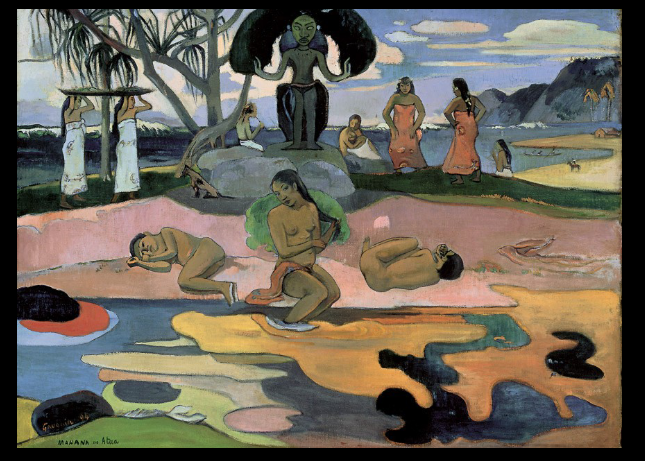
9
a seminal work of the Symbolist movement, depicting a figure on a bridge with a distorted face, screaming in anguish against a surreal, swirling backdrop of sky and water. The painting, executed in oil on canvas, is renowned for its vivid colors, expressive brushwork, and haunting portrayal of existential dread.
Edvard Munch, The Scream, 1893. Oil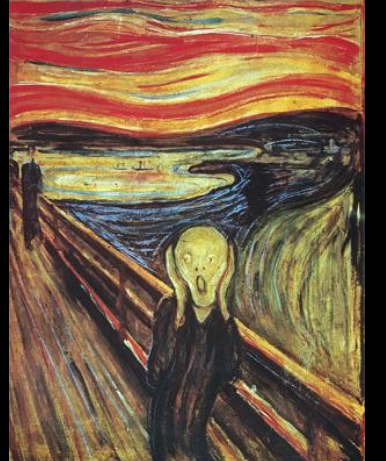
10
exemplifies Kollwitz's style of expressionism, characterized by its emotive and raw portrayal of human suffering and social injustice.
Käthe Kollwitz, The Outbreak, from the Peasants’ War Series. 1903. etching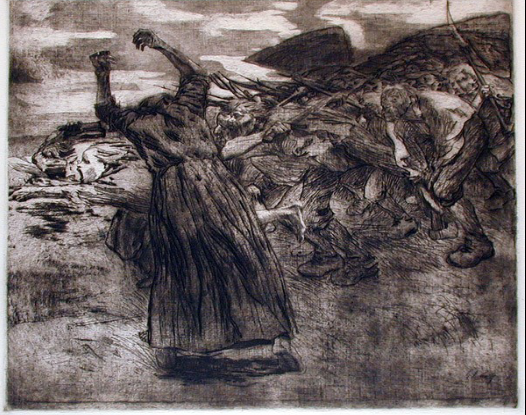
11
a prime example of Romanticism, depicting the execution of Spanish civilians by French soldiers during the Peninsular War. The painting captures the raw emotion and brutality of the event, emphasizing the individual suffering and the stark contrast between the oppressors and the oppressed.
Goya, 3rd of May, 1908, 1814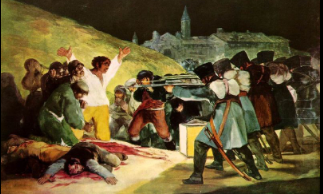
12
It belongs to the Expressionist style, characterized by its bold colors, distorted perspectives, and emotional intensity, depicting a bustling urban scene with angular figures and sharp contrasts.
Ernst Ludwig Kirchner, Street, Berlin, 1913. Oil on Canvas, 47 ½” x 35 7/8”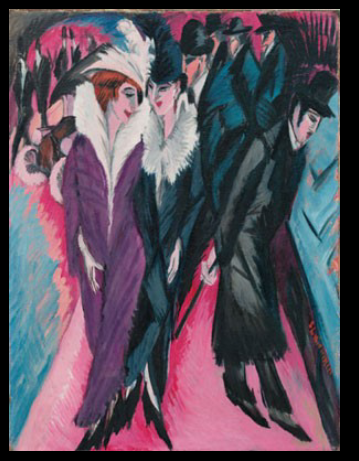
13
Nietzche rejected:
the ability of religion to determine
moral values any longer (God is dead),
Nietzsche suggested that humanity set itself the
goal of the Overman (Übermensch)
moral values any longer (God is dead),
Nietzsche suggested that humanity set itself the
goal of the Overman (Übermensch)
14
Nietzche called for
the youth to shed the shackles of
conservatism espoused by their elders and
bring forth sweeping social change.
conservatism espoused by their elders and
bring forth sweeping social change.
15
epitomizes the principles of abstract art, particularly within the context of the Expressionist and early abstract movements. This work features bold colors, dynamic shapes, and non-representational forms, reflecting Kandinsky's exploration of spiritual and emotional themes through purely visual elements.
Vasily Kandinsky, Sketch for Composition II, 1910. Oil on canvas.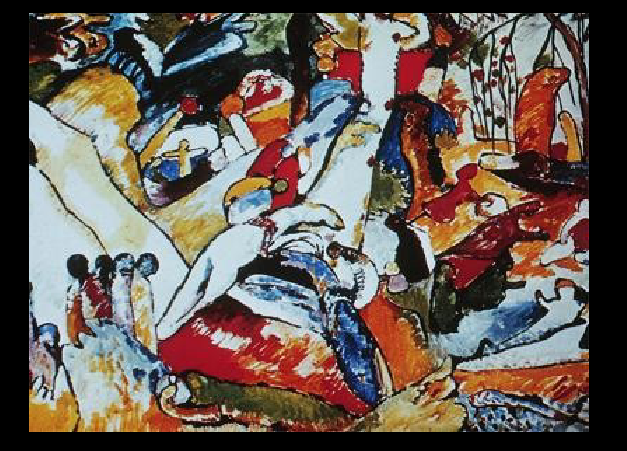
16
a significant work of German Expressionism. It depicts abstracted, stylized blue horses against a vividly colored background, showcasing Marc's interest in conveying emotional and spiritual qualities through bold colors and simplified forms.
Franz Marc, The Large Blue Horses, 1911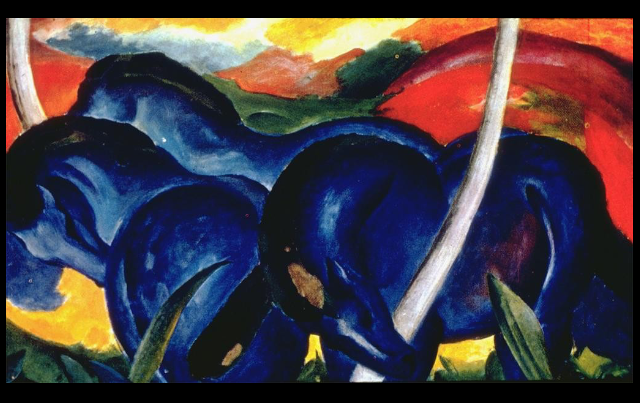
17
Kandinsky, Cover design for Der Blaue Reiter Almanac, publ. 1912 by Kandinsky and
Marc. woodcut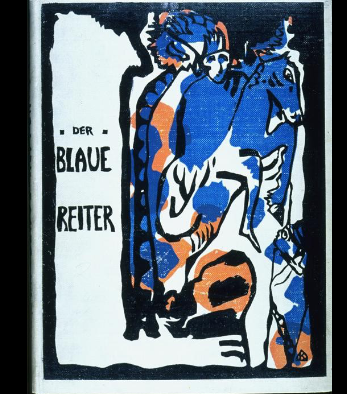
Marc. woodcut
The artwork, characterized by bold colors, geometric shapes, and dynamic lines, epitomizes the artists' pioneering abstract-expressionist style, marking a significant moment in the development of modern art.
18
what are some similarities and differences between Kandinsky, Cover design for Der Blaue
Reiter Almanac, publ. 1912 by Kandinsky
and Marc. woodcut and St. George and the Dragon, reproduced
in Der Blaue Reiter Almanac
as an example of Russian folk art
Reiter Almanac, publ. 1912 by Kandinsky
and Marc. woodcut and St. George and the Dragon, reproduced
in Der Blaue Reiter Almanac
as an example of Russian folk art
Kandinsky's cover design for Der Blaue Reiter Almanac and Marc's woodcut "St. George and the Dragon" both appeared in the same publication, "Der Blaue Reiter Almanac," indicating a shared context within the Blue Rider movement. Both artworks exhibit elements of abstraction and symbolism, reflecting the movement's interest in spiritual and emotional expression. However, while Kandinsky's cover design emphasizes geometric shapes and vibrant colors to evoke a sense of dynamic energy, Marc's woodcut presents a more figurative depiction rooted in Russian folk art tradition, with stylized forms and narrative symbolism.
19
reflects a synthesis of traditional Russian iconography and Wassily Kandinsky's avant-garde sensibilities. The artwork showcases vibrant colors, simplified forms, and stylized elements characteristic of Kandinsky's abstract-expressionist style, creating a harmonious blend of folk tradition and modern artistic innovation.
St. George and the Dragon, reproduced in Der Blaue Reiter
as an example of Russian folk art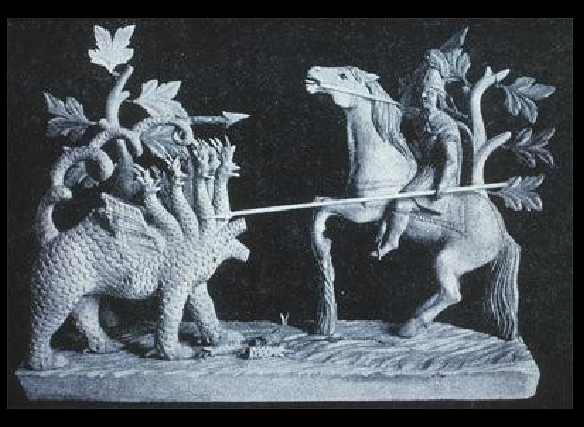
as an example of Russian folk art
20
a seminal work of Expressionism characterized by its vibrant use of color, dynamic geometric forms, and an abstract arrangement of shapes and lines. Executed in oil on canvas, the painting exemplifies Kandinsky's pioneering approach to non-representational art, where emotional and spiritual expression takes precedence over depicting recognizable objects.
Vasily Kandinsky, Composition VII, 1913. Oil on canvas. [Expressionism]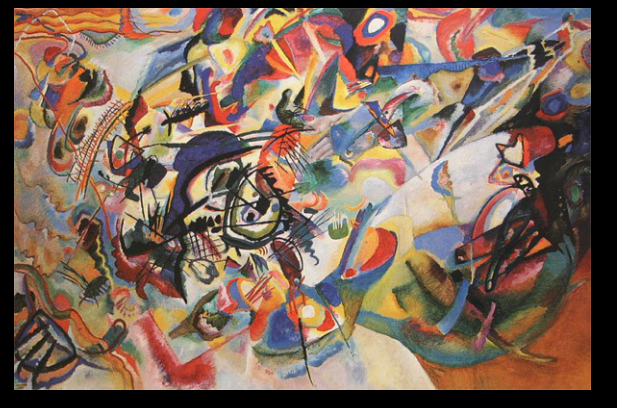
21
masterpiece of French expressionism, particularly associated with the Fauvist movement. The painting, characterized by its bold and vivid use of color, distorted forms, and a celebration of uninhibited expression, epitomizes the Fauvist style, which sought to evoke emotion and spontaneity through a departure from traditional color and form conventions.
Henri Matisse, The Joy of Life, 1905.
French expressionism (Fauvism)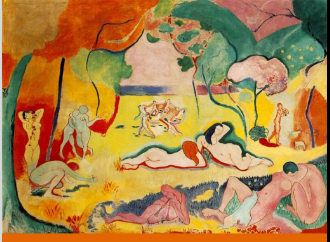
French expressionism (Fauvism)
22
what are some similarities and differences between Henri Matisse, The Joy of Life, 1905 and Gauguin, Day of the Gods, 1892?
Both Henri Matisse's "The Joy of Life" and Paul Gauguin's "Day of the Gods" depict idyllic scenes of paradise and leisure, showcasing a vibrant and harmonious palette. However, while Matisse's painting emphasizes the celebration of life and sensuality through fluid and lyrical forms, Gauguin's work presents a more symbolic and spiritual vision of the exotic, influenced by his experiences in Tahiti and featuring flattened perspectives and stylized figures imbued with mythological and cultural references. Additionally, Matisse's painting is rooted in European modernist traditions, while Gauguin's work reflects his exploration of primitivism and exoticism, marking a departure from conventional Western artistic conventions.