Futurism, Suprematism, Constructivism
Study these flashcardsFree · spaced repetition · iPhone, Android, Mac & web
All cards
1
What is Futurism?
an influential avant garde movement birthed in 1909 which glorified modernity, technology, speed, and the dynamism of urban life. It aimed to break away from traditional artistic forms and embrace the energy and spirit of the industrial age. Key components include dynamic motion ( concept of Speed, blurs), urban life, abstract forms, and embracing technology.
2
What is cubism
an influential art movement that emerged in the early 20th century, pioneered by artists Pablo Picasso and Georges Braque, with significant contributions from others like Juan Gris. It revolutionized Western art and laid the groundwork for many modern art movements. key components include geometric shapes, multiple perspectives, two dimentional space, and a neutral color palette.
3
What is cubo futurism?
a fusion of two influential early 20th-century art movements: Cubism and Futurism emerging in 1912. combined the formal innovations of Cubist artists like Pablo Picasso and Georges Braque with the dynamic energy and celebration of modernity characteristic of Futurism. Key elemnts include dynamic motion, urban life, embracing technology, geometric shapes, a neutural coller pallette, multiple perspectives, and two dimentional space.
4
What is Suprematism
an influential modern art movement that emerged in Russia in the early 20th century, specifically around 1913. It was founded by the Russian artist Kazimir Malevich, who believed that art should transcend representational forms and focus on the purity of geometric shapes and colors. Suprematism sought to express the essence of pure feeling and perception through abstract forms. Key components include: geometric abstraction, limited color pallete, purity of subject matter, and trancendance.
5
a Futurist poem inspired by his time as a war correspondent in the Balkan War, capturing the chaos and violence of modern warfare. It employs a dynamic, experimental art style, characterized by fragmented language and typographic innovation, reflecting the Futurist movement's emphasis on speed, technology, and the machine age.
Filippo Marinetti, Zang, Tumb, Tuuum,
1912. A poem based on Marinetti’s
experience as a war reporter during the
Balkan War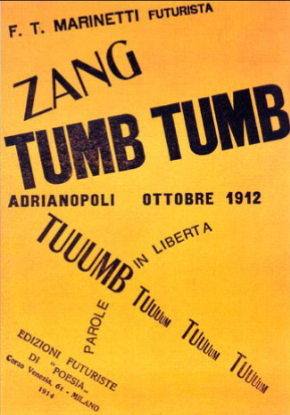
1912. A poem based on Marinetti’s
experience as a war reporter during the
Balkan War
6
a seminal work of Italian Futurism, capturing the dynamism and energy of urbanization through fragmented forms and bold colors. Boccioni employs a Cubist-influenced style to depict the chaotic vitality of a rapidly modernizing city, pulsating with movement and industrialization. Elements of futurism are seen within the paintings perseption of motion and abstract forms whilst embracing the technological advancements of society.
Umberto Boccioni, The City Rises, 1910-11. oil on canvas. 6’ 6” x 9’ 10”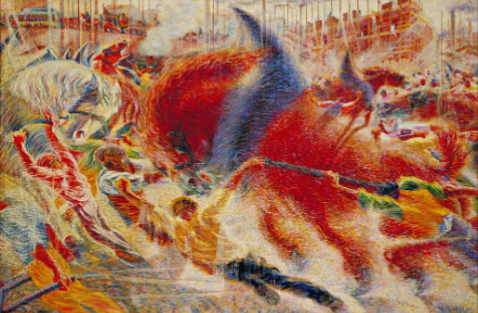
7
a notable example of Cubo-Futurism, blending Cubist and Futurist elements. Malevich portrays a rural landscape with geometric forms and dynamic brushwork, capturing the energy and movement of the scene after a storm. Futurism can be seen through the walking motion of characters and abstraction, and cubist elements can be seen in geometric shapes, multiple perspectives and a neutural collar pallette.
Kasimir Malevich, Morning in the Country After the Storm, 1912. Oil on canvas
[Cubo-Futurism]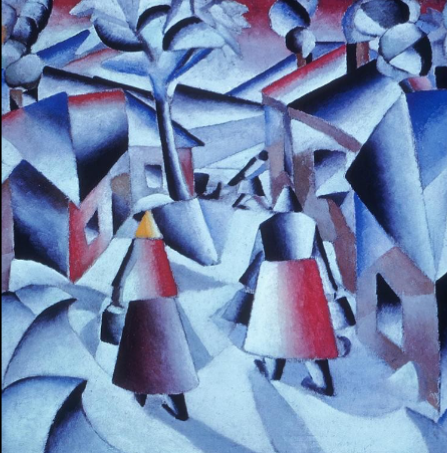
[Cubo-Futurism]
8
depicts a cubist portrayal of a young woman holding a mandolin, showcasing fragmented forms and geometric shapes. Painted in late spring 1910, this oil on canvas masterpiece exemplifies Picasso's innovative approach to art, breaking away from traditional representation to explore multiple perspectives simultaneously. Cubism can be seen in this work through the use of geometric shapes, neutural color pallette, and a 2d spacing
Picasso, Girl with Mandolin (Fanny
Tellier), late spring 1910. oil on canvass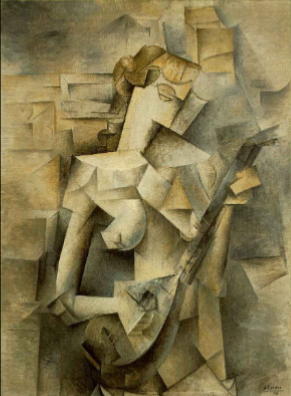
Tellier), late spring 1910. oil on canvass
9
showcased the birth of Suprematism, an avant-garde art movement he pioneered. Through geometric forms and a reductionist approach, Malevich aimed to transcend the material world, seeking to express pure feeling and spirituality through art.
Malevich, Last Futurist Exhibition of Paintings 0.10 St. Petersburg, 1915-1916
[Suprematism]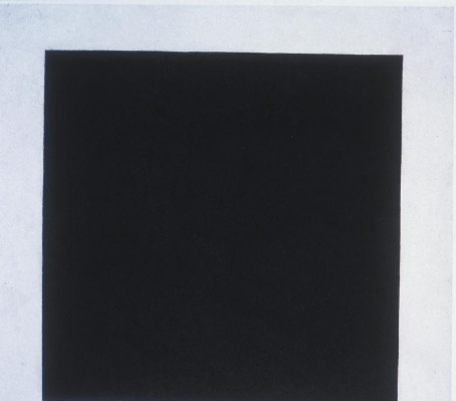
[Suprematism]
10
a seminal work of Russian Suprematism, characterized by geometric abstraction. This iconic piece features a simple black square on a white background, challenging traditional notions of representation and paving the way for non-objective art.
Malevich, Black Square, 1915. Oil on canvas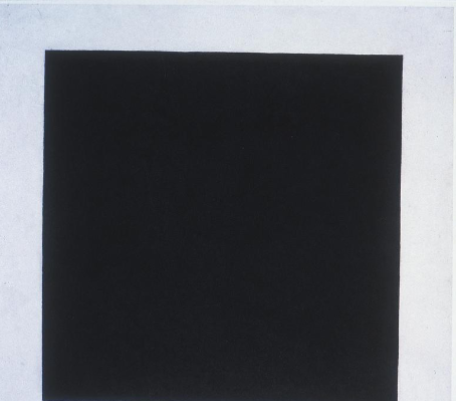
11
What is Russian Constructivism?
a pioneering avant-garde art movement that emerged in Russia in the early 20th century, particularly after the Russian Revolution of 1917. It was closely associated with the broader Constructivist movement, which aimed to create art that served a social and political purpose, often in conjunction with the goals of the socialist state. Focuses on Utilitarianism (Everyday Life), Industrial Materials, Geometric abstraction, social and political engagement, and Archtiectual influence
12
a striking propaganda poster featuring geometric shapes and bold colors, emblematic of Lissitzky's Constructivist style, advocating for the Bolsheviks during the Russian Civil War.
El (Eliezer Markovich) Lissitzky, Beat the Whites with the Red Wedge, 1919. Poster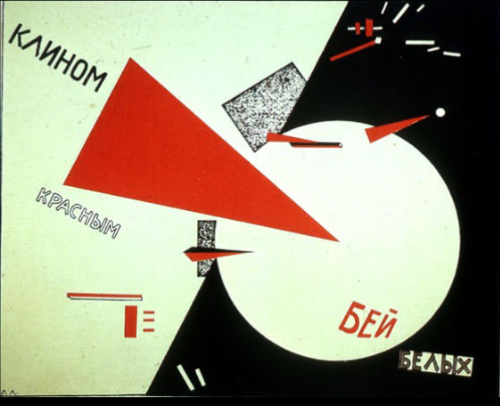
13
a pioneering example of Constructivist art, showcasing industrial materials like iron, copper, wood, and rope arranged dynamically. It embodies the movement's principles of geometric abstraction and functional design, challenging traditional notions of sculpture by integrating materials and spatial dynamics.
Vladimir Tatlin, Counter-relief,
1915, iron, copper, wood and rope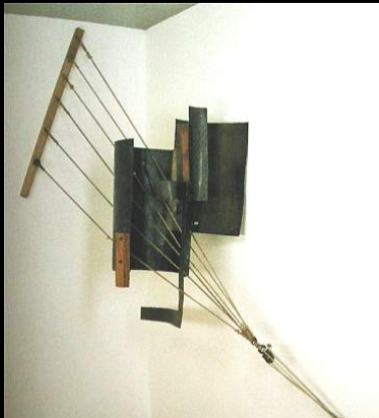
1915, iron, copper, wood and rope
14
This innovative design, created during the Constructivist movement, utilized wood, iron, and glass, reflecting the avant-garde aesthetic and ideals of the early 20th century.
Vladimir Tatlin with Monument to the Third International, 1919-1920. 20’ h wood,
iron, glass model of an edifice intended to be 1,300’ h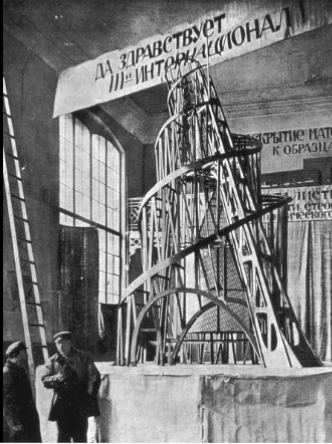
iron, glass model of an edifice intended to be 1,300’ h