Carbohydrates, Lipids, Proteins,
Study these flashcardsFree · spaced repetition · iPhone, Android, Mac & web
All cards
1
General formula for carbohydrates
(CH2O)n, where n>=3
2
Define a monosaccharide
a single sugar unit
3
Define Disaccharides
made up of two monosaccharides joined together by the removal of H2O molecule
4
What is Condensation?
Condensation - the process in which two or more molecules are linked together (synthesized) by the removal of water (anabolism)
5
What is Hydrolysis?
Hydrolysis - the splitting of a molecule by the addition of water (catabolism)
6
What bond links monosaccharides?
alpha 1–4 or beta 1–4 Glycosidic linkage
7
Define Polysaccharide
insoluble in H2O chain of monosaccharides (starches and cellulose)
8
Explain the solubility of polysaccharides
Polymers have more brenches = less soluble
Large polysaccharides = insoluble in H2O = can’t pass through the pores of a membrane = don’t enter chem rxns = excelent storage units
Large polysaccharides = insoluble in H2O = can’t pass through the pores of a membrane = don’t enter chem rxns = excelent storage units
9
What are the functions of Carbohydrates?
1. Supply energy for cellular functions
2. Form support material: cellulose in plants and chitin in animals
2. Form support material: cellulose in plants and chitin in animals
10
Name the main Monosaccharides
glucose
galactose
fructose
galactose
fructose
11
Name the main Disaccharides
maltose (glucose + glucose)
sucrose (glucose + fructose)
lactose (glucose + galactose)
sucrose (glucose + fructose)
lactose (glucose + galactose)
12
Name the main polysaccharides
starch
cellulose
glycogen
pectin
cellulose
glycogen
pectin
13
Define Lipids
1. nonpolar, insoluble chain-like molecules with a C as a backbone (fats, oils, steroids)
2. Large number of C-H bonds = yield twice as much energy as carbs or proteins
2. Large number of C-H bonds = yield twice as much energy as carbs or proteins
14
What are the two subunits of lipids or triglycerides?
Glycerol which has 3 OH groups that join with 3 fatty acid units
glycerol + fatty acids = fat
glycerol + fatty acids = fat
15
What bond forms between glycerol and fatty acids?
Ester bond via dehydration synthesis
16
Trigliceride molecule is a product of which reaction?
product of dehydration synthesis reaction (condensation reaction)
17
Trigliceride molecule is a reactant of which reaction?
reactant of hydrolysis reaction
18
How to identify the saturated fat?
1. Each C has two H in the backbone
2. solid at room temperature
2. solid at room temperature
19
How to identify unsaturated fats?
1. there are C in backbones that have not recieved their full compliment of H, so they form a double bond C=C
2. liquid at room temperature
2. liquid at room temperature
20
Define monounsaturated fats
have one set of C=C
1. cis-fatty acid (H are on the same side)
2. trans-fatty acid (H are on different sides)
1. cis-fatty acid (H are on the same side)
2. trans-fatty acid (H are on different sides)
21
define polyunsaturated fats
have more than one set of C=C
22
Define cholesterol
It is a sterol.
23
What is atherosclerosis?
High levels of saturated fats increases the amount of chalesterol flowing through the blood vessels, and it clings to the wall of blood vessels, deacreasing their diameter and cutting off the blood supply to various organs.
24
High levels of saturated fats increases the amount of chalesterol flowing through the blood vessels, and it clings to the wall of blood vessels, deacreasing their diameter and cutting off the blood supply to various organs.
atherosclerosis
25
What are the functions of fats?
1. energy storage - fats in animals, oils in plants
2. heat insulation - subcutaneous layer of fat
3. buoyancy - fats are less dense than H2O
4. sex hormones - estrogen and tesosteron
5. vision pigments
2. heat insulation - subcutaneous layer of fat
3. buoyancy - fats are less dense than H2O
4. sex hormones - estrogen and tesosteron
5. vision pigments
26
Define Proteins
Long chain of amino acids. Proteins are made up of C, H, O, N, and often S
27
What are the functions of proteins?
1. structural molecules - bone, muscle, membranes
2. enzymes - perform metabolic function
3. antibodies - immune system
4. hormones - regulate body activities
5. blood proteins - blood clotting
6. source of energy (last resort)
2. enzymes - perform metabolic function
3. antibodies - immune system
4. hormones - regulate body activities
5. blood proteins - blood clotting
6. source of energy (last resort)
28
What are the two general categories of proteins according to their function?
1. Fibrous proteins
2. Globular proteins
2. Globular proteins
29
Define fibrous proteins
1. insoluble in water and are physically very strong
2. structural or protective elements in the organism
3. their long polypeptide chains form strand-like shape. Eg: feathers and nails
2. structural or protective elements in the organism
3. their long polypeptide chains form strand-like shape. Eg: feathers and nails
30
Define globular proteins
1. soluble in H2O and diffuse readily
2. polypeptide chains are tightly folded into spherical or globular shapes. Eg: enzymes, hormones
2. polypeptide chains are tightly folded into spherical or globular shapes. Eg: enzymes, hormones
31
Amino acid consists of..
Amino acid consists of:
1. Amino group
2. carboxyl group
3. α- carbon
4. R - side group
1. Amino group
2. carboxyl group
3. α- carbon
4. R - side group
32
Define dipeptide
when two amino acids join each together by dehydration synthesis (condensation), the resulting bond formed is a peptide bond and the resulting molecule is a dipeptide.
The carboxyl group from one amino acid joins the amino group from the other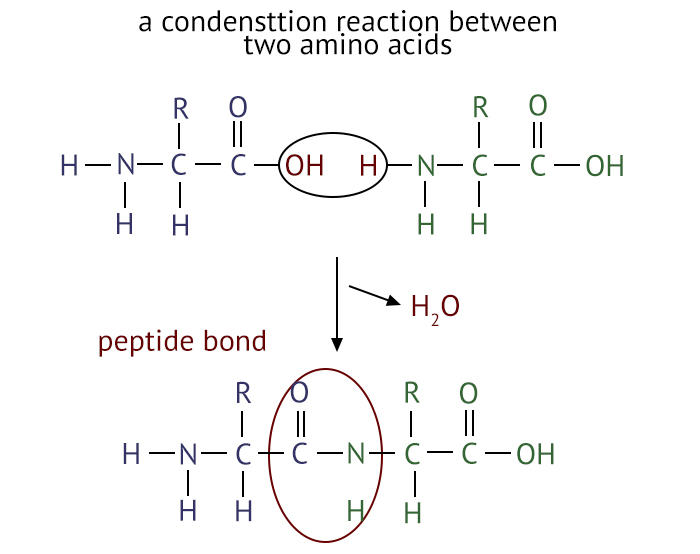
The carboxyl group from one amino acid joins the amino group from the other
33
What are the 4 levels of protein structure?
1. Primary
2. Secondary
3. Tertiary
4. Quaternary
2. Secondary
3. Tertiary
4. Quaternary
34
Define primary stucture of proteins
It is the sequence of amino acids in the protein
35
Define secondary structure of proteins
Local folding patterns of the polypeptide backbone due to hydrogen bonding.
1. Alpha helix (α-helix) → spiral structure
2. Beta-pleated sheet (β-sheet) → sheet-like folded structure
1. Alpha helix (α-helix) → spiral structure
2. Beta-pleated sheet (β-sheet) → sheet-like folded structure
36
Define tertiary structure of proteins
Formed by interactions between R-groups (side chains).
Types of R-group interactions:
1. Hydrogen bonds (between polar R-groups)
2. Ionic bonds (between charged R-groups)
3. Disulfide bridges (covalent bond between cysteine residues)
4. Hydrophobic interactions (nonpolar R-groups cluster inside protein)
Types of R-group interactions:
1. Hydrogen bonds (between polar R-groups)
2. Ionic bonds (between charged R-groups)
3. Disulfide bridges (covalent bond between cysteine residues)
4. Hydrophobic interactions (nonpolar R-groups cluster inside protein)
37
Define quaternary structure of proteins
Occurs when two or more polypeptide chains (subunits) combine to form one functional protein.
Examples:
1. Hemoglobin (4 subunits)
2 Many enzymes
Examples:
1. Hemoglobin (4 subunits)
2 Many enzymes
38
What causes protein denaturation?
Changes in pH or temperature alter 2°, 3°, or 4° structure, causing loss of function.
Function of the protein is dependent on its shape, and the shape is dependent on its amino acids sequence which, in turn, is dependent on the genetic code or specific DNA sequence.
Function of the protein is dependent on its shape, and the shape is dependent on its amino acids sequence which, in turn, is dependent on the genetic code or specific DNA sequence.
39
What are enzymes?
Proteins that act as organic catalysts controlling chemical reactions of the cell
40
What are nucleic acids made of?
Nucleotides (sugar + phosphate group + nitrogen base).
41
Define DNA
Deoxyribonucleic acid, found in the nucleus, double chain in the form of a double helix
42
What is the sugar in DNA?
Deoxyribose
43
Name two types of nitrogen bases in DNA
1. Purines - adenine and guanine (large, double ringed compounds)
2. Pyrimidines - cytosine and thymine (smaller, single ringed compounds)
2. Pyrimidines - cytosine and thymine (smaller, single ringed compounds)
44
What pairs with what?
Adenine + Thymine
Guanine + Cytosine
Guanine + Cytosine
45
Define RNA
RNA - ribonucleic acid, this is found in the nucleus and cytoplasm of a cell.
46
What is the sugar in RNA?
Ribose
47
What base replaces thymine in RNA?
Uracil
48
What are the four types of RNA?
1. mRNA - messenger RNA, carries the coded message from the nucleus to the ribosomes in the cytoplasm
2. rRNA - ribosomal RNA, assists the functioning of the ribosomes
3. tRNA - transfer RNA, transports the amino acids to the ribosome for use in building the polypeptide and positions each amino acid in the correct place
4. snRNA - small nuclear RNA, cuts out introns from pre-mRNA before it leaves the nucleus
2. rRNA - ribosomal RNA, assists the functioning of the ribosomes
3. tRNA - transfer RNA, transports the amino acids to the ribosome for use in building the polypeptide and positions each amino acid in the correct place
4. snRNA - small nuclear RNA, cuts out introns from pre-mRNA before it leaves the nucleus