Gynaecology
Study these flashcardsFree · spaced repetition · iPhone, Android, Mac & web
All cards
1
Primary amenorrhoea definition
Not starting menstruation by:
13 years with no evidence of pubertal development
OR
15 years with other signs of puberty [breast bud development]
13 years with no evidence of pubertal development
OR
15 years with other signs of puberty [breast bud development]
2
Primary amenorrhoea causes
Hypogonadism [lack of sex hormones],
Congenital adrenal hyperplasia, Androgen insensitivity syndrome,
Structural pathology
Congenital adrenal hyperplasia, Androgen insensitivity syndrome,
Structural pathology
3
Hypogonadotrophic hypogonadism definition and causes
This is where there is a lack of LH and FSH due to damage or abnormalties to the hypothalamus or pituitary gland
Causes include: hypopituitarism, damage to the hypothalamus or pit. gland such as radiotherapy / surgery, excessive exercise or dieting [delays puberty onset], constitutional delay in growth / development, endocrine disorders [GH deficiency, Cushings, hypothyroidism], Kallmans syndrome [anosmia]
Causes include: hypopituitarism, damage to the hypothalamus or pit. gland such as radiotherapy / surgery, excessive exercise or dieting [delays puberty onset], constitutional delay in growth / development, endocrine disorders [GH deficiency, Cushings, hypothyroidism], Kallmans syndrome [anosmia]
4
Hypergonadotrophic hypogonadism definition and causes
This is when the gonads fail to respond to FSH and LH, leading to no negative feedabck response from the sex hormones. Results in hypergonadotrophic and reduction in androgens
Causes: damage to the gonads [torsion, cancer, infection], congential absence of ovaries, Turners syndrome
Causes: damage to the gonads [torsion, cancer, infection], congential absence of ovaries, Turners syndrome
5
Congenital adrenal hyperplasia
Deficiency in 21-hydroxylase enzyme [autosomal recessive]. This leads to low aldosterone / cortisol and an overproduction of androgens. This can lead to unwell neonates and absent periods later on.
6
Androgen insensitivity syndrome
Tissues dont respond to androgen hormones so typical male sexual characteristics do not develop. Results in an external female phenotype [sexually male but externally female], Patients will have normal female external genitalia and breast tissue BUT testes will be present in the abdomen / inguinal canal WITH absent uterus, upper vagina, fallopian tubes and ovaries.
7
Structural pathology leading to primary amenorrhoea
Imperforate hymen can present with teenagers who experience regular painful cycles. Transverse vaginal septae, vaginal agenesis, absent uterus, FGM
8
Assessment for primary amenorrhoea
Take a detailed Hx and examination. Take FBC / ferritin [for anaemia], U&E for CKD, anti-TTG / anti-EMA for coeliac disease.
Check hormone blood levels [FSH, LH, thyroid, IGF-1, prolactin, testosterone], genetic testing, imaging [pelvic US, brain MRI, wrist Xray for constitutional delay]
Check hormone blood levels [FSH, LH, thyroid, IGF-1, prolactin, testosterone], genetic testing, imaging [pelvic US, brain MRI, wrist Xray for constitutional delay]
9
Management for Primary Amenorrhoea
Find underlying pathology. Conservative management for stress or low BMI causes via diet or CBT.
Give pulsatile GnRH in some cases like hypogonadotrophic hypogonadism, HRT in other cases if pregnancy is unwanted.
Give pulsatile GnRH in some cases like hypogonadotrophic hypogonadism, HRT in other cases if pregnancy is unwanted.
10
Secondary amenorrhoea definition
no menstruation for more than 3 months after previous regular menstrual periods.
If irregularly infrequent previously, consider 6-12 months, to warrant investigations
If irregularly infrequent previously, consider 6-12 months, to warrant investigations
11
Secondary amenorrhoea causes
pregnancy is the most common cause. Menopause and premature ovarian failure, hormonal contraception, Pituitary tumour / prolactinoma / damage / Sheehans
Psychological or physiological stress such as excessive exercise, low body weight, eating disorders, chronic diseases.
PCOS, Ashermans syndrome, thyroid pathology
Psychological or physiological stress such as excessive exercise, low body weight, eating disorders, chronic diseases.
PCOS, Ashermans syndrome, thyroid pathology
12
Secondary amenorrhoea investigations
Detailed Hx and examination. beta-HCG to rule out pregnancy. Take LH and FSH as low levels can indicate a hypothalamic cause whilst high levels indicate ovarian problems. High FSH may indicaate primary ovarian failure, high LH may suggest PCOS.
Pelvic US for PCOS
Pelvic US for PCOS
13
Secondary amenorrhoea management
Find underlying pathology and treat that. Give replacement hormones to induce menstruation and improve sx. PCOS patients need to induce a withdrawal bleed every 3-4 months to reduce the risk of endometrial hyperpalsia / cancer. Medroxyprogesterone is used for 14 days or COCp use regularly.
Amenorrhoea associated with low oestrogen levels have increased risk of osteoporosis. Ensure adequate vitamin D and calcium intake and give HRT or COCp.
Amenorrhoea associated with low oestrogen levels have increased risk of osteoporosis. Ensure adequate vitamin D and calcium intake and give HRT or COCp.
14
Premenstrual syndrome definition
the psychological, emotional, physical symptoms that occur during the luteal phase of menstrual cycle. Usually the days prior to the onset of menstruation. These Sx can affect QOL and usually resolves once menstruation begins
15
Premenstrual dysphoric disorder
When premenstrual syndrome sx are severe / distressing and have significant impact on QOL
16
Cause of premenstrual syndrome
thought to be caused by fluctuation in oestrogen / progesterone hormones during menstrual cycle
17
Premenstrual syndrome occurence
Can develop in the absence of menstruation after a hysterectomy, endometrial ablation or the mirena coil. This is due to the ovaries still functioning and the hormonal cycle continuing
18
progesterone induced premenstrual disorder
sx of premenstrual cycle due to response to COCp / cyclical hormone replacement therapy
19
Premenstrual syndrome symptoms
low mood / anxiety, mood swings / irritability, bloating, fatigue / headaches, breast pain, reduced confidence, coginitive impariment, clumsiness, reduced libido
20
Premenstrual syndrome investigations
Sx diary spanning two monthly cycles to see that cyclical symptoms occur before and resolve after menstruation.
Definitive diagnosis is to induce menopause with GnRH analogues to stop sx.
Definitive diagnosis is to induce menopause with GnRH analogues to stop sx.
21
Premenstrual syndrome management
Conservative: exercise, stop smoking / alcohol, dietary changes, CBT
Medical: COCp [Drospirenone]. SSRIs can be used for severe sx. Danazole or Tamoxifen for cyclical breast pain. Spironolactone for bloating / water retention
Surgical: hysterectomy / bilateral oophorectomy only in cases where everything else has failed. If women under 45 years, need HRT.
Medical: COCp [Drospirenone]. SSRIs can be used for severe sx. Danazole or Tamoxifen for cyclical breast pain. Spironolactone for bloating / water retention
Surgical: hysterectomy / bilateral oophorectomy only in cases where everything else has failed. If women under 45 years, need HRT.
22
Menorrhagia definition
heavy menstrual periods, more than 80mls is excessive but this is not calculatable.
23
Menorrhagia causes
dysfunctional uterine bleeding, extremes of reproductive age, fibroids, endometriosis / adenoymosis, pelvic inflammatory disease, contraceptives, anticoagulant meds, bleeding disorders, endocrine disorders, CT disorders, endometrial hyperplasia / cancer, PCOS
24
Menorrhagia investigations
thorough history taking [more than usual, more pads needed]
Pelvic examination with speculum should be done to look for fibroids / cancer UNLESS the Px has menorrhagia confirmed from Hx with no other RFs and Sx OR the patient young and not sexually active.
FBC for anaemia. Outpatient hysteroscopy can be done, if declined then transvaginal US can be done.
Swabs for infection, Coag screen if FHx relevant. TFTs
Pelvic examination with speculum should be done to look for fibroids / cancer UNLESS the Px has menorrhagia confirmed from Hx with no other RFs and Sx OR the patient young and not sexually active.
FBC for anaemia. Outpatient hysteroscopy can be done, if declined then transvaginal US can be done.
Swabs for infection, Coag screen if FHx relevant. TFTs
25
Menorrhagia Managment
Treat underlying pathology if able. If unable, ask if they need contraceptives. If yes, Mirena coil [levonorgestrel releasing IUS] is first line. 2nd line is COCp and 3rd line is long-acting progesterone
if no, Tranexamic acid if there is NO PAIN. Mefanemic acid if there IS PAIN
Surgical management involves endometrial ablation / balloon thermal ablation. Hysterectomy if all else fails
if no, Tranexamic acid if there is NO PAIN. Mefanemic acid if there IS PAIN
Surgical management involves endometrial ablation / balloon thermal ablation. Hysterectomy if all else fails
26
Fibroids definition
benign tumours of the smooth muscle of the uterus. They are oestrogen sensitive so they grow in response to raised levels
27
Fibroids types
Intramural: within the myometrium of the uterus, distorting the shape of the uterus
Subserosal: below the outer layer of the uterus, fibroids grow outwards into the abdominal cavity
Submucosal: below the endometrium
Pedunculated: on a stalk, hanging inside the uterine cavity
Subserosal: below the outer layer of the uterus, fibroids grow outwards into the abdominal cavity
Submucosal: below the endometrium
Pedunculated: on a stalk, hanging inside the uterine cavity
28
Fibroids clinical features
Menorrhagia
prolonged menstruation, bulk related problems [bloating, feeling full, abdo pain on menstruation], deep dyspareunia, decreased fertility
Polycythaemia 2ndary to autonomous production of erythropoietin is RARE
prolonged menstruation, bulk related problems [bloating, feeling full, abdo pain on menstruation], deep dyspareunia, decreased fertility
Polycythaemia 2ndary to autonomous production of erythropoietin is RARE
29
Fibroids: investigations
1st line: hysteroscopy / transvaginal US
Pelvic US for larger fibroids.
MRI scanning may be considered if more information about the fibroid is needed
Pelvic US for larger fibroids.
MRI scanning may be considered if more information about the fibroid is needed
30
Fibroids management
if ASx = no Tx
Treat the menorrhagia secondary to fibroids.
GnRH agonists can be used to reduce the fibroid size but usually are only used in short term due to menopausal Sx
Surgical: Myomectomy, hysteroscopic endometrial ablation, hysterectomy, uterine artery embolisation
Treat the menorrhagia secondary to fibroids.
GnRH agonists can be used to reduce the fibroid size but usually are only used in short term due to menopausal Sx
Surgical: Myomectomy, hysteroscopic endometrial ablation, hysterectomy, uterine artery embolisation
31
Fibroids sequelae
Anaemia, infertility, pregnancy complications like miscarriages. Constipation, UTI and urinary outflow obstruction, red degeneration, fibroid torsion
malignant change to a leiomyosarcoma [rare]
malignant change to a leiomyosarcoma [rare]
32
Red degeneration
when fibroid growth outstrips blood supply, they degenerate and undergo necrosis. Usually large fibroids > 5cm during pregnancy.
Presents with severe abdominal pain, fever, tachycardia, vomiting
Manage via rest, fluids, analgesia
Presents with severe abdominal pain, fever, tachycardia, vomiting
Manage via rest, fluids, analgesia
33
Fibroids prognosis
usually regresses are menopause due to no oestrogen
34
Ectopic pregnancy definition
A life-threatning obstetric emergency in which the fertilised ovum implants outside the uterine cavity, usually in the Fallopian tube
35
Ectopic pregnancy risk factors
previous ectopic pregnancy / recurrence, tubal abnormalities / adhesions / congenital / surgery, assisted reproduction methods, intrauterine device use, endometriosis, smoking [impairs tubal and cilia function]
36
Ectopic pregnancy pathophysiology
Either due to impaired tubal transport or environment [infection / endometriosis] OR abnormal embryo-tubal interactions
37
Ectopic pregnancy clinical features
typical history is a female with 6-8 weeks amenorrhoea + lower abdominal pain and later vaginal bleeding
other sx may be shoulder tip pain [phrenic nerve], pain on defecation / tenesmus, dizziness, fainting, syncope
other sx may be shoulder tip pain [phrenic nerve], pain on defecation / tenesmus, dizziness, fainting, syncope
38
Ectopic pregnancy investigations
Serial human chorionic gonadotrophic levels: if the rise is slower than expected or there is a decline = suspicion
Intravaginal US is first line, might see “tubal ring sign”. If CI, abdominal US
Intravaginal US is first line, might see “tubal ring sign”. If CI, abdominal US
39
Ectopic pregnancy management
if size is less than 35mm, unruptured, ASx and hCG is less than 1000 = closely monitor the patient over 48hrs and if hCG levels rise again or sx manifest, intervene
Medical management involves giving methotrexate only if the patient is willing to attend follow-up
if the size > 35mm, ruptured, pain sx, hCG levels is more than 5000 = surgical management via salpingectomy [1st line for women with no other RFs for infertility] or salpingotomy
Medical management involves giving methotrexate only if the patient is willing to attend follow-up
if the size > 35mm, ruptured, pain sx, hCG levels is more than 5000 = surgical management via salpingectomy [1st line for women with no other RFs for infertility] or salpingotomy
40
Ectopic pregnancy complications
tubal rupture can lead to intraperitoneal haemorrhage [haemoperitoneum], persistent trophoblastic tissue producing hCG, dmg to reproductive organs, psychological impacts
41
Endometriosis definition & pathophysiology *
ectopic endometrial tissue build up outside the uterus, sensitive to oestrogen levels
the ectopic tissue leads to irritation / inflammation of tissues around sites of endometriosis, leading to cyclic dull burning pain during menstruation. These can form adhesions which can lead to ovaries being fixed to the peritoneum.
the ectopic tissue leads to irritation / inflammation of tissues around sites of endometriosis, leading to cyclic dull burning pain during menstruation. These can form adhesions which can lead to ovaries being fixed to the peritoneum.
42
Endometriosis clinical features *
cyclic extreme pain around menstruation with sometimes bleeding occuring elsewhere. Patients will also complain of deep dyspareunia, infertility and cyclical urinary / bowel sx
Speculum examination can show endometrial tissue on the vagina, bimanual may show a fixed cervix. There will be tenderness in the vagina, cervix, adnexa
Speculum examination can show endometrial tissue on the vagina, bimanual may show a fixed cervix. There will be tenderness in the vagina, cervix, adnexa
43
Endometriosis investigations *
Pelvic US may show very large endometriomas but are often unremarkable.
Laparoscopic surgery is the gold standard with a biopsy
Laparoscopic surgery is the gold standard with a biopsy
44
Endometriosis staging *
Stage 1: small superficial lesions
Stage 2: mild, deeper lesions
Stage 3: deeper lesions with mild adhesions on the ovaries
Stage 4: deep large lesions affecting the ovaries with extensive adhesions
Stage 2: mild, deeper lesions
Stage 3: deeper lesions with mild adhesions on the ovaries
Stage 4: deep large lesions affecting the ovaries with extensive adhesions
45
Endometriosis management
Conservative: analgesia for pain
Medical: Hormonal management via COCp, POP, Mirena coil. GnRH agonists can be used if the pill doesnt work but has menopause sx
Surgical: laparoscopic surgery, hysterectomy / bilateral salpingo-ophoerectomy
Medical: Hormonal management via COCp, POP, Mirena coil. GnRH agonists can be used if the pill doesnt work but has menopause sx
Surgical: laparoscopic surgery, hysterectomy / bilateral salpingo-ophoerectomy
46
Adenomyosis definition
endometrial tissue inside the myometrium. it is more common in women’s later reproductive years and those that have had multiple pregnancies.
47
Menopause diagnosis
no period for more than 12 months
48
perimenopause definition
time around menopause where women may experience vasomotor sx and irregular periods. Includes the time leading up to the last menstrual period and 12 months after
49
Premature menopause
Women younger than 40 years old experiencing menopause due to premature ovarian insufficiency
50
Menopause physiology
menopause starts with the decline in the development of the ovarian follicles which leads to less oestrogen. No oestrogen leads to no -ve feedback which leads to a rise in FSH / LH and the endometrium does not develop = amenorrhoea
51
Perimenopausal sx *
Periods become irregular, hot flushes, urogenital changes [vaginal dryness / atrophy], psychological [low mood, low libido, short term memory impairment], joint pain / osteoporosis
52
Menopause investigations
Diagnosis can be made in women over 45 years with sx, without investigations.
FSH blood test can be used if women is under 40yrs for suspected premature menopause OR 40-45years with menopausal sx
FSH blood test can be used if women is under 40yrs for suspected premature menopause OR 40-45years with menopausal sx
53
Contraceptives and menopause *
Risks of pregnancy increases with age so women should use effective contraception for 2yr after LMP in women under 50yrs OR 1yr after LMP in women over 50yrs
Most contraceptives are UKMEC1 such as the mirenal coil, POP.
COCp is UKMEC2 in women over 40yrs
Most contraceptives are UKMEC1 such as the mirenal coil, POP.
COCp is UKMEC2 in women over 40yrs
54
Progesterone depot injection side effects in menopausal women *
weight gain and osteoporosis, so therefore unsuitable in women over 45yrs old
55
Menopause management *
Vasomotor sx usually resolve after 2-3yrs without Tx.
Lifestyle changes: exercise, weight loss, sleep, CBT to help with hot flushes and mood
HRT is increasingly used but has its own risks like endometrial cancer / hyperplasia, VTE, stroke
Fluoxetine / citalopram can be used for vasomotor sx. Moisturisers for vaginal dryness. Vaginal oestrogen prescribed for urogenital atrophy
Lifestyle changes: exercise, weight loss, sleep, CBT to help with hot flushes and mood
HRT is increasingly used but has its own risks like endometrial cancer / hyperplasia, VTE, stroke
Fluoxetine / citalopram can be used for vasomotor sx. Moisturisers for vaginal dryness. Vaginal oestrogen prescribed for urogenital atrophy
56
post menopausal bleeding definition, causes and referral *
vaginal bleeding after 12 months of amenorrhoea. Exclude malignancy is important. If the patient is older than 55 and has post menopausal bleeding = 2 week referral for endometrial cancer.
other causes include vaginal atrophy, HRT, endometrial hyperplasia and other cancers
other causes include vaginal atrophy, HRT, endometrial hyperplasia and other cancers
57
PCOS pathophysiology
Initial insulin resistance leads to increased insulin production in the pancreas. This promotes the release of androgens from ovaries / adrenal glands. Insulin also suppresses sex hormone binding globulin [SHBG] production in the liver which usually binds to androgens to suppress it. High insulin levels also halt the development of follicles in the ovaries leading to anovulation and multiple partially developed follicles = cysts
58
PCOS clinical features
subfertility, menstrual disturbance [oligomenorrhoea / amenorrhoea], hirsutism / acne, obesity, acanthosis nigricans, hair loss in male patterns
59
PCOS investigations
bloods for baseline FSH / LH, prolactin, TSH, testosterone, SHBG, glucose tolerance levels.
Pelvic US for string of pearls appearance
Pelvic US for string of pearls appearance
60
PCOS diagnosis
Rotterdam criteria: need 2 of the 3
infrequent / anovulation
clinical signs of hyperandrogenism
cysts on US scan [more than 12 follicles in ovaries]
infrequent / anovulation
clinical signs of hyperandrogenism
cysts on US scan [more than 12 follicles in ovaries]
61
PCOS managment
weight reduction, orlistat for BMI > 30. COCp to regulate cycle and induce a monthly bleed. This needs to be done to reduce the risk of endometrial cancer due to a build up of oestrogen
this is done by medroxyprogesterone acetate 10mg for 14 days OR the COCp
this is done by medroxyprogesterone acetate 10mg for 14 days OR the COCp
62
Premature ovarian insufficiency definition & causes
Menopause before 40yrs of age, due to a decline in normal activity of ovaries at an early age. Causes vary from idiopathic, iatrogenic [chemotherapy, radiotherapy, surgery], autoimmune, genetic, infections [mumps, TB, cytomegalovirus]
63
Premature ovarian insufficiency clinical features
irregular menstrual periods / amenorrhoea, infertility, vasomotor sx [hot flushes, night sweats, vaginal dryness]
64
Premature ovarian insufficiency diagnosis
Diagnosed in women under 40yrs with typical menopause sx and persistently raised FSH [>25] OR 2 consecutive samples separated by 4-6 weeks apart
65
Premature ovarian insufficiency management and safety netting
HRT until usual age of menopause [-51yrs of age]. Advise use of contraception as still able to get pregnant. Remind that traditional HRT does not increase risk of breast cancer in women < 50yrs BUT does increase risk of VTE which can be handled via transdermal delivery. Alternatively, use COCp
66
Ovarian torsion definition
Due to the presence of a cyst of another type of adnexal mass [>5cm], the ovary twists in relation to the surrounding tissue, fallopian tube and blood supply. This leads to ischaemia, to necrosis and eventually, ovary function loss
67
Ovarian torsion RFs *
90% Ovarian Mass cause, being in reproductive age, pregnancy, ovarian hyperstimulation syndrome
68
Ovarian torsion clinical signs
sudden onset severe unilateral colicky abdominal pelvic pain. Constant, progressively worsens usually, n / v
Can resolve spontaneously, think hernias.
There will be localised tenderness and perhaps a palpable mass
Can resolve spontaneously, think hernias.
There will be localised tenderness and perhaps a palpable mass
69
Ovarian torsion investigations
Pelvic US is first line to see whirlpool sign, free fluid or oedema of the ovary. Doppler scans may show ischaemia. Laparoscopic surgery is definitive
70
Ovarian torsion management
Emergency admission to gynaecological surgery unit. Laparoscopic surgery to either untwist [detorsion] or remove the affected artery [oophorectomy]
71
Pelvic organ prolapse definition
refers to the descent of pelvic organs into the vagina. This results in weakness / lengthening of ligaments and muscles surrounding the uterus, rectum and bladder.
72
Pelvic organ prolapse classifications
Uterine prolapse: uterus into the vagina
Vault prolapse: top of vagina descends, usually in hysterectomy px
Rectocele and Cystocele
Vault prolapse: top of vagina descends, usually in hysterectomy px
Rectocele and Cystocele
73
Rectocele definition and associations
defect in the posterior vagina wall which allows the rectum to prolapse into the vagina. It is associated with constipation due to faecal loading in prolapse and urinary retention, due to compression on urethra and palpable lump in the vagina
74
Cystocele definition
anterior wall defect, allowing bladder to prolapse into the vagina.
75
Urethrocele and cystourethrocele
urethra prolapse vs urethra AND bladder prolapse
76
RFs for pelvic organ prolapse
multiple vaginal deliveries, instrumental / prolonged / traumatic deliveries, age / post menopausal status, obesity, chronic respiratory disease [coughing], chronic constipation causing straining
77
Pelvic organ prolapse clinical features
Px complain of “something coming down”, dragging / heavy sensation in pelvis, palpable lump
Urinary sx [retention, urgency, incontinence, frequency, weak stream], Bowel sx [constipation, incontinence, urgency], Sexual dysfunction [pain, altered sensation, less enjoyment]
Signs include a palpable lump, usage of a Sim’s speculum to support the vaginal walls and ask px to cough to see the descent
Urinary sx [retention, urgency, incontinence, frequency, weak stream], Bowel sx [constipation, incontinence, urgency], Sexual dysfunction [pain, altered sensation, less enjoyment]
Signs include a palpable lump, usage of a Sim’s speculum to support the vaginal walls and ask px to cough to see the descent
78
Pelvic organ prolapse quantification system [POP-q]
Grade 0: normal
Grade 1: lowest part is >1cm above introitus
Grade 2: within 1cm of introitus
Grade 3: >1cm below introitus but not fully descended
Grade 4: full descent and eversion of vagina
Prolapse beyond introitus = uterine procidentia
Grade 1: lowest part is >1cm above introitus
Grade 2: within 1cm of introitus
Grade 3: >1cm below introitus but not fully descended
Grade 4: full descent and eversion of vagina
Prolapse beyond introitus = uterine procidentia
79
Pelvic organ prolapse management
Conservative is for women with mild sx or not suitable for surgery / pessaries: physiotherapy, weight loss, lifestyle changes for stress incontinence, vaginal oestrogen cream
Medical: vaginal pessary to provide support. There are many types and they should be replaced every 4 months as they can cause vaginal irritation and erosion over time
Surgical is definitive management [Sacrocolpoplexy]. Mesh repairs are NOT recommended by NICE
Medical: vaginal pessary to provide support. There are many types and they should be replaced every 4 months as they can cause vaginal irritation and erosion over time
Surgical is definitive management [Sacrocolpoplexy]. Mesh repairs are NOT recommended by NICE
80
Urge incontinence definition
Overactivity of detrusor muscle of the bladder leads to the px needing to go to the toilet frequently / nocturia. Px can become self-conscious and impact QOL
81
Stress incontinence defintion
Pelvic floor muscles become weakened which allows the canals to become lax and allow urine to leak at times of increased pressure like laughing / coughing
82
Overflow definition and causes *
chronic urinary retention due to obstruction to flow.
Causes include anticholinergic meds, fibroids, pelvic tumours, neurologic conditions like MS
If the bladder is still palpable after urination = overflow
Causes include anticholinergic meds, fibroids, pelvic tumours, neurologic conditions like MS
If the bladder is still palpable after urination = overflow
83
Urinary incontinence RFs
Increasing age, postmenopausal status, high BMI, previous pregnancies / vaginal deliveries, pelvic organ prolapse, pelvic floor surgery, neurological conditions, cognitive impairment / dementia
84
Urinary incontinence investigations
Urine dipstick for infection, haematuria
Post-void residual bladder volume used to assess incomplete emptying.
Bladder diary for fluid intake / urination episodes
Urodynamic testing is used for px not responding to first line meds or unclear diagnosis. This involves a catheter into the bladder to measure pressures
Post-void residual bladder volume used to assess incomplete emptying.
Bladder diary for fluid intake / urination episodes
Urodynamic testing is used for px not responding to first line meds or unclear diagnosis. This involves a catheter into the bladder to measure pressures
85
Stress incontinence management
Conservative: avoid caffeine / diuretics / overfilling, avoid excessive / restrictive fluid intake, weight loss, supervise pelvic floor exercises for at least 3 months
Medical: Duloexetine used if surgery not preferred. It is a SNRI
Surgical management involves: Tension free vaginal tape around the urethra for support, colosuspension, intramural urethral bulking.
In cases of neurological disorder, can do specialist referral for artificial urinary sphincter surgery with manual control of continence
Medical: Duloexetine used if surgery not preferred. It is a SNRI
Surgical management involves: Tension free vaginal tape around the urethra for support, colosuspension, intramural urethral bulking.
In cases of neurological disorder, can do specialist referral for artificial urinary sphincter surgery with manual control of continence
86
Urge incontinence management
Bladder retraining for 6 weeks is first line.
Anticholinergic medication like oxybutynin can be given [SEs: dry mouth / eyes, constipation, cognitive decline, memory problems]
Mirabegron is used for elderly px but need to monitor BP
Surgical involves botulinium toxin injections, urostomy, percutaneous sacral nerve stimulation
Anticholinergic medication like oxybutynin can be given [SEs: dry mouth / eyes, constipation, cognitive decline, memory problems]
Mirabegron is used for elderly px but need to monitor BP
Surgical involves botulinium toxin injections, urostomy, percutaneous sacral nerve stimulation
87
Atrophic vaginitis definition
Dryness and atrophy of the vaginal mucosa due to lack of oestrogen. Epithelial lining responds to oestrogen to become thicker and produce secretions. No oestrogen leads to dry tissue, inflammation, changes in pH
88
Atrophic vaginitis clinical features
itchiness, dryness, dyspareunia, bleeding due to localised inflammation.
Pale mucosa, thin skin, erythema / inflammation, dryness, sparse pubic hair
Pale mucosa, thin skin, erythema / inflammation, dryness, sparse pubic hair
89
Atrophic vaginitis management
Vaginal lubricants like Sylk
Topical oestrogen like estriol cream / pessaries / tablets. CI for FHx of breast cancer, angina, VTE. Monitor women annually.
Topical oestrogen like estriol cream / pessaries / tablets. CI for FHx of breast cancer, angina, VTE. Monitor women annually.
90
Post partum haemorrhage classifications
Primary if less than 24hrs with more than 1000mls. Secondary if more than 24hrs and 12 weeks post-natal
Minor is 500-1000mls, major is up to 2000, severe is more than 2000, lifethreatning is more than 2800mls
Minor is 500-1000mls, major is up to 2000, severe is more than 2000, lifethreatning is more than 2800mls
91
PPH clinical features
bleeding, hypovolaemic shock, oligouria, delayed CRT
92
PPH causes
Tone: placenta praevia, multiple pregnancies, prolonged labour, big baby, age above 40, obesity, previous PPH
Trauma: cervical tears, episiotomy, instrumental delivery
Tissue: retained placenta
Thrombin: abruption, pre-eclampsia
Trauma: cervical tears, episiotomy, instrumental delivery
Tissue: retained placenta
Thrombin: abruption, pre-eclampsia
93
PPH immediate management
call for help 2222 or red button, massive obstetric haemorrhage. ABC + request G+S, cross match, give fluids take bloods. Monitor and arrest the bleeding if possible
94
PPH management
Conservative / management: bimanual uterine compression + rubbing [buys time for other interventions]
Medical: syntocinon infusion [prostaglandin infusion], Ergometrine, Carboprost, Misoprostal, IV tranexamic acid
Surgical: balloon tamponade, brake suture [b-lynch / haymans], bilateral uterine artery ligation or internal iliac artery, hysterectomy, admit to HDU / ITU
Medical: syntocinon infusion [prostaglandin infusion], Ergometrine, Carboprost, Misoprostal, IV tranexamic acid
Surgical: balloon tamponade, brake suture [b-lynch / haymans], bilateral uterine artery ligation or internal iliac artery, hysterectomy, admit to HDU / ITU
95
FGM definiton
All procedures that involve partially or totally removing the external female genitalia or any other injury to the female genital organs for non-medical reasons.
Female circumcision / cutting
Female circumcision / cutting
96
What rights does FGM violate?
The right to be free from gender discriminaton, the right to life / physical integrity, right to health, rights of the child.
97
Countries with the highest prevalence of FGM
Somalia [98%], Guinea [96%]. Dijbouti [93%]
98
FGM classifications
Type 1: clitoris removal
Type 2: clitoris and labia minora removal
Type 3: all of above + narrowing / closing of vaginal orifice
Type 4: anything else, tatoos, piercings
Type 2: clitoris and labia minora removal
Type 3: all of above + narrowing / closing of vaginal orifice
Type 4: anything else, tatoos, piercings
99
FGM risks: short term
infection, haemorrhage, urinary retention, death
100
FGM risks: long term
vulval / pelvic pain, recurrent UTI, urinary incontinence, recurrent vaginal infections, painful menstruation, dyspareunia, recurrent abscesses, infertility, pregnancy complications, depression / anxiety / PTSD
101
FGM managment
profressional duty to record and report.
inform px that FGM is illegal, take thorough history of relatives and any plans of going abroad or doing any similar procedures for future daughters
if over 18yrs old, offer referral to FGM clinic to support and consider surgical procedures like deinfibulation
if under 18yrs old, this is a criminal offence, call police or social services
inform px that FGM is illegal, take thorough history of relatives and any plans of going abroad or doing any similar procedures for future daughters
if over 18yrs old, offer referral to FGM clinic to support and consider surgical procedures like deinfibulation
if under 18yrs old, this is a criminal offence, call police or social services
102
CI for HRT
medical conditions: endometrial hyperplasia / cancer, breast cancer or FHx, liver disease
Uncontrolled HPTN, active angina / MI, VTE
Pregnancy, undiagnosed abnormal bleeding
Uncontrolled HPTN, active angina / MI, VTE
Pregnancy, undiagnosed abnormal bleeding
103
HRT safety netting
3 month follow up for SEs and sx. Mention to px that sx usually settle after 3 months. Any problematic / irregular bleeding should be referred to specialist. Any major surgery planned, stop HRT 4 weeks before hand
104
Ovarian cyst: what is it
A fluid filled sac, usually benign, in the ovaries. Ovarian cysts are related to the fluctuating hormones of the menstrual cycle and are common in premenopausal women
105
What are follicular cysts?
When the follicle failes to rupture and release the egg, a cysts can persist. These are the most common ovarian cyst and tend to disappear after a few menstrual cycles. Reassuring on US due to thin walls and no internal structures.
106
Corpus Luteum cyst: what is it, sx, seen when
When the corpus luteum fails to break down and fills with fluid. Causes pelvic discomfort, pain, delayed menstruation. Often seen in early pregnancy
107
Dermoid cyst: what is it, associations
Teratomes [benign germ cell tumour] so they can contain various tissue types. Associated with ovarian torsion
108
Benign epithelial tumours types and what are they
Serous cystadenoma AND
Mucinous cystadenoma [these can become huge and take up lots of space in pelvis]
Mucinous cystadenoma [these can become huge and take up lots of space in pelvis]
109
Endometriomas what are they
lumps of endometrial tissue within the ovary causing pain and ovulation problems
110
Benign sex cord - stromal tumours
these arise from stroma or sex cords. Includes Sertoli-Leydig cell tumours and granulosa cell tumours
111
Ovarian cysts clinical features
usually ASx, found incidentally on US scan
can cause vague sx of:
Pelvic pain [may be acute if there is torsion, haemorrhage or rupture], bloating, fullness in abdomen, palpable pelvic mass
can cause vague sx of:
Pelvic pain [may be acute if there is torsion, haemorrhage or rupture], bloating, fullness in abdomen, palpable pelvic mass
112
Ovarian cyst investigations / diagnosis
Detailed history / examination for malignancy.
CA125 can be taken if cyst is cancer related. if the woman is under 40yrs old, can test for possible germ cell tumour via alpha-fetoprotein or hCG
US will show “string of pearls” appearance. Biopsy can be taken to exclude malignancy
CA125 can be taken if cyst is cancer related. if the woman is under 40yrs old, can test for possible germ cell tumour via alpha-fetoprotein or hCG
US will show “string of pearls” appearance. Biopsy can be taken to exclude malignancy
113
Ovarian cyst management *
Suspected ovarian cancer needs 2 week urgent referral for GYN oncology specialist.
Tx depends on size of cyst:
less than 5cm = almost always resolves within 3 cycles, needs follow up
between 5-7cm: routine referral with yearly US monitoring
over 7cm: consider MRI or surgical evaluation
Persistent or enlarging cysts needs surgical intervention with laparoscopy [ovarian cystectomy or even oophorectomy]
Tx depends on size of cyst:
less than 5cm = almost always resolves within 3 cycles, needs follow up
between 5-7cm: routine referral with yearly US monitoring
over 7cm: consider MRI or surgical evaluation
Persistent or enlarging cysts needs surgical intervention with laparoscopy [ovarian cystectomy or even oophorectomy]
114
Meigs syndrome triad and Tx
ovarian fibroma, pleural effusion, ascites
remove ovarian fibroma = resolution of ascites and effusion
remove ovarian fibroma = resolution of ascites and effusion
115
Asherman syndrome: what is it and aetx
When adhesions form within the uterus, forming a physical obstruction and distorting pelvic organs and damage to the uterus.
usually occurs after pregnancy-related dilation, curettage procedure, post uterine surgery or several infections
usually occurs after pregnancy-related dilation, curettage procedure, post uterine surgery or several infections
116
Asherman syndrome clinical features *
px background of c-section, cutterage, surgery w/ :
secondary amenorrhoea, significantly lighter periods, dysmenorrhoea, infertility
secondary amenorrhoea, significantly lighter periods, dysmenorrhoea, infertility
117
Asherman syndrome: investigations / diagnosis *
hysteroscopy is gold standard. Others include hysterosalpingography or sonohysterography. MRI is also an option
118
Asherman syndrome management
Dissecting adhesions but reoccurence is common after treatment
119
Cervical ectropion what is it
when the columnar epithelium of the endocervix has extended out to the ectocervix [outside the cervical canal]. Will see a visible difference and these cells are prone to trauma / more fragile
120
Cervical ectropion RFs
higher oestrogen levels such as pregnancy or women using COCp
121
Cervical ectropion clinical features
increased vaginal discharge, vaginal bleeding, dyspareunia
cervix examination will show well-demarcated border between the red columnar epithelium vs the pinker stratified squamous
rule out cervical infection first before diagnosing
cervix examination will show well-demarcated border between the red columnar epithelium vs the pinker stratified squamous
rule out cervical infection first before diagnosing
122
Cervical ectropion management
if ASx = no treatment as usually resolves as px gets older, stops using pill or is no longer pregnant
Cauterisation of the ectropion with silver nitrate or “cold coagulation” during colposcopy ONLY if there is problematic bleeding
Cauterisation of the ectropion with silver nitrate or “cold coagulation” during colposcopy ONLY if there is problematic bleeding
123
Nabothian cyst what is it & pathophysiology & causes
fluid filled cysts seen on the cervix surface. usually 1cm in size, harmless and unrelated to cervical cancer.
Columnar endocervix produces cervical mucus. The squamous ectocervix covers the endocervix, leading to mucuous being trapped and a cyst formed. Usually after childbirth OR trauma to the cervix OR cervicitis
Columnar endocervix produces cervical mucus. The squamous ectocervix covers the endocervix, leading to mucuous being trapped and a cyst formed. Usually after childbirth OR trauma to the cervix OR cervicitis
124
Nabothian cyst clinical features
incidentally found on speculum, usually no sx unless very large where the px will feel full / bloated in pelvis. 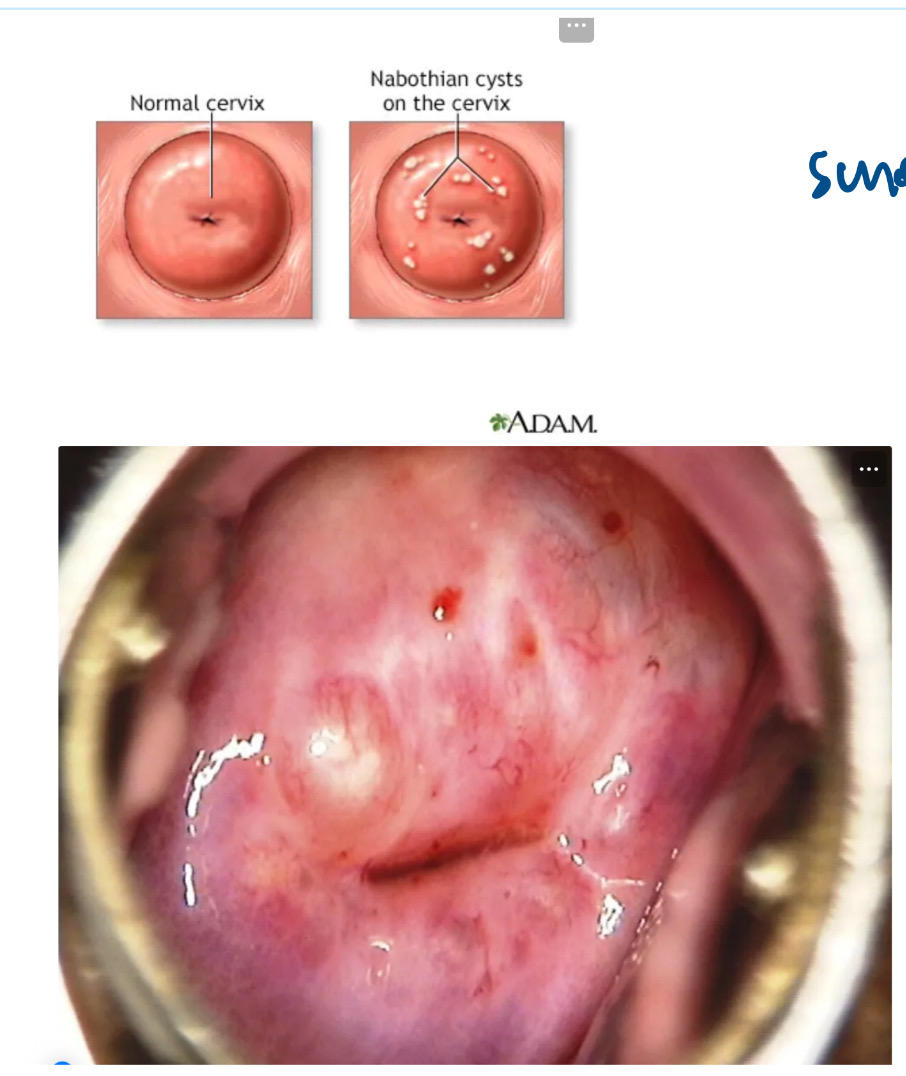
125
Nabothian cyst management
reassure women if diagnosis is clear, no tx required as resolves spontaneously.
if unclear, refer for colposcopy and take biopsy to exclude other pathologies
if unclear, refer for colposcopy and take biopsy to exclude other pathologies
126
Bartholins cysts what is it
Bartholins glands are a pair of glands located on either side of the posterior vaginal introitus. These produce mucus for lubrication. If these ducts become blocked = bartholin cyst formation usually unilateral.
These cysts can become infected and lead to an abscess formation
These cysts can become infected and lead to an abscess formation
127
Bartholins cyst management
Conservative: resolves with good hygiene, analgesia and warm compress. usually avoid incision due to reoccurence risk. Biopsy taken if vulval malignancy needs to be avoided
Medical: ABx given depending on sensitivities, most commonly E.coli
Surgical: Word catheter is inserted under LA to drain pus from abscess and then filled with saline to keep space and prevent reoccurence. These are held in place until the tissue heals around the catheter when they can be removed afterwards
Medical: ABx given depending on sensitivities, most commonly E.coli
Surgical: Word catheter is inserted under LA to drain pus from abscess and then filled with saline to keep space and prevent reoccurence. These are held in place until the tissue heals around the catheter when they can be removed afterwards
128
Lichen sclerosis what is it
chronic inflammatory skin condition that presents with patches of shiny, “porcelain-white” skin, commonly on the labia, perineum and perianal skin.
129
Lichen sclerosis: clinical features
45-60yr old px with vulval itching and skin changes, Affected skin may appear shiny, tight, thin, slightly raised, papules or plaques may be present 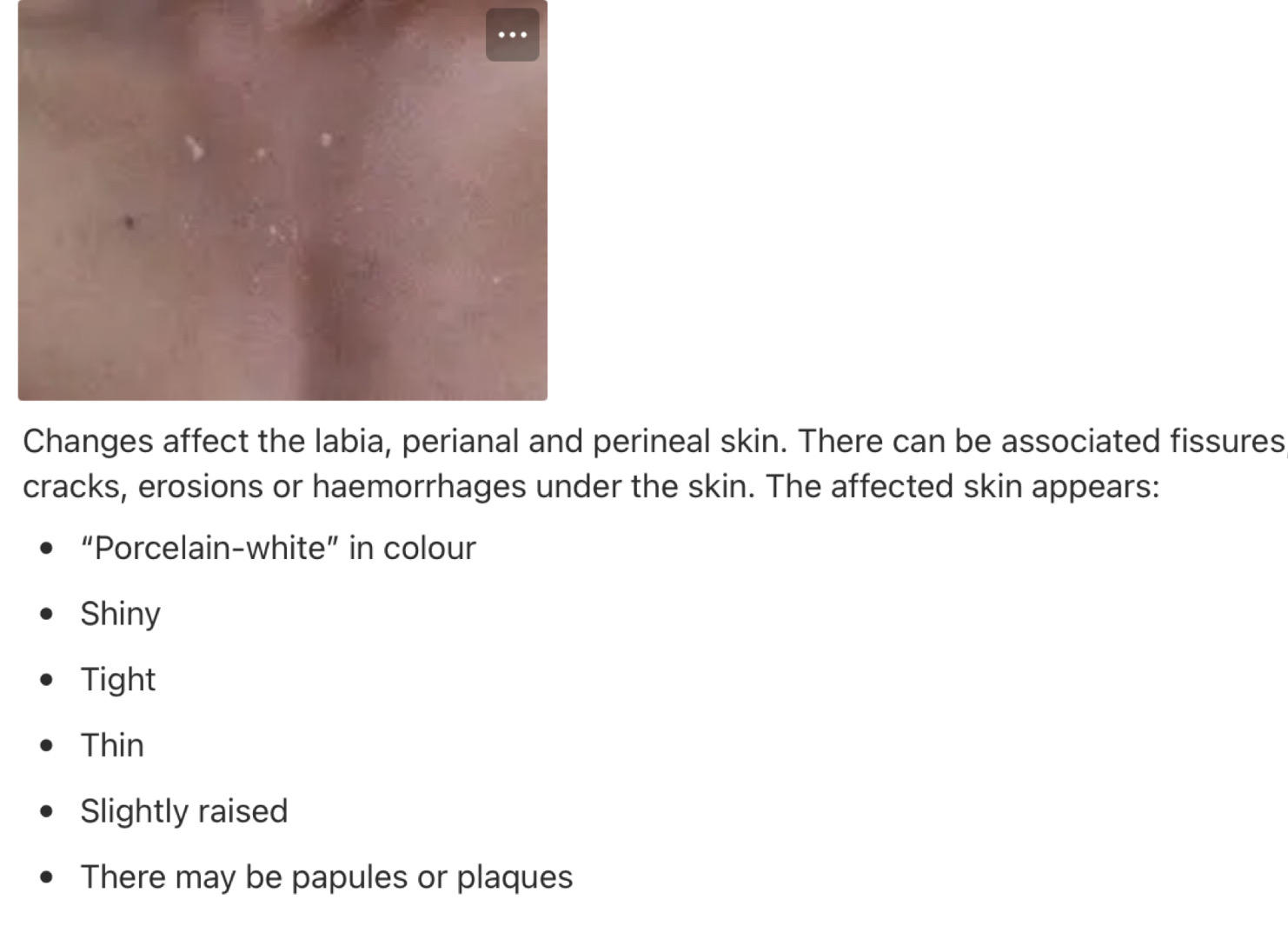
130
Lichen sclerosis investigations
made on clinical grounds but can take biopsy if atypical features occur. Histological examination is advisable as well if there are atypical features or any suspicion of neoplastic changes.
Biopsy taken if there is suspicion of neoplastic change OR failure of Tx, extragenital lichen sclerosus with overlap of morphoen OR pigmented areas OR second line therapy is needed
Biopsy taken if there is suspicion of neoplastic change OR failure of Tx, extragenital lichen sclerosus with overlap of morphoen OR pigmented areas OR second line therapy is needed
131
Lichen sclerosis management
cannot be cured, control sx and follow up every 3-6 months via GYN or dermatologist
Emollients can be used, topical steroids like clobetasol propionate can be used
Emollients can be used, topical steroids like clobetasol propionate can be used
132
Androgen insensitivity syndrome what is it
cells unable to respond to androgen hormones due to lack of receptors [x linked recessive condition]. Patients will be genetically male but will appear female externally. Testes may be in the abdomen, will lack a uterus, cervix, ovaries, vagina.
Px will be infertile with increased testicular cancer risk and inguinal hernias
Px will be infertile with increased testicular cancer risk and inguinal hernias
133
Androgen insensitivity syndrome investigations
Bloods will show raised LH and FSH. There will be very high oestrogen for a male. Chromosomal analysis will show 46XY genotype
134
Androgen insensitivity syndrome management
Specialist MDT approach.
Bilateral orchidectomy to avoid tumours, oestrogen therapy, vaginal surgery / dilation
Bilateral orchidectomy to avoid tumours, oestrogen therapy, vaginal surgery / dilation
135
ovarian cancer presentation
in women 50 or over of age, if they have IBS sx in the last 12 months, suspects ovarian cancer