Lenses - 12.3
Study these flashcardsFree · spaced repetition · iPhone, Android, Mac & web
All cards
1
What are the 2 types of lenses?
Converging lens and diverging lens
2
What is converging lens?
A piece of glass which is thicker at the centre and thinner at the edges. - Light rays come together
3
What is a diverging lens?
A piece of glass which is thinner at the centre and thicker at the edges. - Light rays separate
4
What is the optical center?
Optical center, O, is the center of the lens
5
What is the principal axis?
It is the horizontal line that passes through the optical center of lens
6
What is the focal point?
Focal point, F, is a point where all rays parallel to the principal axis converge to
7
What is the focal length?
It is the distance between the focal point and optical center
8
What is the focal plane?
It is a plane through the focal point and is perpendicular to the principal axis
9
What are the 3 ways in which a principal ray can behave
1. Any incident ray passing through the optical centre, does not bend.
2. Any incident ray parallel to the principal exis is refracted to pass through the focal point
3. Any incident ray passing through the focal point is refracted parallel to the principal axis after it hits the lens
2. Any incident ray parallel to the principal exis is refracted to pass through the focal point
3. Any incident ray passing through the focal point is refracted parallel to the principal axis after it hits the lens
10
What are the 3 characteristics of an image?
1. Inverted or upright 2. Real or Virtual 3, Magnified, same size or diminished
11
In a ray diagram, how do you show that the object is inverted?
By drawing an arrow facing downwards
12
In a ray diagram how do you show that the object is of a different size
By drawing the length of the arrow shorter or longer depending on the size
13
In a ray diagram, how do you show whether the object is virtual
By drawing the object behind the lens if it’s virtual with dotted lines
14
How to draw a ray diagram IF the object is visible behind the lens AND the distance is GREATER than f or focal length?
Draw 1 line straight from the top of the object through the optical center of the lens and beyond. Draw another line parallel to the principal axis and once it hits the lens, refract it such that it MEETS the 1st light ray while also going through the focal point
15
How to draw a ray diagram IF the object is visible behind the lens AND the distance is EXACTLY at f or focal length?
Draw 1 line straight from the top of the object through the optical center of the lens and beyond, Draw another line parallel to the principal axis and once it hits the lens, refract it such that it’s PARALLEL to the 1st light ray while also going through the focal point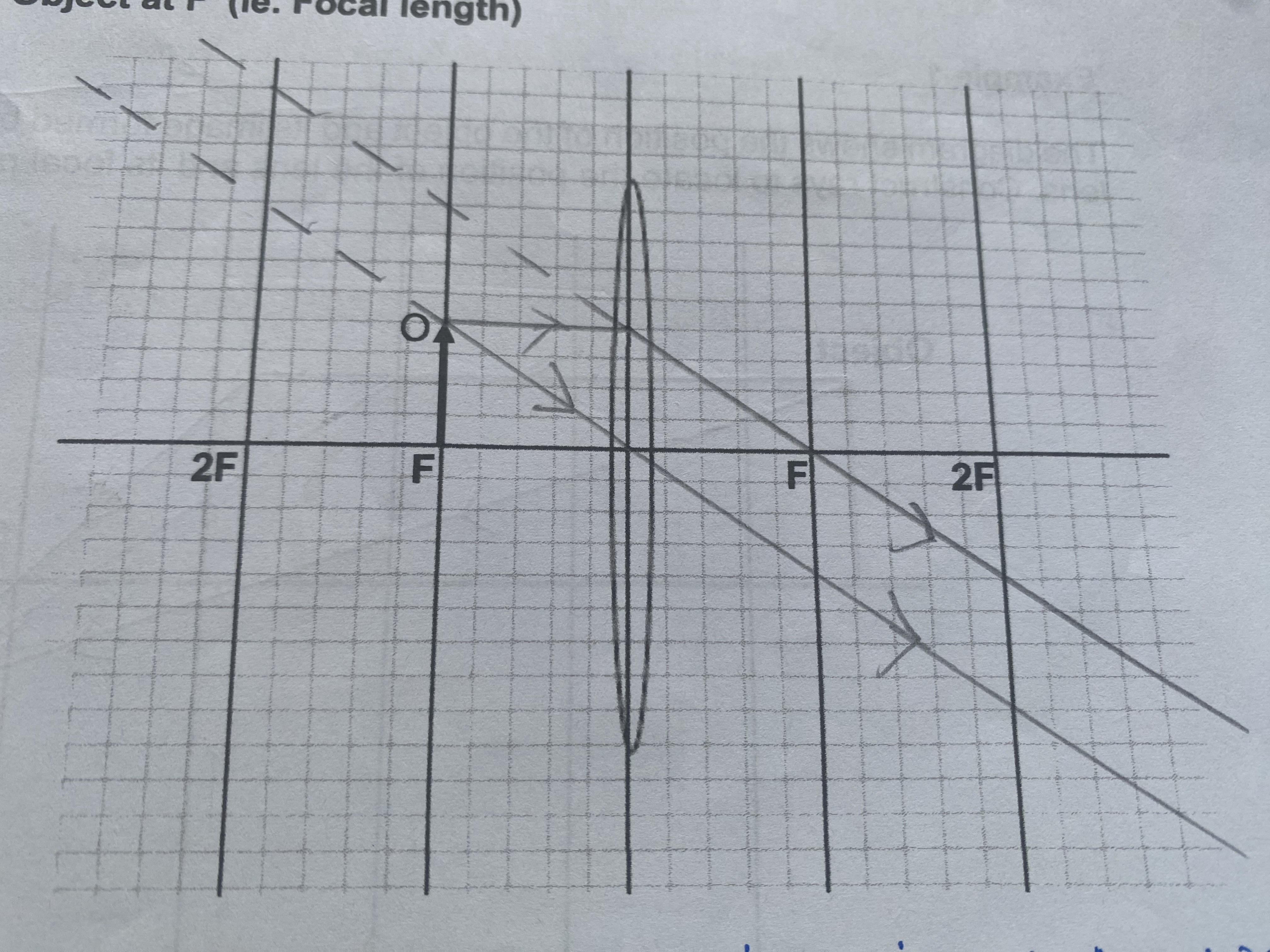
16
How to draw a ray diagram IF the object is at infinity AND the light rays are parallel to the principal axis
Refract both light rays to the focal point after they hit the lens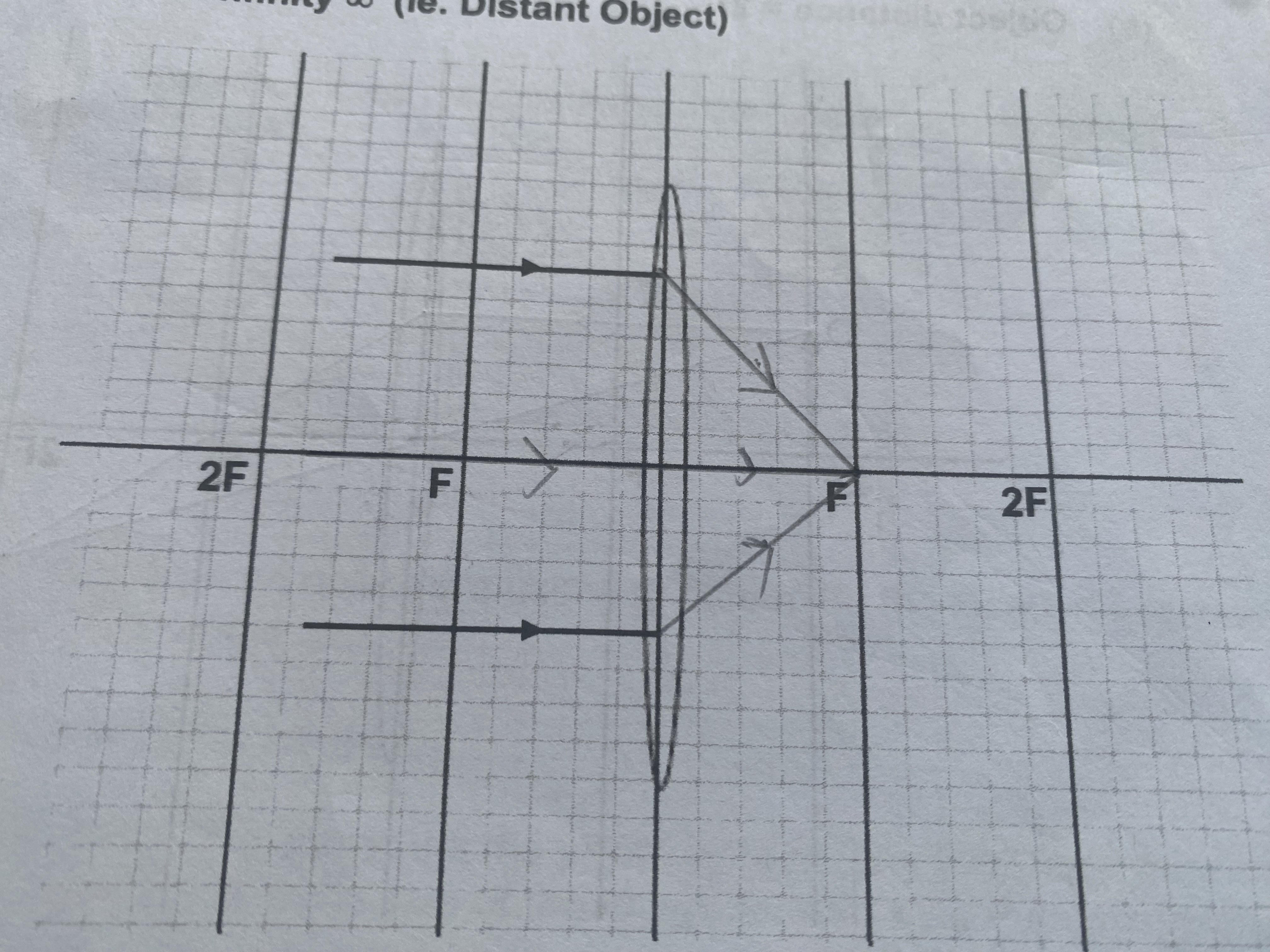
17
How to draw a ray diagram IF the object is at infinity AND the light rays are NOT parallel to the principal axis
1. Draw a light ray parallel to the other 2 light rays that goes through the optical center of the lens and hits the focal point 2. Refract the other 2 light rays to that middle light ray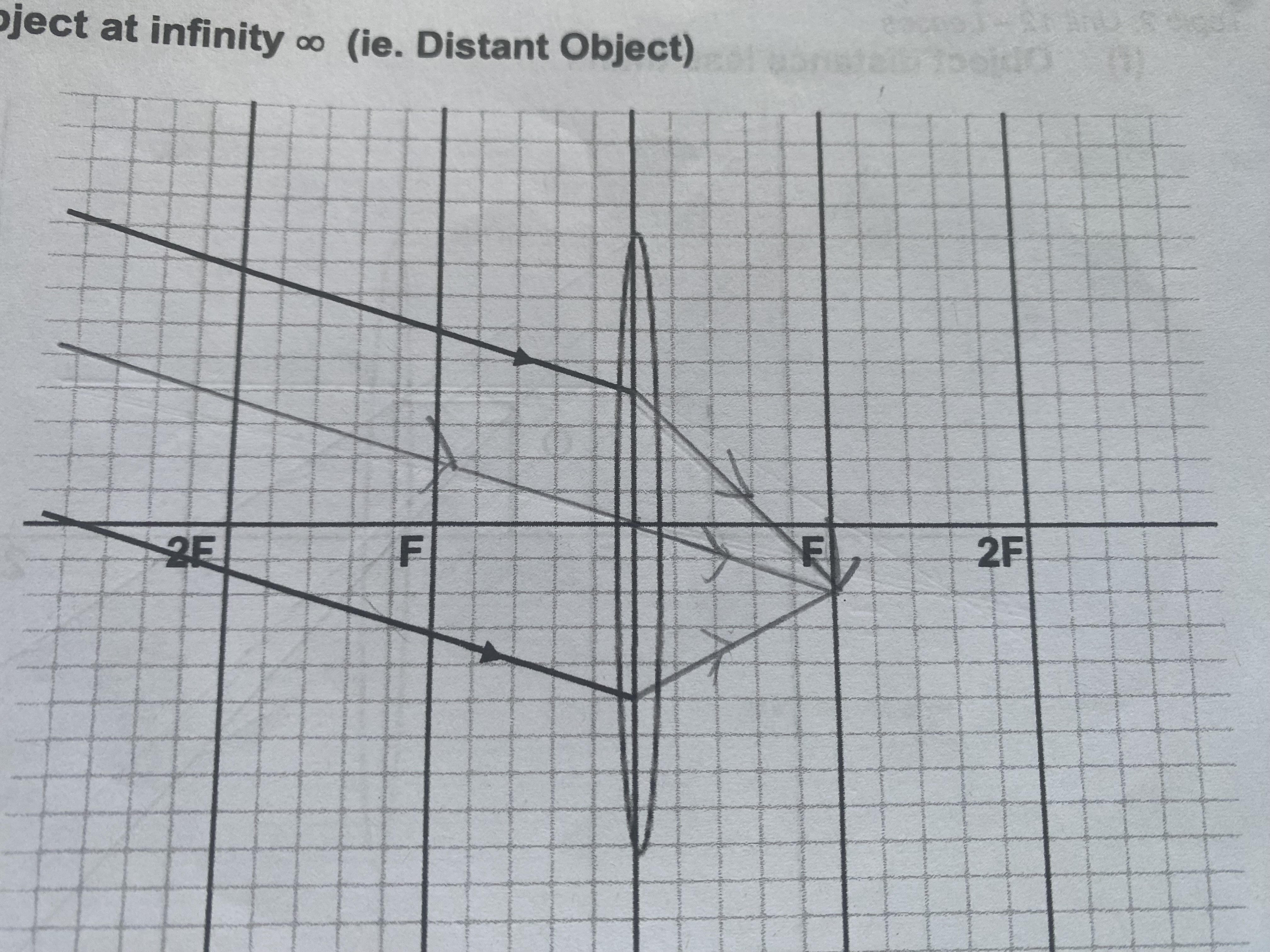
18
How to draw a ray diagram IF the object distace is at less than f or focal length?
1. Draw 1 line straight from the top of the object through the optical center of the lens and beyond, Draw another line parallel to the principal axis and once it hits the lens, refract it such that it hits the focal point. 2. Draw dotted lines behind the lens from these lines until they meet, that is now the image with the arrow also drawn as dotted lines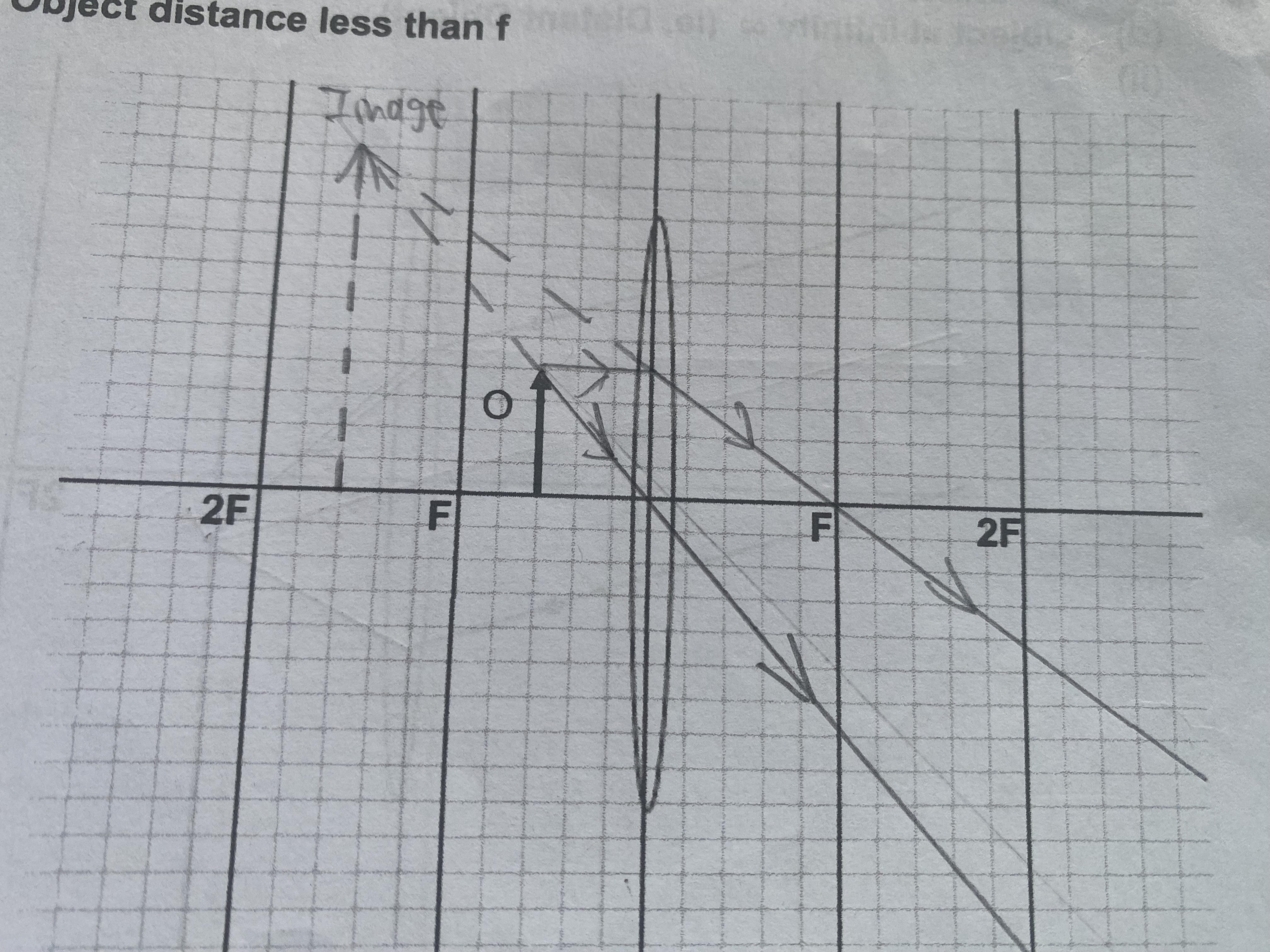
19
What’s a usecase for lenses with object distance greater than 2f and the type of image made
camera; inverted, real, diminished
20
What’s a usecase for lenses with object distance equal 2f and the type of image made
photocopier making same sized copy; inverted, real, same size
21
What’s a usecase for lenses with object between f and 2f and the type of image made
projector, photo enlarger; inverted, real, magnified
22
What’s a usecase for lenses with object distance at f and the type of image made
spotlight; upright, virtual, magnified
23
What’s a usecase for lenses with object distance less than f and image type
magnifying glass; upright, virtual, magnified