Intro to Psychology Test 1
Study these flashcardsFree · spaced repetition · iPhone, Android, Mac & web
All cards
1
How can critical thinking help you evaluate claims in the media, even if you're not a scientific expert on the issue?
By encouraging you to ask questions.
2
As scientists, psychologists
- Reject evidence that competes with traditional findings
- Are willing to ask questions and to reject claims that cannot be verified by research
- Keep their methods private so others will not repeat their research.
- Assume the truth of articles published in leading scientific journals
3
In 1879, in psychology's first experiment, __________ __________ and his students measured the time lag between hearing a ball hit a platform and pressing a key
William Wundt
4
William James would be considered a(n) ________. Wilhelm Wundt would be considered a(n) ______.
- Evolutionairy theorist; structuralist
- Structuralist; functionalist
- Functionalist; evolutionary theorist
- Functionalist; structuralist
5
In the early twentieth century, _____ redefined psychology as "the scientific study of observable behavior."
- John B. Watson
- Abraham Maslow
- Sigmund Freud
- William James
6
Nature is to nurture as
- Psychological traits are to behaviors
- Intelligence is to biology
- Biology is to experience
- Personality is to intelligence
7
"Nurture works on what nature provides." Describe what this means, using your own words.
The effects of the environment can only affect what you have been given genetically. If you were born with genetics predisposing you to lower intelligence, no amount of education will be able to raise your intelligence beyond that bar.
8
Which of the following is true regarding gender differences and similarities?
- Both similarities and differences among the genders depend more on biology than on
environment. - Despite some gender differences, the underlying processes of human behavior are the
same. - Gender differences are so numerous that it is difficult to make meaningful comparisons.
- Differences among the gender outweigh any similarities.
9
________ _______________ is the principle that our mind processes information on two tracks at the same time -- one with our full awareness and the other outside of our awareness.
Dual Processing
10
A psychologist treating emotionally troubled adolescents at a local mental health agency is most
likely to be a(n)
likely to be a(n)
- Research psychologist
- Psychiatrist
- Clinical psychologist
- Industrial-organizational psychologist
11
A mental health professional with a medical degree who can prescribe medication is a _________.
Psychiatrist
12
Martin Seligman and other researchers who explore various aspects of human flourishing refer to
their field of study as _____ ______.
their field of study as _____ ______.
Positive psychology
13
__________ _______ refers to our tendency to perceive events as predictable and obvious after the fact.
Hindsight bias
14
A theory-based prediction is called a(n) ______.
Hypothesis
15
Which of the following is NOT one of the descriptive methods psychologists use to observe and
describe behavior?
describe behavior?
- A phone survey
- Naturalistic observation
- A case study
- Correlational research
16
For your survey, you need to establish a group of people who represent the country’s entire adult
population. To do this, you will need to question a ___________________ sample of the
population.
population. To do this, you will need to question a ___________________ sample of the
population.
random (representative)
17
A study finds that the more childbirth training classes women attend, the less pain medication
they require during childbirth. This finding can be stated as a _________ (positive/negative)
correlation.
they require during childbirth. This finding can be stated as a _________ (positive/negative)
correlation.
negative
18
Knowing that two events are correlated provides
- An explanation of why the events are related
- An indication that an underlying third variable is at work
- Proof that as one increases, the other also increased
- A basis for prediction
19
To explain behaviors and clarify cause and effect, psychologists use ________.
Experiments
20
To test the effect of a new drug on depression, we randomly assign people to control and
experimental groups. Those in the control group take a pill that contains no medication. This pill is a _______.
experimental groups. Those in the control group take a pill that contains no medication. This pill is a _______.
Placebo
21
In a double-blind procedure,
- someone separate from the researcher will ask people to volunteer for the experimental group or the control group.
- only the participants know whether they are in the control group or the experimental group.
- neither the participants nor the researchers know who is in the experimental group or control group.
- experimental and control group members will be carefully matched for age, sex, income, and education level.
22
A researcher wants to know whether noise level affects workers’ blood pressure. In one group, she varies the level of noise in the environment and records participants’ blood pressure. In this experiment, the level of noise is the ________ _______.
independent variable
23
The laboratory environment is designed to
- Re-create psychological forces under controlled conditions
- Reduce the use of animals and humans in psychological research.
- Re-create psychological forces under random conditions
- Exactly re-create the events of everyday life
24
What do psychologists mean when they say the brain is "plastic"
Psychologists use the term "plastic" to describe the brain's neuroplasticity, its ability to change and reorganize itself. This can occur by building new neural pathways based on new information or by reorganizing after damage:*\
25
The neuron fiber that passes messages through its branches to other neurons or to muscles and
glands is the _____.
glands is the _____.
axon
26
The tiny space between the axon of one neuron and the dendrite or cell body of another is called
the
the
- Synaptic gap
- Axon terminal
- Branching fiber
- Threshold
27
Regarding a neuron's response to stimulation, the intensity of the stimulus determines
- How intense an impulse will be
- How fast an impulse is transmitted
- Whether or not an impulse is generated
- Whether reuptake will occur.
28
In a sending neuron, when an action potential reaches a terminal branch, the impulse triggers the
release of chemical messengers called ______________.
release of chemical messengers called ______________.
neurotransmitters
29
Endorphins are released in the brain in response to
- The all-or-none response
- Pain or vigorous exercise
- All of the above
- Morphine or heroin
30
The autonomic nervous system
- Monitors sensory input and triggers motor output.
- Is a voluntary system under our conscious control.
- Is also referred to as the skeletal nervous system
- Controls the glands and the muscles of our internal organs
31
The sympathetic nervous system arouses us for action and the parasympathetic nervous system
calms us down. Together, the two systems make up the ______ nervous system.
calms us down. Together, the two systems make up the ______ nervous system.
autonomic
32
The neurons of the spinal cord are part of the ________ nervous system
central
33
The most influential endocrine gland, known as the master gland, is the
- Pituitary
- Pancreas
- Hypothalamus
- Thyroid
34
The ______ ______ secrete(s) epinephrine and norepinephrine, helping to arouse the body during
times of stress
times of stress
adrenal glands
35
The part of the brainstem that controls heartbeat and breathing is the
- Medulla
- Cerebellum
- Thalamus
- Cortex
36
The thalamus functions as a
- Sensory control center
- Breathing regulator
- Balance center
- Memory bank
37
The lower brain structure that governs arousal is the
- medulla
- Spinal cord
- Cerebellum
- Reticular formation
38
The part of the brain that coordinates voluntary movement and enables nonverbal learning and
memory is the ________.
memory is the ________.
cerebellum
39
Two parts of the limbic system are the amygdala and the
- Cerebral hemispheres
- Thalamus
- Pituitary
- Hippocampus
40
A cat's ferocious response to electrical brain stimulation would lead you to suppose the electrode
had touched the _______.
had touched the _______.
amygdala
41
The neural structure that most directly regulates eating, drinking, and body temperature is the
- Amygdala
- Endocrine system
- Hypothalamus
- Hippocampus
42
The initial reward center discovered by Olds and Milner was located in the ___________.
hypothalamus
43
If a neurosurgeon stimulated your right motor cortex, you would most likely
- Feel a touch on the right arm
- See light
- Move your left leg
- Hear a sound
44
Which of the following body regions has the greatest representation in the somatosensory cortex?
- Upper arm
- Toes
- All regions are equally represented
- Lips
45
The "uncommitted" areas that make up about three-fourths of the cerebral cortex are called _______ _______.
association areas
46
Judging and planning are enabled by the _____ lobes.
frontal
47
The flexible brain's ability to respond to damage is especially evident in the brains of
- Split-brain patients
- Right-handed people
- Young adults
- Young children
48
An experimenter flashes the word HERON across the visual field of a man whose corpus callosum
has been severed. HER is transmitted to his right hemisphere and ON to his left hemisphere. When
asked to indicate what he saw, the man says he saw _____ but his left hand points to ____.
has been severed. HER is transmitted to his right hemisphere and ON to his left hemisphere. When
asked to indicate what he saw, the man says he saw _____ but his left hand points to ____.
Saw ON, points to HER
49
Studies of people with split brains and brain scans of those with undivided brains indicate that the left hemisphere excels in
- Processing language
- Visual perceptions
- Neurogenesis
- Making inferences
50
Damage to the brain's right hemisphere is most likely to reduce a person's ability to
- Understand verbal instructions
- Solve arithmetic problems
- Recite the alphabet rapidly
- Make inferences
51
Consciousness refers to our _________ awareness of ourselves and our environment
subjective
52
Failure to see visible objects because our attentions is occupied elsewhere is called ___________ ______.
inattentional blindness
53
Inattentional blindness is a product of our ________ attention.
selective
54
Our body temperature tends to rise and fall in sync with a biological clock, which is referred to as
the ______ _______.
the ______ _______.
circadian rhythm
55
During the N1 sleep stage, a person is most likely to experience
- Deep sleep
- Night terrors or nightmares
- Hallucinations
- Rapid eye movements
56
The brain emits large, slow delta waves during __ sleep
N3
57
As the night progresses, what happens to the REM (R) stage of sleep?
It increases in duration
58
Which of the following is NOT one of the reasons that have been proposed to explain why we need sleep?
- Sleep plays a role in the growth process
- Sleep has survival value
- Sleep helps us recuperate
- Sleep rests the eyes
59
What is the difference between narcolepsy and sleep apnea?
Narcolepsy is the sudden onset of drowsiness during the day, while sleep apnea is when a person stops breathing for periods of times while they are asleep
60
In interpreting dreams, Freud was most interested in their
- Physiological function
- Latent content, or hidden meaning
- Manifest content, or story line
- Information-processing function
61
Which dream theory best explains why we often dream of daily things we've seen or done?
The information-processing explanation of dreaming proposes that the brain activity during REM sleep enables us to sift through the daily events and activities we have been thinking about.
62
The tendency for REM sleep to increase following REM sleep deprivation is referred to as _____ _______.
REM rebound
63
Describe what's involved in critical thinking.
Thinking about sources, asking questions, how do they know this, what is intent
64
Describe the 3 parts of the scientific attitude.
1. Curiosity- Does it work
2. Skepticism - How do you know?
3. Humility - I didn't expect that, lets investigate
2. Skepticism - How do you know?
3. Humility - I didn't expect that, lets investigate
65
What event defined the start of scientific psychology?
Willhelm Wundt measuring how long it took to press a button after hearing a ball fall in 1897
66
From the 1920s until the 1960s, the two major forces in psychology were _______ and _______ psychology
behaviorism;psychoanalytic
67
How did the cognitive revolution affect the field of psychology?
Returning to the roots of psychology led to the creation of cognitive neuroscience
68
The _____________-__________ perspective in psychology focuses on how behavior and thought differ from situation to situation and from culture to culture, while the ________ perspective emphasizes observation of how we respond to and learn in different situations.
biopsychosocial-approach; behavioral
69
Clinical psychology
- studies, assesses, and treats people with psychological disorders but usally does not provide medical therapy
- works to create social and physical environments that are healthy for all
- is a branch of medicine dealing with psychological disorders
70
Psychiatry
- is a branch of medicine dealing with psychological disorders
- studies, assesses, and treats people with psychological disorders but usally does not provide medical therapy
- works to create social and physical environments that are healthy for all
71
Community Psychology
- is a branch of medicine dealing with psychological disorders
- works to create social and physical environments that are healthy for all
- studies, assesses, and treats people with psychological disorders but usally does not provide medical therapy
72
Why, after friends start dating, do we often feel that we knew they were meant to be together?
Hindsight bias
73
What does a good theory do?
organize, predict, replicate
74
Why is replication important?
Allows other researches to verify original results:*\ and determine validity :*\
75
We cannot assume that case studies always reveal general principles that apply to all of us. Why not?
Case studies only involve one individual or group.
76
What is an unrepresentative sample, and how do researchers avoid it?
A sample that does not represent a population
using random sampline is one method
using random sampline is one method
77
Negative or positive correlation:
The more husbands viewed internet pornography, the worse their marital relationships
The more husbands viewed internet pornography, the worse their marital relationships
negative
78
Negative or positive correlation:
The more time teen girls spent absorbed with online social media, the more at risk they were for
depression and suicidal thoughts
The more time teen girls spent absorbed with online social media, the more at risk they were for
depression and suicidal thoughts
Positive
79
The longer children were breast-fed, the greater their later academic achievement
Positive
80
The more leafy vegetables older adults ate, the less their mental decline over the ensuing 5 years
Negative
81
Length of marriage positively correlates with hair loss in men. Does this mean that marriage causes
men to lose their hair (or that balding men make better husbands)?
men to lose their hair (or that balding men make better husbands)?
There is likely to be a third factor that is not explained by the graph
82
What measures do researchers use to prevent the placebo effect from confusing their results?
experimental and control groups and double blind procedures
83
By using random assignment, researchers are able to control for ______ _______, which are
other variables besides the independent variable(s) that may influence research results.
other variables besides the independent variable(s) that may influence research results.
CONFOUNDING VARIABLES
84
Double-blind procedure
- Helps minimize preexisting differences between experimental and control groups
- Helps researchers generalize from a small set of survey responses to a larger population
- Controls for the placebo effect; neither researchers nor participants know who receives the real treatment
85
Random sampling
- Helps researchers generalize from a small set of survey responses to a larger population
- Helps minimize preexisting differences between experimental and control groups
- Controls for the placebo effect; neither researchers nor participants know who receives the real treatment
86
Random assignment
- Helps minimize preexisting differences between experimental and control groups
- Helps researchers generalize from a small set of survey responses to a larger population
- Controls for the placebo effect; neither researchers nor participants know who receives the real treatment
87
Why, when testing a new drug to control blood pressure, would we learn more about its effectiveness from giving it to half the participants in a group of 1000 than to all 1000 participants?
By splitting the group in half we can determine if the drug's effects were effective or entirely placebo
88
How are animal and human research participants protected?
ethical guidelines, animal protection laws, and informed consent
89
The _____ ______describes the enhanced memory that results from repeated retrieval (as in selftesting) rather than from simple rereading of new information.
testing effect
90
What does SQ3R stand for?
Survey, Question, Read, Retrieve, Review
91
How does learning a new skill affect the structure of our brain?
Learning a new skill makes the brain generate new structures, through a process known as
neuroplasticity.
neuroplasticity.
92
When a neuron fires an action potential, the information travels through the axon, the dendrites, and the cell body, but not in that order. Place these three structures in the correct order.
Dendrite, cell body, axon
93
How does our nervous system allow us to experience the difference between a slap and a tap on the
back?
back?
A slap will cause more neurons to fire and to fire more quickly than a tap on the back
94
What happens in the synaptic gap:_\?
Chemical messengers called neurotransmitters are sent into the gap and bind with receptors on the receiving neuron.
95
Serotonin, dopamine, and endorphins are all chemical messengers called ___________.
neurotransmitters
96
Motor neurons
- Carry outgoing messages from the CNS to muscles and glands.
- Carry incoming messages from sensory receptors to the CNS
- Communicate within the CNS and prcoess information between incoming and outgoing messages
97
Sensory Neurons
- Carry outgoing messages from the CNS to muscles and glands.
- Carry incoming messages from sensory receptors to the CNS
- Communicate within the CNS and prcoess information between incoming and outgoing messages
98
Interneurons
- Communicate within the CNS and prcoess information between incoming and outgoing messages
- Carry outgoing messages from the CNS to muscles and glands.
- Carry incoming messages from sensory receptors to the CNS
99
How was the ANS involved in Hawaiians' terrified responses, and in calming their bodies once they realized it was a false alarm?
Sympathetic division causes arousal (e.g., faster heartbeat, reduced digestion); parasympathetic division induces calm.
100
Why is the pituitary gland called the master gland?
receiving information from hypothalamus, it releases hormones that cause other endocrine glands to secrete.
101
How are the nervous and endocrine systems alike, and how to they differ?
Both send and receieve signals
nervous system uses nerves while endocrine system uses bloodstream and hormones
nervous system uses nerves while endocrine system uses bloodstream and hormones
102
fMRI scan
- Tracks successive images of brain tissue to show brain function:_\
- Tracks radioactive glucose to reveal brainactivity:_\
- Uses magnetic fields and radio waves to show brain anatomy:_\
103
PET Scan
- Uses magnetic fields and radio waves to show brain anatomy:_\
- Tracks radioactive glucose to reveal brainactivity:_\
- Tracks successive images of brain tissue to show brain function:_\
104
MRI Scan
- Uses magnetic fields and radio waves to show brain anatomy:_\
- Tracks successive images of brain tissue to show brain function:_\
- Tracks radioactive glucose to reveal brainactivity:_\
105
The ______ is a crossover point where nerves from the left side of the brain are mostly linked to the right side of the body, and vice versa.
brainstem
106
In what brain region would damage be most likely to disrupt your ability to jump rope:*\
cerebellum
107
In what brain region would damage be most likely to disrupt your ability to hear:*\
thalamus
108
In what brain region would damage be most likely to leave you in a coma:*\
Reticular formation
109
In what brain region would damage be most likely to cut off the very breath and heartbeat of life:*\
Medulla
110
Electrical stimulation of a cat’s amygdala provokes angry reactions, suggesting the amygdala’s role in aggression. Which autonomic nervous system division is activated by such stimulation?
Sympathetic nervous system
111
What are the three key structures of the limbic system, and what functions do they serve?
1. Amygdala -- aggression and fear
2. Hypothalamus - thirst, body temp, sexual behavior
3. Hippocampus - explicit memory
2. Hypothalamus - thirst, body temp, sexual behavior
3. Hippocampus - explicit memory
112
What function does the amygdala :*\ serve?
aggression and fear
113
What function does the Hypothalamus:*\ serve?
thirst, body temp, sexual behavior
114
What function does the hippocampus:*\ serve?
explicit memory
115
Our brain’s _______ cortex registers and processes body touch and movement sensations. The ______ cortex controls our voluntary movements.
sensory; motor
116
Why are association areas important?
They are involved in higher mental functions: interpreting, integrating, and acting
117
What three functions do association areas perform?
interpreting, integrating, and acting
118
Why would communal sleeping provide added protection for those whose safety depends upon vigilance, such as these refugees in Paris?
With each individual in their own sleep cycle, at least one will be in an easily awakenable stage
119
What are the four sleep stages, and in what order do we normally travel through those stages?
N1, N2, N3, REM
120
N1
- Fleeting images
- Minimal awareness
- Story-like dream
121
N3
- Story-like dream
- Fleeting images
- Minimal awareness
122
REM
- Minimal awareness
- Fleeting images
- Story-like dream
123
What are five proposed reasons for our need for sleep?
1. Protection
2. Recovery
3. Restore & Rebuild memories
4. Creative Thinking
5. Growth
2. Recovery
3. Restore & Rebuild memories
4. Creative Thinking
5. Growth
124
1. Protection
2. Recovery
3. Restore & Rebuild memories
4. Creative Thinking
5. Growth
2. Recovery
3. Restore & Rebuild memories
4. Creative Thinking
5. Growth
What are five proposed reasons for our need for sleep?
125
A well-rested person would be more likely to have _________ (trouble concentrating/quick reaction times) and a sleep-deprived person would be more likely to ______ (gain weight/fight off a cold).
reaction times ; gain weight
126
What are five theoretical explanations for why we dream?
1. Satisfy our own wishes
2. File away memories
3.. Develop and preserve neural pathways
4.. Make sense of neural static
5. Reflect cognitive development
2. File away memories
3.. Develop and preserve neural pathways
4.. Make sense of neural static
5. Reflect cognitive development
127
1. Satisfy our own wishes
2. File away memories
3.. Develop and preserve neural pathways
4.. Make sense of neural static
5. Reflect cognitive development
2. File away memories
3.. Develop and preserve neural pathways
4.. Make sense of neural static
5. Reflect cognitive development
What are five theoretical explanations for why we dream?
128
Two parts of the central nervous system
Brain and spinal cord
129
2 parts of the Peripheral nervous system (PNS)
Somatic & Autonomic
130
Parts of the Somatic nervous system
Sensory & Motor
131
What do Glia cells do?
Glia cells are the "glue" of the central nervous system
132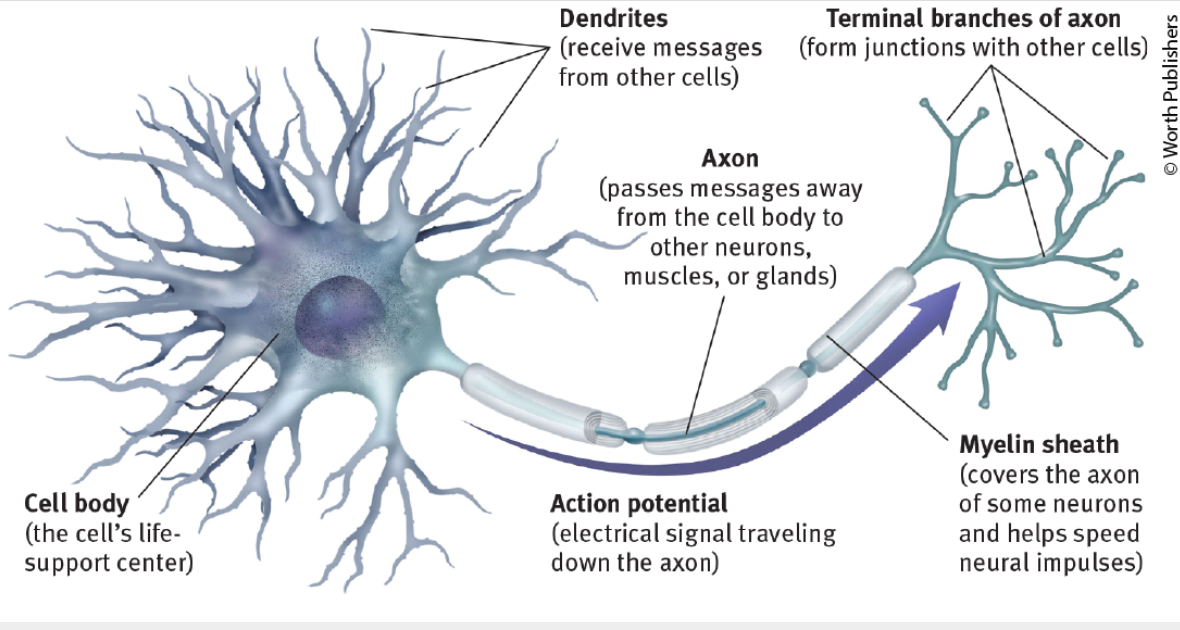
Image occlusion: name the hidden labels
133
Image occlusion: name the hidden labels
134
Image occlusion: name the hidden labels
135
Image occlusion: name the hidden labels
136
Image occlusion: name the hidden labels
137
Image occlusion: name the hidden labels
138
What is the space between the Myelin called?
saltatory conduction
139
What is the Myelin?
a fatty insulator and protector axons
140
Acetylcholine (ACh)
Excitatory EPSP, most common, positive graded potential
141
GABA
Inhibitory IPSP, negative graded potential
142
EPSP
excitatory postsynaptic potential
143
IPSP
inhibitory postsynaptic potential
144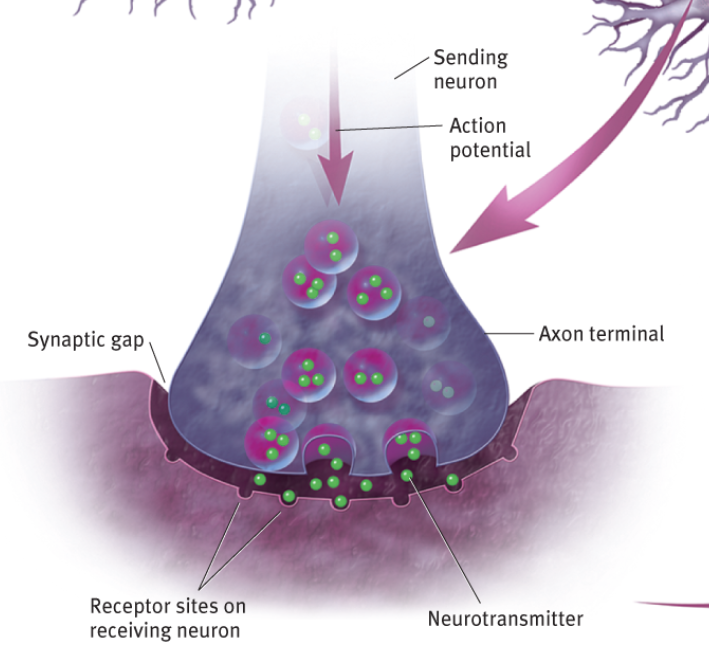
Image occlusion: name the hidden labels
145
Image occlusion: name the hidden labels
146
Image occlusion: name the hidden labels
147
Image occlusion: name the hidden labels
148
Image occlusion: name the hidden labels
149
What two hormones do the adrenal glands produce?
epinephrine and norepinephrine.
150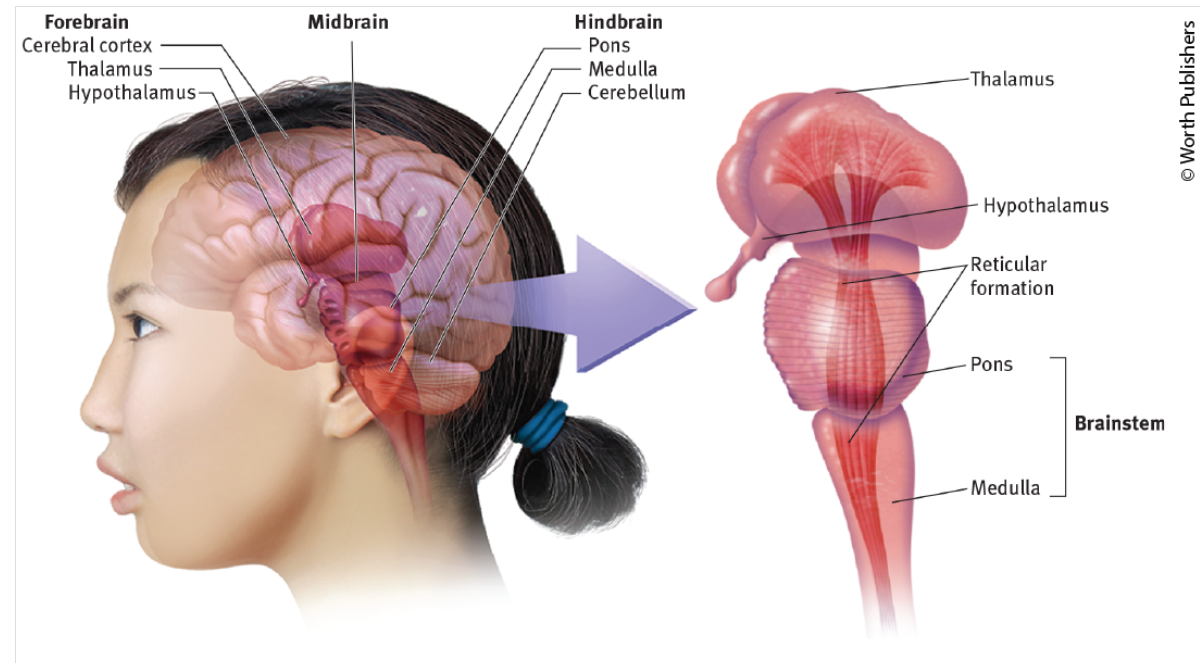
Image occlusion: name the hidden labels
151
Image occlusion: name the hidden labels
152
Image occlusion: name the hidden labels
153
Image occlusion: name the hidden labels
154
Image occlusion: name the hidden labels
155
Image occlusion: name the hidden labels
156
Image occlusion: name the hidden labels
157
Image occlusion: name the hidden labels
158
Image occlusion: name the hidden labels
159
Image occlusion: name the hidden labels
160
Image occlusion: name the hidden labels
161
Image occlusion: name the hidden labels
162
Image occlusion: name the hidden labels
163
Image occlusion: name the hidden labels
164
Image occlusion: name the hidden labels