Instrument Ground
Study these flashcardsFree · spaced repetition · iPhone, Android, Mac & web
First 300 of 338 cards
1
Select the true statement regarding flight rules terminology.
- IMC describes weather conditions in terms of visibility, distance from clouds. and ceiling equal to or greater than specified VFR minimums.
- IFR describes the rules that govern flight operations in weather conditions below VFR minimums.
- IMC describes the rules that govern flight operations in weather conditions below VFR minimums.
2
Select the true statement regarding flight simulation.
- An authorized instructor can provide part of the instrument instruction required for the instrument rating in an FSTD, but not an ATD.
- An FFS is a replica of a specific type; or make, model and series aircraft cockpit. which uses a force (motion) cueing system and visual system.
- An FTD meets the basic or advanced qualification level requirements specified in AC 61-136.
3
You may log instrument time for all the flight time during which you operate the airplane under IFR.
- True
- False
4
A person acting as a safety pilot must meet which requirement?
- Flight instructor certificate; category and class ratings appropriate to the aircraft that you are flying; current third-class medical certificate.
- Private pilot certificate; category and class ratings appropriate to the aircraft that you are flying; current third-class medical certificate.
- Private pilot certificate; category and class ratings appropriate to the aircraft that you are flying; instrument rating; current third-class medical certificate.
5
What are the recency of experience requirements to act as PIC under IFR? (Within the preceding six months)
Six instrument approaches
Holding procedures and tasks
Intercepting and tracking courses through the use of navigational electronic systems
Holding procedures and tasks
Intercepting and tracking courses through the use of navigational electronic systems
6
What are the recency of experience requirements to act as PIC under IFR? (Within the preceding two months in simulator)
Three hours of instrument experiences,
two unusual attitude recoveries while descending, Vne airspeed condition and two unusual attitude recoveries while in an ascending, stall speed condition
And the same as the regular
two unusual attitude recoveries while descending, Vne airspeed condition and two unusual attitude recoveries while in an ascending, stall speed condition
And the same as the regular
7
Under what (4) conditions may you use an FFS, FTD, or ATD to meet recency of experience requirements to act as PIC under IFR?
The device represents the category of aircraft for the instrument rating privileges
Tasks are performed under simulated IMC
You list the training device, time, and content in the logbook or training record
An authorized flight instructor must be present
Tasks are performed under simulated IMC
You list the training device, time, and content in the logbook or training record
An authorized flight instructor must be present
8
It is January 1st. Under which of these circumstances must you complete an instrument proficiency check to be current to act as PIC under IFR? During the last 12 calendar months you performed:
- Two instrument approaches in May: and four instrument approaches; holding procedures; and intercepting and tracking courses in October.
- Six instrument approaches; holding procedures; and intercepting and tracking courses in June.
- Three instrument approaches; holding procedures, and intercepting and tracking courses in May and three instrument approaches in June.
9
Which are limitations when acting as pilot in command under the BasicMed rule?
- Operations below 18,000 feet MSL only.
- VFR operations only.
- Maximum airspeed of 200 knots.
10
Explain the difference between the cone and rod cells of the retina.
Cone cells detect color while rod cells are good at seeing at night.
11
What techniques can be used to see objects better at night?
Off center viewing
12
List at least three actions you can take to preserve and improve your night vision.
Avoid bright lights
Reduce brightness of screens as the night gets darker
Use supplemental oxygen when above 4,000 feet
Reduce brightness of screens as the night gets darker
Use supplemental oxygen when above 4,000 feet
13
What is the term for the visual illusion of movement that occurs when you stare at a fixed light against a dark background for more than a few seconds?
Autokinesis
14
Which is true regarding landing illusions?
- Wide runway-illusion of greater height causing you to fly a higher-than-normal approach.
- Downsloping runway-illusion of greater height causing you to fly a lower-than-normal approach.
- Narrow runway-illusion of greater height causing you to fly a lower-than-normal approach.
15
Name the three primary sensory sources that provide you with an awareness of your body's position in space.
Visual system
Vestibular System
Somatosensory system
Vestibular System
Somatosensory system
16
Explain why your vestibular system does not sense any motion during a prolonged constant-rate turn.
Because the motion detecting hairs stops detecting motion because the fluid reaches equilibrium
17
Name at least two ways to help prevent or alleviate motion sickness.
Focus on the horizon in VFR
Focus on the instrument panel in IFR
Focus on the instrument panel in IFR
18
Hypoxic Hypoxia
inadequate supply of oxygen
19
inadequate supply of oxygen
Hypoxic Hypoxia
20
Hypemic Hypoxia
the inability of the blood to carry oxygen
21
the inability of the blood to carry oxygen
Hypemic Hypoxia
22
Stagnant Hypoxia
Insufficient blood circulation of oxygen
23
Insufficient blood circulation of oxygen
Stagnant Hypoxia
24
Histotoxic Hypoxia
Caused by alcohol, drugs, or poisons
25
Hypoxia caused by alcohol, drugs, or poisons
Histotoxic Hypoxia
26
What are the supplemental oxygen requirements?
Crew must use supplemental oxygen above 12,500 MSL after 30 minutes, and continuously above 14,000MSL, and above 15,000 each occupant must be provided oxygen.
27
Select the true statement regarding high-altitude training.
- You must pass a knowledge and practical test to operate a pressurized airplane with a service ceiling or maximum operating altitude higher than 25,000 feet
- You must complete this training prior to operating a pressurized airplane, with a service ceiling or maximum operating altitude higher than 20,000 feet MSL
- High-altitude training includes flight training in emergency procedures for simulated rapid decompression and ground training on subjects such MSL. respiration, hypoxia, and the use of supplemental oxygen.
28
Select the true statement regarding ear and sinus block during flight.
- Pressure in the ear can be equalized by performing the Valsalva maneuver holding the nose and mouth shut and forcibly exhaling.
- During descent, high pressure in the middle ear typically opens the eustachian tube to equalize the pressure.
- Rapid descent rates can help increase the pressure differential between the auditory canal and the middle ear helping to open the eustachian tube.
29
How would you treat a passenger who is suffering from hyperventilation?
Recommend the passenger slow their breathing rate, talk aloud, or breath in a paper bag.
30
In addition to pressure effects and motion sickness, name at least three factors that can impair your fitness for flight.
Stress
Fatigue
Dehydration
Alcohol and drugs
Hypothermia
Fatigue
Dehydration
Alcohol and drugs
Hypothermia
31
Select the true statement regarding alcohol.
- The FARs state that you must not fly within 12 hours of using alcohol.
- The body requires about 1 hour to rid itself of all the alcohol contained in one mixed drink or one beer.
- According to the FARs, you may not fly when you have a blood alcohol level of .04% or greater.
32
OSUN
Overshoot south, undershoot north
33
ANDS
Accelerate North, Decelerate South
34
What flight instruments are required for flight under IFR?
Generator/Alternator
Radios (nav and communication)
Altimeter (Sensitive and adjustable)
Ball (slip/skid indicator)
Clock (installed, displaying seconds)
Attitude Indicator
Rate of Turn indicator
Directional Gyro
Radios (nav and communication)
Altimeter (Sensitive and adjustable)
Ball (slip/skid indicator)
Clock (installed, displaying seconds)
Attitude Indicator
Rate of Turn indicator
Directional Gyro
35
Name the gyroscopic flight instruments.
Attitude indicator
Heading indicator
Turn coordinator
Heading indicator
Turn coordinator
36
Which flight instrument gives you an instantaneous display of both pitch and bank information ?
Attitude indicator
37
True/False. The gyroscopic instruments are the only flight instruments that provide
bank information.
bank information.
- False
- True
38
Why is the turn coordinator a good backup for the attitude and heading indicators in most small airplanes?
The turn coordinator is electrically powered while the other two are vacuum powered
39
What is the approximate bank angle required to maintain a standard-rate turn at 90 knots?
14 degrees
40
How do you calculate required bank angle for a standard-rate turn?
(TAS / 10) + 5
41
How long does it take to make a 360 degree standard-rate turn?
- Two minutes
- One minute
- Four minutes
42
Assume the pilot is applying rudder pressure in the direction of the turn. Which turn coordinator shows too much rudder pressure being used for the amount of bank? 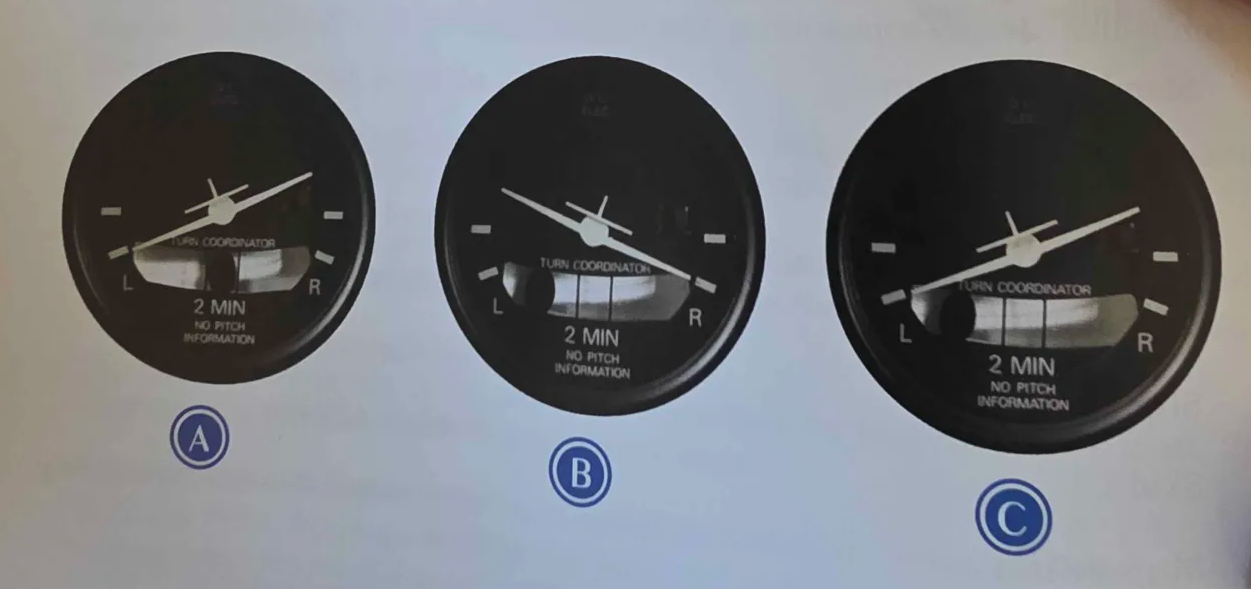
- B
- A
- C
43
9. Assume the pilot is applying rudder pressure in the direction of the turn. Which turn coordinator shows too little rudder pressure being used for the amount of bank? 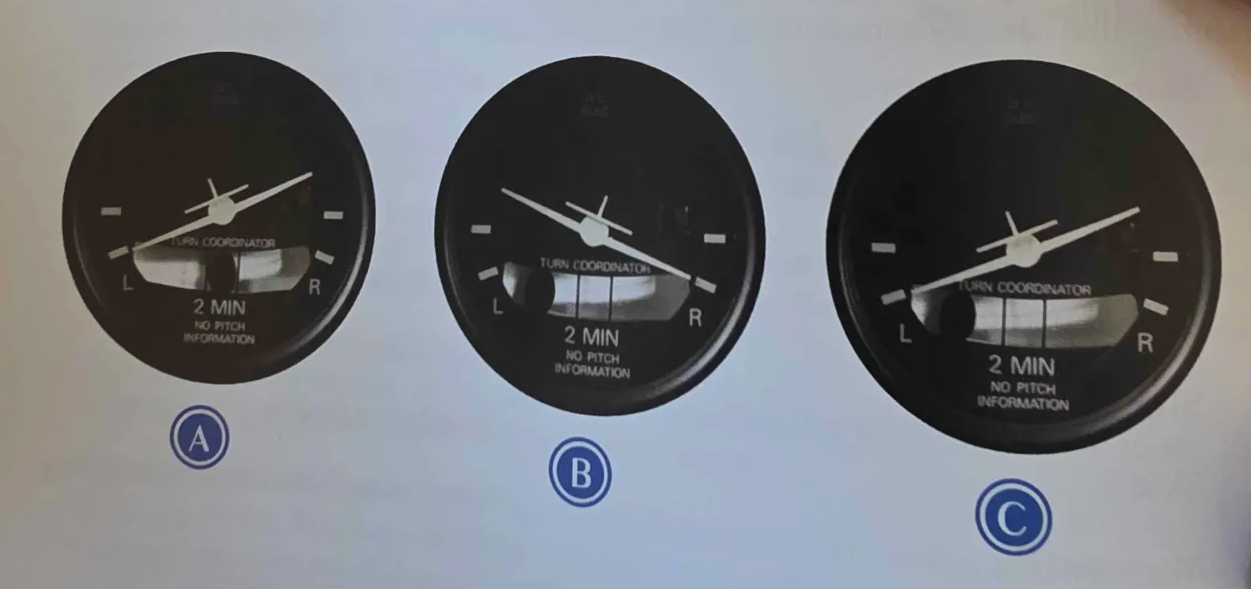
- B
- C
- A
44
What condition leads to unreliable operation of the heading indicator and attitude indicator?
- Short in the electrical system
- Pitot-static system leak
- Low vacuum pressure
45
What should you use to correct for magnetic deviation?
- Compass correction card
- Adjustment knob on the heading indicator
- Variation lines on instrument charts
46
During a compass turn, what heading should you use for roll-out if making a right turn to a heading of 360° degrees at a latitude of 45°N? Assume you are using a 16° bank angle.
307°
47
$V_{LO}$
Maximum landing gear operating speed
48
$V_{A}$
Design Maneuvering speed
49
$V_{S1}$
Stall speed in clean config
50
indicated altitude
The altitude you read from the altimeter
51
The altitude you read from the altimeter
indicated altitude
52
pressure altitude
Altitude displayed on the altimeter when it is set to 29.92 or above 18,000ft
53
Altitude displayed on the altimeter when it is set to 29.92 or above 18,000ft
pressure altitude
54
density altitude
Pressure altitude corrected for nonstandard temperature
55
Pressure altitude corrected for nonstandard temperature
density altitude
56
true altitude
Actual height of an object above mean sea level
57
Actual height of an object above mean sea level
true altitude
58
How does colder-than-standard temperature affect the relationship between indicated altitude and true altitude?
Indicated altitude is higher than true altitude when the temperature is lower than standard.
59
What does the airpseed indicator show if the ram air is clogged?
Zero
60
What happens to the airspeed indicator when the ram air and drain hole become plugged
The airspeed will remain constant unless a change in altitude occurs, it will act like an altimeter if the static port is unclogged
61
What is the acronym to remember common in-flight illusions?
ICEFLAGS
62
ICEFLAGS
Inversion
Coriolis
Elevator
False Horizon
Leans
Autokinesis
Graveyard Spiral
Somatogravic illusions
Coriolis
Elevator
False Horizon
Leans
Autokinesis
Graveyard Spiral
Somatogravic illusions
63
Narrow runway illusion + approach
Illusion: Greater height
Approach: Lower than normal
Approach: Lower than normal
64
Wide runway
Illusion: less height
Approach: higher than normal
Approach: higher than normal
65
Upsloping runway
Illusion: Greater height
Approach: lower than normal
Approach: lower than normal
66
Down sloping runway
Illusion: Less height
Approach: Higher than normal
Approach: Higher than normal
67
What are the names of the three semicircular canals in the vestibular system?
Anterior, Posterior, Lateral
68
To fly IFR in uncontrolled airspace, which of the following is NOT required?
- Instrument rating for the aircraft
- An ATC clearance
- A two-way radio
- Instrument rating for the pilot
69
If you have a current medical certificate but suddenly develop a condition like heart palpitations, what is your legal obligation?
- You are good to fly until the certificate expires.
- You must notify the FAA within 48 hours.
- You are required by regulations to self-ground.
- You can fly as long as a safety pilot is present
70
.Describe the function of the AHRS.
An attitude and heading reference system.
Provides attitude, heading, rate of turn, and slip/skid
Provides attitude, heading, rate of turn, and slip/skid
71
Select the true statement regarding the digital attitude indicator.
- The turn-rate vector located on the roll scale indicates standard-rate turns.
- In a slip, the trapezoid of the slip/skid indicator located beneath the roll pointer moves to the inside of the turn.
- The roll scale reference marks are at 10, 25, 45, and 60 degrees.
72
What information is provided by the trend vector on the HSI?
The end of the trend vector shows what the airplane's heading will be after 6 seconds.
The index marks 18 degrees to provide reference for a standard rate turn
The index marks 18 degrees to provide reference for a standard rate turn
73
If the AHRS detects a problem with the integrity of the sensor information, what occurs?
- After an alert message appears, you must determine the affected instrument by comparing the indications of all instruments.
- The system reverts to reversionary mode and PFD information is displayed on the MFD.
- A red X is placed over the display of the affected instrument (attitude indicator or HSI)
74
Select the true statement about the ADC.
- The pitot tube, static source, and outside air temperature probe provide information to the ADC.
- The failure of a single sensor affects every instrument that receives information from the ADC.
- The ADC determines the readings for the airspeed indicator, attitude indicator, and altimeter.
75
What is true about the indications on the altimeter?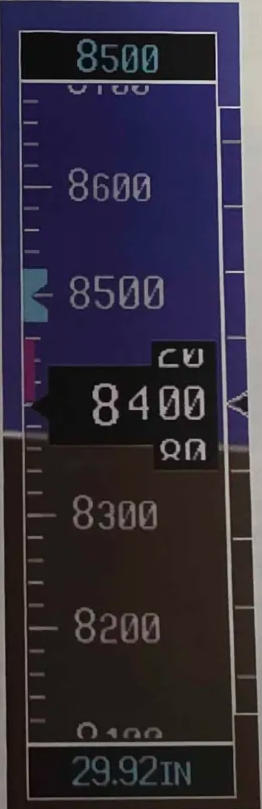
- In ten seconds, the airplane will reach an altitude of 8,460 feet MSL if it continues to climb at the same rate.
- In six seconds, the airplane will reach an altitude of 8,500 feet MSL if it continues to climb at the same rate.
- In six seconds, the airplane will reach an altitude of 8,460 feet MSL if it continues to climb at the same rate.
76
Describe how the electronic flight display system compensates for a screen failure of the PFD.
It will switch to revisionary mode and the non-failed screen will become the PFD
77
An enhanced flight vision system (EFVS) can be displayed on a PFD.
- True
- False
78
Describe at least three functions of a typical MFD.
Moving map display
Waypoints
Nearest
Waypoints
Nearest
79
Select the true statement regarding autopilot operation.
- The flight director is comprised of a set of servo actuators that perform the control movement.
- Flight director command bars displayed on the HSI of the PFD provide navigation course guidance.
- After engaging the autopilot, you should verify that the selected modes appear on the annunciator panel.
80
What acronym helps you to remember the minimum required instruments and equipment for IFR flight?
GRABCARD
81
GRABCARD
Generator/Alternator
Radios (nav and communication)
Altimeter (Sensitive and adjustable)
Ball (slip/skid indicator)
Clock (installed, displaying seconds)
Attitude Indicator
Rate of Turn indicator
Directional Gyro
Radios (nav and communication)
Altimeter (Sensitive and adjustable)
Ball (slip/skid indicator)
Clock (installed, displaying seconds)
Attitude Indicator
Rate of Turn indicator
Directional Gyro
82
What is the Lead/lag equation?
$Direction - (Latitude + (bank angle/2))$
83
What causes a slip?
Insufficient rudder pressure
84
What causes a skid?
Too much rudder pressure
85
Compass Variation
the angular difference between the tru and magnetic north poles. Varies by location.
86
Compass Deviation
Error due to magnetic or electrical interference with metal/electrical components in the aircraft.
87
Calibrated airspeed
Indicated airspeed corrected for installation and instrument errors.
88
A standard rate turn is how many degrees per second?
- 5
- 10
- 3
89
What is responsible for most significant compass errors?
- Magnetic Ridgity
- Magnetic Precession
- Magnetic Dip
90
What four conditions must be met to fly in IMC within controlled airspace according to FAR 91.173?
The pilot and aircraft must be instrument-rated, an IFR flight plan must be filed, and an ATC clearance must be received.
91
What is the key difference regarding ATC clearance when flying in IMC in uncontrolled airspace versus controlled airspace?
No ATC clearance is required to fly in IMC in uncontrolled airspace.
92
What is the colloquial name for FAR 91.13, which prohibits operating an aircraft in a manner that endangers life or property?
The "careless or reckless operation" rule.
93
For the purpose of instrument currency, if a pilot has not met the recency requirements in the last six calendar months, what is the next period of time called where they can regain currency with a safety pilot?
The six-month grace period.
94
If a pilot's instrument currency has lapsed for more than 12 calendar months, what must they complete to act as PIC under IFR?
An Instrument Proficiency Check (IPC) with a CFII or other authorized person.
95
"To log an instrument approach in actual IMC, the pilot only needs to be in IMC until passing which point of the approach?"
The Final Approach Fix (FAF)
96
"A safety pilot used for currency flights must be at least a private pilot with category and class ratings appropriate for the aircraft, but do they need to be instrument rated or current?"
No, the safety pilot does not need to be instrument rated or current for a flight in VMC.
97
"The _____ program at FAAsafety.gov is an effective way to maintain proficiency, and completing a phase can satisfy flight review requirements."
WINGS Pilot Proficiency Program
98
"What illusion occurs during a constant rate turn when a pilot moves their head too fast, creating a sensation of tumbling or turning on a different axis?
The Coriolis illusion.
99
"A loss of altitude during a prolonged, constant-rate turn may be interpreted as a wings-level descent, leading to what dangerous illusion?
graveyard spiral
100
An abrupt correction from a bank can create the sensation of banking in the opposite direction. What is this illusion called?
The leans.
101
The illusion of being in a nose-high attitude caused by rapid acceleration during straight-and-level flight is known as the _____ illusion.
somatogravic
102
"What is the term for the illusion caused by an abrupt change from a climb to straight-and-level flight, creating a feeling of tumbling backwards?"
Inversion illusion.
103
"What type of hypoxia is caused by carbon monoxide poisoning, where the blood is unable to carry sufficient oxygen?"
Hypemic hypoxia.
104
"Oxygen deficiency due to poor circulation, such as from pulling excessive positive Gs, is known as what type of hypoxia?"
Stagnant hypoxia
105
"The impairment of cells' ability to use oxygen, often caused by alcohol or drugs, results in which type of hypoxia?"
Histotoxic hypoxia.
106
The 'D' in the DECIDE model for aeronautical decision-making stands for what?
Detect the fact that a change has occurred.
107
In the DECIDE model, 'C' stands for 'Choose a desirable outcome.' What does the 'I' stand for?"
Identify actions that could successfully control the change.
108
"What is the antidote for the hazardous attitude of Impulsivity (""Do it quickly"")?"
Not so fast. Think first.
109
"The hazardous attitude of ""It won't happen to me"" is known as _____ and its antidote is ""It could happen to me."""
invulnerability
110
"What is the antidote for the hazardous attitude of Macho (""I can do it"")?"
Taking chances is foolish.
111
"The hazardous attitude ""What's the use?"" is called Resignation. What is its antidote?"
I'm not helpless. I can make a difference.
112
What does PAVE stand for?
Pilot, Aircraft, enVironment, External pressures.
113
The 5P's checklist helps pilots assess risk throughout a flight. The 'Plan' P includes assessing what factors?
"Airport conditions, terrain and airspace, and weather."
114
What illusion can cause a pilot to feel like they are moving when a nearby object, like an adjacent aircraft, begins to move?
Vection
115
"To avoid the autokinesis illusion at night, a pilot should..."
avoid staring at a single point of light and instead use a scanning technique.
116
"A pilot is cleared to an altitude but the controller forgets about them, creating a conflict with another aircraft. This highlights the importance of not surrendering 100% of your authority to _____ for separation."
ATC
117
"When a pilot stares into a featureless sky, their eyes may relax and focus at a point only 50 feet in front of the aircraft. This phenomenon is known as...
empty field myopia (or empty-field myopia)
118
"What is the penalty for falsifying information, such as not reporting a DUI, on an FAA medical application form?
Up to five years in prison and a \$250,000 fine.
119
"If you know of a medical condition that would make you unsafe to fly you are required by regulation to _____ yourself
ground
120
What is the correct holding entry procedure when holding WEST of a VOR on the 270° radial with standard turns, approaching on a heading of 330°? (Ref: Fig 116)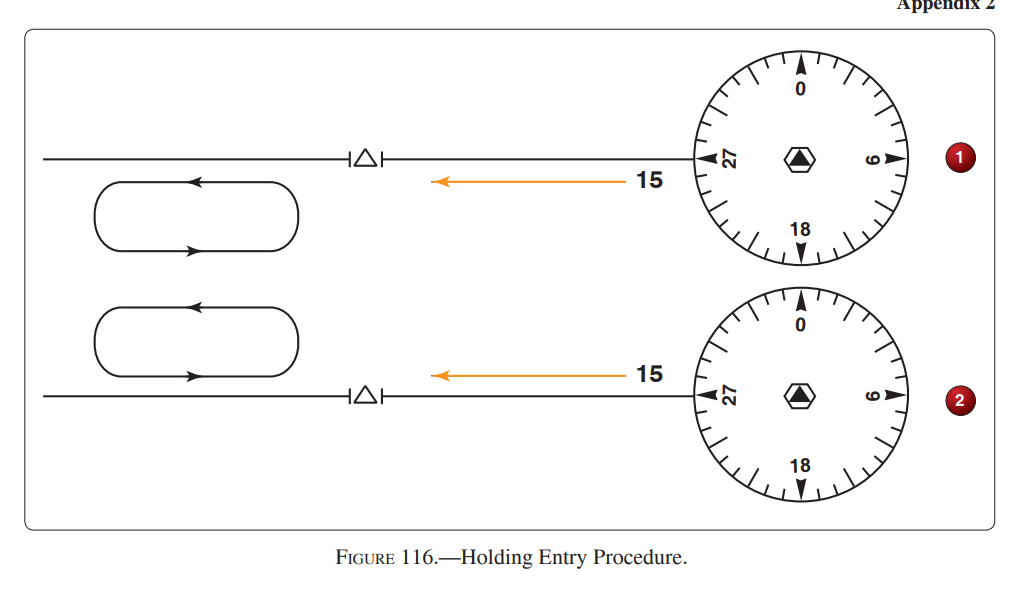
Teardrop entry
121
What is the correct holding entry procedure when holding EAST of a VOR on the 090° radial with standard turns, approaching on a heading of 350°? (Ref: Fig 112)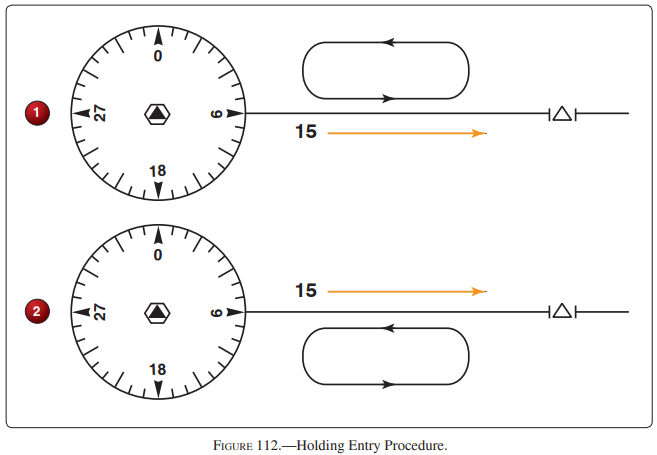
Direct entry.
122
What is the correct holding entry procedure when holding SOUTH of a VOR on the 180 radial with standard turns?
Direct entry.
123
When holding on the 360° radial with standard (right) turns, what is the correct entry procedure?"
Parallel entry.
124
"Generally, controlled airspace in the continental U.S. begins at _____ feet AGL, and can be lowered to _____ feet AGL around airports."
1,200; 700
125
Which of the following is an advantage of being on an IFR flight plan even in VMC?
ATC provides separation services and you are guaranteed entry into Class B airspace if on a filed flight plan.
126
If you are on an IFR clearance and ATC instructs you to fly a heading that takes you into Class B airspace, are you in violation?"
No, because you have a clearance to be there as you were told to fly that course by ATC.
127
What are the three main components of the vestibular system located in the inner ear?
three semicircular canals, the utricle, and the saccule
128
The semicircular canals are filled with a fluid called endolymph and are primarily responsible for sensing what type of motion?
"Rotational motion (roll
129
The otolithic organs contain small crystals and are responsible for detecting what types of motion?
Linear acceleration and head positioning relative to gravity.
130
Flicker vertigo can be caused by light flickering at a rate between _____ and _____ flashes per second.
4; 20
131
"An upsloping runway can create the illusion of being too _____, potentially causing a pilot to fly a _____-than-normal approach.
high; lower
132
"A downsloping runway can create the illusion of being too _____, potentially causing a pilot to fly a _____-than-normal approach.
low; high
133
"What is the recommended wait time before ascending to 8,000 feet MSL after a scuba dive that did not require a controlled ascent?
12 hours
134
Aviation regulations concerning alcohol use state you may not fly within 8 hours of consuming alcohol or with a blood alcohol level of _____% or greater.
0.04
135
What is the physiological term for the condition where the body does not receive enough oxygen?
Hypoxia.
136
"When turning from a northerly heading in the Northern Hemisphere, the magnetic compass will initially indicate a turn in the _____ direction."
opposite
137
"When turning from a southerly heading in the Northern Hemisphere, the magnetic compass will initially indicate a turn in the _____ direction, but at a _____ rate than is actually occurring.
correct; faster
138
A standard rate turn is how many degrees per second?
- 10
- 5
- 3
139
What is responsible for most significant compass errors?
- Magnetic Rigidity
- Magnetic Dip
- Magnetic Precession
140
Equivalent airspeed is
- indicated airspeed corrected for installation errors
- airspeed corrected for adiabatic compressible flow.
- actual speed the aircraft moves through the air converted to mach airspeed.
141
Absolute altitude is
- the vertical distance above a theoretical plane.
- the actual height above mean sea level
- actual height above the earth's surface
142
Modern electronic flight devices use what type of devices for the attitude and heading reference systems?
- Mechanical rotating gyros that convert derived attitude into an electronic signal
- Magnetometer gyros that use magnetic reference to determine attitude.
- MEMS gyros that use Coriolis force to determine aircraft attitude
143
In an electronic flight display, what provides the information needed to display pitot and static source information?
- Inertial Reference Computer
- a Magnetometer Computer
- Air Data Computer
144
In the correct sequence, name the three fundamental skills of attitude instrument flying.
Instrument cross-check; instrument interpretation; aircraft control
145
Describe the three common instrument cross-check errors.
Fixation: applying full concentration to one instrument
Omission: excluding on or more pertinent instruments from your scan
Emphasis: Relying on an instrument that you readily understand even when it lacks important info
Omission: excluding on or more pertinent instruments from your scan
Emphasis: Relying on an instrument that you readily understand even when it lacks important info
146
Instrument cross-check error Fixation:*\
applying full concentration to one instrument
147
Instrument cross-check error Omission:*\
excluding one or more pertinent instruments from your scan
148
Instrument cross-check error Emphasis:*\
Relying on an instrument that you readily understand even when it lacks important info
149
Describe the two methods of attitude instrument flying.
Control and performance
Primary and supporting
Primary and supporting
150
As a rule of thumb, how should you correct an altitude discrepancies of less than 100 feet?
- Initially adjust the power before changing pitch.
- Use a full-bar width correction on the attitude indicator
- Use a one-half bar width correction on the attitude indicator.
151
What action(s) should you take to maintain altitude if you reduce power to decrease airspeed in a level turn?
Increase angle of attack
152
If you are cruising at 120 knots and want to establish a climb at 85 knots, you should make your initial pitch change by increasing back elevator pressure until you observe what indication?
- The attitude indicator shows the approximate pitch attitude appropriate for the 85-knot climb.
- The airspeed indication reaches 85 knots.
- The attitude indicator, airspeed indicator, and VSI all indicate a climb.
153
What actions should you take to enter a constant-airspeed descent from level-cruising flight, and maintain cruising airspeed?
- First, adjust the pitch attitude to a descent using the attitude indicator as a reference, then adjust the power to maintain the cruising airspeed.
- Simultaneously reduce power and adjust the pitch using the attitude indicator as a reference to maintain the cruising airspeed.
- First, reduce power, then adjust the pitch using the attitude indicator as a reference to establish a specific rate on the VSI.
154
Select the true statement regarding rate and radius of turn.
- A decrease in bank angle with a constant airspeed increases the rate of turn and decreases the radius of turn.
- An increase in airspeed with a constant bank angle increases the rate of turn and decreases the radius of turn.
- An increase in bank angle with a constant airspeed increases the rate of turn and decreases the radius of turn.
155
If leveling off from a 700 ft/min descent, begin the level off at approximately 70 feet before you reach the desired altitude.
- True
- False
156
Refer to the instrument panel image. What system has failed and what action should you take to return the airplane to straight-and-level flight?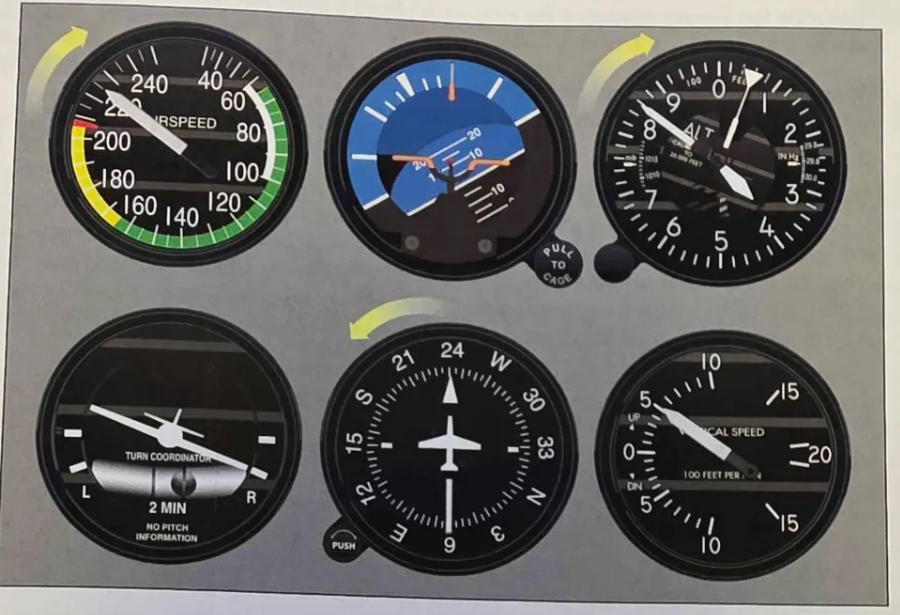
- The electrical system has failed; reduce power, roll left to level the wings, raise the nose to reduce airspeed.
- The vacuum system has failed; reduce power, roll left to level the wings, an pitch up to reduce airspeed.
- The pitot system is blocked; use the attitude indicator to lower the nose and level the wings.
157
What instrument has malfunctioned and what is the flight attitude?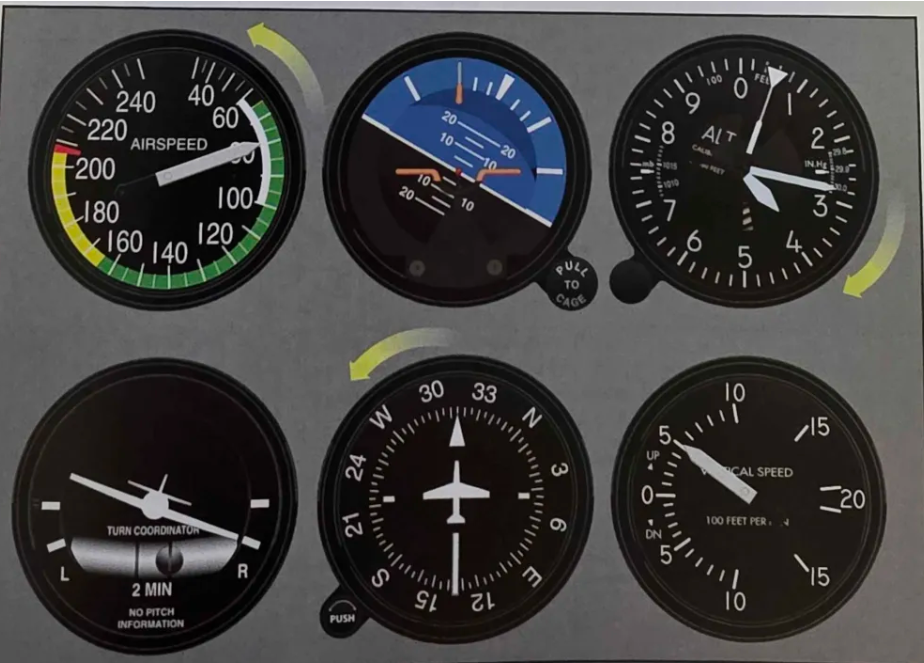
- Attitude indicator: climbing turn to the left
- Attitude indicator; climbing turn to the right
- Turn coordinator: descending turn to the right
158
Assume that the aircraft is level at 4000 at feet and the airspeed is 120 indicated. If only the inlet of the pitot tube freezes, what will the airspeed indicate.
- The airspeed will increase with a descent.
- The airspeed will drop to 0
- The airspeed will increases with an increase in altitude
159
If the pitot tube and pitot drain hole freeze, how will the airspeed indicator react?
- The airspeed indicator will remain constant.
- If altitude is increased, the airspeed will read erroneously low.
- If altitude is increased, the airspeed will read erroneously high.
160
If the pitot tube and drain port and the static port all freeze, how will the airspeed indicator react?
- If altitude is increased, the airspeed will read erroneously high.
- It will remain constant.
- If altitude is increased, the airspeed will read erroneously low.
161
If only the static port freezes at 4000, how will the airspeed indicator be affected. Pick 2 answers.
- As you climb above 4000, the airspeed will read lower than it should.
- As you climb above 4000, the airspeed will read higher than it should.
- As you descend below 4000, the airspeed will read higher than it should.
- As you descend below 4000, the airspeed will read lower than it should.
162
If the static port freezes at 4000 feet, how will the altimeter react?
- It will decrease when you climb and increase when you descend.
- It will not be affected.
- It will remain constant at 4000 feet regardless if the airplane is climbing or descending.
163
If the static source freezes at 4000 feet and you use alternate air, how will the airspeed indicator react.
- During climb or descent, it will read faster than actual.
- As you climb above 4000, it will indicate slower than actual airspeed and as you descend below 4000, it will indicate faster than actual.
- As you climb above 4000 , it will indicate faster than actual airspeed and as you descend below 4000, it will indicate slower than actual.
164
If the static port freezes and you use alternate air, how will the altimeter react.
- There will be no effect.
- The altimeter will read slightly low.
- The altimeter will read slightly high
165
What displacement from course is indicated by this instrument when used in con-
junction with a VOR?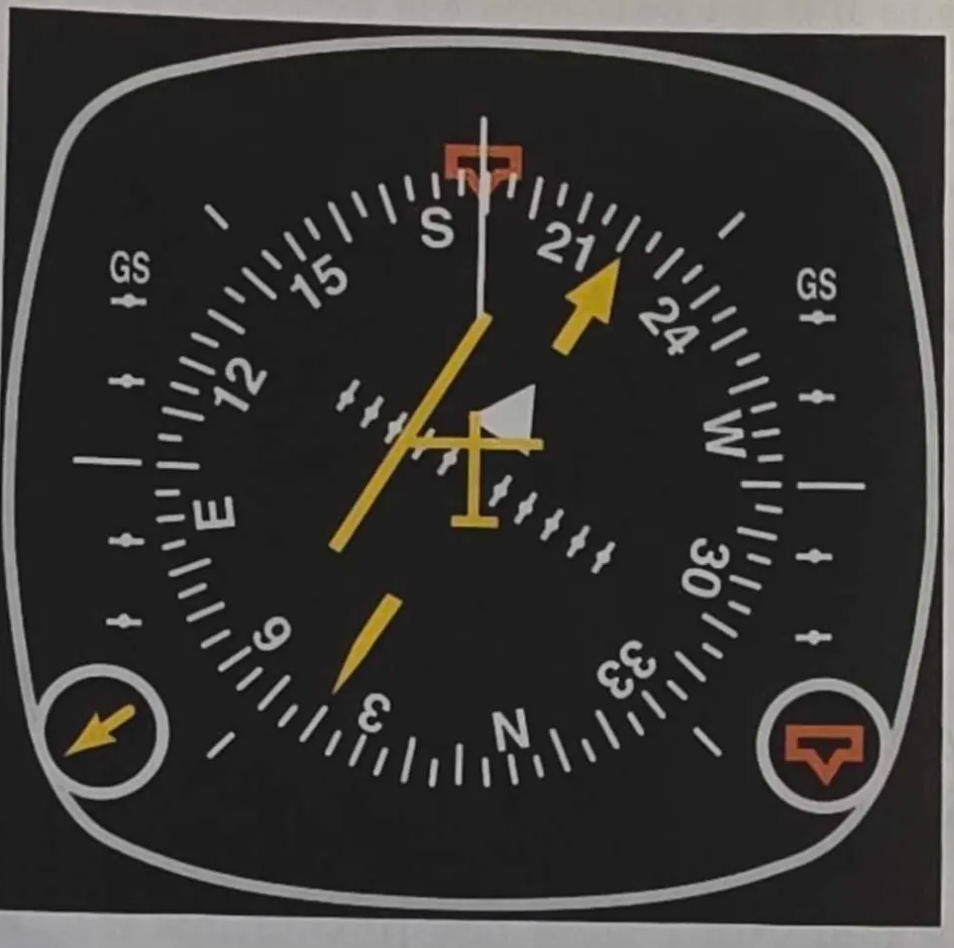
junction with a VOR?
- 5°
- 2 1/2°
- 10°
166
Why is it impossible for a horizontal situation indicator to provide reverse sensing when tuned to a VOR?
It always provides proper sensing when tuned to a VOR because the CDI is mounted on a compass card which automatically rotates to the correct heading
167
True/False. Station passage is indicated when the TO/FROM indicator first starts fluctuating.
- False
- True
168
Assume that you are 15 nautical miles from the VOR. Using these HSI indications and a 6,000-foot nautical mile, how far off course are you in degrees and nautical miles?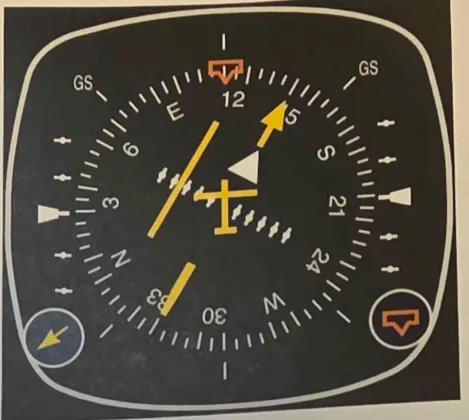
7°, 1.75 nm
169
Refer to the following figure to match each navigation indicator with the appropriate
airplane position.
A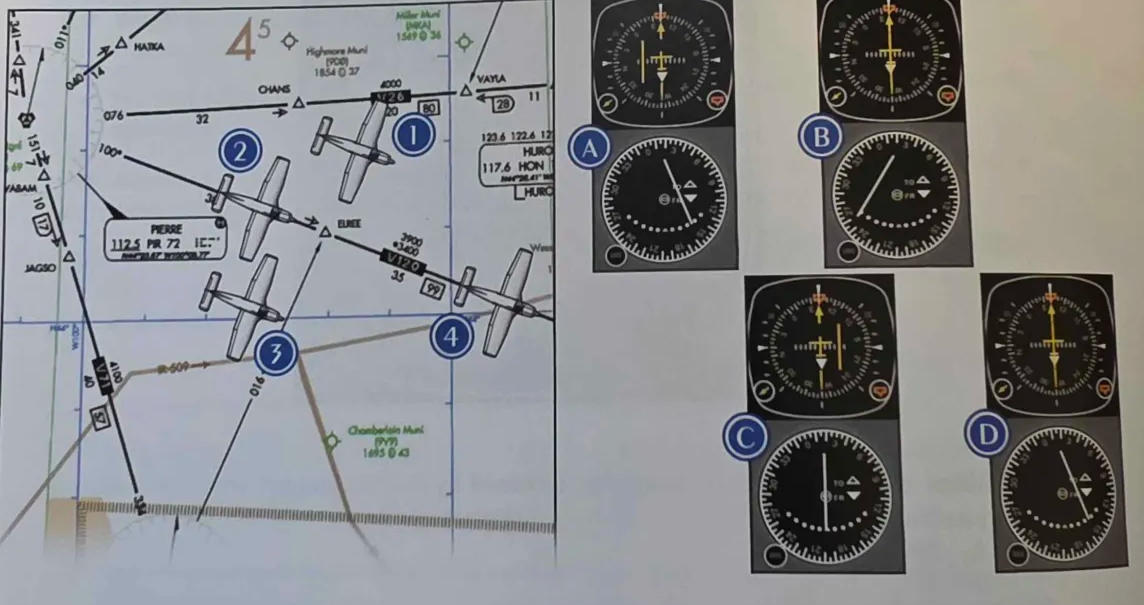
airplane position.
A
3
170
Refer to the following figure to match each navigation indicator with the appropriate
airplane position.
B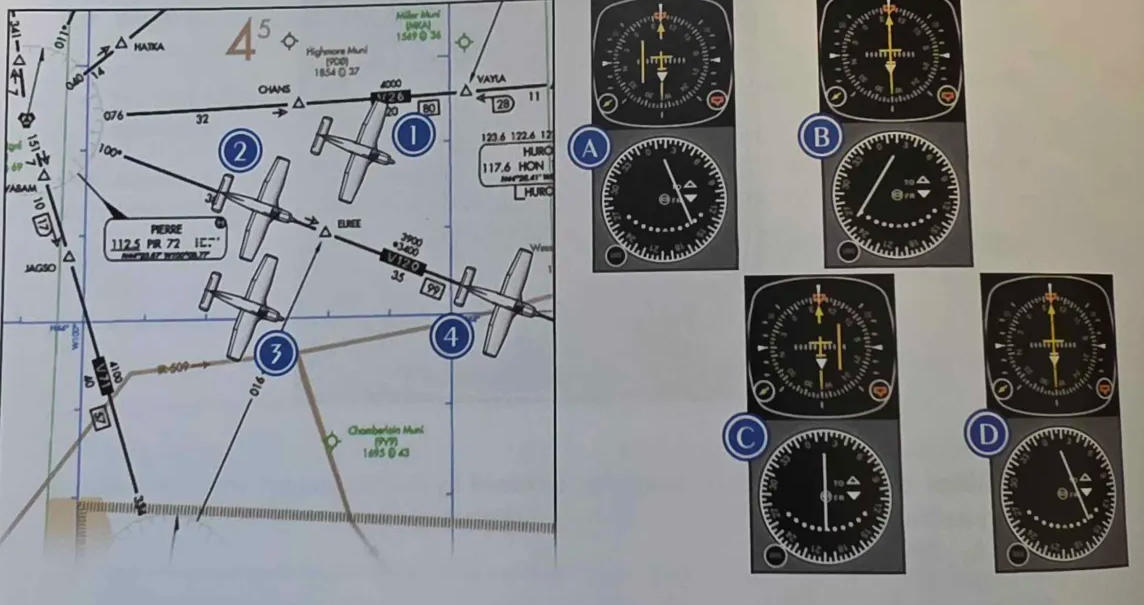
airplane position.
B
4
171
Refer to the following figure to match each navigation indicator with the appropriate
airplane position.
C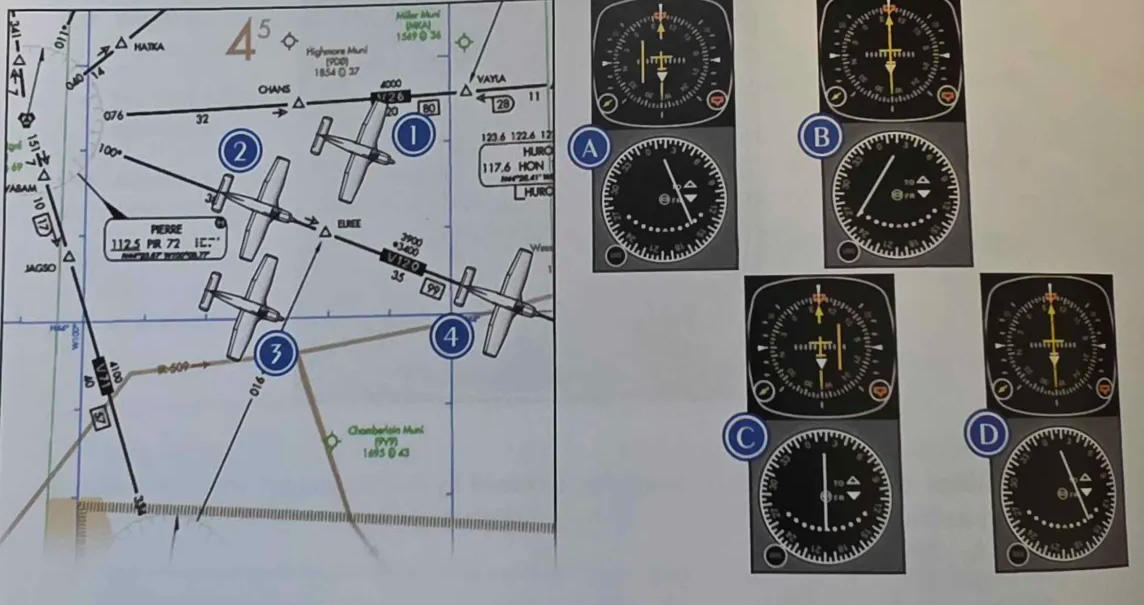
airplane position.
C
1
172
Refer to the following figure to match each navigation indicator with the appropriate
airplane position.
D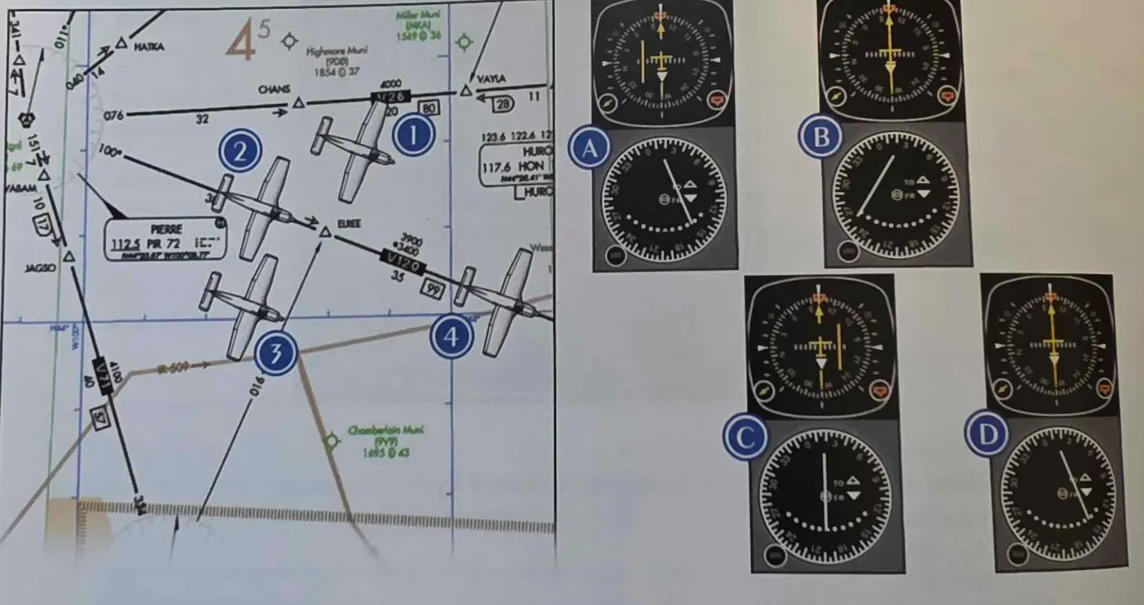
airplane position.
D
2
173
What is the maximum distance at which you can expect a reliable signal from a high altitude VOR. At what altitudes does this maximum range occur?
130nm; 18,000ft to 45,000ft
174
True/False. The maximum allowable error on a VOR check using a VOT is 4°
- True
- False
175
What is the maximum allowable difference when checking two VORs against each other?
4°
176
True/False. When tuning a VOR and hearing the correct 1,020 Hz Morse code identifier signal, you are assured that both the VOR and DME are properly tuned and usable for navigation.
- False
- True
177
What is required navigation performance (RNP)?
Required navigation performance is a set of standard that apply to both airspace and nav equipment. The use of RNP with RNAV provides greater flexibility in procedure and airspace design. Makes it more effective for ATC to offer direct routing.
178
What does RNP stand for?
Required Navigation Performance
179
To comply with RNP standards, you must operate within what distance of the centerline of a route, path, or procedure?
- 2 nautical miles for approach operations; 1 nautical mile for terminal operations; 0.3 nautical miles for enroute operations
- 3 nautical miles for enroute operations; 2 nautical miles for terminal operations; 1 nautical mile for approach operations
- 2 nautical miles for enroute operations; 1 nautical mile for terminal operations; 0.3 nautical miles for approach operations
180
What is the wide area augmentation system (WAAS)?
- WAAS enhances the accuracy of GPS by using receivers to send corrective signals over a localized area, generally 20 to 30 miles.
- WAAS enhances the accuracy of GPS by using a series of ground stations to generate a corrective message that is transmitted to the airplane by a geostationary satellite. This message accounts for positional drift of the satellites and signal delays caused by the ionosphere and other atmospheric factors.
- WAAS is a navigation computer in the airplane used in addition to GPS to calculate the position with enhanced accuracy.
181
Select the true statement regarding the requirements to use GPS equipment for IFR operations.
- You must refer to TSO-C145 or TSO-C146 to determine if your GPS equipment is approved for IFR operations.
- WAAS-certified GPS receivers are approved for IFR operations by the current version of TSO-C-129.
- You can determine if a GPS is approved for IFR enroute and approach operations by referring to the airplane flight manual (AFM) or AFM supplement.
182
True/False. For domestic enroute and terminal IFR flights with a GPS receiver certified according to TSO-C129 or TSO-C196, the airplane must be equipped with alternate avionics necessary to receive the ground-based facilities appropriate for the route to the destination and to any required alternate.
- False
- True
183
Prior to using GPS for IFR operations, what actions must you take?
- For all GPS equipment, you must you must verify that WAAS will be available for the intended route and duration of the flight and ensure that your GPS navigational database is current.
- For WAAS-certified GPS equipment, you must verify that RAIM will be available for the intended route and duration of the flight and ensure that your GPS navigational database is current.
- For non-WAAS GPS equipment, you must verify that RAIM will be available for the intended route and duration of the flight and ensure that your GPS navigational database is current.
184
A full-scale deviation of the CDI of this HSI equals what cross-track error? 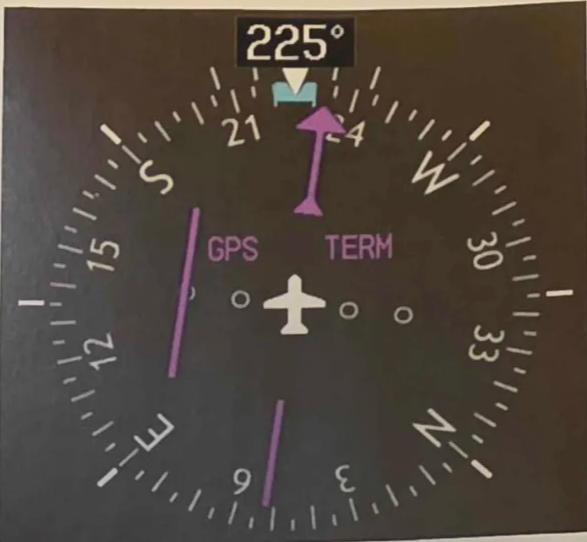
- 1.0 nautical mile
- 2.0 nautical miles
- 0.3 nautical miles
185
What does auto-sequencing mean?
When the airplane receiver senses that you passed a waypoint and automatically cycles to the next one.
186
True/False. To comply with AIM guidelines, you should plan any random routes to begin and end over arrival and departure transition fixes or navaids that are appropriate for the altitude that you will be flying. You should also define your route with a minimum of one waypoint for each air route traffic control center area that you pass through.
- True
- False
187
ATC asks you to report your position. Which of the following is correct?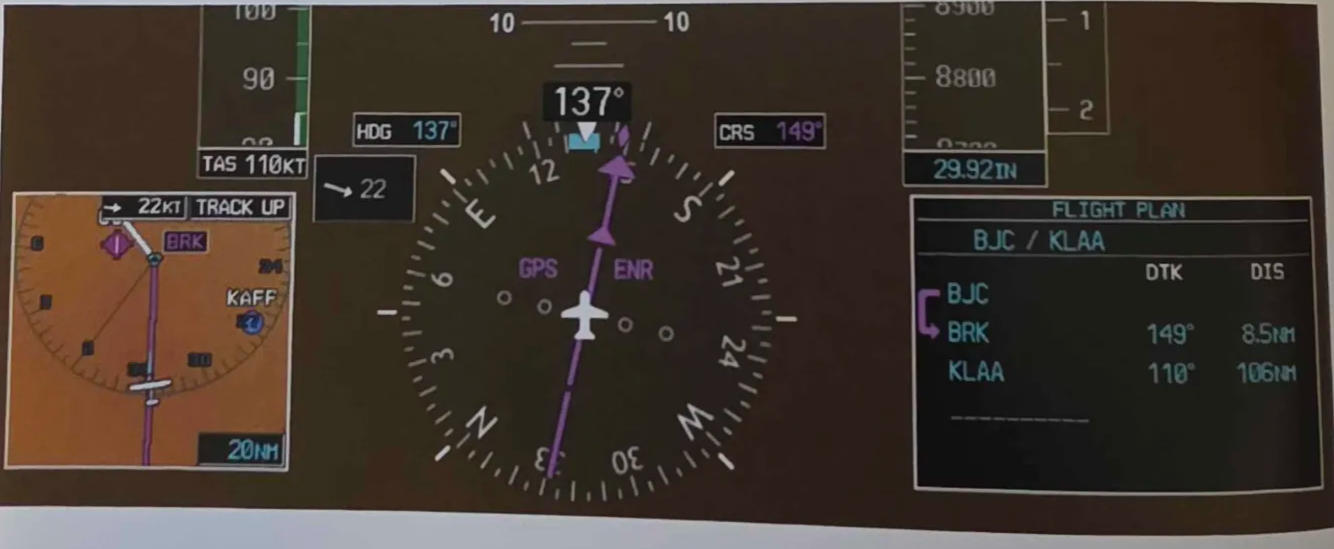
- You are 8.5 nautical miles northwest of BRK
- You are 8.5 nautical miles southwest of BJC
- You are 8.5 nautical miles southwest of BRK
188
What is true regarding your flight plan? 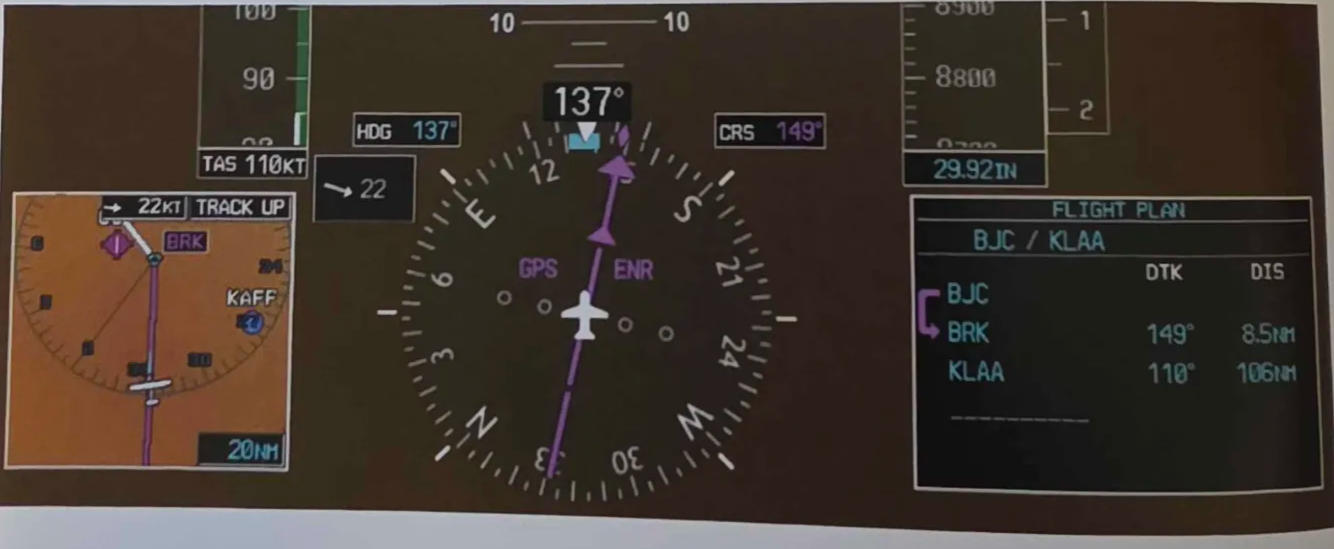
- You are on the leg from BJC to BRK, which has a total distance of 8.5 nautical miles.
- At BRK you will need to program the GPS to turn to a course of 1100 to continue your flight to KLAA.
- You are on the leg from BJC to BRK and there are 8.5 nautical miles remaining to BRK.
189
What is true regarding the navigation indications shown on this GPS display?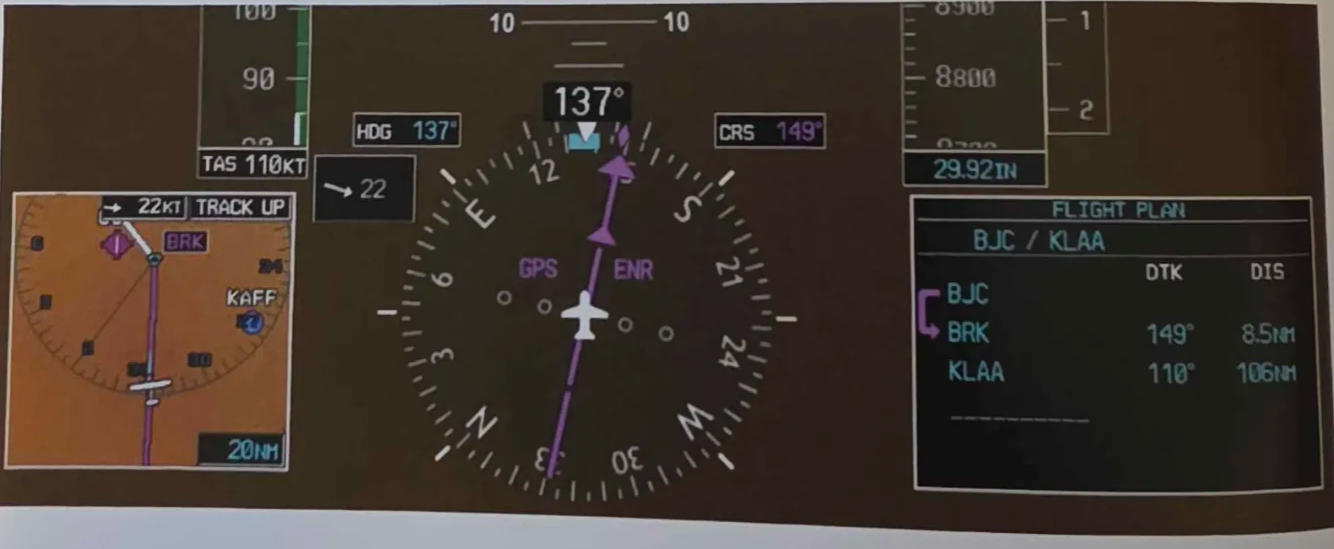
- You are off the course 120 to the left and must turn right to intercept the course of 1490.
- You are on the course of 137° using a wind correction angle to compensate for a 22 knots wind from the east.
- You are on the course of 149° using a wind correction angle to compensate for a 22 knot wind from the east.
190
Which letter corresponds to the Side Stripe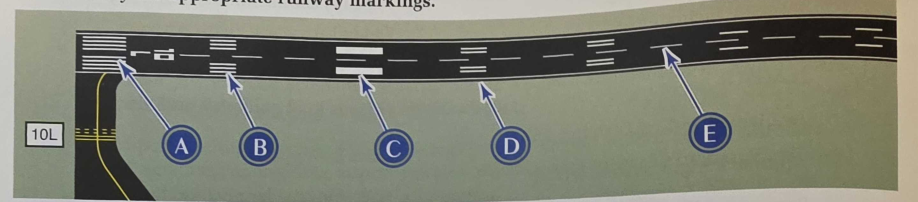
D
191
Which letter corresponds to the Threshold Markings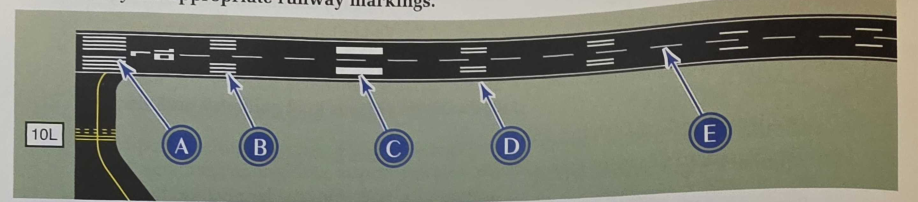
A
192
Which letter corresponds to the Runway Centerline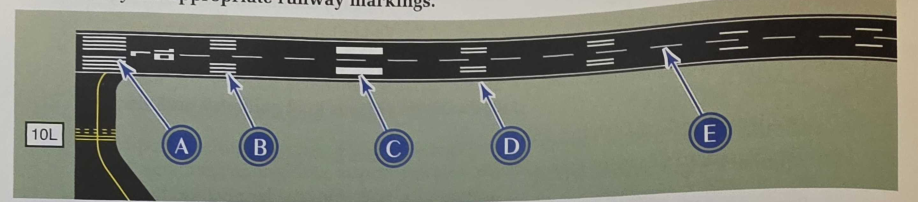
E
193
Which letter corresponds to the Aiming point marking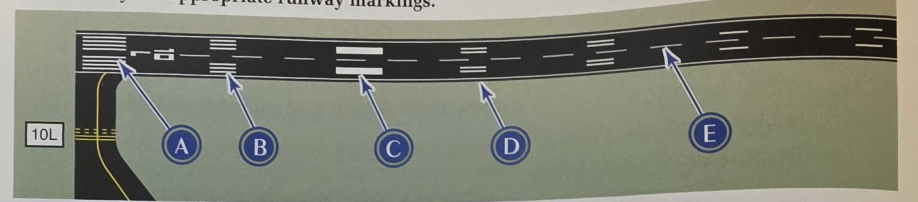
C
194
Which letter corresponds to the Touchdown zone marking
B
195
True/false. Runway holding position signs are black with yellow inscriptions and yellow borders
False
196
Name the high intensity white strobe lights located laterally, one on each side of the runway threshold
- Runway end identifier lights
- Sequenced flashing lights
- Runway alignment indicator lights
197
VASI, on glide path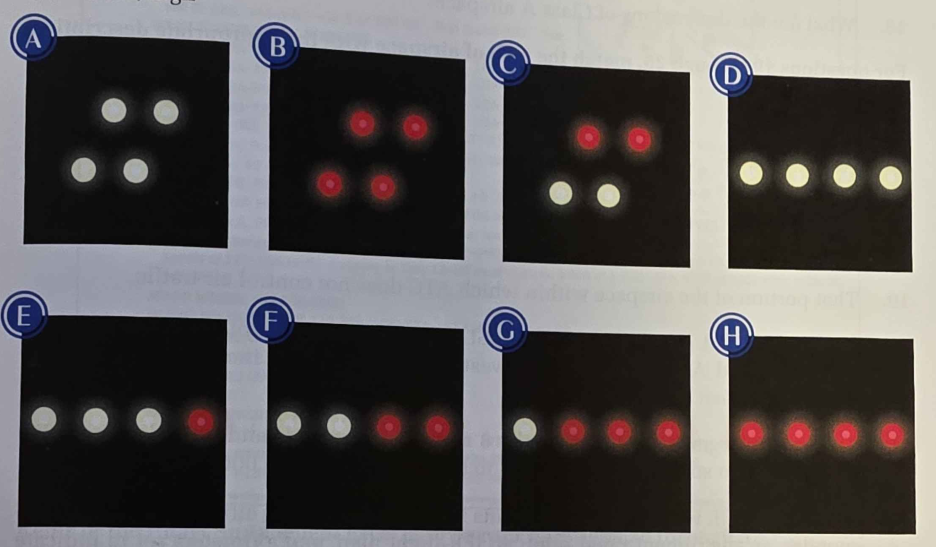
C
198
PAPI, slightly low 
G
199
PAPI, on glide path 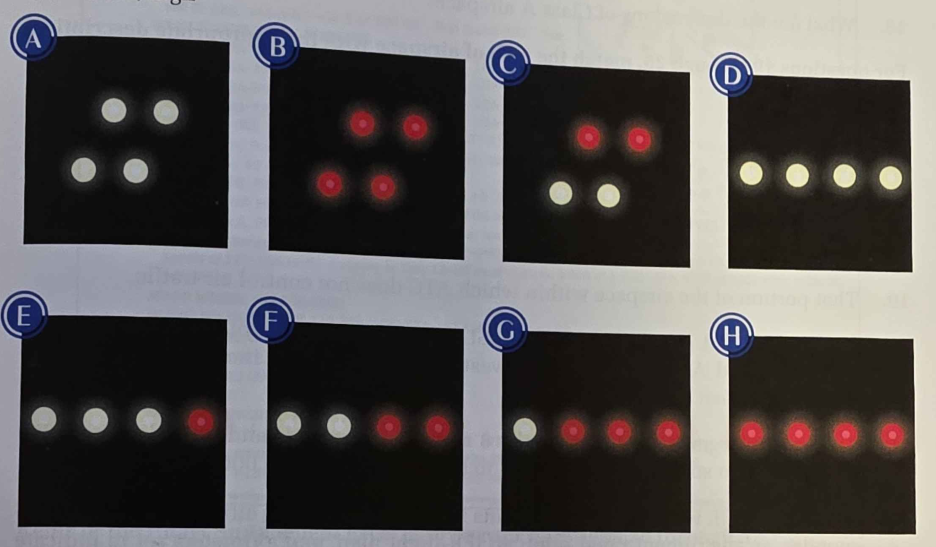
F
200
VASI, high 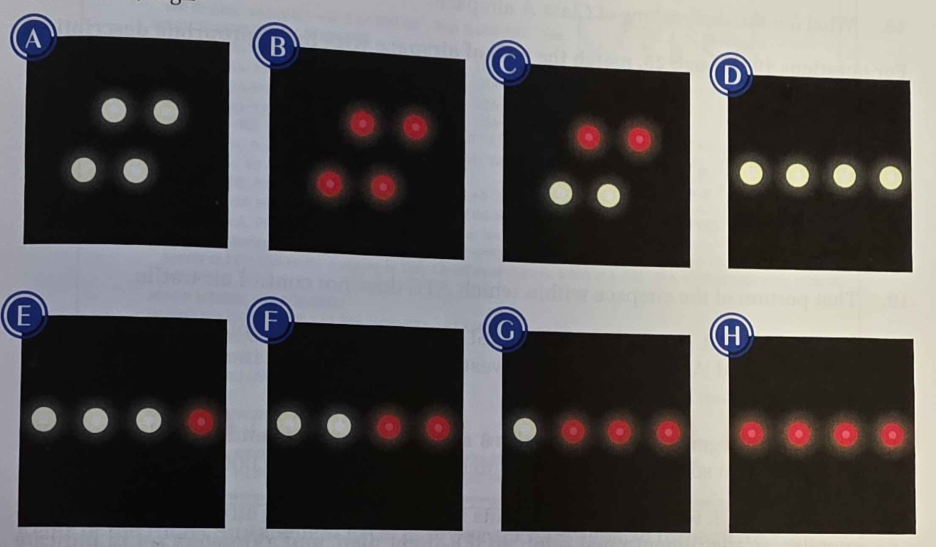
A
201
As you approach for landing, what color are the runway threshold lights? What color are they when departing the runway?
Green, red
202
How many feet of runway remain when the centerline lights change from white to alternating red and white lights?
3,000 feet
203
What is indicated when the airport beacon is illuminated during daylight hours?
Might indicate the ground visibility is less than 3 miles and/or ceiling is less than 1,000ft
204
There is no apparent relative motion when you see this pattern of lights from your airplane. What is the relationship of the other airplane to yours? 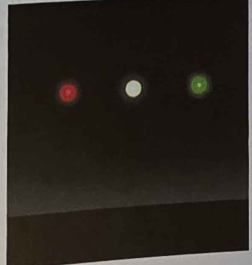
- The other airplane is passing from right to left at a lower airspeed than your own.
- You are following the other airplane.
- The other airplane is flying toward you on a collision course.
205
When should you turn on your aircraft's anti-collision lights?
- Whenever an engine is operating.
- Whenever you, as pilot-in-command, determine that it is in the interest of safety to do so.
- For all aircraft operations, day or night
206
Excluding the airspace at and below 2,500 feet ACL, ADS-B/Mode C transponder capability is required in all airspace (controlled or uncontrolled) of the contiguous states and the District of Columbia at and above what altitude?
- 14,500 feet MSL
- 10,000 feet MSL
- 10,000 feet AGL
207
What are the dimensions of Class A airspace?
Base is 18,000 ft MSL and extends up to and including FL600
208
That portion of the airspace within which ATC does not control air traffic
Class G
209
Airspace at and above 14,500 feet MSL over the 48 contiguous states, District of Columbia, and Alaska east of 1600 west longitude, but not including the airspace within 1,500 feet of the surface
Class E
210
An airspace segment that is normally 8 nautical miles wide and extends from 1,200 feet AGL (or in some cases higher) up to but not including 18,000 feet MSL
Federal Airways
211
Airspace within which the requirements include an operating altitude-encoding transponder, an instrument-rated pilot, an IFR flight plan, and altimeters set to indicate pressure altitude.
Class A
212
Airspace within which equipment requirements include an operable VOR (for IFR operations), two-way radio capable of communicating with ATC, an ATC clearance, and a transponder with Mode C automatic altitude reporting
Class B
213
Airspace generally consisting of circular areas extending to 4,000 feet above the primary airport where the shelf area has a radius of 10 nautical miles, the core area has a radius of 5 nautical miles, and two-way radio communication is required
Class C
214
Airspace outside Class B or Class C airspace that normally extends from the surface up to 2,500 feet above the elevation of the airport and having charted, but possibly irregular, lateral dimensions at which a control tower is operating
Class D
215
What is the maximum indicated aircraft speed limit (in knots) below 2,500 feet when within 4 nautical miles of the primary airport of a Class C airspace area?
200 knots
216
True/False. Military training route flights are generally limited to operations under VFR
False
217
In December, what are the hours (in local time) when the airport is attended? 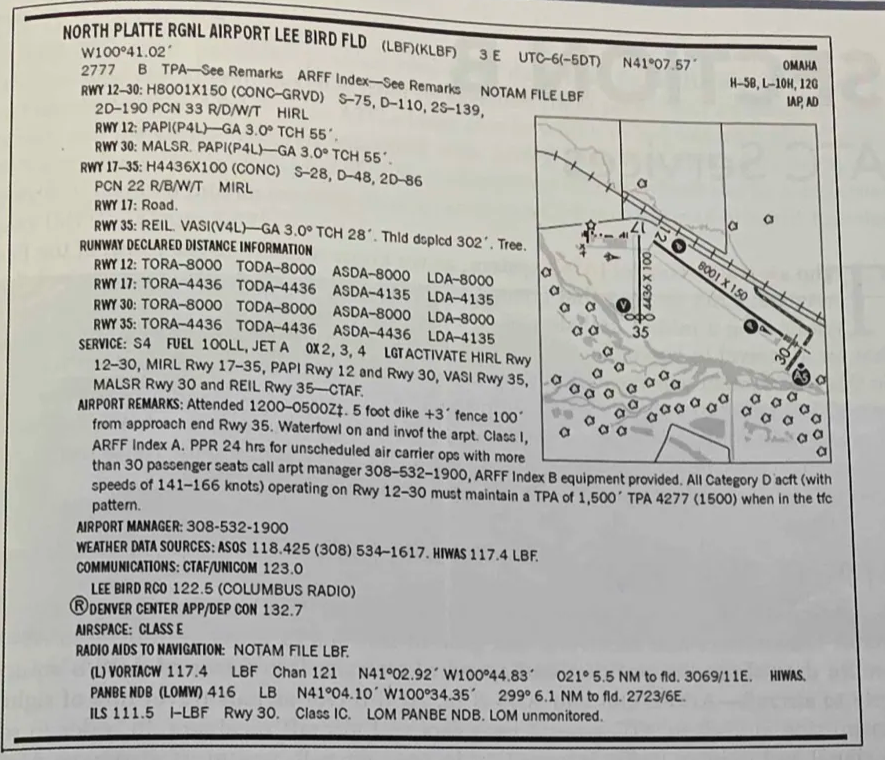
0600-2300 local time
218
What type of approach lighting system and VGSI are installed on Runway 30? 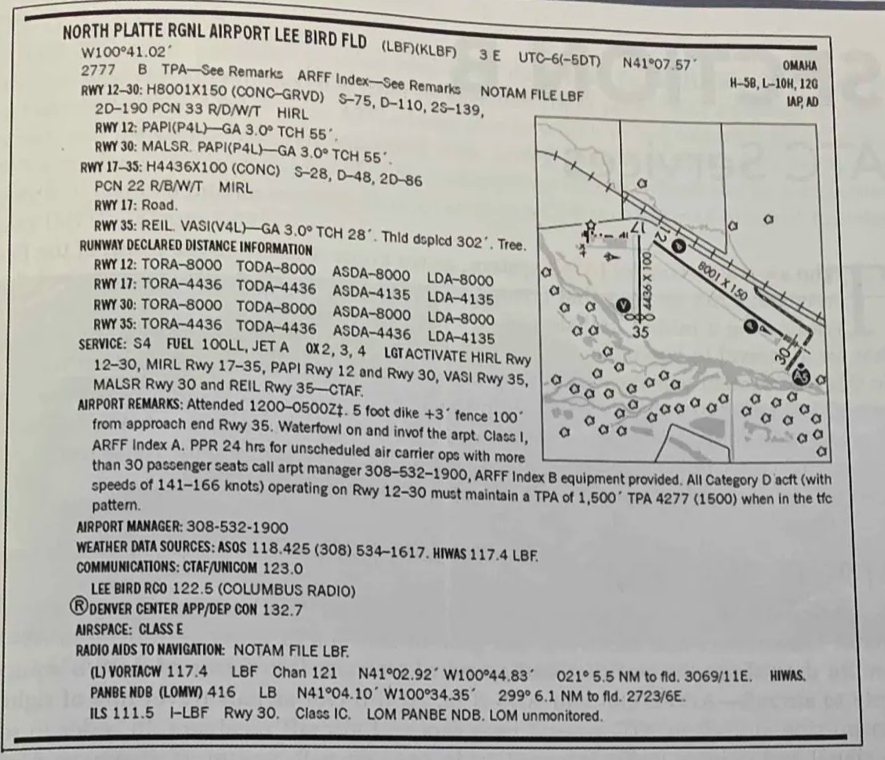
MALSR (medium intensity approach light system with runway alignment indicator lights)
219
How far is the threshold displaced on Runway 35? 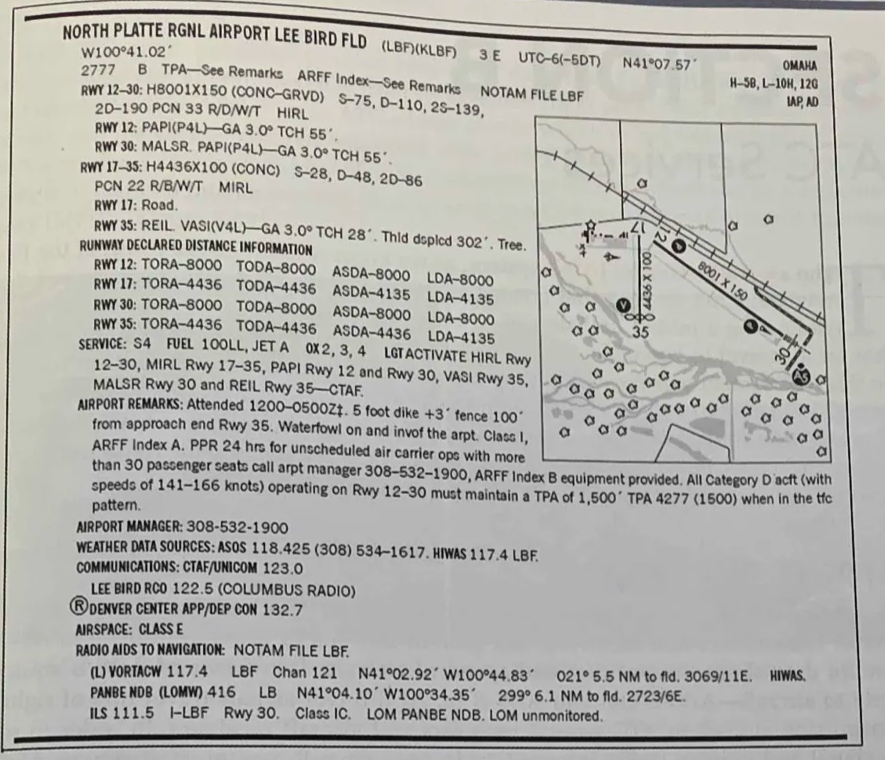
302 feet
220
What is the name of the approach/departure control facility that serves North Platte Regional Airport Lee Bird Field?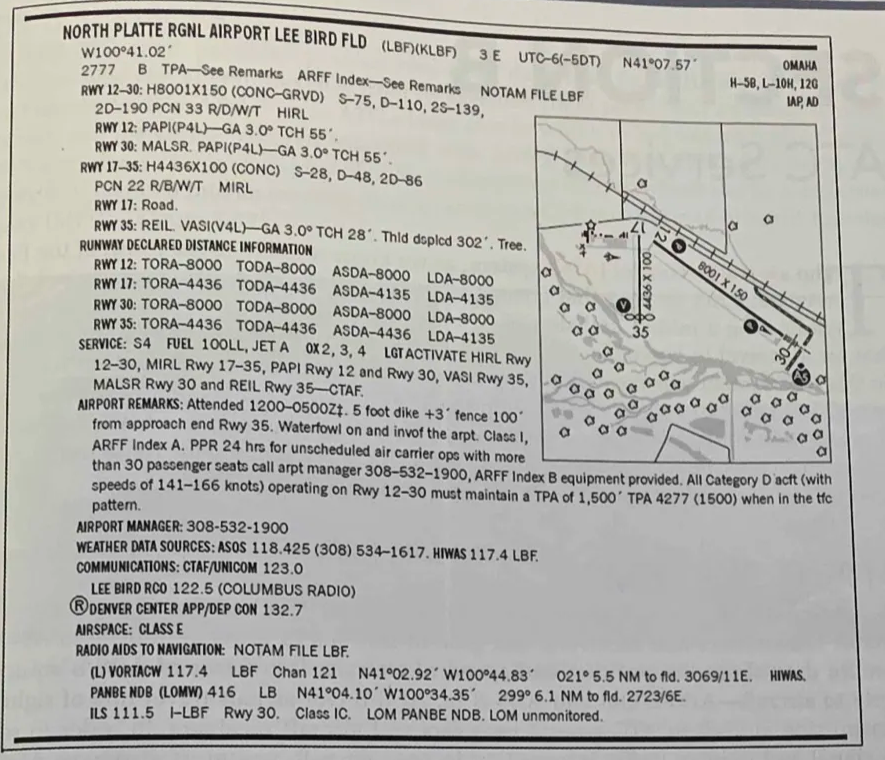
Denver Center
221
What is the frequency and identification for the ILS approach? 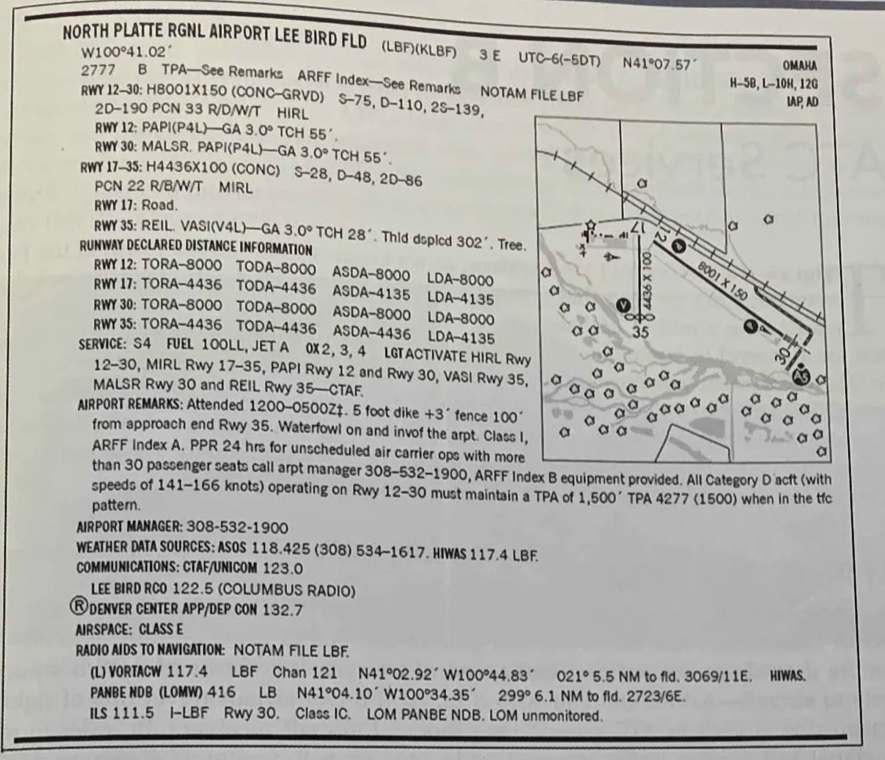
111.5, I-LBF
222
Select the information that you can obtain by referencing the Aeronautical Information Manual (AIM).
- ATC services and procedures for instrument departure, enroute, arrival, and approach operations
- Information regarding specific airports, including runway lengths, communication frequencies, and airport services
- The official text of regulations issued by the agencies of the Federal government
223
Explain the differences between NOTAM(D)s and FDC NOTAMs.
NOTAM(D) information is for all navigational facilities while the FDC NOTAMS are regulatory and temporary, such as TFRs.
224
In what section of a Chart Supplement can you find information regarding runway incursion hot spots?
- Special notices
- Airport Diagrams
- Associated Data
225
To accept a land and hold short clearance you must be at least a
- Private pilot
- ATP rated pilot
- Commercial pilot
226
If you stay on the glide path of a VASI, you are guaranteed obstruction clearance
- +- 10 degrees of extended centerline out to 4 nautical miles.
- +- 4 degrees of extended centerline out to 10 nautical miles.
- +- 3 degrees of extended centerline out to 10 nautical miles.
227
How far down the runway do touchdown zone lights extend?
- 3000 feet
- 1500 feet
- 1000 feet
228
What is the minimum VFR separation from clouds in class C airspace?
- clear of clouds
- 1000 above, 1000 feet below, 1 mile horizontal
- 500 feet below, 1000 above, 2000 horizontal
229
When operating in Class C or D airspace, at or below 2500 from the surface and within 4 nautical miles of the primary airport, what is the maximum operating speed?
- 250 kias
- 235 kias
- 200 kias
230
What are two principles that are characteristic of all gyroscopes?
Ridgity in space and precession
231
Reference a VOR, full scale deflection of a CDI occurs when the course deviation bar or needle
- deflects from the center of the scale to either far side of the scale.
- deflects from half scale left to half scale right.
- deflects from left side of the scale to right side of the scale.
232
When using GPS for navigation and instrument approaches, any required alternate airport must have
- a GPS approach that is anticipated to be operational and available at the ETA.
- authorization to fly approaches under IFR using GPS avionics systems.
- an approved operational instrument approach procedure other than GPS.
233
Where does the DME indicator have the greatest error between ground distance to the VORTAC and displayed distance?
- High altitudes close to the VORTAC.
- Low altitudes far from the VORTAC.
- High altitudes far from the VORTAC.
234
(Refer to Figure 240.) How should a pilot determine when the DME at Price/Carbon County Airport is inoperative? 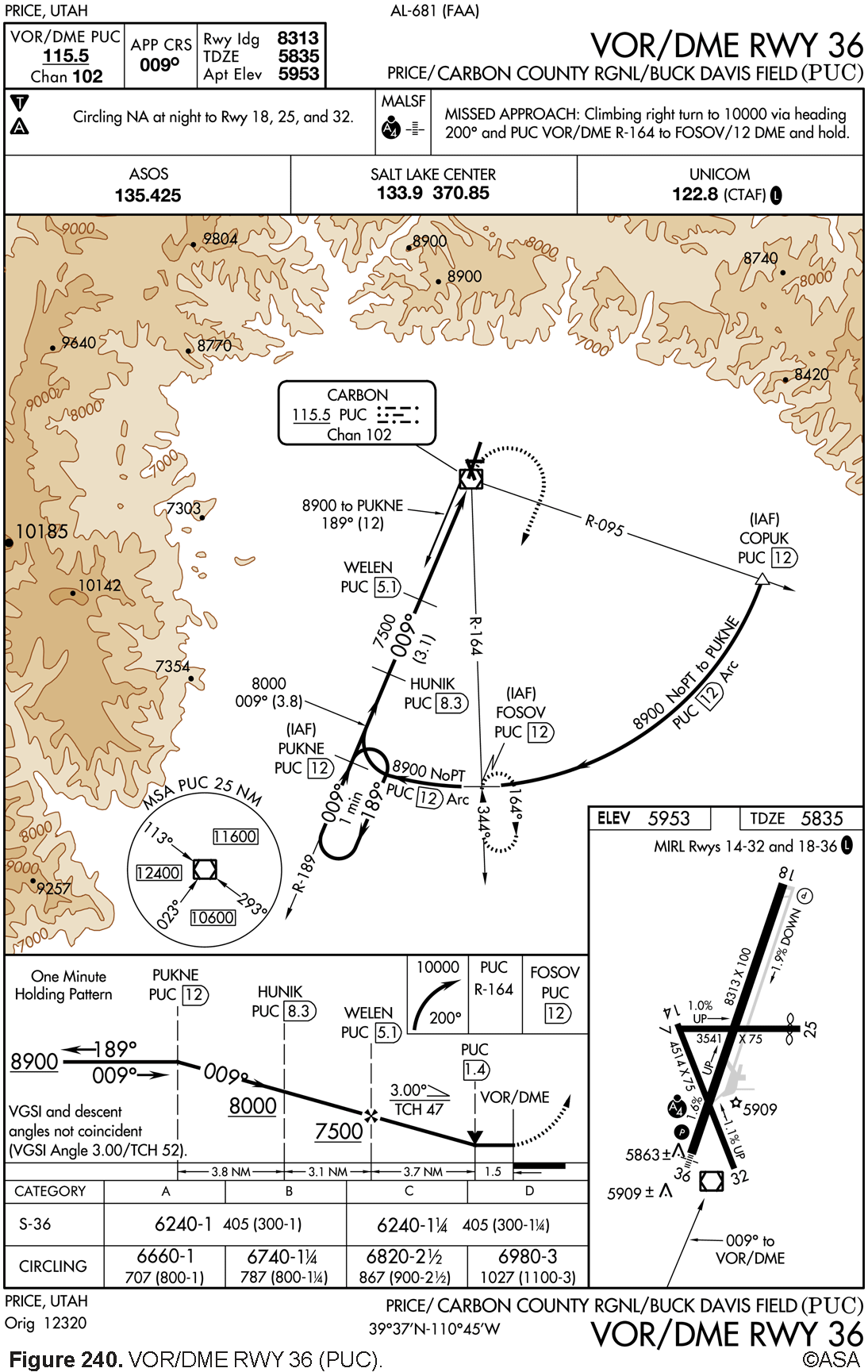
- The airborne DME will 'search,' but will not 'lock on.'
- The airborne DME may appear normal, but there will be no code tone.
- The airborne DME will always indicate '0' mileage.
235
How should the pilot make a VOR receiver check when the airplane is located on the designated checkpoint on the airport surface?
- Set the OBS on 180° plus or minus 4°; the CDI should center with a FROM indication.
- With the aircraft headed directly toward the VOR and the OBS set to 000°, the CDI should center within plus or minus 4° of that radial with a TO indication.
- Set the OBS on the designated radial. The CDI must center within plus or minus 4° of that radial with a FROM indication.
236
An ATC clearance is an authorization to proceed under specified conditions within what type of airspace?
Controlled
237
If you deviate from a clearance due to an emergency, when must you notify ATC?
- Immediately after landing
- As soon as possible
- Within 24 hours after landing
238
If ATC provides you with priority service because of an emergency, you may be required to submit a written report to the manager of that ATC facility within what time frame?
- Within 48 hours after landing
- Within 24 hours after landing
- Immediately after landing
239
When are you required to see and avoid other aircraft?
- When ATC provides you with traffic advisories, regardless of what type of flight plan you are on.
- When operating in VFR conditions, even on an IFR flight plan.
- Only when on a VFR flight plan.
240
True/False. To operate under IFR within controlled airspace, you must file an IFR flight plan and obtain an ATC clearance.
True
241
Regardless of weather conditions, you are required to file an IFR flight plan before you can legally fly within what class of airspace?
- Class B
- All controlled airspace
- Class A
242
When will ATC issue a standard instrument departure (SID)?
- Only when you request it in your flight plan.
- Only when IFR conditions exist at the airport.
- As appropriate, without request.
243
True/False. When ATC issues a clearance with significant changes to your requested routing, you can expect an abbreviated clearance.
False
244
What is the significance of the following clearance: “…cruise 5,000”?
- You can fly at any altitude from 5,000 feet MSL up to the base of Class A airspace.
- You can fly at any altitude from the minimum IFR altitude up to and including 5,000 feet MSL, but you must report leaving each altitude to ATC.
- You can conduct your flight at any altitude from the minimum IFR altitude up to and including 5,000 feet MSL.
245
Before a contact approach is approved, the reported ground visibility must be at least what?
- One statute mile
- Three statute miles
- One nautical mile
246
Select the true statement when cleared to fly VFR-on-top on an IFR flight.
- Your IFR flight plan is automatically cancelled.
- You may fly below the minimum en route altitude prescribed for the route segment you are flying as long as you remain VFR.
- You are required to comply with VFR cruising altitude rules.
247
When ATC issues a clearance void time in conjunction with a departure clearance, in what time frame must you depart?
- No later than 30 minutes after the clearance void time
- No later than the clearance void time
- 30 minutes or later after the clearance void time
248
You should read back all portions of an ATC clearance that contain what items?
- Altitude and heading assignments.
- Specific instructions, such as altitude assignments or radar vectors.
- Only instructions requiring clarification.
249
DP
Departure Procedure
250
SID
standard instrument departure
251
ODP
obstacle departure procedures
252
DVA
diverse vector areas
253
What is the standard climb gradient established by TERPs?
200 feet per nautical mile
254
How do you determine the necessary rate of climb to meet a required climb gradient for a departure when using Jeppesen charts? When using FAA charts?
The chart provided on the Jeppesen chart or the table provided in the FAA Terminal Procedures Publication (TPP)
255
List at least two differences between a SID and an ODP.
SID: Used for traffic flow, published in graphic form, requires ATC clearance
ODP: Designed solely for obstacle clearance, graphical or text, no ATC clearance
ODP: Designed solely for obstacle clearance, graphical or text, no ATC clearance
256
Select the true statement regarding vector and pilot navigation SIDs.
- Pilot navigation SIDs do not include textual descriptions of any routing.
- Pilot navigation SIDs do not include vectors.
- Vector SIDs do not show departure routes or transitions.
257
What is true regarding operations in a diverse vector area (DVA)?
- ATC assumes responsibility for obstacle clearance while vectoring your airplane prior to reaching the minimum vectoring altitude.
- Departures in a DVA follow a specific ground track.
- A DVA chart contains an initial set of instructions and several fixes to which ATC provides vectors.
258
What aircraft and ATC equipment is required to fly this SID?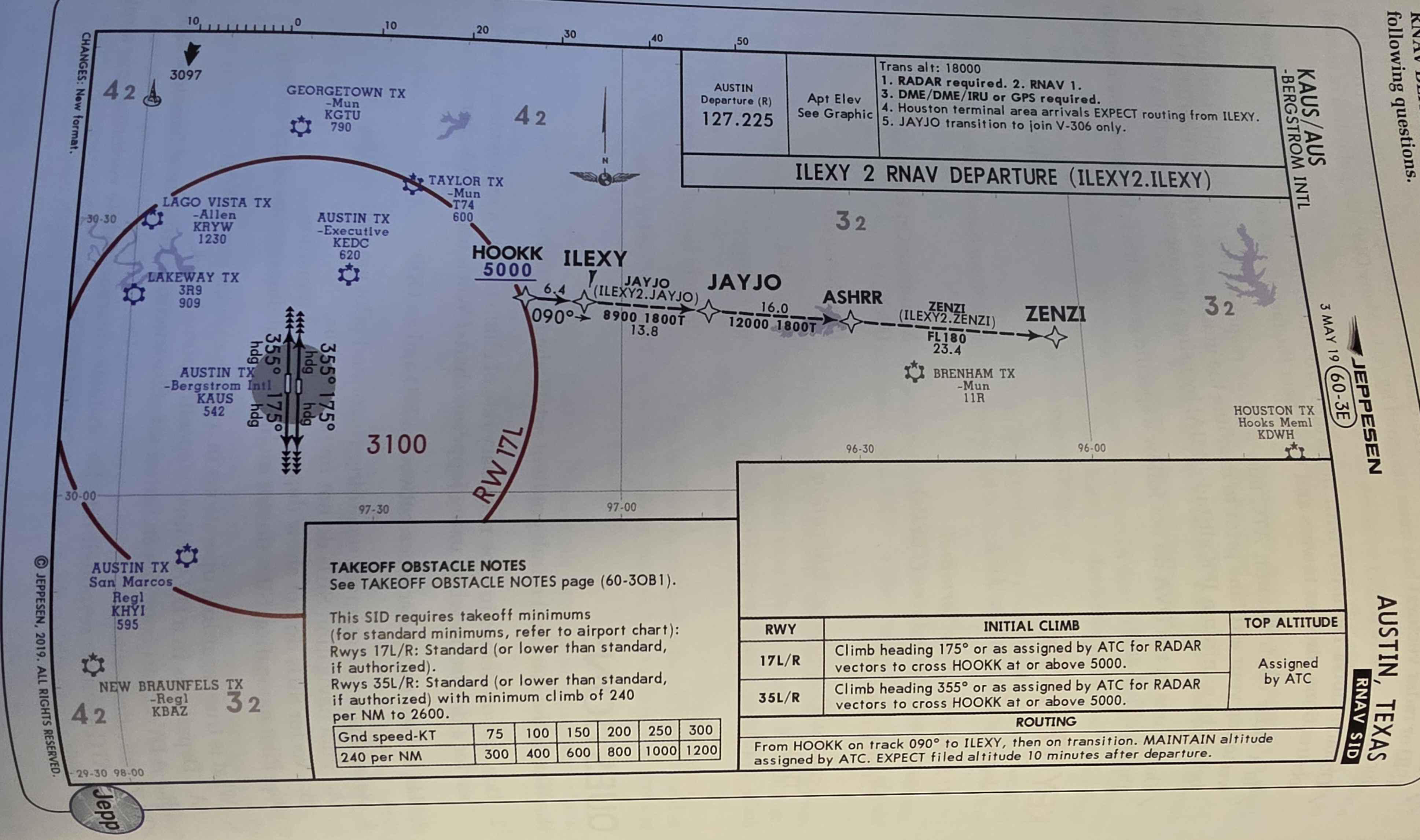
Radar; RNAV 1; DME/DME/IRU or GPS
259
When filing your flight plan, what code should you enter on the flight plan for the ILEXY 2 RNAV Departure with the ZENZI transition?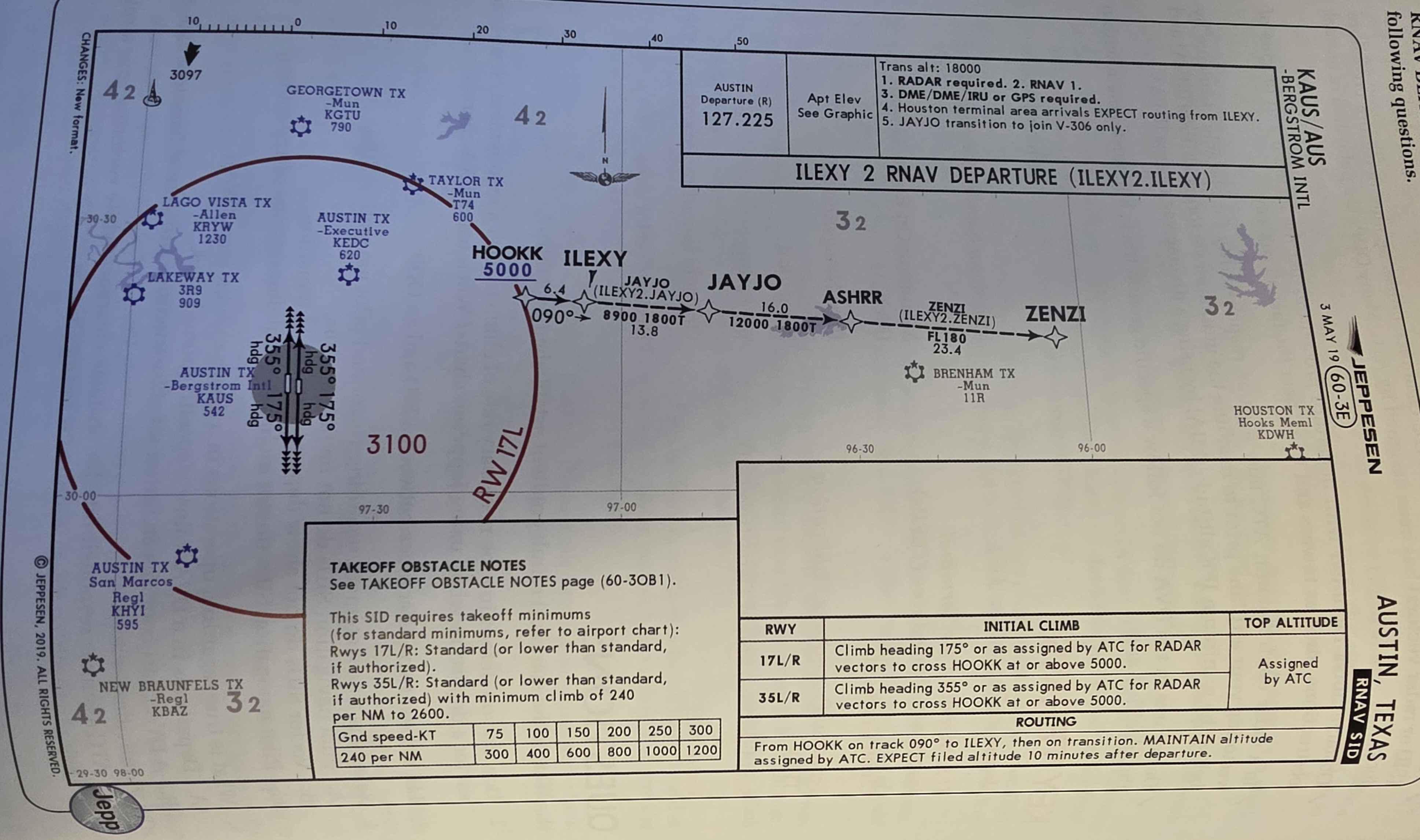
ILEXY2.ZENZI
260
What is the MSA when departing KAUS?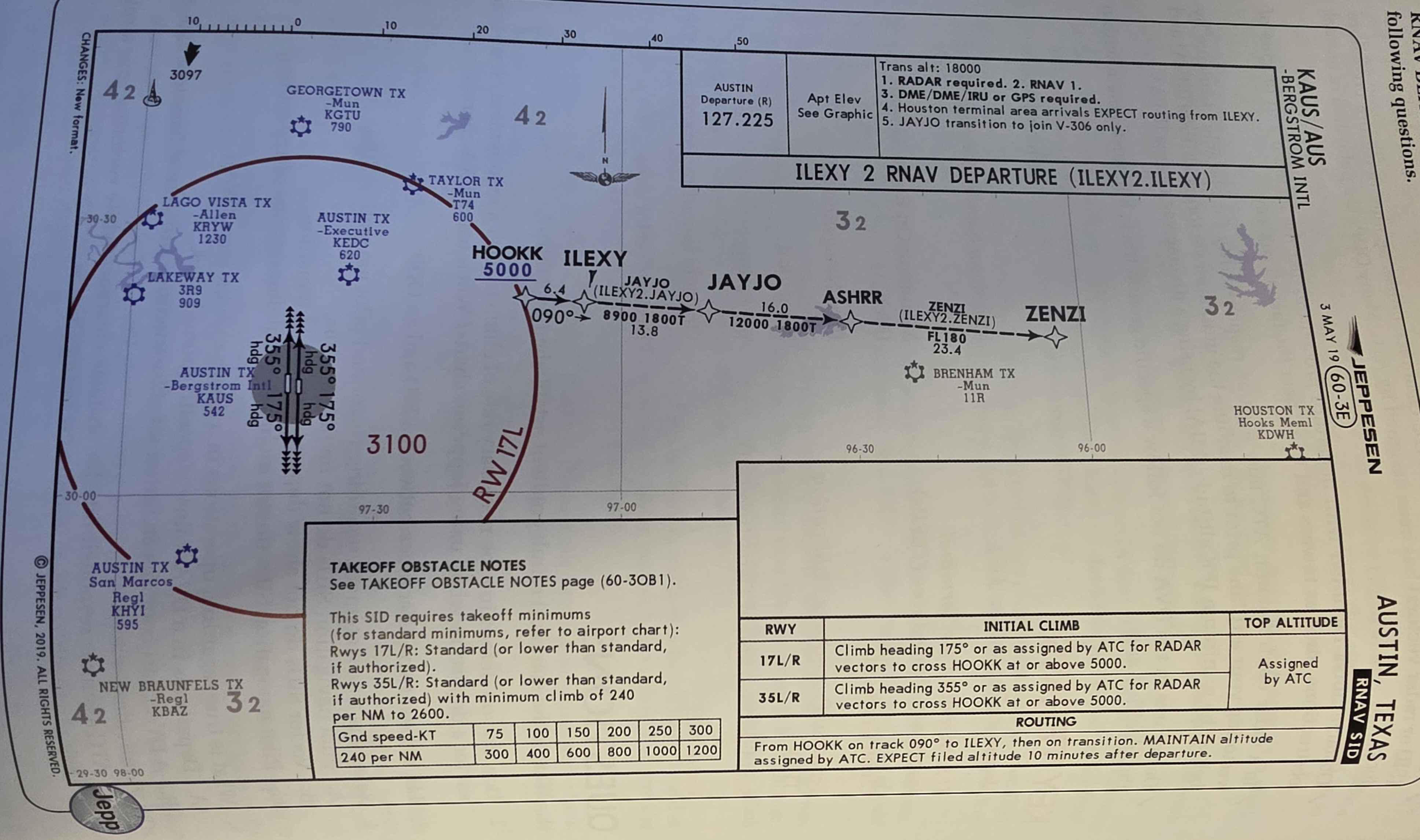
- 4,200 feet MSL
- 5,000 feet MSL
- 3,100 feet MSL
261
What is the MORA in the area surrounding JAYJO?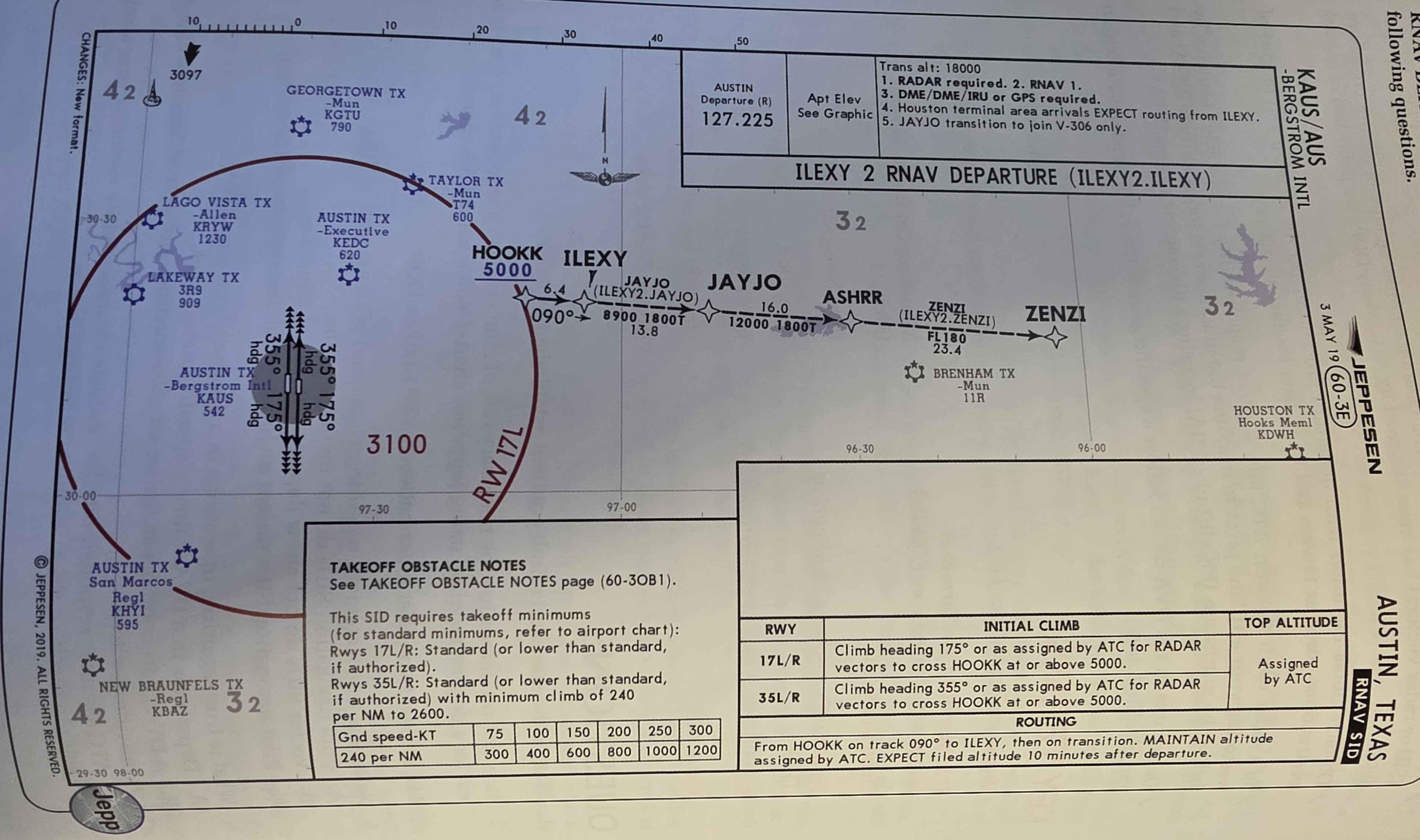
3,100 feet MSL
262
If you depart Runway 17L, what heading should you fly during the initial climb?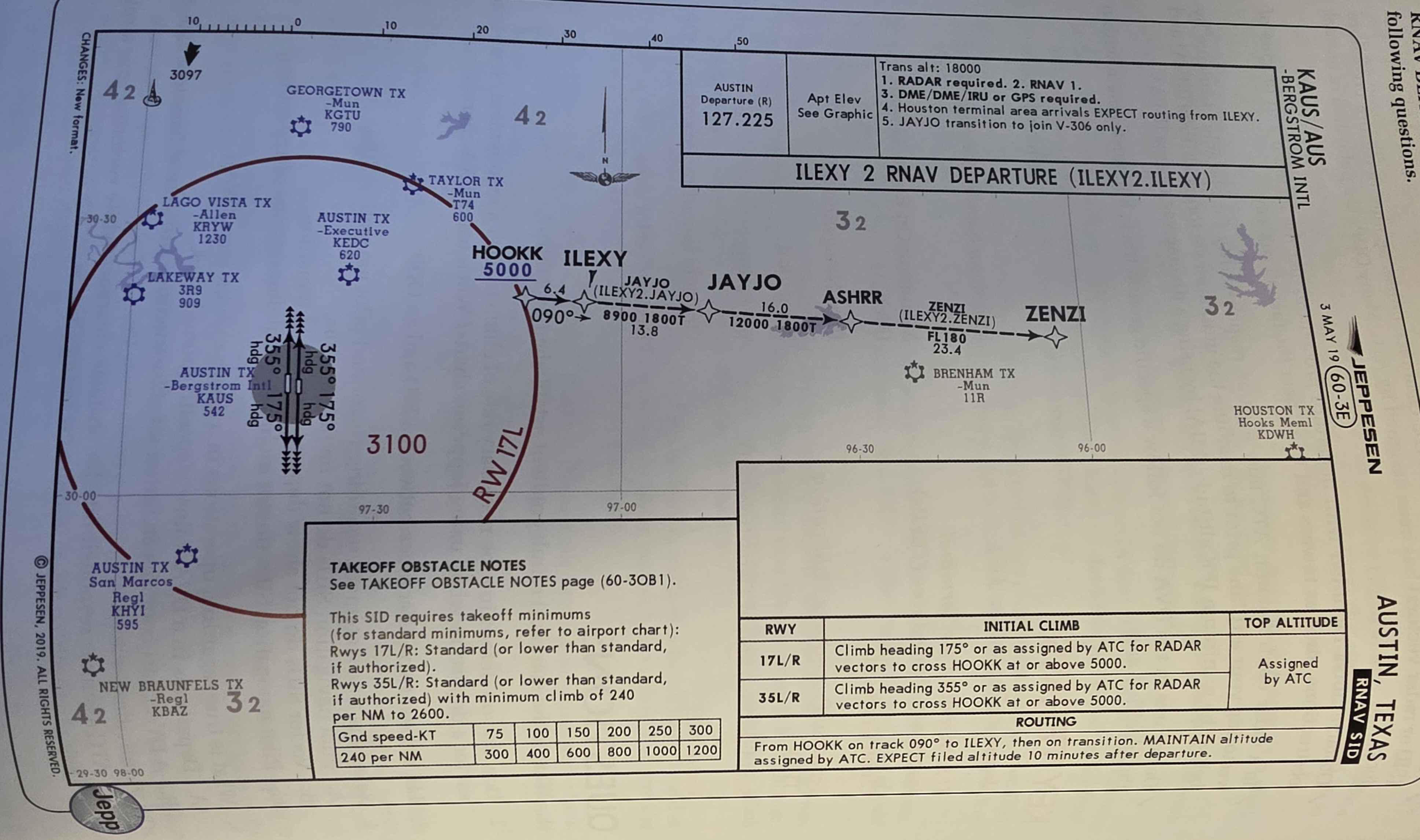
175°
263
Where does the basic portion of the ILEXY 2 RNAV Departure end?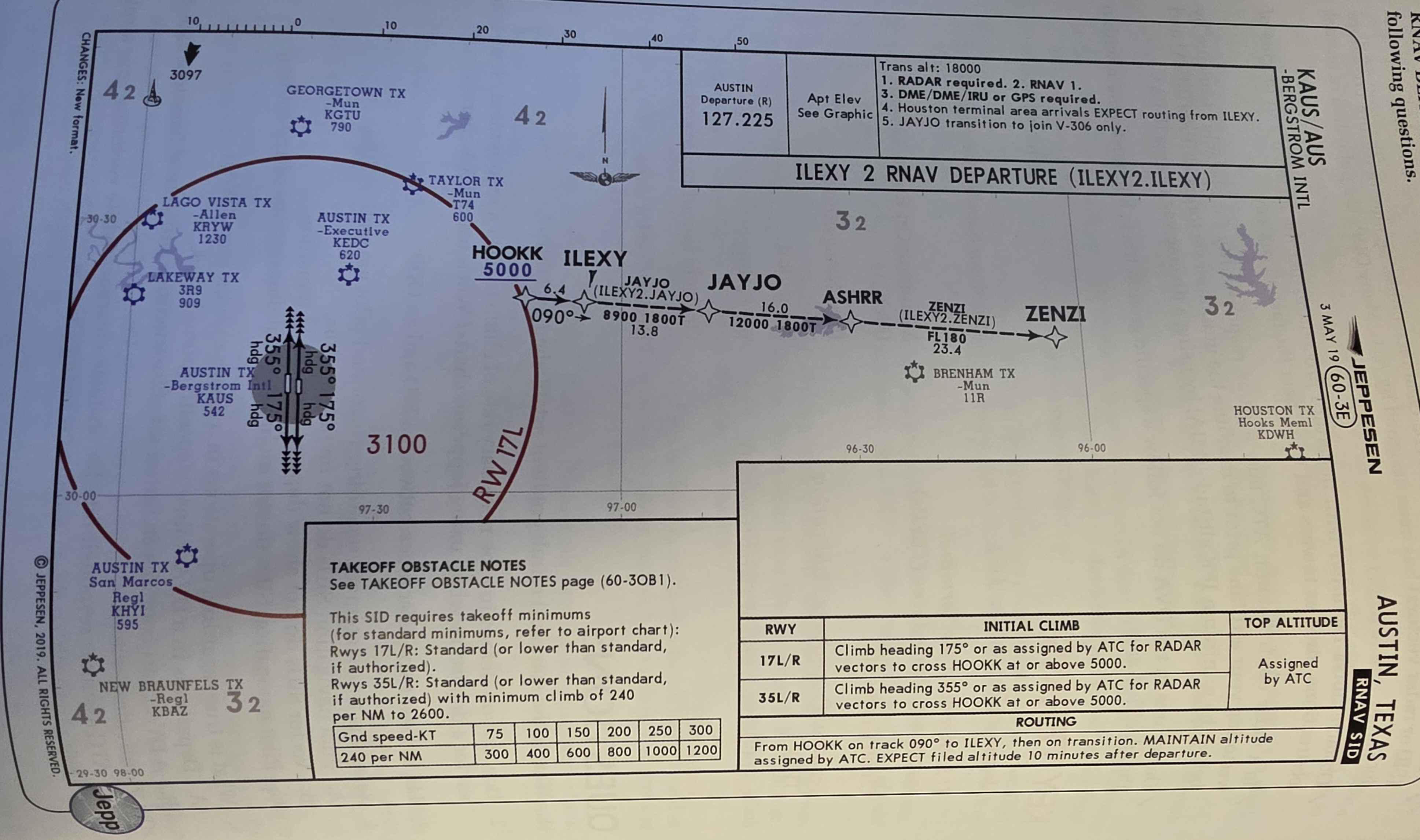
- ILEXY
- HOOK
- ZENZI
264
With a groundspeed of 100 knots, what is the minimum climb gradient when taking off from Runway 35L?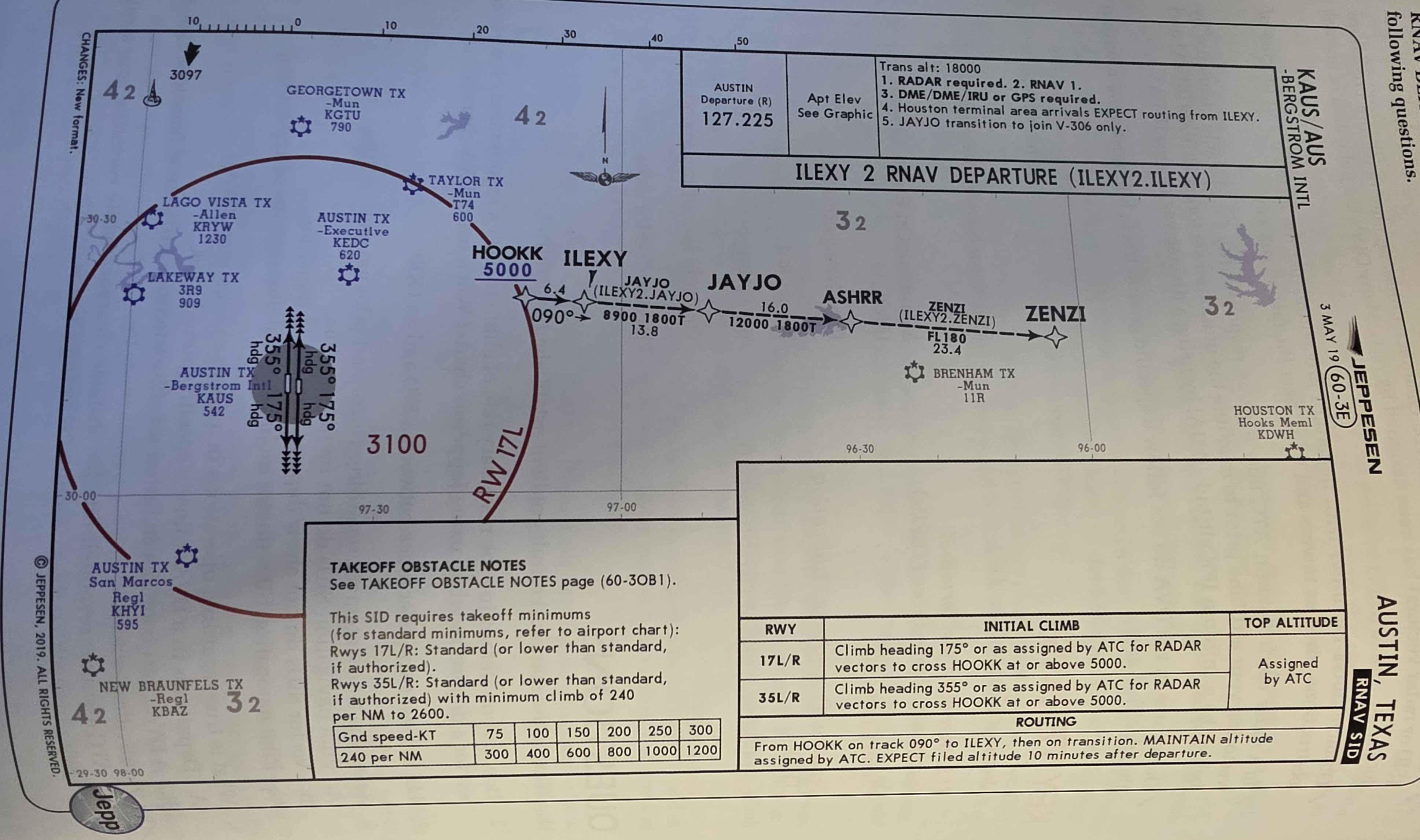
- 400 feet per minute
- 240 feet per nautical mile
- 240 feet per minute
265
What is runway visual range (RVR)?
- A prediction of what a pilot in a moving aircraft should see when looking down the runway from the approach end, reported in hundreds of feet.
- The visibility—reported in statute miles—determined for a particular runway by a weather observer.
- The greatest distance a weather observer can see throughout one-half the horizon, reported in statute miles.
266
List at least four items to include in a departure procedure briefing.
1. Procedure title and departure airport
2. Communication frequencies
3. Runway and min climb gradient
4. Navaid/fix information
5. Departure instructions and route (heading, initial altitude, top altitude, route)
6. Transition route
2. Communication frequencies
3. Runway and min climb gradient
4. Navaid/fix information
5. Departure instructions and route (heading, initial altitude, top altitude, route)
6. Transition route
267
Unless a higher climb gradient is specified for the procedure, what is the standard climb gradient that your airplane must meet for IFR departure procedures?
200 feet per nautical mile
268
What is a VCOA?
- A procedure to visually perform climbing turns over the airport to the published “climb-to” altitude from which to proceed with the instrument portion of the departure.
- An alternative to complying with climb gradients of 200 feet per nautical mile when departing an airport.
- A procedure to visually perform climbing turns over the airport to the published “climb-to” altitude that enables you to avoid close-in obstacles.
269
What is the recommended procedure if you do not wish to use a SID?
- Advise departure control upon initial contact.
- Enter “NO SID” in the remarks section of the IFR flight plan.
- No action is necessary because ATC will not assign a SID unless you specifically request it.
270
What is a true statement regarding flying this SID?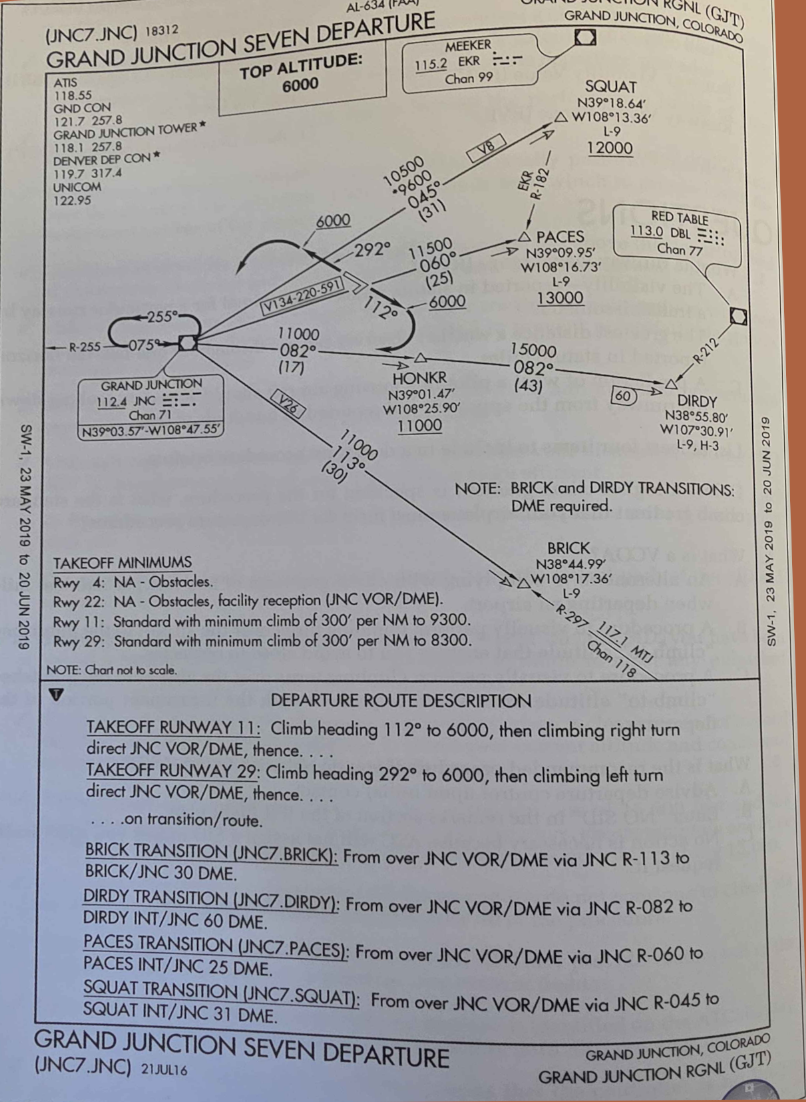
- Taking off from Runway 4 is not authorized due to obstacles and faulty reception of INC.
- When taking off from Runway 29, you must climb at least 300 feet per nautical mile to 6,000 feet MSL before turning left to NCO.
- Taking off from Runway 29 requires a standard climb gradient of 200 feet per nautical mile.
271
When taking off from Runway 29, what initial heading should you maintain and to what altitude?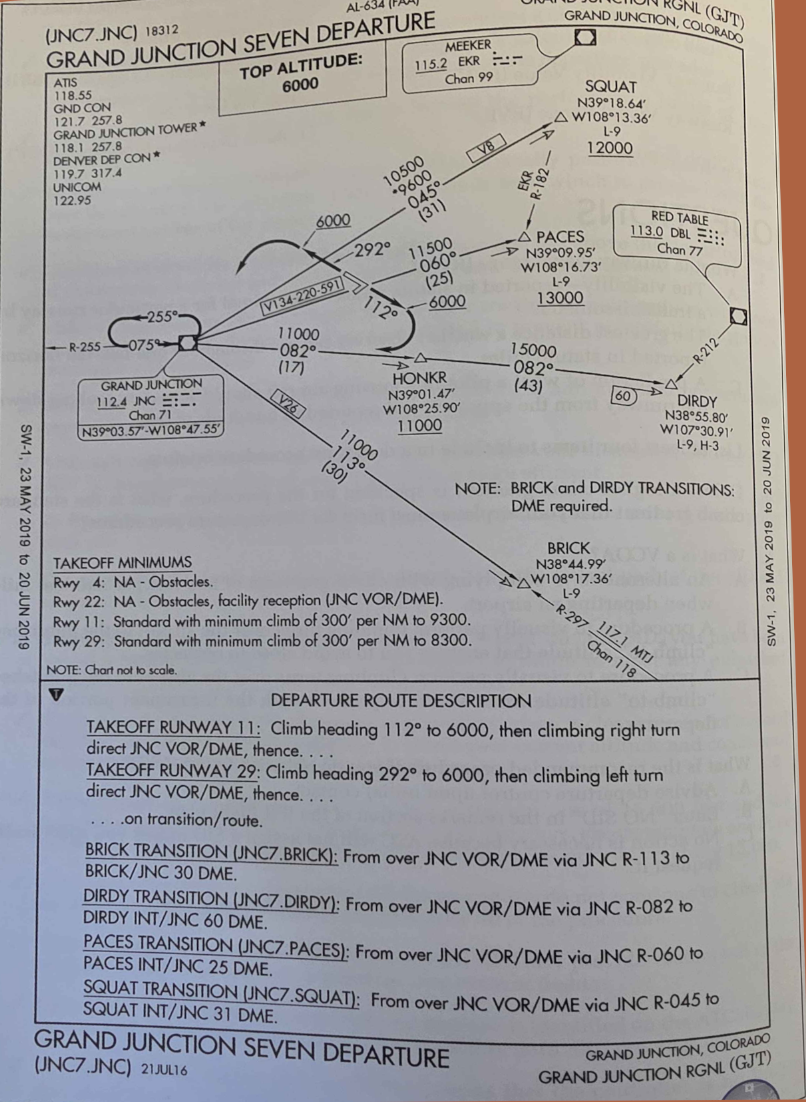
292° to 6,000' MSL
272
What is the minimum altitude you should maintain at HONKR?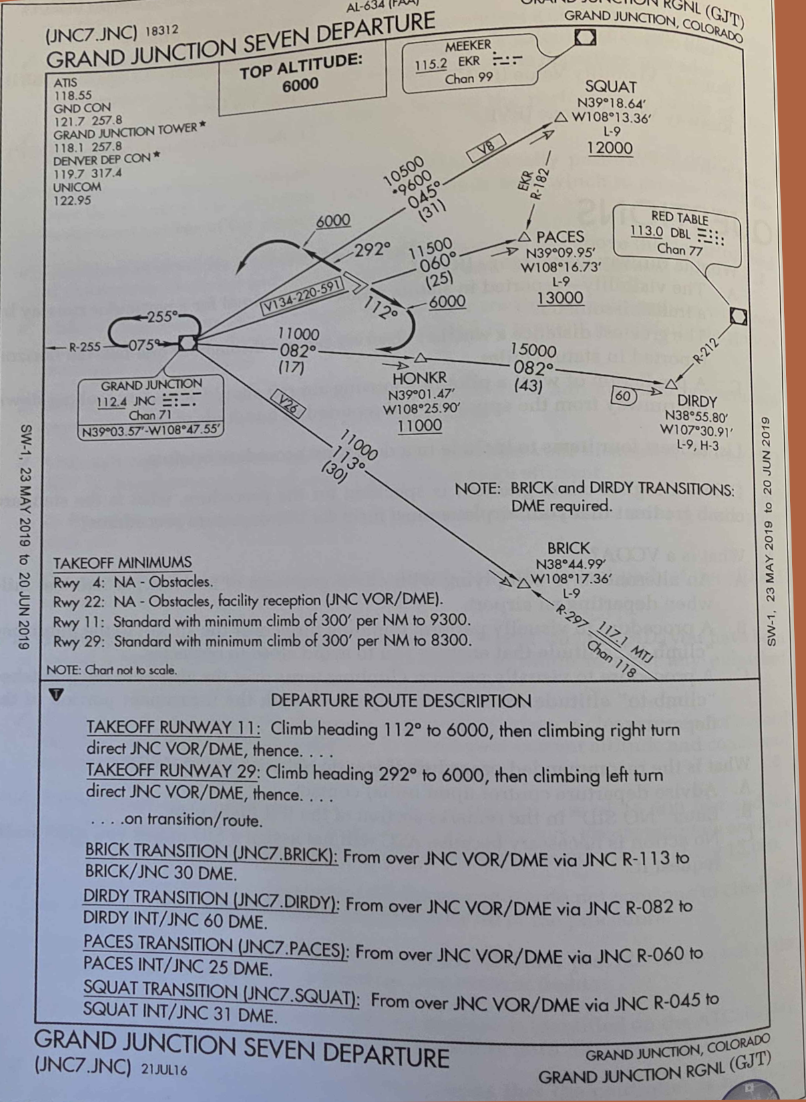
11,000' MSL
273
Which routing applies to the PACES transition?
- Fly the 060° radial from INC to 25 DME.
- Fly the 113° radial from INC to 30 DME.
- Fly the 060° radial from BRICK.
274
True/False. If the controller states that you are “cleared” or “cleared via” the SID, you must comply with the lateral path of the SID and all published speed and altitude restrictions.
False
275
If you depart on a climb via clearance, which is true?
- If you are given a clearance to “climb and maintain” an altitude, you are expected to continue to comply with altitude restrictions until reaching that altitude.
- If the top altitude is 11,000 feet and the departure controller says “climb via the (SID name) departure, except maintain 8,000,” comply with all published altitude restrictions prior to reaching 8,000.
- If the controller vectors your airplane off the procedure, prepare to join the SID again by climbing to the altitude specified at the next fix.
276
Where can you find textual ODPs published by the FAA?
Takeoff minimum section of the Terminal Procedures Publication (TPP)
277
True/False. You must be cleared by ATC to fly an ODP.
False
278
True/False. After the controller advises “radar contact,” you can assume that ATC provides terrain and obstruction clearance.
False
279
You have been vectored to an airway that is part of your ATC clearance, and departure control advises you to “resume own navigation.” What is meant by this term?
- You are still in radar contact, but you must make position reports.
- Radar service has terminated.
- You should intercept and maintain the airway centerline by use of your own navigation equipment.
280
How do you convert ft/nm to climb rate?
$\frac{groundspeed}{60}*ft/nm$
281
When do you make a parallel entry?
When the heading to the fix is between 090° and 200°
282
When do you fly a teardrop entry?
When the heading to the fix is between 020° and 090°
283
When do you fly a direct entry?
When the heading is between 200° and 020°
284
Select the true statement regarding STARs.
- A STAR is usually named for the primary arrival airport for which it is designed.
- When a significant change in the procedure occurs, a letter is added to the procedure name, starting with A.
- If you do not have the chart for the procedure with you, do not accept an clearance for the STAR.
285
You are planning to fly from Newcomerstown VOR/DME to Bellaire Air VOR/DME, then on course to WISKE, FEWGA, landing Runway 32. What computer code would you include in your flight plan?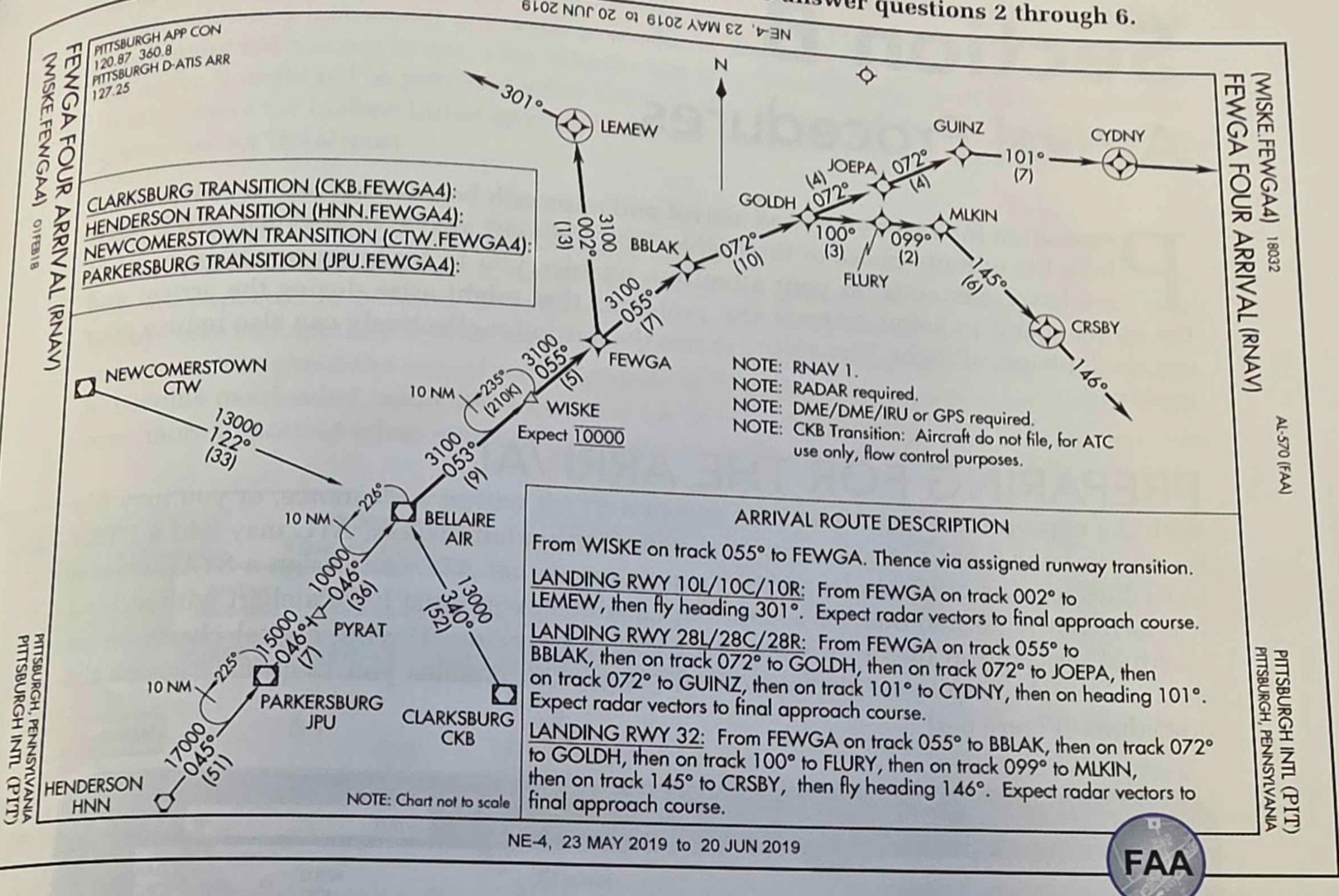
CTW.FEWGA4
286
At what point does the FEWGA FOUR ARRIVAL begin?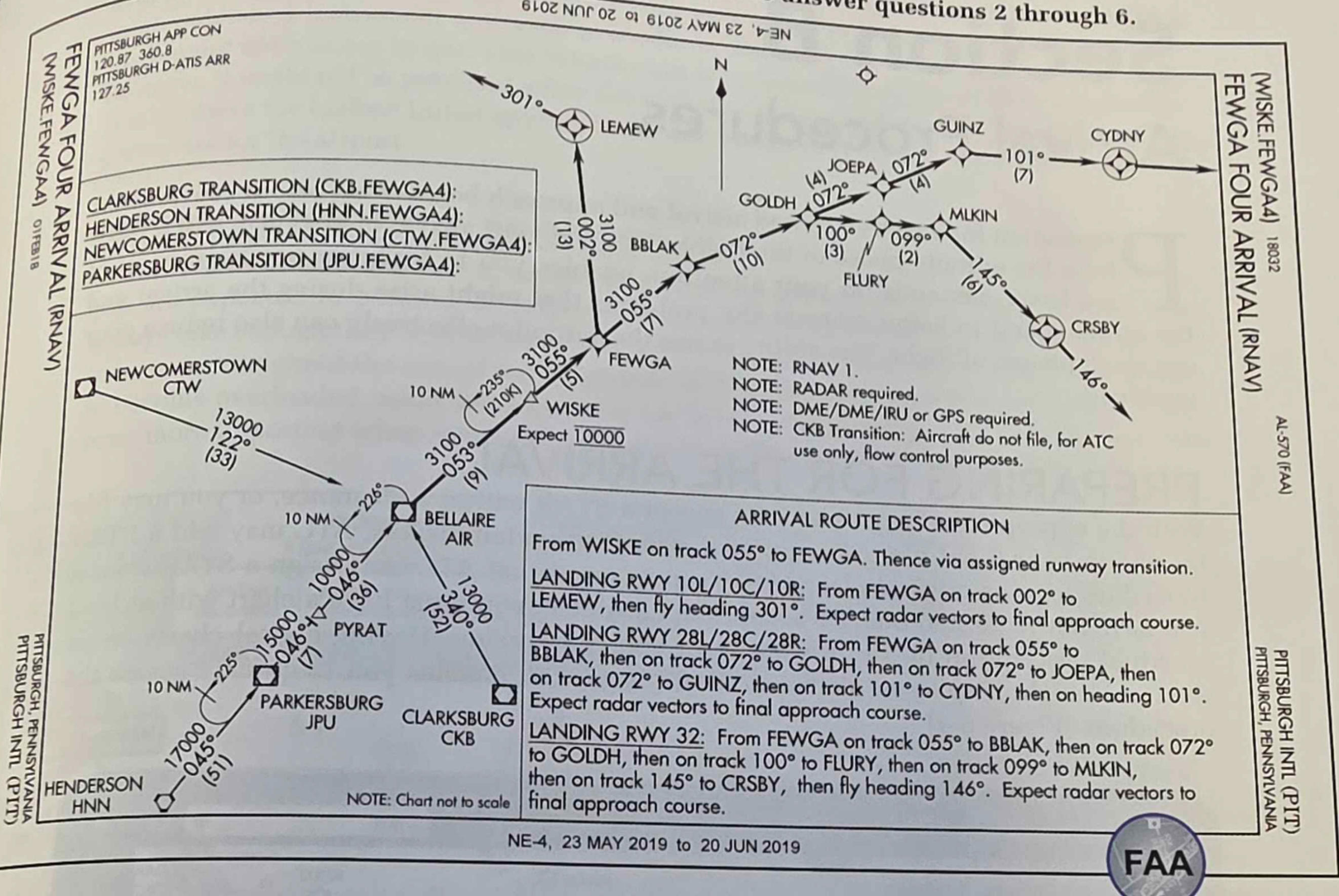
- WISKE waypoint
- FEWGA waypoint
- It depends on the transition used.
287
What frequency would you use to contact approach control? 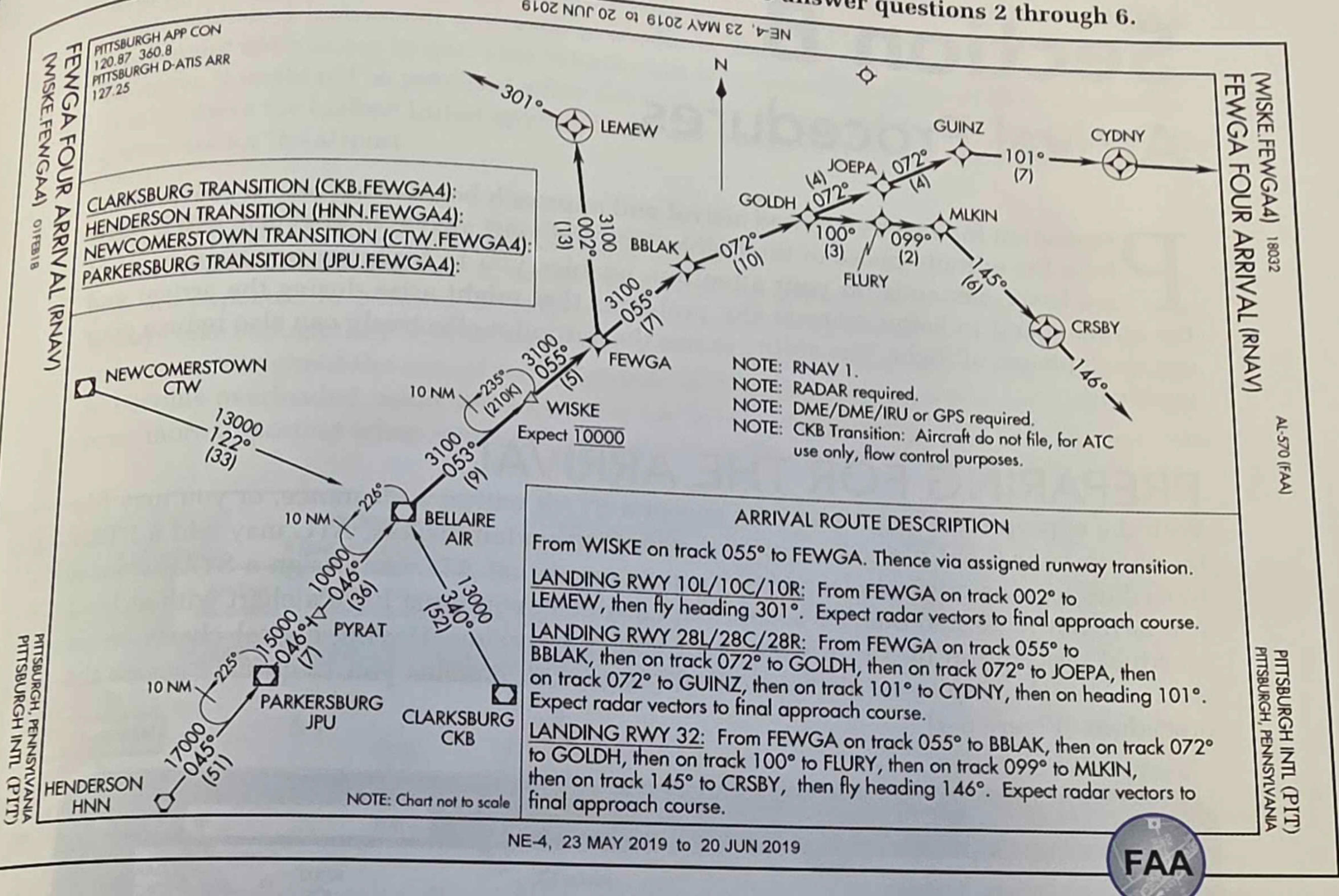
120.87
288
Which is required to fly this STAR?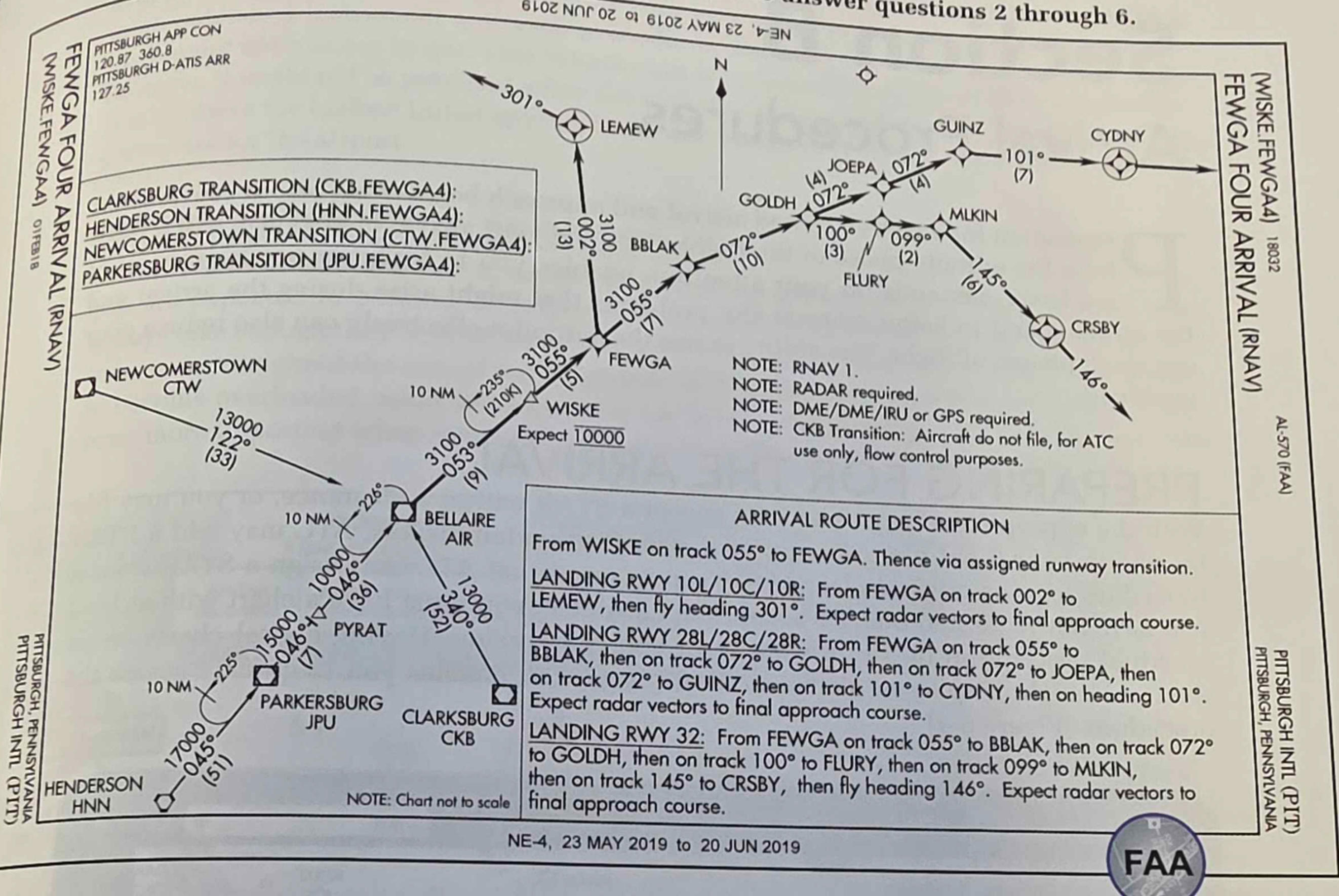
- GPS that requires a TSE of no more than .5 nautical mile for 95% of the total flight time.
- Radar and DME/DME/IRU or GPS that meets RNAV-I requirements
- Radar, DME/DME/IRU or GPS, and VOR/DME
289
What altitude should you expect to be assigned at WISKE? 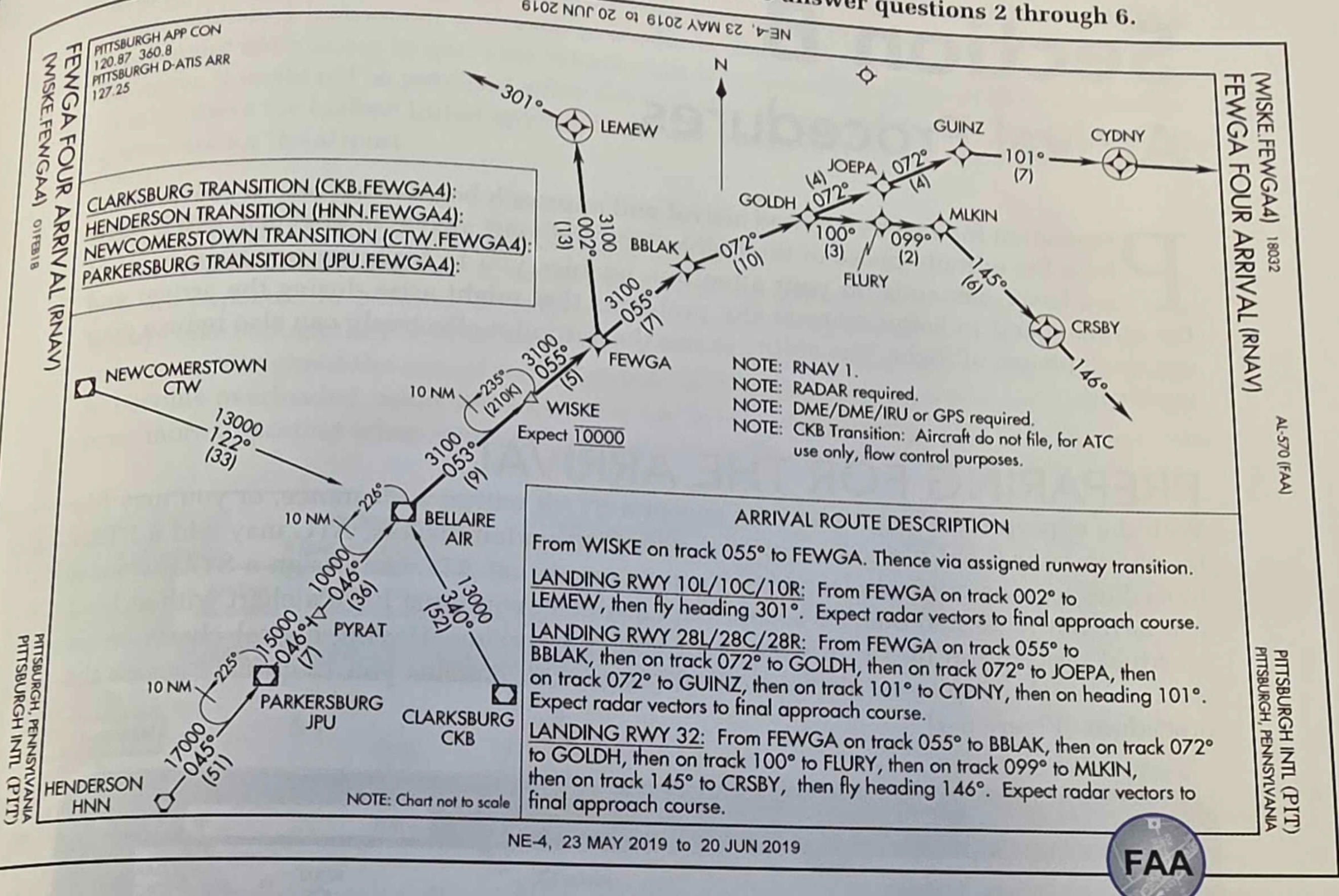
- 3,100 feet MSL
- 10,000 feet MSL
- An altitude above the minimum altitude of 10,000 feet MSL
290
True /False. Your GPS equipment will not provide guidance for a turn to a course of 101° until you pass over GUINZ waypoint. 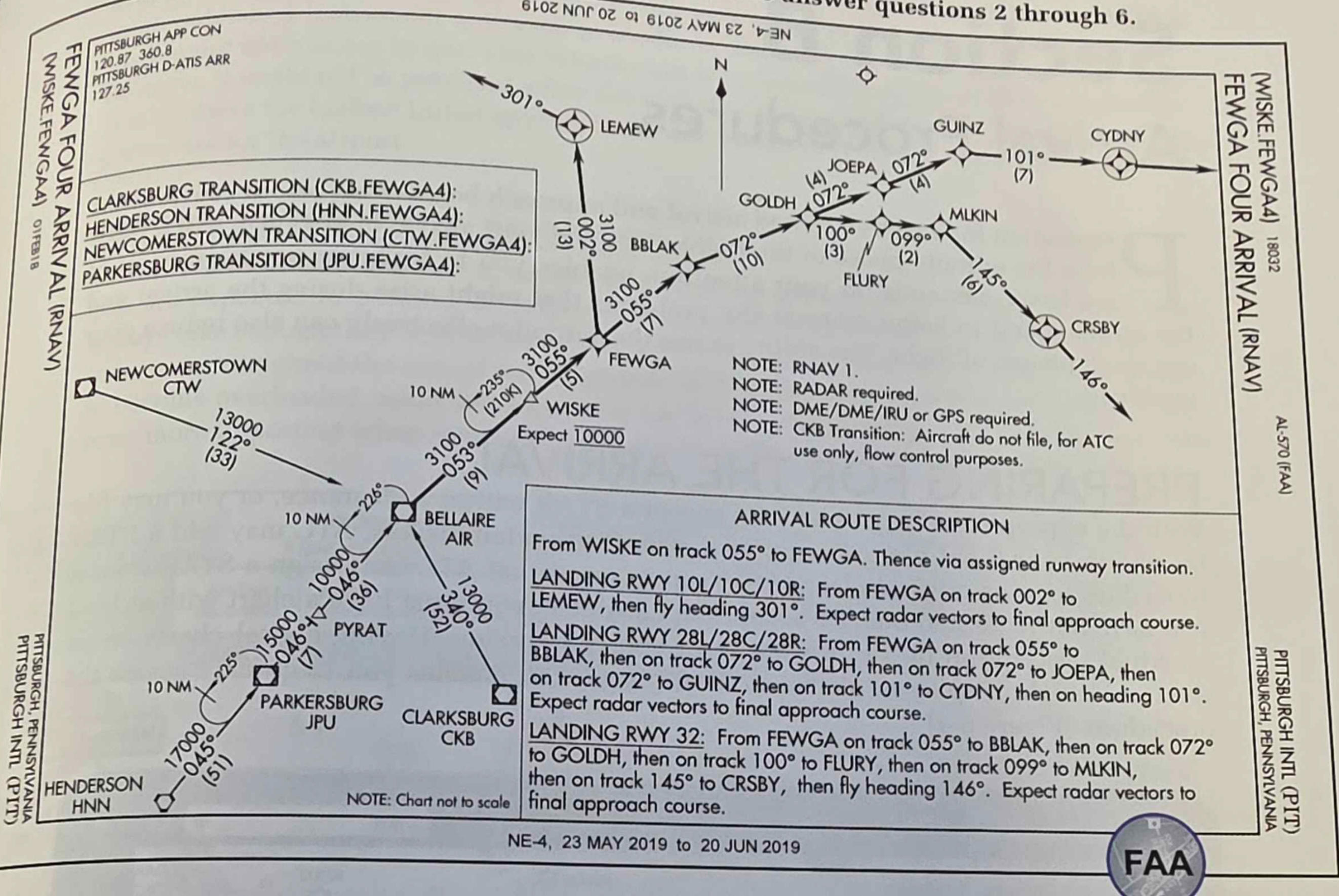
False
291
What direction are the turns of a nonstandard holding pattern?
- Left
- Pilots Discretion
- Right
292
If told to hold east of a VOR on the 090 degree radial, what will be the inbound heading to the fix once established in the hold?
- 270
- 090
- Depends whether or not the holding pattern is standard or nonstandard
293
Which of the following is an appropriate holding speed at 7000 msl?
- 210
- 250
- 235
294
Which of the following is a method for entering a holding pattern?
- Arc entry
- Procedure turn entry
- Parallel entry
295
How long should the inbound leg be in minutes if you are holding below 14000 msl
- 1:00
- 2:30
- 1:30
296
True/False. Turns are made to the left in nonstandard holding patterns.
True
297
Above what altitude are the straight legs for a standard holding pattern one and a half minutes?
- 14,000 feet MSL
- 10,000 feet MSL
- 12,000 feet MSL
298
What is the speed limit in holding patterns below 6,000 feet MSL?
200 KIAS
299
The first complete circuit of your standard holding pattern at 10,000 feet MSL takes a total of 3 minutes and 52 seconds. To achieve an inbound leg time of 1 minute on your next circuit, assuming there is no crosswind, approximately how many seconds should you fly outbound before turning?
- 68 seconds
- 60 seconds
- 52 seconds
300
Name the four segments of instrument approach procedures.
1. Initial
2. Intermediate
3. Final
4. Missed approach
2. Intermediate
3. Final
4. Missed approach
38 more cards in OutLearn. Open the full deck