Chapter 2 Anatomy and Physiology of Adult Friction Ridge Skin
Study these flashcardsFree · spaced repetition · iPhone, Android, Mac & web
All cards
1
What 3 layers is the skin composed of?
Epidermis, Dermis, Hypodermis
2
Epidermis Blurb:
- Outermost layer of skin
- Protective barrier for underlying tissue
- Protects "Melanocytes" pigment producing cells
- Pigment shields DNA of "Keratinocyte" (primary cell type of epidermis)
- Protective barrier for underlying tissue
- Protects "Melanocytes" pigment producing cells
- Pigment shields DNA of "Keratinocyte" (primary cell type of epidermis)
3
Dermis Blurb:
- Layer of connective tissue that supports the Epidermis
- Network of cells, fibers, blood vessels and gelatinous material that provides structural support and nourishment to epidermis.
- Blood reserve
- Temperature regulation and sensory reception.
- Network of cells, fibers, blood vessels and gelatinous material that provides structural support and nourishment to epidermis.
- Blood reserve
- Temperature regulation and sensory reception.
4
Hypodermis Blurb:
- Connective tissue that lies under the dermis
- Contains adipose cells (fat) which contours the body and serves as energy reserve.
- Contains adipose cells (fat) which contours the body and serves as energy reserve.
5
What is the only skin appedage of the friction ridge skin called?
Eccrine sweat gland
6
What kind of details does the friction ridge skin contain?
- Ridges and furrows on the surface are firmly rooted in the dermis by primary ridges (under the surface ridges) and secondary ridges (under the valleys).
- Primary and secondary ridges are interlocked with the dermis to provide support and strength to the friction ridge skin.
- Primary and secondary ridges are interlocked with the dermis to provide support and strength to the friction ridge skin.
7
What are the cells the epidermis is composed of?
Keratinocytes, melanocytes, langerhans cells, merkel cells.
8
What is the primary cell in the epidermis? Function?
Keratinocyte, reinforces skin cells
9
What are the 5 layers of keratinocytes? Surface -> Down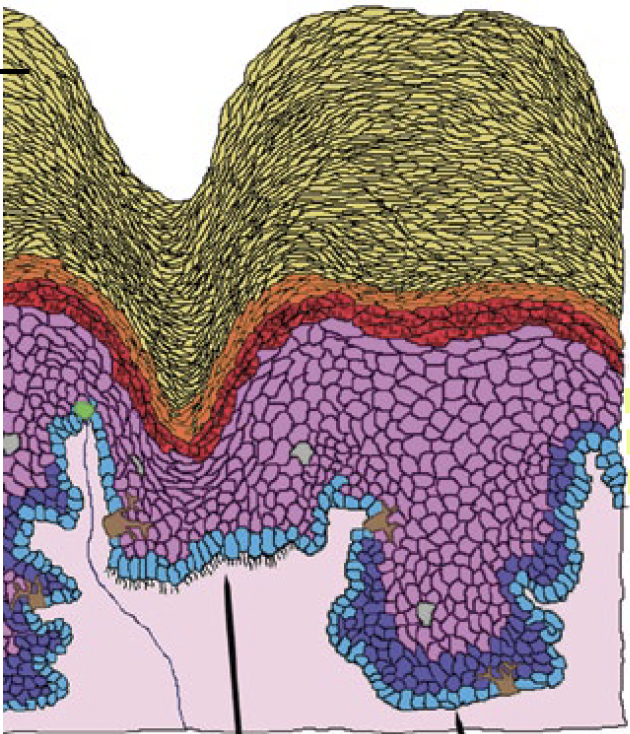
Stratum Lucidum, Stratum Granulosum, Stratum Spinosum, Supra-basal layer, Stratum Basale.
10
Stratum Basale
- Innermost layer of the epidermis
- Consists of a single layer of keratinocytes, scattered melanocytes, and Merkel cells.
- Consists of a single layer of keratinocytes, scattered melanocytes, and Merkel cells.