Cardiac Chapter 9,10 EXAM 3
Study these flashcardsFree · spaced repetition · iPhone, Android, Mac & web
All cards
1
What is Cardiac Output?
Volume of blood pumped by 1 ventricle in a given period of time. Cardiac output is a measure of cardiac performance.
Cardiac Output = heart rate x stroke volume
Cardiac Output = heart rate x stroke volume
2
How to calculate Heart Rate?
Heart Rate = beat/min
3
How to calculate Stroke Volume?
Stroke Volume = EDV-ESV
Volume of blood before contraction minus volume of blood after contraction (volume / beat).
Volume of blood before contraction minus volume of blood after contraction (volume / beat).
4
Heart rate is determined by _____ and innervated by _____ .
Sinoatrial node, Autonomic Nervous System.
5
Describe a Parasympathetic heart rate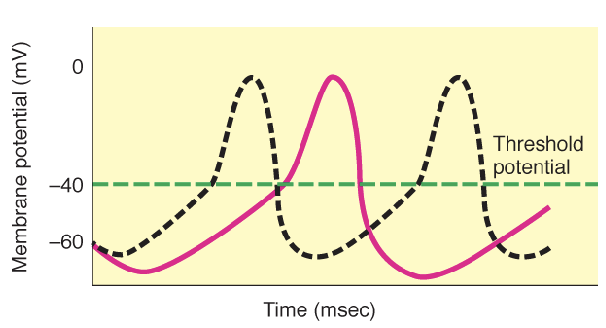
- Slower heart rate
- The duration of pacemaker potential between action potentials increases
- Acetylcholine activates muscarinic receptors and causes increased potassium permeability in Sinoatrial node.
- Potassium hyperpolarizes Vm
- Potassium leaving fights the rate of calcium entering.
- The duration of pacemaker potential between action potentials increases
- Acetylcholine activates muscarinic receptors and causes increased potassium permeability in Sinoatrial node.
- Potassium hyperpolarizes Vm
- Potassium leaving fights the rate of calcium entering.
6
Describe a Sympathetic heart rate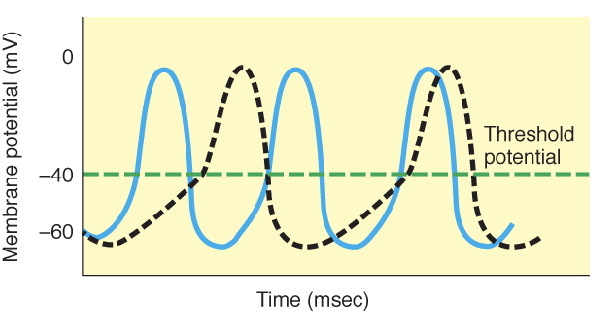
- Increased heart rate
- Norepinephrine activates B1 adrenergic receptors and causes decreased potassium permeability.
- Less K+ leaving the cell makes threshold easily achievable
- Norepinephrine activates B1 adrenergic receptors and causes decreased potassium permeability.
- Less K+ leaving the cell makes threshold easily achievable
7
What are the 2 kinds of stroke volume regulation?
Intrinsic and Extrinsic
8
What is Intrinsic regulation?
- Venous return (blood returning from venous vasculiture)
- More blood increases volume
- Sarcomere stretching and heart rate is more efficient
- More blood increases volume
- Sarcomere stretching and heart rate is more efficient
9
What is Extrinsic regulation?
Outside of heart
- Stimulated by sympathetic activity and epinephrine
- Increases strength of contractions and calcium ions
- Stimulated by sympathetic activity and epinephrine
- Increases strength of contractions and calcium ions
10
How is Cardiac Output distributed?
Reconditioning organs maintains homeostasis
- pulmonary circulation such as lungs
- systemic circulation in the digestive tract (nutrients), kidneys (metabolic waste and water/pH) and skin (heat)
- pulmonary circulation such as lungs
- systemic circulation in the digestive tract (nutrients), kidneys (metabolic waste and water/pH) and skin (heat)
11
What is blood flow and how is it calculated?
Volume of blood per minute
- Directly proportional to pressure gradient
- Inversely proportional to vascular resistance
Flow = (change in pressure gradient) / resistance
- Directly proportional to pressure gradient
- Inversely proportional to vascular resistance
Flow = (change in pressure gradient) / resistance
12
Explain the pressure gradient...
- Change in pressure between 2 areas of a vessel
- Blood flows from an area of higher pressure to an area of lower pressure
- Derived from heart
High pressure leaving heart
Low pressure entering heart
- Blood flows from an area of higher pressure to an area of lower pressure
- Derived from heart
High pressure leaving heart
Low pressure entering heart
13
If pressure gradient increases...
Blood flow increases
14
What is resistance?
Opposition to blood flow caused by friction of vessel walls.
15
What are 3 determining factors for resistance?
Blood Viscosity
Vessel length, longer the distance the molecules will push against the vessel walls
Vessel radius, wide vessels more room to move = less resistance, narrow vessels less room to move = more resistance
Vessel length, longer the distance the molecules will push against the vessel walls
Vessel radius, wide vessels more room to move = less resistance, narrow vessels less room to move = more resistance
16
Radius is _____ proportional to _____.
A small radius = _____ resistance = _____ flow.
A large radius = _____ resistance = _____ flow.
A small radius = _____ resistance = _____ flow.
A large radius = _____ resistance = _____ flow.
Inversely, resistance
High, Low
Low, High
High, Low
Low, High
17
What is the order to vascular tree?
Arteries -> Arterioles -> Capillaries -> Venules -> Veins
18
What is the function of arteries?
- Pressure reservoir
- Thick layers of vascular smooth muscle
- Lots of elastic and fibrous connective tissue
- Thick layers of vascular smooth muscle
- Lots of elastic and fibrous connective tissue
19
What is the function of arterioles?
Regulates blood pressure and distribution of blood flow
- Site of variable resistance
- Less elastic and more muscular
- Site of variable resistance
- Less elastic and more muscular
20
What is the function of capillaries?
- Smallest vessel
- Primary site of exchange between blood and interstitial fluid.
- Primary site of exchange between blood and interstitial fluid.
21
What is the function of venules?
Connection point between capillaries and veins
- Receive blood from capillaries
- Thin exchange epithelium
- Receive blood from capillaries
- Thin exchange epithelium
22
What is the function veins?
Take blood back to the heart
- Blood volume resevoir
- Thin walls of vascular smooth muscles
- Contains one-way valves, prevent backward flow
- Large in diameter
- Blood volume resevoir
- Thin walls of vascular smooth muscles
- Contains one-way valves, prevent backward flow
- Large in diameter
23
When large volumes of blood are received at _____, the arteries _____.
Ventricle systole, expand.
24
What is recoil?
A passive motion caused by the elastic fibers of arteries snapping back.
25
Define systolic pressure, diastolic pressure and pulse pressure:
- Max pressure during systole
- Minimum pressure when blood is draining out
- Difference between systolic and diastolic
- Minimum pressure when blood is draining out
- Difference between systolic and diastolic
26
What is mean arterial pressure and how is it calculated?
The main driving force for blood flow.
MAP (Mean Arterial Pressure) = Diastolic pressure + 1/3 (pulse pressure)
MAP (Mean Arterial Pressure) = Diastolic pressure + 1/3 (pulse pressure)
27
Explain arterioles vasoconstriction and vasodilation:
- Arterioles are major resistance vessels due to their small radius.
- The arterioles' radius changes due to thick smooth muscles (myogenic) and little elastic tissue
- Sympathetic innervation
- The arterioles' radius changes due to thick smooth muscles (myogenic) and little elastic tissue
- Sympathetic innervation
28
What are the 2 controlling factors that affect vascular tone of arterioles?
Intrinsic factors regulate distribution of CO (Cardiac Output).
Extrinsic factors regulate blood pressure
Extrinsic factors regulate blood pressure
29
What kind of intrinsic changes will trigger vasodilation(active hyperemia) ?
Decrease in O2
Increased CO2
Increased acidity (linked to CO2 increase and lactic acid)
Increased K+ ion concentration (increased osmolarity, adenosine release)
Increased CO2
Increased acidity (linked to CO2 increase and lactic acid)
Increased K+ ion concentration (increased osmolarity, adenosine release)
30
What do local vasoactive mediators do?
Released from endothelial cells:
- Endothelial derived relaxing factor (EDRF), vasodilation via inhibition of calcium (Nitric oxide and viagra, leads to hypertension and heart failure).
- Endothelin, vasoconstriction
- Endothelial derived relaxing factor (EDRF), vasodilation via inhibition of calcium (Nitric oxide and viagra, leads to hypertension and heart failure).
- Endothelin, vasoconstriction