1 - renal system
Study these flashcardsFree · spaced repetition · iPhone, Android, Mac & web
All cards
1
the _______ kidney is lower than the other; this is because of the _______
right
liver
liver
2
role of the renal system
maintain homeostasis by balancing fluids/electrolytes and making hormones
3
hormones made by the kidneys (3)
erythropoietin (RBCs)
renin (BP modulation)
calcitral (vitamin D to maintain Ca++ levels)
renin (BP modulation)
calcitral (vitamin D to maintain Ca++ levels)
4
when would the kidneys produce erythropoietin?
in response to hypoxemia!!
ppl with pulm/card disease have LOTS of rbcs and hemoglobin bc the kidneys are like popping their pussy to make up for the lack fo O2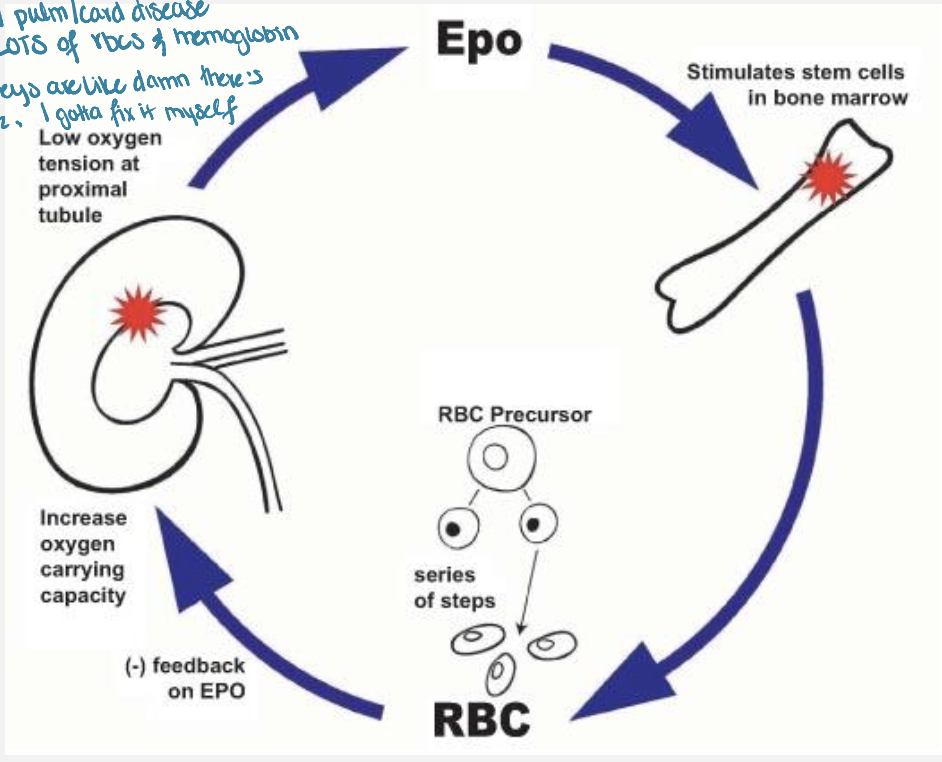
ppl with pulm/card disease have LOTS of rbcs and hemoglobin bc the kidneys are like popping their pussy to make up for the lack fo O2
5
renin-angiotensin system
1) BP drops/fluid volume drops
2) renin released from kidneys
3) renin + angiotensinogen = angiotensin 1
4) ACE released from lungs
5) ACE + angiotensin 1 = angiotensin 2
6) angiotensin 2 goes to the adrenal glands AND acts on blood vessels
7) adrenal glands release aldosterone (stimulated salt and water resorption) AND vasocontriction
8) BP up :))))))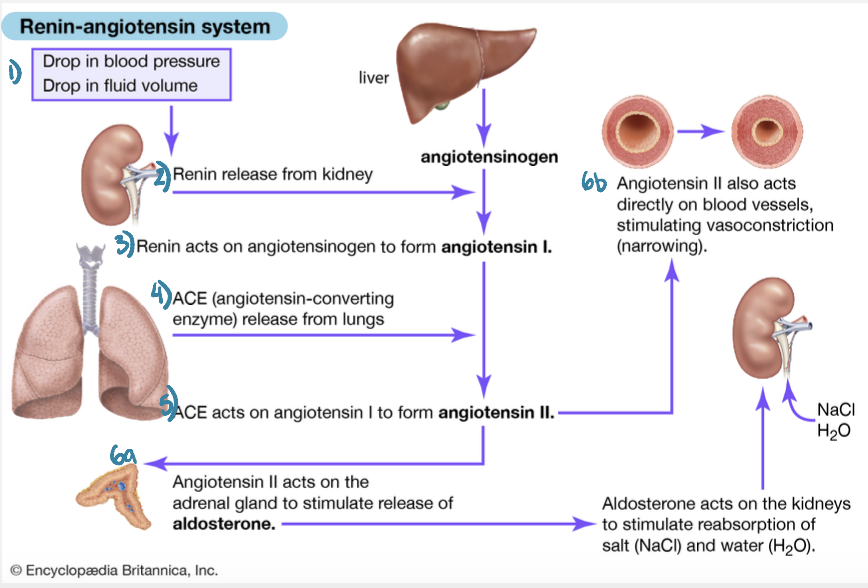
2) renin released from kidneys
3) renin + angiotensinogen = angiotensin 1
4) ACE released from lungs
5) ACE + angiotensin 1 = angiotensin 2
6) angiotensin 2 goes to the adrenal glands AND acts on blood vessels
7) adrenal glands release aldosterone (stimulated salt and water resorption) AND vasocontriction
8) BP up :))))))
6
how do ACE inhibitors work?
blocks the release of ACE from the lungs --> prevents conversion of angiotensin 1 to 2
prevents rises in BP (via salt and water resorption and vasoconstriction)!
#diuretic
prevents rises in BP (via salt and water resorption and vasoconstriction)!
#diuretic
7
pyelonephritis (definition, acute vs chronic)
infectious inflammation at the basin of the kidney
acute: from under/ untreated UTI; infection travels up the ureter to kidney basin; fever, chills, headache, back pain and flank pain
chronic: injury, obstruction or reflux; leads to End Stage Renal Disease
acute: from under/ untreated UTI; infection travels up the ureter to kidney basin; fever, chills, headache, back pain and flank pain
chronic: injury, obstruction or reflux; leads to End Stage Renal Disease
8
pyelonephritis (diagnosis and t/x)
diagnosis: urine analysis (bacteria, hematuria, leukocytosis)
treatment: long course of antibiotics (14 days)
treatment: long course of antibiotics (14 days)
9
pyelonephritis (PT considerations)
no contraidications to activity (aside from like fatigue and malaise)
encourage to complete all antibiotics!!!!
encourage to complete all antibiotics!!!!
10
glomerulonephritis (defintion, symptoms)
infectious, inflammatory disease of the filtering units of the kidney (glomerulus); common cause of chronic renal failure (ESRD)
common comorbidities: diabetes, lupus, peripheral artery disease
signs and symptoms: hematuria, proteinuria, decreased urin output --> systemic edema, pulmonary edema, INCREASED BP
common comorbidities: diabetes, lupus, peripheral artery disease
signs and symptoms: hematuria, proteinuria, decreased urin output --> systemic edema, pulmonary edema, INCREASED BP
11
glomerulonephritis (diagnosis and t/x)
diagnosis: urine analysis with proteinuria, hematuria, pyuria
treatments:
-- low fat, low protein, low salt diet (very sad)
-- diuretics!! (ACE inhibitor is the first line; for BP r/x calcium channel blockers, beta blockers)
-- dialysis and transplantation
treatments:
-- low fat, low protein, low salt diet (very sad)
-- diuretics!! (ACE inhibitor is the first line; for BP r/x calcium channel blockers, beta blockers)
-- dialysis and transplantation
12
glomerulonephritis (PT considerations)
ELECTROLYTES ARE OFF!! muscle cramping (K+), muscle weakness, hemodynamic compromise, incr SBP
toxins stay in system eek
excess fatigue
BP prone to fluctuating a lot (disease elevates BP, dialysis drops BP, etc)
toxins stay in system eek
excess fatigue
BP prone to fluctuating a lot (disease elevates BP, dialysis drops BP, etc)
13
renal calculi (definition and symptoms)
kindey stones!; crystal formations that cause urinary obstruction and pain (spiky ouch)
signs and symptoms: PAIN!!!!!!!!!!! flank pain, abdominal pain, back pain; urgency, frequency, hematuria
signs and symptoms: PAIN!!!!!!!!!!! flank pain, abdominal pain, back pain; urgency, frequency, hematuria
14
kidney stones (diagnosis and t/x)
diagnosis: CT scan, ultrasound
treatment: (spoiler, there is no fun option)
-- if small, time and pain meds
-- if big, lithotripsy (shock waves) to break up stones into passable pieces
treatment: (spoiler, there is no fun option)
-- if small, time and pain meds
-- if big, lithotripsy (shock waves) to break up stones into passable pieces
15
kidney stones (PT considerations)
can cause decreased urine output but also urgency
serious pain and discomfort
serious pain and discomfort
16
rhabdomyolosis (definition, causes and symptoms)
breakdown of striated muscle
-- exertional
-- crush induced
-- fever, hyperthemia (extreme and prolonged)
-- meds
-- excessive alcohol
-- endocrine disorders, infections, electrolye abnormalities, etc
symptoms:
- local swelling, pain, weakness
- systemic fever, fatigue, hypotension, arrhytmias
- confusion, nausea, vomiting, dark urine, decreased urine output
-- exertional
-- crush induced
-- fever, hyperthemia (extreme and prolonged)
-- meds
-- excessive alcohol
-- endocrine disorders, infections, electrolye abnormalities, etc
symptoms:
- local swelling, pain, weakness
- systemic fever, fatigue, hypotension, arrhytmias
- confusion, nausea, vomiting, dark urine, decreased urine output
17
rhabdomyolysis (diagnosis and treatment)
diagnosis: decreased urine output, proteinuria
treatment:
-- PHYSICAL REST + CORRECT ELECTROLYET BALANCE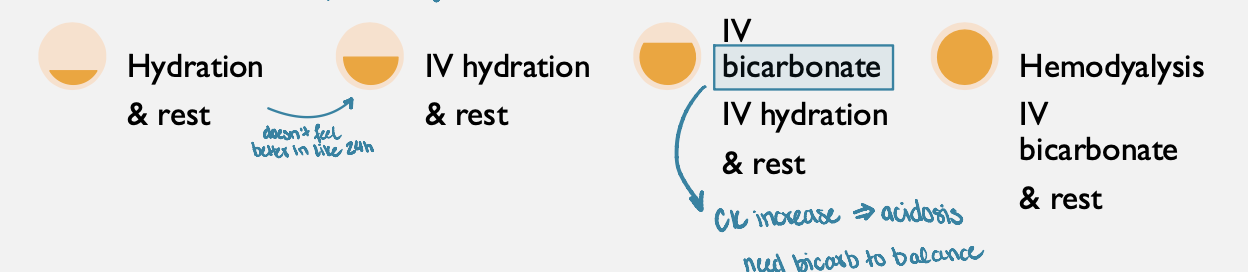
treatment:
-- PHYSICAL REST + CORRECT ELECTROLYET BALANCE
18
kidney trauma (grading and symptoms)
graded 1 (bruise) to 5 (basin and ureter disconnected)
symptoms: hematuria, low back pain, signs of internal bleeding, decreased urine output
symptoms: hematuria, low back pain, signs of internal bleeding, decreased urine output
19
signs of internal bleeding
dizziness
low BP
nausea
vomiting
skin tone discoloration
shock
low BP
nausea
vomiting
skin tone discoloration
shock
20
kidney trauma (diagnosis and treatment)
diagnosis: ultrasound (FAST)
t/x:
-- conservaive t/x 4-6 weeks; just lay low and be nice to ur kidneys
-- excision if grade 5!! cannot reattach ureter
t/x:
-- conservaive t/x 4-6 weeks; just lay low and be nice to ur kidneys
-- excision if grade 5!! cannot reattach ureter
21
FAST ultrasound
Focused Assessment using Sonogrpahy in Trauma
pretty reliable and quick form of ultrasound for traumatic injuries
pretty reliable and quick form of ultrasound for traumatic injuries
22
kidney trauma (PT considerations)
trauma from contact, fall,or injury
just watch for symptoms
just watch for symptoms
23
chronic renal failure (definition and symptoms)
usually secondary to diabetes, HTN, chronic UTIs, primary renal dysfunction and advancing age
signs and symptoms:
-- SHORT TERM: incr weight, edema, mental status changes, fatigue, incr BP, nausea, vomiting, loss of apetite, low urine output
-- LONG TERM: bone demineralization, tendon avulsion, avascular necrosis, demyelination of PNS, anemia
signs and symptoms:
-- SHORT TERM: incr weight, edema, mental status changes, fatigue, incr BP, nausea, vomiting, loss of apetite, low urine output
-- LONG TERM: bone demineralization, tendon avulsion, avascular necrosis, demyelination of PNS, anemia
24
chronic renal failure (diagnosis and treatment)
diagnosis: lab tests
t/x:
diet
meds
renal replacement therapy
transplants
t/x:
diet
meds
renal replacement therapy
transplants
25
renal replacement therapy (4)
fast hemodialysis
slow hemodialysis
peritoneal dialysis
transplant
slow hemodialysis
peritoneal dialysis
transplant
26
fast hemodialysis
-- 3x per week for 3-4 hour sessions
-- A-V fistula necessary!!!!!!! fast arterial to slow venular = turbulence; need easy connection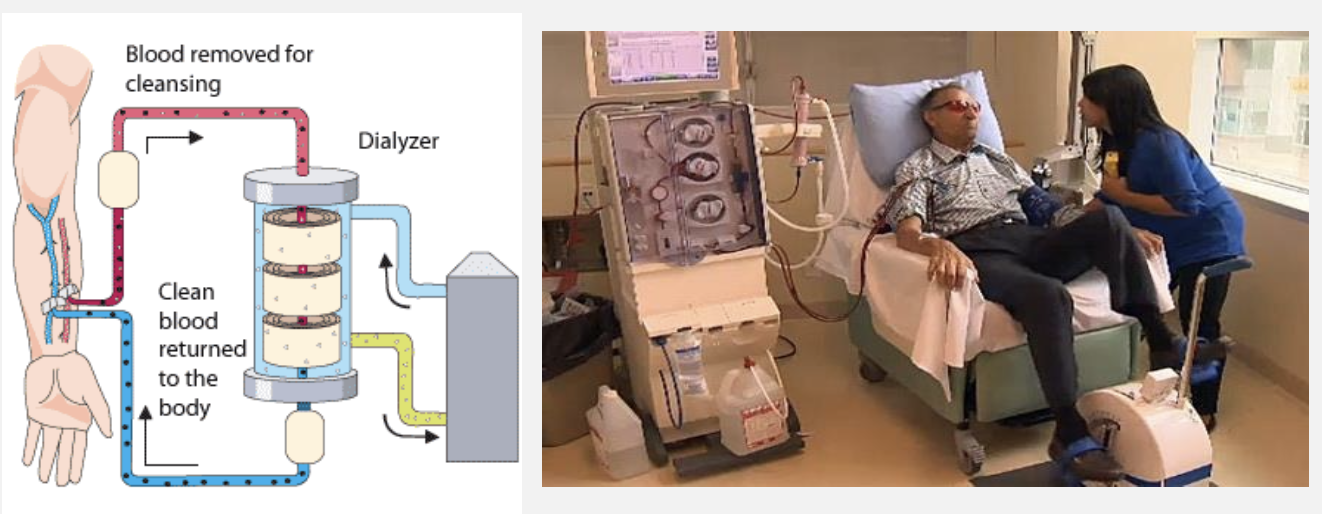
-- A-V fistula necessary!!!!!!! fast arterial to slow venular = turbulence; need easy connection
27
slow hemodialysis
-- continuous renal replacement therapy, continuous veno veno hemodialysis
-- slower and can be done at home
-- slower and can be done at home
28
peritoneal dialysis
electrolyte fluid inserted into peritoneal space (abdominal cavity) via catheter
special ion balance will draw out waste products via osmosis
second bag drains fluid from space
*** gravity driven, can be done independently/overnight, tedious, risk of infection
*** 30-40 min 4x/day PR overnight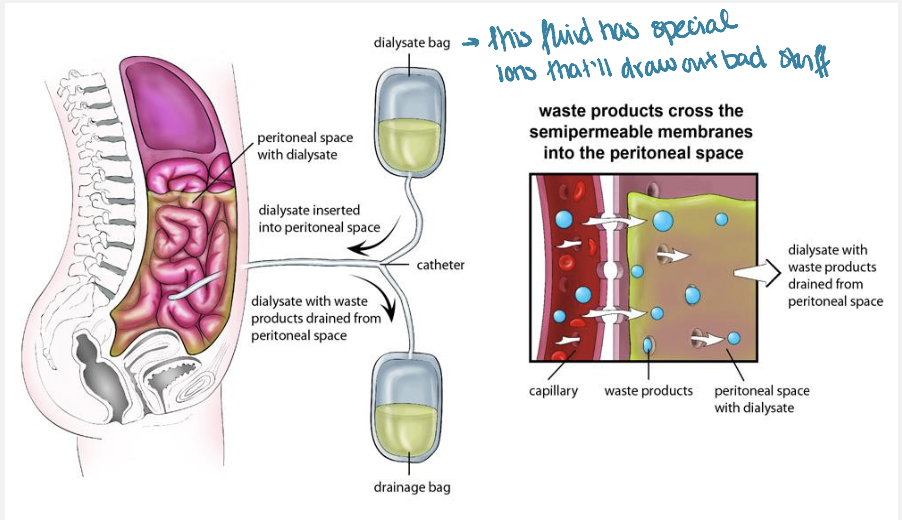
special ion balance will draw out waste products via osmosis
second bag drains fluid from space
*** gravity driven, can be done independently/overnight, tedious, risk of infection
*** 30-40 min 4x/day PR overnight
29
kidney transplant
with good tissue typing, they tend to be really successful; live transplant >>> cadaver, but both good options
** btw, they keep the old kidney in ther eek
** btw, they keep the old kidney in ther eek
30
5 lab tests indicative of renal health
creatinine
BUN
GFR
electorlytes
microalbuminuria
BUN
GFR
electorlytes
microalbuminuria
31
creatinine lab test
result of natural breakdown of creatinine phosphate (PCr) in muscles; kidneys are supposed to filter her out
increase = kidneys aren't filtering OR excess PCr in blood (too much muscle breakdown)
anything above 2.0 is a lil concerning; dependent on muscle mass though
increase = kidneys aren't filtering OR excess PCr in blood (too much muscle breakdown)
anything above 2.0 is a lil concerning; dependent on muscle mass though
32
GFR lab test
glomerular filtration rate!calculated by measuring any chemical that's common in the blood that is filtered and excreted by kidneys (neither reasorbed nor secreted)
creatinine clearance is an easy one since it's already at a steady-state ca in blood
creatinine clearance is an easy one since it's already at a steady-state ca in blood
33
how can we use the relationship between creatinine test and GFR (creatinine clearance) to tell us about renal disease?
early renal disease = large change in GFR, small change in creatinine; suddenly we're not filtering efficiently, and there's just a little effect on the actual amt of creatinine
advanced renal failure = large change in creatinine (amount), small change in GFR; we've been inefficient with filtering for a hot minute, now we're seeing a significant change in the amt of creatinine being filtered out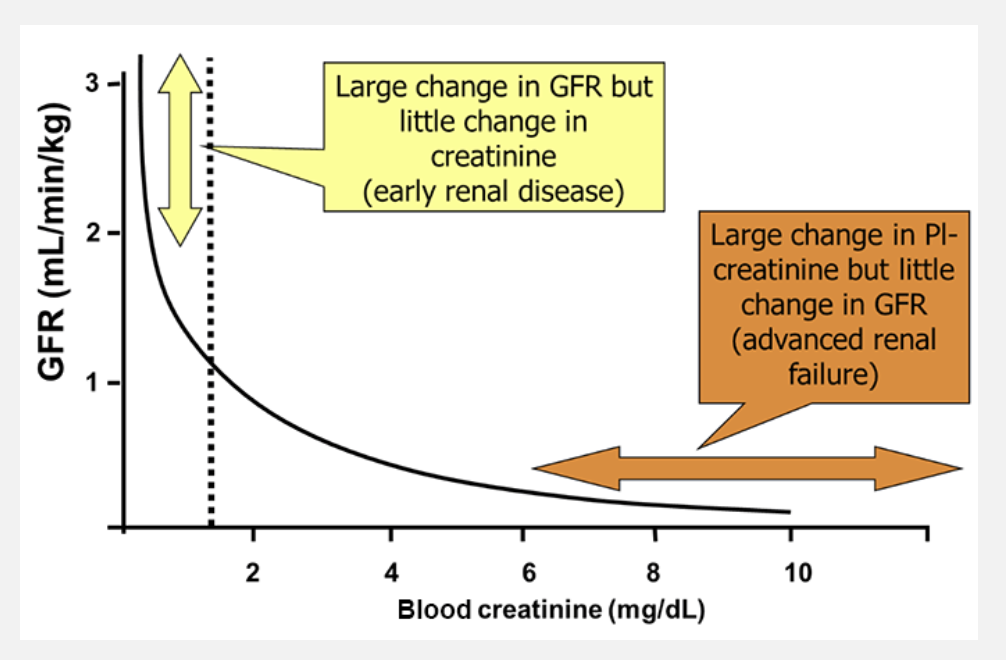
advanced renal failure = large change in creatinine (amount), small change in GFR; we've been inefficient with filtering for a hot minute, now we're seeing a significant change in the amt of creatinine being filtered out
34
BUN lab test
blood urea nitrogen is a measure of the amnt of nitrogen in the blood that comes from urea
indicative of kidney ORRRR liver damage!!!!!!
increase = kidneys aren't removing it OR elevated protein breakdown
decrease = liver problems, malnutrition, excessive alcohol, overhydration, pregnancy (not that significant tbh)
indicative of kidney ORRRR liver damage!!!!!!
increase = kidneys aren't removing it OR elevated protein breakdown
decrease = liver problems, malnutrition, excessive alcohol, overhydration, pregnancy (not that significant tbh)
35
urea
waste product from liver; result of protein digestion
36
BUN reference range
7-25 mg/dL
37
if creatinine is normal, an elevated BUN level could be due to ____ (7)
dehydration
heart failure
GI bleed
high protein diet
steriod use
burns
fever
heart failure
GI bleed
high protein diet
steriod use
burns
fever
38
how might dehydration, heart failure and GI bleeding result in an elevated BUN?
they all cause decreased blood flow in general, so there's just less volume for the kidneys to filter --> relatively low everything
39
how might high protein diets, steroid use and burns result in an elevated BUN?
they all result in increased protein breakdown --> greater production of urea --> more appears in urine
40
what non-renal issues might an elevated BUN indicate?
uremia!!! (buildup of other nitrogenous waste)
can cause:
altered cognitive function (encephalopathy)
impaired taste (dysgeusia)
loss of apetitie (anorexia)
nausea and vomiting
bleeding
skin discoloration
can cause:
altered cognitive function (encephalopathy)
impaired taste (dysgeusia)
loss of apetitie (anorexia)
nausea and vomiting
bleeding
skin discoloration
41
electrolytes lab test
electrolyes are super important for maintaining homeostasis, and your kidneys have a huge role in regulating them
they regulate myocardial and neuro function, fluid balance, oxygen delivery, acid-base balance, etc
renal failure is the most common cause of electrolye distrubances
they regulate myocardial and neuro function, fluid balance, oxygen delivery, acid-base balance, etc
renal failure is the most common cause of electrolye distrubances
42
Na+ role in homeostasis (4)
regulation of blood and body fluids
transmission of nerve impulses
heart activity
some metabolic functions
transmission of nerve impulses
heart activity
some metabolic functions
43
K+ role in homeostasis (2)
neuron function (muscle cramping, arrythmias)
osmotic balance (incr edema, incr seeping)
osmotic balance (incr edema, incr seeping)
44
Cl- role in homeostasis (4)
gastric metabolism
acid-base balance
CNS transmission
protein transport
acid-base balance
CNS transmission
protein transport
45
HCO3 role in homeostasis
the base in the acid-base balance!! increases pH!!
46
microalbuminuria lab test
measures albumin levels in urine
healthy kidneys: albumin's large size and (-) charge mean that it doesn't get excreted in glomerulus
renal disease: albumin (and other similar proteins) can cross glomerulus bc of dysfunction
healthy kidneys: albumin's large size and (-) charge mean that it doesn't get excreted in glomerulus
renal disease: albumin (and other similar proteins) can cross glomerulus bc of dysfunction
47
albumin reference range
30-50 g/L
48
urinalysis appearance
color:
should be straw to amber
abnormal is due to illness, diet or drugs
clarity/transparency:
should be clear
abnormal due to insoluble elements
should be straw to amber
abnormal is due to illness, diet or drugs
clarity/transparency:
should be clear
abnormal due to insoluble elements
49
NSAID effect on kidneys
constrict the Afferrent arteriole
can cause potential kidney damage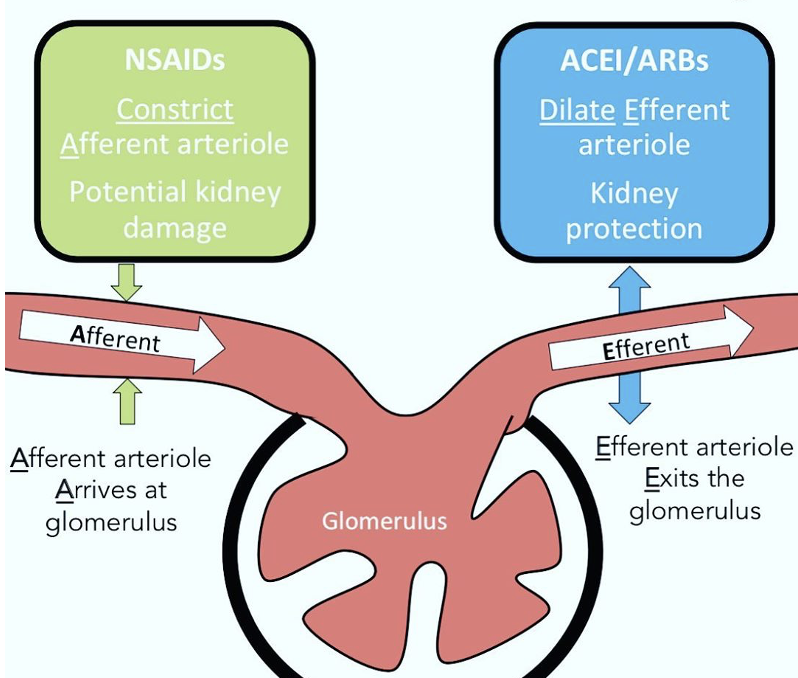
can cause potential kidney damage
50
ACE inhibitors / Anciotensin II Receptor Blockers (ARBs) effect on kidneys
dilate the Efferent arteriole
protects kidneys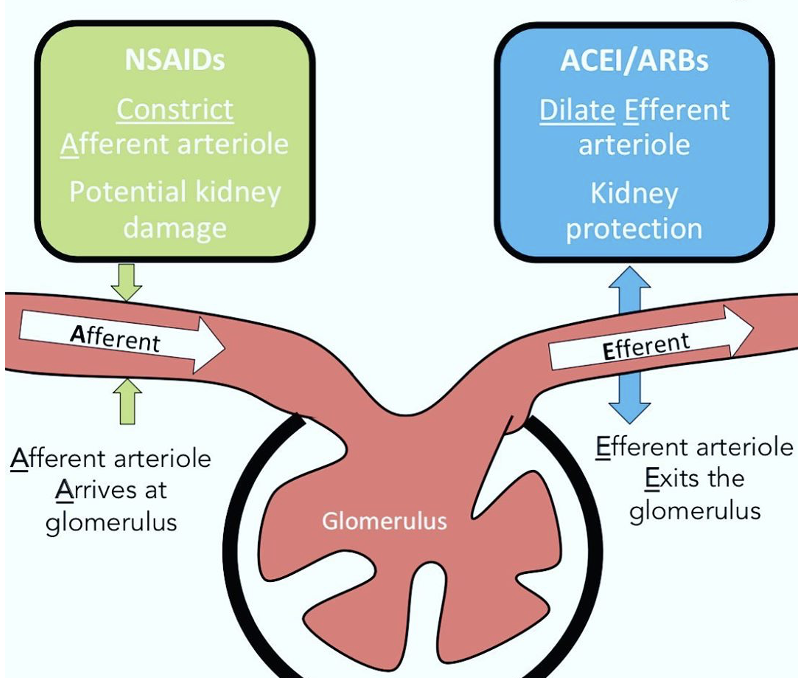
protects kidneys