lecture 1 -intro to MS systems
Study these flashcardsFree · spaced repetition · iPhone, Android, Mac & web
All cards
1
the musculoskeletal system consists of: (2)
skeletal system (bones and joints)
skeletal muscl system
skeletal muscl system
2
basic functions of musculoskeletal system (6)
protection
support
blood cell formation
mineral homestasis
storage
leverage
support
blood cell formation
mineral homestasis
storage
leverage
3
lever definition (in body)
lever = a simple machine that magnifies speed of movement or force
in body = mainly the long bones of the body + the joints where they meet
in body = mainly the long bones of the body + the joints where they meet
4
subsection of the APTA that specializes in the MS system
Academy of Orthopedic Physical Therapy
5
steps of diagnostic reasoning in practice
1) gather date
2) organize info
3) generate hypotheses
4) test hypotheses (make sure you PRIORITIZE)
5) synthesize info into an eval/assessment statement
2) organize info
3) generate hypotheses
4) test hypotheses (make sure you PRIORITIZE)
5) synthesize info into an eval/assessment statement
6
history of present condition (HPI) questions
when did this injury/disease state begin?
how did it occur?
is it improving or getting worse?
has pt seen other providers?
had pt tried other treatments?
has this happened before?
what are the pt's expectations for physical therapy?
how did it occur?
is it improving or getting worse?
has pt seen other providers?
had pt tried other treatments?
has this happened before?
what are the pt's expectations for physical therapy?
7
past medical history questions
relevant medical history (include previous testing)
medications
mental function (memory, level of edu/literacy)
medications
mental function (memory, level of edu/literacy)
8
when gathering data, what is a "red flag"?
a sign or cluster of symptoms that should raise suspicion of serious pathology
like maybe it isn't acting like muscle or bone should be
should we refer to MD/PCP for further follow up?
should we send them for imaging first?
like maybe it isn't acting like muscle or bone should be
should we refer to MD/PCP for further follow up?
should we send them for imaging first?
9
what are potential red flag conditions for the shoulder? (5)
tumor
infection
fracture or unreduced dislocatin
neurologic lesion
visceral pathology
infection
fracture or unreduced dislocatin
neurologic lesion
visceral pathology
10
in your gathering of pt information, you find that a patient has:
- a history of cancer
- unexplained weight loss
- pain not correlated with mechanical stress
- unexplained fatigue
- unexplained mass, swelling, or deformity
what potential red flag (for the shoulder) might you suspect?
- a history of cancer
- unexplained weight loss
- pain not correlated with mechanical stress
- unexplained fatigue
- unexplained mass, swelling, or deformity
what potential red flag (for the shoulder) might you suspect?
tumor
11
in your gathering of pt information, you find that a patient has:
- red skin
- fever
- systemically unwell
what potential red flag (for the shoulder) might you suspect?
- red skin
- fever
- systemically unwell
what potential red flag (for the shoulder) might you suspect?
infection
12
in your gathering of pt information, you find that a patient has:
- significant trauma
- seizure
- acute disabling pain
- acute loss of motion
- defomity or loss of normal contour
what potential red flag (for the shoulder) might you suspect?
- significant trauma
- seizure
- acute disabling pain
- acute loss of motion
- defomity or loss of normal contour
what potential red flag (for the shoulder) might you suspect?
fracture or unreduced dislocation
13
in your gathering of pt information, you find that a patient has:
- unexplained sensory or motor deficit
what potential red flag (for the shoulder) might you suspect?
- unexplained sensory or motor deficit
what potential red flag (for the shoulder) might you suspect?
neurologic lesion
14
in your gathering of pt information, you find that a patient has:
- pain not reproduced w mechanical stress
- pain or symptoms with physical exertion or respiratory stress
- pain associated with GI stuff
- scapular pain associated with ingestion of fatty foods
what potential red flag (for the shoulder) might you suspect?
- pain not reproduced w mechanical stress
- pain or symptoms with physical exertion or respiratory stress
- pain associated with GI stuff
- scapular pain associated with ingestion of fatty foods
what potential red flag (for the shoulder) might you suspect?
visceral pathology
15
when gather pt data, what is a "yellow flag"?
psychological, social and/or environmental risk factors for prolonged disability or failure to recover due to MS condition
-- basically, anything that makes u worry about their resiliency, mindset or expectations for care
-- psychosocial and/or environmental things that might impede their outcome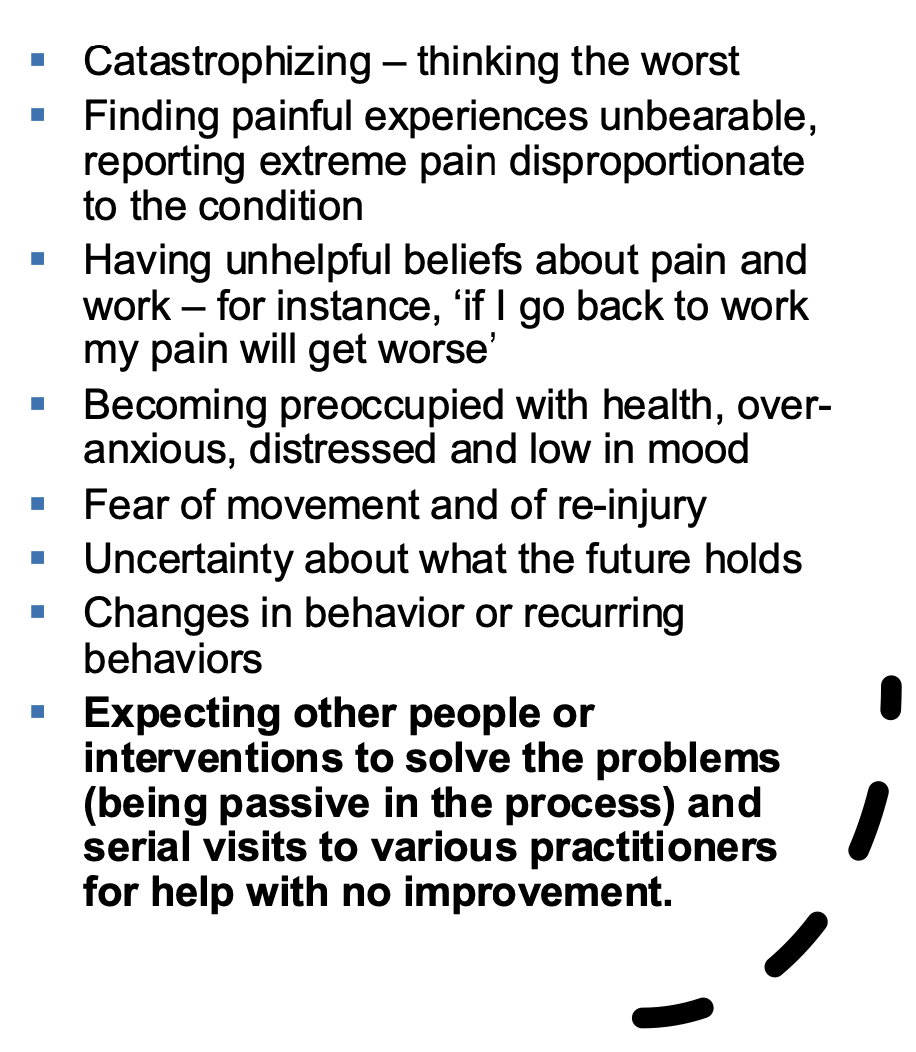
-- basically, anything that makes u worry about their resiliency, mindset or expectations for care
-- psychosocial and/or environmental things that might impede their outcome
16
patient reported outcome measures (PROMS)
standardized tool used in examination to measure how much teh issue is actually affecting the patient's life
important uses:
-- idnetify pts at risk for poor/adverse outcomes
-- facilitate continuity of care and common measure of response to treatment
-- assist in determining cost-effective settings for rehab
-- determine most effective interventions for some painful MS conditions
-- assess the practitioner/organization performance
important uses:
-- idnetify pts at risk for poor/adverse outcomes
-- facilitate continuity of care and common measure of response to treatment
-- assist in determining cost-effective settings for rehab
-- determine most effective interventions for some painful MS conditions
-- assess the practitioner/organization performance
17
PROMs examples (5)
OSPRO-YF
numeric pain rating scale (NPRS)
DASH/quick DASH
global MS outcome tool
symptom irritability scale
numeric pain rating scale (NPRS)
DASH/quick DASH
global MS outcome tool
symptom irritability scale
18
OSPRO-YF
Optimal Screening for Prediction of Referral and Outcome
asseses pt beliefs, mood, fears, self-efficacy, general mental healt
asseses pt beliefs, mood, fears, self-efficacy, general mental healt
19
NPRS
Numeric Pain Rating Scale
"rate ur pain on a scale of 0-10, 0 being nothing and 10 being so intense u think u will drop dead any minute"
ordinal scale!!! (no definitive, calcuable difference btwn each number)
+/- 2 is a significant change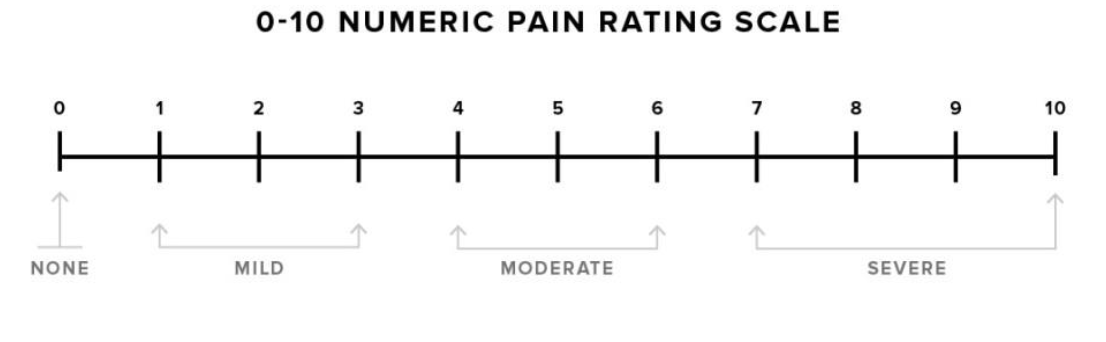
"rate ur pain on a scale of 0-10, 0 being nothing and 10 being so intense u think u will drop dead any minute"
ordinal scale!!! (no definitive, calcuable difference btwn each number)
+/- 2 is a significant change
20
(quick) DASH
Disabilites of Arm, Shoulder and Hand
14y/o+
for any UE condition!!! it's really really great
quick dash is the short n sweet version (less intimidating for patients)
14y/o+
for any UE condition!!! it's really really great
quick dash is the short n sweet version (less intimidating for patients)
21
(quick) DASH scoring categories
normal = 0-20%
mild disability = 21-40%
moderate disability = 41-60%
severe disability = 61-81%
complete disability is >81%
mild disability = 21-40%
moderate disability = 41-60%
severe disability = 61-81%
complete disability is >81%
22
Global MS Outcome Tool
patient-specific scale! this means that the pt picks 5 activities that are most important to them and scores
10= good
0 = bad
10= good
0 = bad
23
symptom irritability scale
classifies the level of tissue irritability for the patient; helps us understsand how much the thing is rlly messing with their day to day
0 = good
10 = bad
0 = good
10 = bad
24
symptome irritability scale categories
high irritability: >7/10
moderate irritability: 4-6/10
low irritability: <3/10
moderate irritability: 4-6/10
low irritability: <3/10
25
MCID
minimal clinically important difference/change
26
MCID for NPRS
+/- 2
27
MCID for (quick) DASH
DASH --> 10.2
quickDASH --> 8
quickDASH --> 8
28
MCID for global MS outcome tool
+/-2
29
overall, what do we need to understnad a pt's level of acuity (severeness) and irritability?
history (onset/suration; pain intensisty/NPRS; aggravating/alleviating factors)
+
Patient-reported tools & Beliefs/Expectations (NPRS, DASH, PSFS, OSPRO-YF, pain diagrams)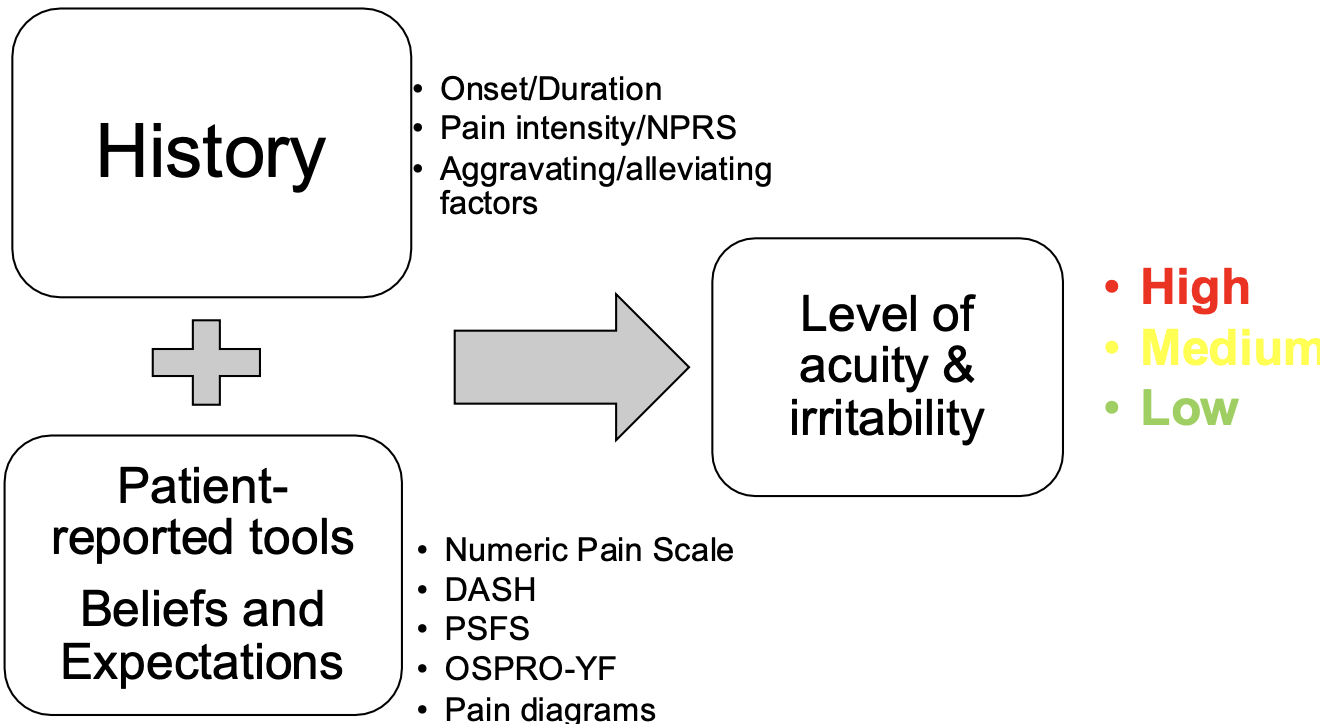
+
Patient-reported tools & Beliefs/Expectations (NPRS, DASH, PSFS, OSPRO-YF, pain diagrams)
30
REVIEW: identify and describe the 3 pain classfications
nociceptive: due to activation of nociceptors; associated with actual mechanical injury/disruption (ex: ankle sprain)
nociplastic: due to disturbance in central pain processing; hella excitability + lowered inhibition = disproportionate responses to disruption (ex: non-specific LBP); "pain that arises from altered nociception despite no actual/threatened tissue damage"
neuropathic: due to lesion or disease of the somatosensory system (ex: carpal tunnel syndrome)
nociplastic: due to disturbance in central pain processing; hella excitability + lowered inhibition = disproportionate responses to disruption (ex: non-specific LBP); "pain that arises from altered nociception despite no actual/threatened tissue damage"
neuropathic: due to lesion or disease of the somatosensory system (ex: carpal tunnel syndrome)
31
central sensitization (CS)
amplification of enural signaling within the CNS that elicits pain hypersensitivity
** giving neuroplastic pain asf
** giving neuroplastic pain asf
32
why is it important to understand pain classifications (nociceptive, nociplastic, neuropathic)?
gives insight on how you should go about treatment
-- nociceptive pain means there's actual damage in connective or contractil tissue, which tells u that u might wanna focus on tissue loading and strengthening to return to prior function
-- nociplastic pain means that the CNS just isn't processing what's going on properly, which might cause you to create a treatment plan focused on relearning responses or movement coordination
-- nociceptive pain means there's actual damage in connective or contractil tissue, which tells u that u might wanna focus on tissue loading and strengthening to return to prior function
-- nociplastic pain means that the CNS just isn't processing what's going on properly, which might cause you to create a treatment plan focused on relearning responses or movement coordination
33
which 2 base questions should we be asking whendetermining what ests to run on a pt?
is the movement strategy typical?
is the movemetn strategy optimal or suboptimal
is the movemetn strategy optimal or suboptimal
34
Your pt walks into their exam and they say "when i raise my right arm up to shoulder level, it hurts really badly." When you observe their movement, their right GH and ST motion looks atypical and painful. What test do you run first? Why?
symptom provocation/alleviation (is it contractile, intra-articular or extra articular)
helps us to figure out WHAT is hurting
helps us to figure out WHAT is hurting
35
Your pt walks into their exam and they say "when i raise my right arm up to shoulder level, it hurts really badly." When you observe their movement, their right GH and ST motion looks atypical and painful. You've done a symptom provocation/alleviation test (finding that it's an extra-articular problem). What would you do next?
test joint mobility --> ROM!! and joint play if ROM is fucked up
we've already figured out WHAT the problem is, so now we need to figure out HOW messed up it is
-- testing the integrity of the structures now
we've already figured out WHAT the problem is, so now we need to figure out HOW messed up it is
-- testing the integrity of the structures now
36
Your pt walks into their exam and they say "when i raise my right arm up to shoulder level, it hurts really badly." When you observe their movement, their right GH and ST motion looks atypical and painful. You've done a symptom provocation/alleviation test (finding that it's an extra-articular problem) and ROM/joint play. If you're still not sure what's going on, what other tests can you run?
muscle performance --> test RTC integrity/irritability/ balance; ST coordination/endurance
thoracic spine and upper quarter mobility/coordination
lower extremity or kinetic chain
these are all like lower on our chain of importance/likeliness! so only do these if u must
thoracic spine and upper quarter mobility/coordination
lower extremity or kinetic chain
these are all like lower on our chain of importance/likeliness! so only do these if u must
37
selective tissue testing
used to infer patho-anatomical source of dysfunction
sensitive or specific
sensitive or specific
38
sensistive selective tissue testing
help to rule out a condition
39
specific selective tissue testing
help to rule in a condition
40
patho-anatomical disorder
identifies primary tissue pathology (super specific)
remains stable across an episode of care
guides general treatment strategy (surgery? rehab? etc)
remains stable across an episode of care
guides general treatment strategy (surgery? rehab? etc)
41
rehabilitation classification
identifies level of irritability and key impairments
typically changes over an episode of care
guides specific rehab intervention (stress intensity? key impairments?)
typically changes over an episode of care
guides specific rehab intervention (stress intensity? key impairments?)
42
if someone says "you have an issue in the RTC that's preventing Force production", is that a pathoanat diagnosis or a classification?
rehab classification!
it's more general
it's more general
43
if someone says "you tore your supraspinatus tendon to the 2nd degree", is that a pathoanat diagnosis or a classification?
pathoanatomical diagnosis
very very specific
very very specific
44
nociceptive specific pain
there is one traumatic incident that could explain stress beyond tissue tolerance
- tendon tear
- muscle strain
- joint dislocation/subluxation
- fractures
- tendon tear
- muscle strain
- joint dislocation/subluxation
- fractures
45
with nociceptive pain, what is the goal of your exam?
deciding if you can proceed with exam or treatment, or if they should be referred for subsequent testing form a different expertise
46
non-specific pain
gradual, subtle onset
symptoms with multiple activites (sometimes during rest)
symptoms with multiple activites (sometimes during rest)
47
with non-specific pain, what is the goal of your exam?
ruling out cervical spine as a source of pain
determining structures that provoke symptoms
determining structures that provoke symptoms
48
why is it important to understand your patient's irritability level at the time of your exam?
it will determine what type of intervention to prioritize!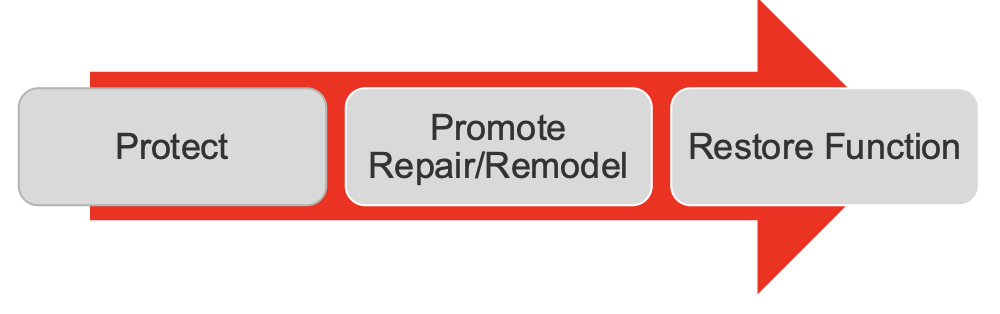
49
if your patient has high irritability, what kinds of intervention are you prioritizing?
PROTECT! this means we're rlly short term after episode, so we wanna allow tissue to heal enough to tolerate extra stress
- minimize physical stress
- modify activity
- monitor impairments
- minimize physical stress
- modify activity
- monitor impairments
50
if your patient has moderate irritability, what kinds of intervention are you prioritizing?
PROMOTE REPAIR/REMODEL! we've healed enough to start some light tissue stress that will encourage the healing process
- mild-moderate physical stress
- address specific impairments
- restore basic level of functional activity
- mild-moderate physical stress
- address specific impairments
- restore basic level of functional activity
51
if your patient has low irritability, what kinds of intervention are you prioritizing?
RESTORE FUNCTION! we are ready to experience loads close to what we were handling before episodes; we're trying to get back to all the activities we used to do
- moderate-high physical stress
- address specific impairments
- restore high demand functional activitiy
- moderate-high physical stress
- address specific impairments
- restore high demand functional activitiy