MMB: Restorative Justice
Study these flashcardsFree · spaced repetition · iPhone, Android, Mac & web
All cards
1
What usually happens in restorative justice?
Communication with the victim.
2
What is an example of restorative justice with no communication?
The offender gives payment as reparation.
3
What are examples of restorative justice with communication?
- offender writes letter to victim
- O interacts w/ V thru video conference/face-to-face w/ impartial facilitator
- O interacts w/ V thru video conference/face-to-face w/ impartial facilitator
4
When are offenders offered restorative justice?
As an alternative to a prison sentence, if the victim agrees.
5
What are the 2 key aims of restorative justice?
- rehabilitation of offenders
- atonement for wrongdoing
- atonement for wrongdoing
6
What is 'rehabilitation of offenders'?
The victim has an opportunity to explain the real impact of the crime.
7
Why can 'rehabilitation of offenders' reduce the possibility of reoffending?
They are encouraged to take responsibility for their crime, which is hoped to affect future behaviour.
8
Why is 'rehabilitation of offenders' better than punishment?
- punishment = passive
- rehabilitative justice requires criminal's active participation -> changes attitudes to crime / behaviour
- rehabilitative justice requires criminal's active participation -> changes attitudes to crime / behaviour
9
What is 'atonement for wrongdoing'?
Offenders may offer concrete compensation for the crime (e.g. money, unpaid community work).
10
Why is 'atonement for wrongdoing' psychological?
As the 'atonement' shows feelings of guilt.
11
How are 'atonement for wrongdoing' and 'rehabilitation of offenders' similar?
Both enable the offender to understand the effects of the crime on the victim.
12
Why is 'atonement for wrongdoing' beneficial for the offender?
The offender can develop empathy by taking the perspective of the victim.
13
Why is 'atonement for wrongdoing' beneficial for the victim?
As they have the opportunity to express their distress (offender learns to take their perspective too).
14
RJ reduces a victim's sense of...
victimisation because they are no longer powerless and have a voice.
15
How can a victim develop a greater understanding for an offender from RJ?
They can listen to their account which reduces their sense of being harmed.
16
Who proposed a theoretical framework for RJ?
Wachtel & McCold (2003).
17
What should RJ focus on according to W&M (2003)?
Relationships rather than punishment.
18
Why should RJ focus on relationships > punishment?
- crime harms ppl & relationships
- justice requires harm b healed as much as possible
- justice requires harm b healed as much as possible
19
What did early models of RJ focus on?
The offender and victim only.
20
What are more recent models of RJ like?
They recognise the effect of crimes on the wider community.
21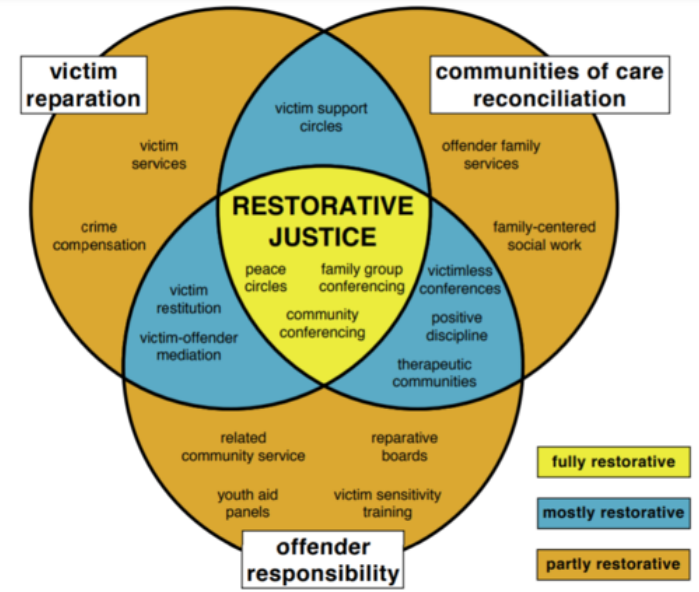
Image occlusion: name the hidden labels
22
Image occlusion: name the hidden labels
23
Image occlusion: name the hidden labels
24
Image occlusion: name the hidden labels
25
Image occlusion: name the hidden labels
26
Describe levels of restorativeness in terms of stakeholders.
partly restorative: 1 stakeholder, e.g. gov pays financial compensation
mostly restorative: 2 SHs, e.g. offender gets therapy
fully restorative: all 3 SHs
mostly restorative: 2 SHs, e.g. offender gets therapy
fully restorative: all 3 SHs
27
What is evidence that RJ is restorative?
UK Restorative Justice Council (2015) reports 85% satisfaction from victims in face-to-face meetings w/ their offenders- covered wide range of crimes from theft -> violent crime.
28
Why is RJ better than other methods?
Dignan reports victims claim a greater sense of satisfaction than when cases go through mainstream courts.
29
What does research by the UK Restorative Justice Council and Dignan show?
RJ is effective from the victim's perspective.
30
What are all examples of why RJ cannot apply to all offenders and victims?
- offender who committed crime needed
- every crime
- some victims can decline
- every crime
- some victims can decline
31
What is RJ used for and why is this a problem?
Every crime (restorativejustice.org) but it might not be suitable for some crimes where psychopathy is involved as offender is unempathetic.
32
RJ is not a ______ to dealing with offending behaviour.
global solution
33
What are possible negative implications for the victim?
That they would feel worse afterwards, i.e. psychological harm.
34
How could a victim feel a loss of self-esteem?
They can feel the criminal showed no empathy for the harm caused so they can feel 'injured' a 2nd time.
35
How could a victim feel taken advantage of?
If the criminal was offered RJ as an alternative to a custodial sentence, especially if they're not taking the procedure seriously.
36
Overall, what are the 3 ways a victim can be psychologically harmed?
- loss of self-esteem
- taken advantage of
- embarrassed by proceedings
- taken advantage of
- embarrassed by proceedings
37
Making offenders face up to their wrongdoing can lead to...
abuses of power, e.g., victims can gang up on offender esp. if they are a child.
38
How can an offender be psychologically harmed by RJ?
Victims can try to shame them, which is not the intention. The process aims to provide mutual benefits so offender should feel 'understood'.
39
What is the UK like compared to other European countries?
It has a very large prison population.
40
What is another reason for RJ than reducing recidivism?
Zehr (2002) says that the traditional penal system does not address the needs of victims or promote offender accountability.
41
How much money is saved by reducing reoffending?
£8 saved for every £1 spent on the restorative process (e.g. custodial costs, court costs, police time).
42
The cost of RJ is sometimes...
funded by fines paid by offenders, so RJ can have substantial financial benefits.
43
What is an example of community programes?
'Peace circles' were developed in communities where crime and violence is high.
44
What is the aim of 'peace circles'?
To foster environment of respect so community offers support to victims & also welcomes offender into circle, enabling mutual understanding.
45
How do 'peace circles' work?
1. ppl sit in chairs placed in circle
2. 'talking piece' passed around circle so person can speak uninterrupted
3. 'keeper' maintains atmosphere of respect & articulates constructive solutions
2. 'talking piece' passed around circle so person can speak uninterrupted
3. 'keeper' maintains atmosphere of respect & articulates constructive solutions
46
Who describes how 'peace circles' work?
Pranis et al. (2003)