BIO 351 FINAL Practice Questions for Chapter 4 (Proteins)
Study these flashcardsFree · spaced repetition · iPhone, Android, Mac & web
All cards
1
How many amino acids and peptide bonds does a tetrapeptide have?
- three amino acids and four peptide bonds
- four amino acids and four peptide bonds
- four amino acids and two peptide bonds
- four amino acids and three peptide bonds
2
Which parts of the amino acids AA1 and AA2 are involved in the formation of a peptide bond?
AA1-AA2
AA1-AA2
carboxyl group of AA1 and amino group of AA2- amino group of AA1 and carboxyl group of AA2
- carboxyl group of AA1 and side chain of AA2
- side chains of both AA1 and AA2
3
Which part of an amino acid gives it its unique identity?
- the components of its side chain
- the glycerol molecule that forms the backbone of the amino acid
- the carboxyl and amino groups
- the long carbon-hydragen tails of the molecule
4
Ovalbumin, the egg white protein is denatured in scrambled egg. Which of the following is not affected?
- primary structure of ovalbumin
- secondary structure of ovalbumin
- tertiary structure of ovalbumin
- quaternary structure of ovalbumin
5
Which of the following statements about proteins is true?
- Denaturation is always irreversible.
- Some proteins form a complete 3-D structure only when they interact with their targets.
- Denaturation leads to bond disruption, and the molecule turns into liquid.
- Final folded structure can reveal the steps of protein folding.
6
You have just sequenced a new protein isolated from mice and observe that sulfur-containing cysteine residues occur at regular intervals. "This finding is most consistent with which of the following claims about the protein?
- Cysteine residues are involved in disulfide bridges that help form tertiary structure.
- Cysteine causes bends, or angles, to occur in the tertiary structure of proteins.
- Cysteine residues are required for the formation of a helices and B pleated sheets.
- It will be important to include cysteine in the diet of the mice.
7
Use the following information to answer the following questions.
"The native structure of hemoglobin (HB) comprises of two a and two ß subunits, each of which carries a heme group. There appear to be no previous studies that report the in-vitro folding and assembly of Hb from highly unfolded a and ß globin in a 'one-pot' reaction. One difficulty that has to be overcome for studies of this kind is the tendency of Hb to aggregate during refolding. This work demonstrates that denaturation of Hb in 40% acetonitrile at pH 10.0 is reversible." (J Am Soc Mass Spectrum 2007, 18, 8-16)
In sickle-cell disease, as a result of a single amino acid change, the mutant hemoglobin tetramers associate with each other and assemble into large fibers. Based on this information alone, what does the sickle-cell hemoglobin exhibit?
"The native structure of hemoglobin (HB) comprises of two a and two ß subunits, each of which carries a heme group. There appear to be no previous studies that report the in-vitro folding and assembly of Hb from highly unfolded a and ß globin in a 'one-pot' reaction. One difficulty that has to be overcome for studies of this kind is the tendency of Hb to aggregate during refolding. This work demonstrates that denaturation of Hb in 40% acetonitrile at pH 10.0 is reversible." (J Am Soc Mass Spectrum 2007, 18, 8-16)
In sickle-cell disease, as a result of a single amino acid change, the mutant hemoglobin tetramers associate with each other and assemble into large fibers. Based on this information alone, what does the sickle-cell hemoglobin exhibit?
- only altered quaternary structure
- only altered tertiary structure
- altered primary structure and altered quaternary structure; the secondary and tertiary structures may or may not be altered
- only altered primary structure
8
Which of the following can be used to predict the 3-D structure of the protein?
- sequence of amino acids in the polypeptide chain
- side chains of various amino acids
- number of water molecules in the vicinity
- peptide bonds between different amino acids
9
Misfolding of polypeptides is a serious problem in cells. Which of the following diseases are associated with an accumulation of misfolded polypeptides?
- Diabetes mellitus
- Parkinson's only
- Alzheimer's only
- Alzheimer's and Parkinson's
10
Use the following figure to answer the question.
Which of the following chemical reactions is represented in the figure?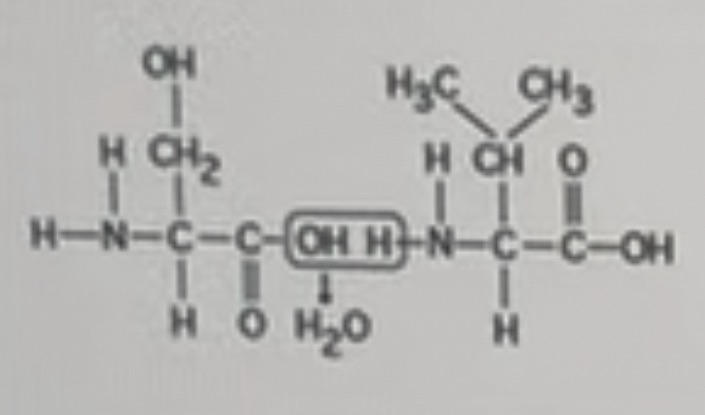
Which of the following chemical reactions is represented in the figure?
- links two polymers to form a monomer
- results in a peptide bond
- is a hydrolysis reaction
- joins two fatty acids together
11
Which of the following pairs of amino acid residues would you expect to form ionic bonds?
- Arginine and lysine
- Glutamic acid and glutamine
- Tyrosine and glutamine
- Tryptophan and tyrosine
- Lysine and glutamic acid
12
Which of the following stretches of amino acid residues would you expect to find in the interior of protein molecules?
- Gly-Tyr-His-Arg-His
- Phe-Glu-Glu-Glu-Asn
- Ala-Val-Leu-Ile-Trp
- Gly-Lys-Ser-Pro-Thr
- Ala-Asp-Asp-Tyr-Arg
13
The observation that proteins often renature into their original conformations after they have been unfolded by denaturing solvents implies that ...
- All of the above
- the final folded structure of a protein is usually NOT the one with the lowest free energy.
- each protein folds into several different conformations inside the cell
- the information needed to specify the three-dimensional shape of a protein is encoded in its amino acid sequence.
- the cell does not need molecular chaperones for survival
14
Complete the sentence with the best option provided below. The primary structure of a protein is the
- amino acid composition
- lowest energy conformation
- averagesize of amino acid side chains
- amino acid sequence
15
To study how proteins fold, scientists must be able to purify the protein of interest, use solvents to denature the folded protein, and observe the process of refolding at successive time points. What is the effect of the solvents used in the denaturation process?
- The solvents create a new protein conformation
- The solvents break all covalent interactions
- The solvents break all noncovalent interactions
- The solvents break some of the noncovalent interactions, resulting in a misfolded protein
16
Which of the following statements is TRUE?
- Peptide bonds are the only covalent bonds that can link together two amino acids in proteins.
- Nonpolar amino acids tend to be found in the interior of proteins.
- The sequence of the atoms in the polypeptide backbone varies between different proteins
- There is free rotation around all covalent bonds in the polypeptide backbone
17
Protein folding can be studied using a solution of purified protein and a denaturant (urea), a solvent that interferes with noncovalent interactions.
Which of the following is observed after the denaturant is removed from the protein solution?
Which of the following is observed after the denaturant is removed from the protein solution?
- The polypeptide returns to its original conformation
- The polypeptide forms solid aggregates and precipitates out of solution
- The polypeptide adopts a new stable conformation
- The polypeptide remains denatured
18
The correct folding of proteins is necessary to maintain healthy cells and tissues. The presence of unfolded proteins is associated with some neurodegenerative disorders as Alzheimer's disease. Huntington's disease, and Creutzfeldt-Jakob disease (the specific faulty protein is different for each disease). What happens to these disease-causing, unfolded proteins?
- They bind a different target protein
- They form protein aggregates
- They form structured filaments
- They are degraded
19
Some proteins have a helices, some have B sheets, and still others have a combination of both. What makes it possible for proteins to have these common structural elements?
- specific amino acid sequences
- side-chain interactions
- hydrogen bonds along the protein backbone
- the hydrophobic-core interactions
20
Which of the following is NOT a feature commonly observed in B sheets?
- exended polypeptide backbone
- coiled-coil patterns
- parallel regions
- antiparallel regions
21
Protein structures have several different levels of organization. The primary structure of a protein is its amino acid sequence. The secondary and tertiary structures are more complicated. Consider the definitions below and select the one that best fits the term "protein domain."
- a complex of more than one polypeptide chain
- the tertiary structure of a substrate-binding pocket
- a protein segment that folds independently
- a small cluster of a helices and B sheets
22
Proteins bind selectively to small-molecule targets called ligands. The selection of one ligand out of a mixture of possible ligands depends on the number of weak, noncovalent interactions in the protein's ligand-binding site. Where is the binding site typically located in the protein structure?
- forms on the surface of the protein in the presence of ligand
- buried in the interior of the protein
- on the surface of the protein
- inside a cavity on the protein surface
23
Studies conducted with a lysozyme mutant that contains an Asp->Asn change at position 52 and a Glu->Gin change at position 35 exhibited almost a complete loss in enzymatic activity. What is the most likely explanation for the decrease in enzyme activity in the mutant?
- larger amino acids in the active site decreases the affinity for substrate
- change in the active-site scaffold
- increased affinity for substrate
- absence of negative charges in the active site