BIO 351 EXAM 2 (Prac Quiz Control of Gene Expression)
Study these flashcardsFree · spaced repetition · iPhone, Android, Mac & web
All cards
1
A neuron and a white blood cell have very different functions. For example, a neuron can receive and respond to electrical signals, while a white blood cell defends the body against infection. This is because:
- all of the proteins found in a neuron are completely different from the proteins found in a white blood cell.
- the neuron and the white blood cell within an individual have the same genome.
- the neuron expresses some mRNAs that the white blood cell does not.
- neurons and white blood cells are differentiated cells and thus no longer need to transcribe and translate genes.
2
Investigators performed nuclear transplant experiments to determine whether DNA is altered irreversibly during development. Which of the following statements about these experiments is TRUE?
- Because the donor nucleus is taken from an adult animal, the chromosomes from the nucleus must undergo recombination with the DNA in the egg for successful development to occur,
- The cells in the embryo that develop from the nuclear transplant experiment have DNA that is identical to the donor of the nucleus.
- Although nuclear transplantation has been successful in producing embryos in some mammals with the use of foster mothers, evidence of DNA alterations
- The melotic spindle of the egg must interact with the chromosomes of the injected nuclei for successful nuclear transplantation to occur.
3
The distinct characteristics of different cell types in a multicellular organism result mainly from the differential regulation of the
- replication of specific genes.
- transcription of housekeeping genes.
- transcription of genes transcribed by RNA polymerase II.
- proteins that directly bind the TATA box of eukaryotic genes.
4
The human genome encodes about 21,000 protein-coding genes. Approximately how many such genes does the typical differentiated human cell express at any one time?
- between 18,900 and 21,000-at least 90% of the genes
- 21,000-all of them
- less than 2100
- between 5000 and 15,000
5
Which of the following is not a good example of a housekeeping protein?
- ATP synthasc
- histones
- hemoglobin
- DNA repair enzymes
6
Which of the following statements about differentiated cells is TRUE?
- Some of the proteins found in differentiated cells are found in all cells of a multicellular organism.
- Once a cell has differentiated, it can no longer change its gene expression.
- Cells of distinct types express nonoverlapping sets of transcription regulators.
- Once a cell has differentiated, it will no longer need to transcribe RNA)
7
Which of the following statements about transcriptional regulators is FALSE?
- The binding of transcription regulators generally does not disrupt the hydrogen bonds that hold the double helix together.
- The DNA-binding motifs of transcription regulators usually bind in the major groove of the DNA helix.
- Transcription regulators interact only with the sugar-phosphate backbone on the outside of the double helix to determine where to bind on the DNA helix.
- Transcription regulators will form hydrogen bonds, ionic bonds, and hydrophobic interactions with DNA)
8
Operons
- can only be regulated by gene activator proteins.
- are commonly found in eukaryotic cells.
- contain a cluster of genes transcribed as a single mRNA.
- are transcribed by RNA polymerase II.
9
The tryptophan operator
- binds to the tryptophan repressor when the repressor is bound to tryptophan.
- is an allosteric protein.
- is important for the production of the tryptophan repressor.
- Is required for production of the mRNA encoded by the tryptophan operon.
10
Which of the following statements about the Lac operon is FALSE?
- Even when the CAP activator is bound to DNA, if lactose is not present. the Lac operon will not be transcribed)
- The Lac operon only produces RNA when lactose is present and glucose is absent
- The CAP activator can only bind DNA when it is bound to cAMP.
- The Lac repressor binds when lactose is present in the cell.
11
What do you predict would happen if you replace the Lac operator DNA from the Lac operon with the DNA from the operator region from the tryptophan operon?
- The lack of glucose will no longer allow CAP binding to the DNA
- The Lac operon will not be transcribed when tryptophan levels are high.
- The presence of lactose will not cause allosteric changes to the Lac repressor.
- RNA polymerase will only bind to the Lac promoter when lactose is present.
12
You are interested in examining the Psf gene. It is known that Psf is normally produced when cells are exposed to high levels of both calcium (Ca2+) and magnesium (Mg2+). MetA, MetB, and MetC are important for binding to the promoter of the Psf gene and are involved in regulatingits transcription. MetA binds to the "A" site in the promoter region, MetB to the "B" site, and MetC to the "C" site. You create binding-site mutations in the A, B, and C sites and observe what happens to transcription of the Psf gene. Your results are summarized in Table above.
From the table above which of the following proteins are likely to act as gene activators?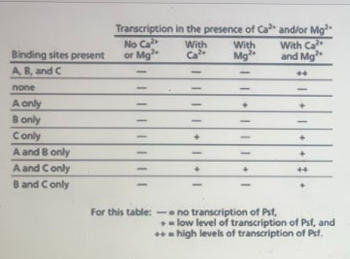
From the table above which of the following proteins are likely to act as gene activators?
- MetC only
- MetA only
- MetB only
- both MetA and MetC
13
You are interested in examining the Psf gene. It is known that Psf is normally produced when cells are exposed to high levels of both calcium (Ca2+) and magnesium (Mg2+). MetA, MetB, and MetC are important for binding to the promoter of the Psf gene and are involved in regulating its transcription. MetA binds to the "A" site in the promoter region, MetB to the "B" site, and MetC to the "C" site. You create binding-site mutations in the A, B, and C sites and observe what happens to transcription of the Psf gene. Your results are summarized in Table below.
Which of the following proteins are likely to act as gene repressors?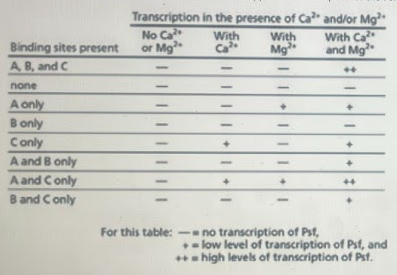
Which of the following proteins are likely to act as gene repressors?
- MetB only
- MetC only
- MetA only
14
You are interested in examining the Psf gene. It is known that Psf is normally produced when cells are exposed to high levels of both calcium (Ca2+) and magnesium (Mg2+). MetA, MetB, and MetC are important for binding to the promoter of the Psf gene and are involved in regulating its transcription. MetA binds to the "A" site in the promoter region, MetB to the "B" site, and MetC to the "C" site. You create binding-site mutations in the A, B, and C sites and observe what happens to transcription of the Psf gene. Your results are summarized in Table below.
Which transcription regulator(s) are normally bound to the Psf promoter in the presence of Mg2+ only?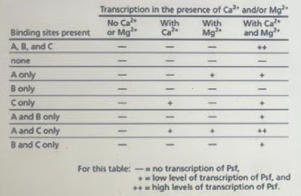
Which transcription regulator(s) are normally bound to the Psf promoter in the presence of Mg2+ only?
- none
- MetA only
- MetA and Met B
- MetA, MetB, and MetC
15
You are interested in examining the Psf gene. It is known that Psf is normally produced when cells are exposed to high levels of both calcium (Ca2+) and magnesium (Mg2+). MetA, MetB, and MetC are important for binding to the promoter of the Psf gene and are involved in regulating its transcription. MetA binds to the "A" site in the promoter region, MetB to the "B" site, and MetC to the "C" site. You create binding-sitemutations in the A, B, and C sites and observe what happens to transcription of the Psf gene. Your results are summarized in Table below.
Table 8-12 Which transcription factors are normally bound to the Psf promoter in the presence of both Mg2+ and Ca2+?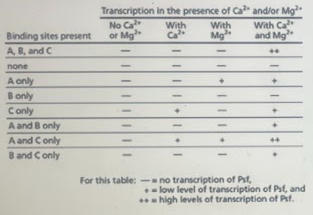
Table 8-12 Which transcription factors are normally bound to the Psf promoter in the presence of both Mg2+ and Ca2+?
- MetA and MetB
- MetA. MetB, and MetC
- MetA and MetC
- MetB and MetC
16
You are interested in understanding the gene regulation of Lkp1, a protein that is normally produced in liver and kidney cells in mice. Interestingly, you find that the LKP1 gene is not expressed in heart cells. You isolate the DNA upstream of the LKP1 gene, place it upstream of the gene for green fluorescent protein (GFP), and insert this entire piece of recombinant DNA into mice. You find GFP expressed in liver and kidney cells but not in heart cells, an expression pattern similar to the normal expression of the LKP1 gene. Further experiments demonstrate that there are three regions in the promoter, labeled A, B, and C in Figure below, that contribute to this expression pattern. Assume that a single and unique transcription factor binds each site such that protein X binds site A, protein Y binds site B, and protein Z binds site C) You want to determine which region is responsible for tissue-specific expression, and create mutations in the promoter to determine the function of each of these regions. In the figure below, if the site is missing, it is mutated such that it cannot bind its corresponding transcription factor.
Which of the following proteins is likely to act as a gene repressor?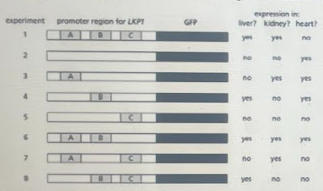
Which of the following proteins is likely to act as a gene repressor?
- factor Y
- none of these answers are correct.
- factor X
- factor Z
17
You are interested in understanding the gene regulation of Lkp1, a protein that is normally produced in liver and kidney cells in mice. Interestingly, you find that the LKP1 gene is not expressed in heart cells. You isolate the DNA upstream of the LKP1 gene, place it upstream of the gene for green fluorescent protein (GFP), and insert this entire piece of recombinant DNA into mice. You find GFP expressed in liver and kidney cells but not in heart cells, an expression pattern similar to the normal expression of the LKP1 gene. Further experiments demonstrate that there are three regions in the promoter, labeled A, B, and C in Figure below, that contribute to this expression pattern. Assume that a single and unique transcription factor binds each site such that protein X binds site A, protein Y binds site B, and protein Z binds site C) You want to determine which region is responsible for tissue-specific expression, and create mutations in the promoter to determine the function of each of these regions. In the figure below, if the site is missing, it is mutated such that it cannot bind its corresponding transcription factor.
Which of the following proteins are likely to act as gene activators?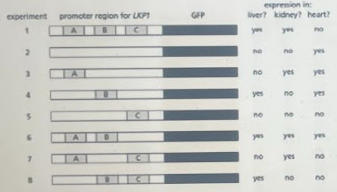
Which of the following proteins are likely to act as gene activators?
- factors X and Z
- factors Y and Z
- factor X only
- factors X and Y
18
You are interested in understanding the gene regulation of Lkp1, a protein that is normally produced in liver and kidney cells in mice. Interestingly, you find that the LKP1 gene is not expressed in heart cells. You isolate the DNA upstream of the LKP1 gene, place it upstream of the gene for green fluorescent protein (GFP), and insert this entire piece of recombinant DNA into mice. You find GFP expressed in liver and kidney cells but not in heart cells, an expression pattern similar to the normal expression of the LKP1 gene. Further experiments demonstrate that there are three regions in the promoter, labeled A, B, and C in Figure below, that contribute to this expression pattern. Assume that a single and unique transcription factor binds each site such that protein X binds site A, protein Y binds site B, and protein Z binds site C) You want to determine which region is responsible for tissue-specific expression, and create mutations in the promoter to determine the function of each of these regions. In the figure below, if the site is missing, it is mutated such that it cannot bind its corresponding transcription factor.
Experiment 1 in Figure above is the positive control, demonstrating that the region of DNA upstream of the gene for GFP results in a pattern of expression that we normally find for the LKP1 gene. Experiment 2 shows what h appens when the sites for binding factors X, Y, and Z are removed) Which experiment above demonstrates that factor X alone is sufficient for expression of LPK1 in the kidney?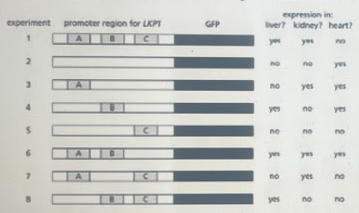
Experiment 1 in Figure above is the positive control, demonstrating that the region of DNA upstream of the gene for GFP results in a pattern of expression that we normally find for the LKP1 gene. Experiment 2 shows what h appens when the sites for binding factors X, Y, and Z are removed) Which experiment above demonstrates that factor X alone is sufficient for expression of LPK1 in the kidney?
- experiment 5
- experiment 3
- experiment 7
- experiment 8
19
You are interested in understanding the gene regulation of Lkp1, a protein that is normally produced in liver and kidney cells in mice. Interestingly, you find that the LKP1 gene is not expressed in heart cells. You isolate the DNA upstream of the LKP1 gene, place it upstream of the gene for green fluorescent protein (GFP), and insert this entire piece of recombinant DNA into mice. You find GFP expressed in liver and kidney cells but not in heart cells, an expression pattern similar to the normal expression of the LKP1 gene. Further experiments demonstrate that there are three regions in the promoter, labeled A, B, and C in Figure below, that contribute to this expression pattern. Assume that a single and unique transcription factor binds each site such that protein X binds site A, protein Y binds site B, and protein Z binds site C) You want to determine which region is responsible for tissue-specific expression, and create mutations in the promoter to determine the function of each of these regions. In the figure below, if the site is missing, it is mutated such that it cannot bind its corresponding transcription factor.
In what tissue is factor Z normally present and bound to the DNA?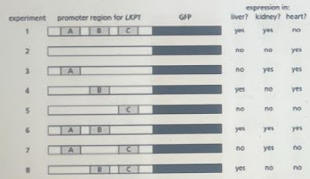
In what tissue is factor Z normally present and bound to the DNA?
- live
- heart
- kidney
- none of these answers are correct.
20
You are interested in the regulation of gene Q. Proteins G, H, and J are proteins that are important for regulating gene Q. and bind to its promoter region in a sequence-specific fashion. Proteins G and H both bind to site "A" but cannot bind to site "A" at the same time. Protein J binds to site "B" on the promoter. The promoter region is diagrammed in the figure below,
You develop a cell-free transcriptional system to study the effects of proteins G, H, and J on the transcription of gene Q. Using this system, you can examine the effects of adding these proteins to the transcriptional system in equal amounts and measuring how much gene Q is produced)
When you add these proteins to the system, you get the results shown in the table below.
Which proteins are likely to act as gene activators?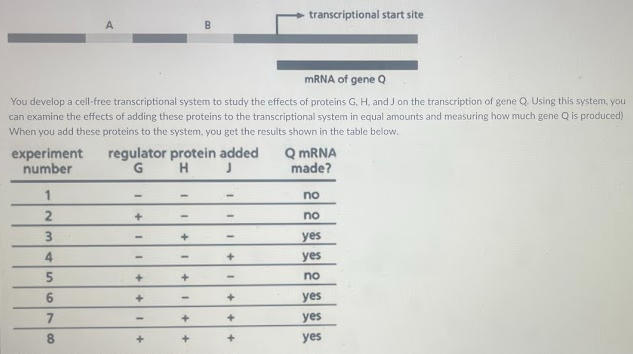
You develop a cell-free transcriptional system to study the effects of proteins G, H, and J on the transcription of gene Q. Using this system, you can examine the effects of adding these proteins to the transcriptional system in equal amounts and measuring how much gene Q is produced)
When you add these proteins to the system, you get the results shown in the table below.
Which proteins are likely to act as gene activators?
- both H and J
- G
- both H and G
- H
21
You are interested in the regulation of gene Q. Proteins G, H, and J are proteins that are important for regulating gene Q. and bind to its promoter region in a sequence-specific fashion. Proteins G and H both bind to site "A" but cannot bind to site "A" at the same time. Protein J binds to site "B" on the promoter. The promoter region is diagrammed in the figure below,
You develop a cell-free transcriptional system to study the effects of proteins G, H, and J on the transcription of gene Q. Using this system, you can examine the effects of adding these proteins to the transcriptional system in equal amounts and measuring how much gene Q is produced)
When you add these proteins to the system, you get the results shown in the table below.
Which proteins are likely to act as gene repressors?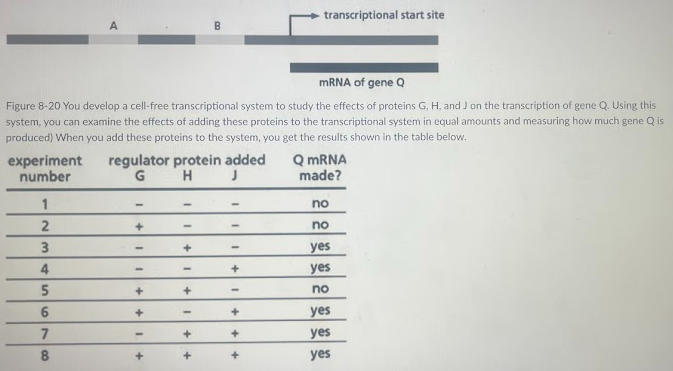
You develop a cell-free transcriptional system to study the effects of proteins G, H, and J on the transcription of gene Q. Using this system, you can examine the effects of adding these proteins to the transcriptional system in equal amounts and measuring how much gene Q is produced)
When you add these proteins to the system, you get the results shown in the table below.
Which proteins are likely to act as gene repressors?
- H
- both H and G
- G
- J
22
You are interested in the regulation of gene Q. Proteins G, H, and J are proteins that are important for regulating gene Q. and bind to its promoter region in a sequence-specific fashion. Proteins G and H both bind to site "A" but cannot bind to site "A" at the same time. Protein J binds to site "B" on the promoter. The promoter region is diagrammed in the figure below,
You develop a cell-free transcriptional system to study the effects of proteins G, H, and J on the transcription of gene Q. Using this system, you can examine the effects of adding these proteins to the transcriptional system in equal amounts and measuring how much gene Q is produced)
When you add these proteins to the system, you get the results shown in the table below.
Your colleague looks at your data above and predicts that protein G will bind more strongly to the DNA at site A, compared to protein H. Which experiment above is critical for this prediction?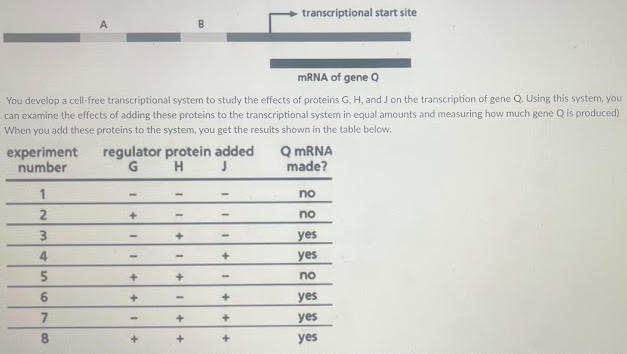
You develop a cell-free transcriptional system to study the effects of proteins G, H, and J on the transcription of gene Q. Using this system, you can examine the effects of adding these proteins to the transcriptional system in equal amounts and measuring how much gene Q is produced)
When you add these proteins to the system, you get the results shown in the table below.
Your colleague looks at your data above and predicts that protein G will bind more strongly to the DNA at site A, compared to protein H. Which experiment above is critical for this prediction?
- 5
- 3
- 2
- 7
23
You are interested in the regulation of gene Q. Proteins G, H, and J are proteins that are important for regulating gene Q. and bind to its promoter region in a sequence-specific fashion. Proteins G and H both bind to site "A" but cannot bind to site "A" at the same time. Protein J binds to site "B" on the promoter. The promoter region is diagrammed in the figure below,
You develop a cell-free transcriptional system to study the effects of proteins G, H, and J on the transcription of gene Q. Using this system, you can examine the effects of adding these proteins to the transcriptional system in equal amounts and measuring how much gene Q is produced)
When you add these proteins to the system, you get the results shown in the table below.
Which proteins do you predict are bound to the promoter in experiment #8?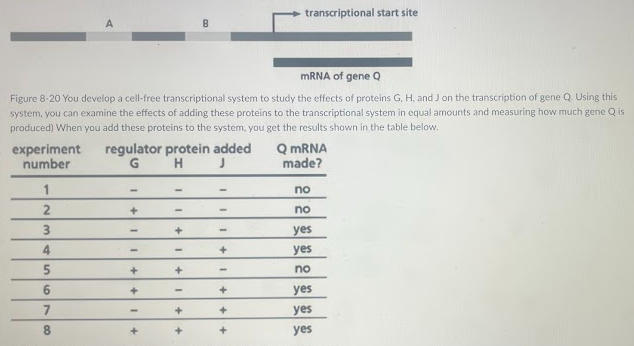
You develop a cell-free transcriptional system to study the effects of proteins G, H, and J on the transcription of gene Q. Using this system, you can examine the effects of adding these proteins to the transcriptional system in equal amounts and measuring how much gene Q is produced)
When you add these proteins to the system, you get the results shown in the table below.
Which proteins do you predict are bound to the promoter in experiment #8?
- only G and J
- only G and H
- H
- G
24
You are interested in studying the transcriptional regulation of the Gip1 promoter. The Gip1 promoter contains a binding site for the Jk8 protein that overlaps with the binding site for the Pa5 protein. Jk8 and Pa5 cannot bind DNA at the same time, but both proteins are present at high levels in adult liver cells. The binding sites for Jk8 and Pa5 are shown in Figure below.
Jk8 binds to site A while Pa5 binds to site B) You create mutations that remove the nonoverlapping sequences of either binding site A or B, and examine Gip1 mRNA production in adult liver cells that contain these mutations. The data you obtain from these experiments are shown in Table below.
You know that Gip1 is only expressed in adult liver cells and not in the liver of embryos. You also know that Jk8 and Pa5 behave similarly on ther promoters in the embryo or in the adult, in terms of whether they act as repressors or gene activators. Given the data, use of which of the following mechanisms would make the most sense for regulating the Jk8 and Pa5 proteins: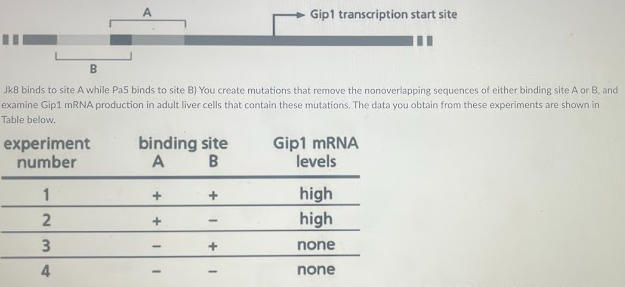
Jk8 binds to site A while Pa5 binds to site B) You create mutations that remove the nonoverlapping sequences of either binding site A or B, and examine Gip1 mRNA production in adult liver cells that contain these mutations. The data you obtain from these experiments are shown in Table below.
You know that Gip1 is only expressed in adult liver cells and not in the liver of embryos. You also know that Jk8 and Pa5 behave similarly on ther promoters in the embryo or in the adult, in terms of whether they act as repressors or gene activators. Given the data, use of which of the following mechanisms would make the most sense for regulating the Jk8 and Pa5 proteins:
- Pa5 binds to the promoter of the gene that encodes Jk8 in embryonic liver cells.
- Jk8, but not Pa5, is transcribed in emryonic liver cells.
- Jk8 is ubiquitylated and targeted for destruction in adult cells.
25
How are most eukaryotic transcription regulators able to affect transcription when their binding sites are far from the promoter?
- by binding to their binding site and sliding to the site of RNA polymerase assembly
- by attracting RNA polymerase and modifying it before it can bind to the promoter
- by unwinding the DNA between their binding site and the promoter
- by looping out the intervening DNA between their binding site and the promoter
26
Which of the following statements about nucleosomes is TRUE?
- Although RNA polymerase can access DNA packed within nucleosomes, the general transcription factors and transcriptional regulators cannot.
- Histone deacetylases remove lysines from histone tails.
- Nucleosomes activate transcription when bound to the promoter.
- Histone acetyltransferases affect transcription by both altering chromatin structure to allow accessibility to the DNA and by adding acetyl groups to histones that can bind proteins that promote transcription.
27
The expression of the BRF1 gene in mice is normally quite low, but mutations in a gene called BRF2 lead to increased expression of BRF1. You have a hunch that nucleosomes are involved in the regulation of BRF1 expression and so you investigate the position of nucleosomes over the TATA box of BRF1 in normal mice and in mice that lack either the BRF2 protein (BRF2-) or part of histone H4 (HHF-) (histone H4 is encoded by the HHF gene). The Table below summarizes your results. A normal functional gene is indicated by a plus sign (+).
Which of the following conclusions CANNOT be drawn from your data?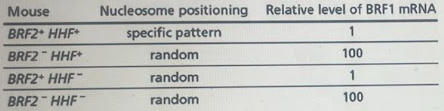
Which of the following conclusions CANNOT be drawn from your data?
- BRF2 is required for the specific pattern of nucleosome positions over the BRF1 upstream region.
- The part of histone H4 missing in HHF- mice is not required for the formation of nucleosomes.
- The specific pattern of nucleosome positioning over the BRF1 upstream region is required for BRF1 repression.
- BRF2 is required for the repression of BRF1.
28
Enhancers can act over long stretches of DNA, but are specific about which genes they affect. How do eukaryotic cells prevent these transcription regulators from looping in the wrong direction and inappropriately turning on the transcription of a neighboring gene?
- The cell uses histone acetyltransferase to prevent enhancer binding to the DNA)
- There is no mechanism to prevent inappropriate enhancer action on neighboring genes. The cells will degrade inappropriately produced mRNA molecules.
- The cell will group neighboring genes into operons so that they are transcribed as a single unit, regulated by a single enhancer.
- Chromosome loop-forming proteins arrange the DNA into topological associated domains such that individual genes and their associated enhancer binding regions are in proximity.
29
Combinatorial control of gene expression
- involves every gene using a different combination of transcriptional regulators for its proper expression.
- involves only the use of gene activators used together to regulate genes appropriately.
- involves groups of transcription regulators working together to determine the expression of a gene.
- is seen only when genes are arranged in operons.
30
In principle, how many different cell types can an organism having four different types of transcription regulators and thousands of genes create?
- up to 8
- up to 16
- up to 4
- thousands
31
You are studying a set of mouse genes whose expression increases when cells are exposed to the hormone cortisol, and you believe that the same cortisol-responsive transcriptional activator regulates all of these genes. If your hypothesis is correct, which of the following statements below should be TRUE?
The cortisol-responsive genes share a DNA sequence in their regulatory regions that binds the cortisol-responsive transcriptional activator.- The cortisol-responsive genes must all be in an operon.
- The transcriptional regulators that bind to the regulatory regions of the cortisol-responsive genes must all be the same.
- The cortisol-responsive genes must not be transcribed in response to other hormones.
32
Which of the following statements about how fruit flies can develop an eye in the middle of a leg is TRUE?
- When the Ey gene is introduced into cells that would normally give rise to a leg. the transcription regulators used to control its expression in the leg are different from those that are normally used to control Ey expression in the eye.
- All the eye cells found in the adult leg are a single cell type and have identical characteristics.
- When the Ey gene is expressed in adult leg cells, these cells dedifferentiate and become eye cells.
- The Ey gene encodes a transcription regulator that is the only transcription regulator used to produce a fruit fly eye.
33
Which of the following statements about iPS cells is FALSE?
- A cell that is deditferentiated to become an iPS cell will undergo changes to its gene expression profile.
- iPS cells can be made by adding a combination of transcription regulators to a fibroblast.
- iPS cells made from mouse cells can differentiate into almost any human cell type.
- Stimulation by extracellular signal molecules causes iPS cells to differentiate.
34
The MyoD transcriptional regulator is normally found in differentiating muscle cells and participates in the transcription of genes that produce muscle-specific proteins, such as those needed in contractile tissue. Amazingly, expression of MyoD in fibroblasts causes these cells derived from skin connective tissue to produce proteins normally only seen in muscles. However, some other cell types do not transcribe muscle-specific genes when MyoD is expressed in them. Which of the following statements below is the best explanation of why MyoD can cause fibroblasts to express muscle specific genes?
During their developmental history, fibroblasts have accumulated some transcriptional regulators in common with differentiating muscle cells- The presence of MyoD is sufficient to activate the transcription of muscle-specific genes in all cell types.
- The muscle-specific genes must be in heterochromatin in fibroblasts.
- Unlike some other cell types, fibroblasts have not lost the muscle-specific genes from their genome.
35
In mammals, individuals with two X chromosomes are female, and individuals with an X and a Y chromosome are male. It had long been known that a gene located on the Y chromosome was sufficient to induce the gonads to form testes, which is the main male-determining factor in development, and researchers sought the product of this gene, the so-called testes-determining factor (TDF). For several years, the TDF was incorrectly thought to be a zinc finger protein encoded by a gene called BoY. Which of the following observations would most strongly suggest that BoY might NOT be the TDF?
- Expression of BoY in adult females does not masculinize them.
A few of the genes that are known to be expressed only in the testes have binding sites for the BoY protein in their upstream regulatory sequences, but most do not
Some XY individuals that develop into females have mutations in a different gene, SRY, but are normal at BoY.
36
Which of the following is NOT a general mechanism that cells use to maintain stable patterns of gene expression as cells divide?
- inheritance of DNA methylation patterns when cells divide
- proper segregation of housekeeping proteins when cells divide
- a positive feedback loop, mediated by a transcriptional regulator that activates transcription of its own gene in addition to other cell-type-specific genes
- faithful propagation of condensed chromatin structures as cells divide
37
Which of the following statements about DNA methylation in eukaryotes is FALSE?
- DNA methylation involves a covalent modification of cytosine bases.
- Immediately after DNA replication, each daughter helix contains one methylated DNA strand, which corresponds to the newly synthesized strand)
- IMethylation of DNA attracts proteins that block gene expression.
- Appropriate inheritance of DNA methylation patterns involves maintenance methyltransferase.
38
Which of the following examples does NOT describe a mechanism of post-transcriptional control of gene expression?
- translational inhibition of an mRNA by the binding of a protein at the 5' untranslated region of the message.
- the activation of a protein when it is phosphorylated by a protein kinase
- the action of the RNA component of telomerase
- the alternative splicing of a gene, leading to the production of a muscle-specific protein
39
Using genetic engineering techniques, you remove the sequences that code for the ribosome-binding sequences of the bacterial LacZ gene. The removal of these sequences will lead to
- transcriptional repression, resulting in fewer mRNA molecules being produced from this gene.
- translational inhibition of the LacZ mRNA)
- more LacZ protein being produced due to faster ribosome movement across the LacZ mRNA)
- a longer half-life for the LacZ mRNA)
40
miRNAs, tRNAs, and rRNAs all
- do not code for proteins.
- act in the nucleus.
- are packaged with other proteins to form RISC)
- form base pairs with mRNA molecules.
41
Which of the following is NOT involved in post-transcriptional control?
- the spliceosome
- Dicer
- RISC
- Mediator
42
MicroRNAs
- contral gene expression by base-pairing with DNA sequences.
- are found only in humans.
- can degrade RNAs by using their intrinsic catalytic activity.
- are produced from a precursor miRNA transcript.
43
Which of the following statements about miRNAs is FALSE?
- One miRNA can regulate the expression of many genes.
- miRNAs are transcribed in the nucleus from genomic DNA.
- miRNAs are made by RNA polymerase.
- miRNAs are produced from rRNAs.
44
Which of the following statements about RNAi is TRUE?
- RNAi is induced when double-stranded, foreign RNA is present in the cell.
- siRNAs bind to miRNAs to induce RNAi.
- The RNAi mechanism is found only in plants and animals.
- RISC uses the siRNA duplex to locate complementary foreign RNA molecules
45
The owners of a local bakery ask for your help in improving a special yeast strain they use to make bread) They would like you to help them design experiments using RNA interference to turn off genes, to allow them to test their hypothesis that certain genes are important for the good flavors found in their bread) Of the components in the following list, which is the most important to check for in this yeast strain if you would like this project to succeed?
- miRNA genes in the genome
- genes in the genome that code for RISC proteins
- foreign double-stranded RNA
- single-stranded siRNAs within the cell
46
The long noncoding RNA Xist
- is important for the formation of highly condensed heterochromatin on the X chromosome.
- binds to foreign RNAs in the cell to promote their destruction,
- acts with the RTS complex to bind to complementary RNA molecules.
- catalyzes miRNA maturation.