Chem 1000 Midterm 2
Study these flashcardsFree · spaced repetition · iPhone, Android, Mac & web
All cards
1
metal
malleable, ductile, good conductor of heat and electricity, shiny, resistivity increases with increasing T
2
nonmetal
brittle when solid, poor conductor of heat and electricity (insulator)
3
Metalloid
intermediate between metal and nonmetal, often semiconducting
4
semiconductor
electrical conductivity is between that of a conductor and insulator, resistivity decreases with increasing T
5
Quasi-free-electron model of metals
Explains metals
-heat and electrical conductivity
-deformability (ductility, malleability)
-heat and electrical conductivity
-deformability (ductility, malleability)
6
crystal lattice
repeating arrangement of points in space
7
polycrystal
a material composed of many microscopic crystals (grains) stuck together in different orientations
8
grain boundary
surface where two grains meet
9
single crystal
a material composed of a single, (nearly) perfectly ordered crystalline material without grain boundaries
10
lattices in 2D
square
rectangle
hexagon
rectangle
hexagon
11
simple cubic unit cell
cubic unit cell in which lattice points are situated only at the corners
8x(1/8)=1 atom per unit cell
8x(1/8)=1 atom per unit cell
12
Body Centered Cubic (BCC)
A common crystal structure found in some elemental metals. Within the cubic unit cell, atoms are located at corner and cell center positions
8x(1/8)+1=2 atoms per unit cell
8x(1/8)+1=2 atoms per unit cell
13
Face Centered Cubic (FCC)
A crystal structure found in some common elemental metals. Within the cubic unit cell, atoms are located at all corner and face-centered positions.
8x(1/8)+6(1/2)=4 atoms per unit cell
8x(1/8)+6(1/2)=4 atoms per unit cell
14
corner atom
shared by 8 unit cells
1/8 of an atom is inside any given cell
1/8 of an atom is inside any given cell
15
facial atom
shared between 2 unit cells
1/2 of an atom is inside any given cell
1/2 of an atom is inside any given cell
16
fcc / ccp (cubic closest packed)
minimum empty space
74% of the space is occupied by atoms
ABCABC...
74% of the space is occupied by atoms
ABCABC...
17
HCP (Hexagonal Closest Packing)
an identical packing fraction is obtained
ABAB...
ABAB...
18
x-ray diffraction
from this experiment we get:
-crystal structure
-positions of atoms within unit cell
-dimensions of unit cell
-crystal structure
-positions of atoms within unit cell
-dimensions of unit cell
19
alkali metals
group 1 except H
soft metals
lowest ionization energies and electronegativities in periodic table, low melting point and boiling points
have among the most negative reduction potentials
very powerful reducing agents
in nature these elements only appear as their +1 cations
almost universally ionic
relatively large, negative enthalpies of hydration
carry a single charge, the forces holding their crystals together, while significant, are less strong than those holding together crystals of more highly charged ions
almost all are extremely soluble in water (Exception, Li with highly charged anions)
soft metals
lowest ionization energies and electronegativities in periodic table, low melting point and boiling points
have among the most negative reduction potentials
very powerful reducing agents
in nature these elements only appear as their +1 cations
almost universally ionic
relatively large, negative enthalpies of hydration
carry a single charge, the forces holding their crystals together, while significant, are less strong than those holding together crystals of more highly charged ions
almost all are extremely soluble in water (Exception, Li with highly charged anions)
20
Alkali metal + water
metal hydroxide + hydrogen
M(s) + H2O(l)-> M+(aq) + OH-(aq) + 1/2H2(g)
M(s) + H2O(l)-> M+(aq) + OH-(aq) + 1/2H2(g)
21
Alkali metal + halogen
metal halide
M(s) + 1/2 X2 -> MX(s)
M(s) + 1/2 X2 -> MX(s)
22
lithium + oxygen
Lithium oxide (Li2O)
2Li(s) + 1/2O2(g) -> Li2O(s)
2Li(s) + 1/2O2(g) -> Li2O(s)
23
reduction potential
half cell potential for gaining electrons
24
hydration
an ion in solution is surrounded by water molecules
25
hydration enthalpy
enthalpy change for the transfer of an ion from the gas phase to solution
M+(g) -> M+(aq)
M+(g) -> M+(aq)
26
Flame tests
Metal ions are often identified by precipitation
Alkali metals compounds are extremely soluble so that wont work. Instead we use flame tests
-putting a sample into a flame puts energy into it. This energy can put ions in excited electronic states
-when the ions return to their ground state (possibly in multiple hops), they emit light
-the emission spectrum depends on a number of factors (including the flame temperature), but is most strongly dependent on the energy levels of the emitter, leading to characteristic colours
Alkali metals compounds are extremely soluble so that wont work. Instead we use flame tests
-putting a sample into a flame puts energy into it. This energy can put ions in excited electronic states
-when the ions return to their ground state (possibly in multiple hops), they emit light
-the emission spectrum depends on a number of factors (including the flame temperature), but is most strongly dependent on the energy levels of the emitter, leading to characteristic colours
27
Li flame color
crimson
28
Na flame color
yellow
29
K flame color
purple
30
Cs flame color
blue
31
Electrolysis of molten chlorides overall reactions
LiCl(l) -> Li(l) + 1/2 Cl2(g)
NaCl(l) -> Na(l) + 1/2 Cl2(g)
NaCl(l) -> Na(l) + 1/2 Cl2(g)
32
Downs Cell
commercial electrochemical cell used to obtain sodium metal by the electrolysis of molten NaCl
melting point of NaCl= 804
melting point of NaCl= 804
33
Downs Cell Cathode reaction
Na+(l) + e- -> Na(l)
34
Downs cell anode reaction
Cl-(l) -> 1/2 Cl2 (g) + e-
35
Downs cell overall reaction
NA+(l) + Cl-(l) -> Na(l) + 1/2 Cl2(g)
36
chlor-alkali process
electrolysis of an aqueous solution of NaCl
Half Reactions:
2Cl- (aq) -> Cl2(g) + 2e-
2H2O (l) + 2e- -> H2(g) + 2OH-(aq)
Overall:
2Cl-(aq) + 2H2O(l) -> Cl2(g) +H2(g) +2OH-(aq)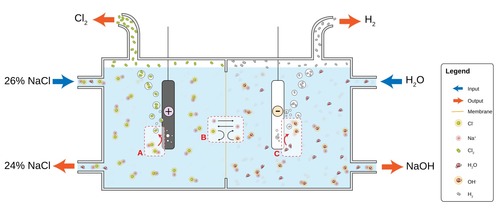
Half Reactions:
2Cl- (aq) -> Cl2(g) + 2e-
2H2O (l) + 2e- -> H2(g) + 2OH-(aq)
Overall:
2Cl-(aq) + 2H2O(l) -> Cl2(g) +H2(g) +2OH-(aq)
37
lattice energy
enthalpy change when an ionic compound is broken up into the corresponding gaseous ions
38
Born-Haber cycle
An enthalpy cycle that allows you to calculate the lattice enthalpy change of formation for system.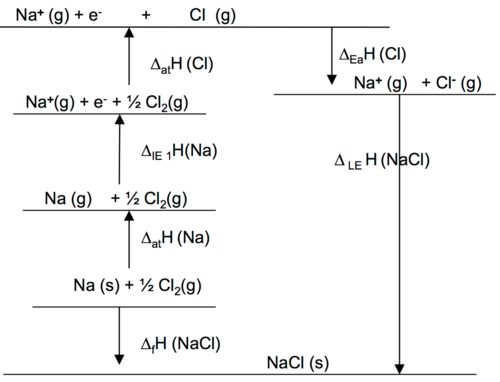
39
Madelung constant
Summing the forces between the ions, assuming that they are point charges occupying their respective lattice sites
40
Alkaline Earth metals
Group 2, except maybe Be
soft metals
form 2+ cations
very negative reduction potentials
M2+(aq) + 2e- -> M(s)
tend to be ionic (other than compounds of Be)
soft metals
form 2+ cations
very negative reduction potentials
M2+(aq) + 2e- -> M(s)
tend to be ionic (other than compounds of Be)
41
alkaline earth metal reaction with water
M(s) + 2H2O -> M(OH)2 + H2
42
alkaline earth metal reaction with oxygen
M(s) + 1/2 O2(g) -> MO(s)
43
alkaline earth metal reaction with nitrogen
3M(s) + N2(g) -> M3N2(s)
44
alkaline earth metal reaction with halogens
M(s) + X2 -> MX2(s)
45
earth
term applied by early chemists to nonmetallic substances which are insoluble in water and remain stable when heated. The alkaline earth metal oxides have these properties
46
alkaline
means basic. The alkaline earth metal oxides, to the extent that they dissolve at all in water, make basic solutions
MO(s) + H2O(l) -> M(OH)2
MO(s) + H2O(l) -> M(OH)2
47
ionic compounds of alkaline earth metals
with monovalent anions (NO3-,Cl-) tend to be soluble in water, except hydroxides and fluorides, which are at best slightly soluble
with divalent anions tend to be insoluble (MCO3, MSO4) or only slightly soluble (MS) in water
with divalent anions tend to be insoluble (MCO3, MSO4) or only slightly soluble (MS) in water
48
Flame test of Ca
Brick red
49
Flame test of Sr
crimson
50
flame test of Ba
green
51
Flame test of Mg and Be
no colour
52
Carbonates
When heated, alkaline earth carbonates decompose to the corresponding oxide and CO2:
MCO3(s) -> MO(s) + CO2(g)
We can regenerate the carbonate in 2 steps:
1. MO(s) + H2O(l) -> M(OH)2
2. M(OH)2 + CO2(g) -> MCO3(s) + H2O(l)
Reaction with excess acid:
MCO3(s) + 2H+(aq) -> M2+(aq) + CO2(g) + H2O(l)
MCO3(s) -> MO(s) + CO2(g)
We can regenerate the carbonate in 2 steps:
1. MO(s) + H2O(l) -> M(OH)2
2. M(OH)2 + CO2(g) -> MCO3(s) + H2O(l)
Reaction with excess acid:
MCO3(s) + 2H+(aq) -> M2+(aq) + CO2(g) + H2O(l)
53
Ba2+
blocks potassium channels
when ingested, Ba2+ released from barium carbonate when it is combined with stomach acid, leading to life-threatening symptoms
Barium sulfate on the other hand is essentially insoluble, so it is safe to ingest. It is used as a contrast agent in x-ray imaging of the GI tract
when ingested, Ba2+ released from barium carbonate when it is combined with stomach acid, leading to life-threatening symptoms
Barium sulfate on the other hand is essentially insoluble, so it is safe to ingest. It is used as a contrast agent in x-ray imaging of the GI tract
54
Hard water
contains divalent cations, esp. Mg2+, Ca2+, and Fe2+
55
temporary hard water
has the counterion HCO3-
Called temporary because alkaline earth metal (and other high-valent metal ions) carbonates can be removed by boiling:
2HCO3- (aq) + heat -> CO3 2-(aq) + CO2 +H2O(l)
M2+ (aq) + CO3 2-(aq) -> MCO3(s)
If untreated, leads to scale in hot water heaters, pipes, kettles, etc.
Called temporary because alkaline earth metal (and other high-valent metal ions) carbonates can be removed by boiling:
2HCO3- (aq) + heat -> CO3 2-(aq) + CO2 +H2O(l)
M2+ (aq) + CO3 2-(aq) -> MCO3(s)
If untreated, leads to scale in hot water heaters, pipes, kettles, etc.
56
permanent hard water
contains counterions other than bicarbonate (chloride, sulfate, nitrate) whose alkaline earth metal compounds cant be removed by boiling
Divalent cations tend to precipitate with soaps and detergents= bathtub ring, greying of clothes
water can have both temporary and permanent hardness
Divalent cations tend to precipitate with soaps and detergents= bathtub ring, greying of clothes
water can have both temporary and permanent hardness
57
Why is Be weird?
Be tends to make covalent bonds instead of ionic bonds
Forms a thin layer of BeO on contact with air or water
BeO is nonporous, so it prevents further oxidation. This is called passivation
BeO doesn't react with water
BeF2 and BeCl2 are covalent (molecular) compounds, not ionic
BeO is amphitaric (both an acid and a base)
Reaction with acid: BeO(s) + 2H3O+(aq) +H2O(l) -> [Be(OH2)4]2+ (aq)
[Be(OH2)4]2+ contains covalent bonds between O and Be
[Be(OH2)4]2+ is acidic:
[Be(OH2)4]2+ + H2O(l) <-> [Be(OH2)3(OH)]+(aq) + H3O+(aq)
Reaction with base:
BeO(s) + 2OH-(aq) + H2O(l) -> [Be(OH)4]2-(aq)
Forms a thin layer of BeO on contact with air or water
BeO is nonporous, so it prevents further oxidation. This is called passivation
BeO doesn't react with water
BeF2 and BeCl2 are covalent (molecular) compounds, not ionic
BeO is amphitaric (both an acid and a base)
Reaction with acid: BeO(s) + 2H3O+(aq) +H2O(l) -> [Be(OH2)4]2+ (aq)
[Be(OH2)4]2+ contains covalent bonds between O and Be
[Be(OH2)4]2+ is acidic:
[Be(OH2)4]2+ + H2O(l) <-> [Be(OH2)3(OH)]+(aq) + H3O+(aq)
Reaction with base:
BeO(s) + 2OH-(aq) + H2O(l) -> [Be(OH)4]2-(aq)
58
diagonal relationships
similarities between pairs of elements in different groups and periods of the periodic table
Li-Mg
Be-Al
B-Si
Li-Mg
Be-Al
B-Si
59
Li-Mg
Li is the only alkali metal to form a nitride, whereas this is a typical reaction for the alkaline earth metals
A number of lithium compounds are much less soluble in water than the corresponding compounds of other alkali metals (e.g. lithium phosphate)
Li2CO3 decomposes to Li2O and CO2 like the alkaline earth metal carbonates, but the other alkali metal carbonates are thermally stable
A number of lithium compounds are much less soluble in water than the corresponding compounds of other alkali metals (e.g. lithium phosphate)
Li2CO3 decomposes to Li2O and CO2 like the alkaline earth metal carbonates, but the other alkali metal carbonates are thermally stable
60
Be- Al
both form a tough and chemically resistant passivation layer
both have amphoteric oxides. Contrast: reaction of alkaline earth metals with water to make alkaline earth hydroxides
Both form covalent halides. Contrast: Ionic halides of alkaline earth metals (Note: ionic vs. covalent character determined from electrical conductivity of melt)
both have amphoteric oxides. Contrast: reaction of alkaline earth metals with water to make alkaline earth hydroxides
Both form covalent halides. Contrast: Ionic halides of alkaline earth metals (Note: ionic vs. covalent character determined from electrical conductivity of melt)
61
Group 13 Metals
All the elements in group 13 except boron are metals
common ions: Al3+, Ga3+, In+, TI+, also sometimes In3+ and TI3+
Under typical reactions, these metals don't react with water
at room temperature, the oxide formed is M2O3
Al(OH)3, Ga(OH)3 and In(OH3) are all insoluble in water, but TIOH is very soluble
Aluminum is a good reducing agent
common ions: Al3+, Ga3+, In+, TI+, also sometimes In3+ and TI3+
Under typical reactions, these metals don't react with water
at room temperature, the oxide formed is M2O3
Al(OH)3, Ga(OH)3 and In(OH3) are all insoluble in water, but TIOH is very soluble
Aluminum is a good reducing agent
62
Thallium
Thallium has many compounds of its +1 ion
TI+ and K+ are very similar in size: 164 and 153pm, respectively. In the body, TI+ can go wherever K+ can go, which is pretty much everywhere
Most thallium compounds are toxic. TISO4 was once used as a rat and ant poison
Thallium (I) sulfate is tasteless, so it was once a popular poison, nicknamed "Inheritance powder"
Unlike K+, TI+ reacts with sullfur ligands, disrupting proteins containing cysteine in particular
TI+ and K+ are very similar in size: 164 and 153pm, respectively. In the body, TI+ can go wherever K+ can go, which is pretty much everywhere
Most thallium compounds are toxic. TISO4 was once used as a rat and ant poison
Thallium (I) sulfate is tasteless, so it was once a popular poison, nicknamed "Inheritance powder"
Unlike K+, TI+ reacts with sullfur ligands, disrupting proteins containing cysteine in particular
63
passivation of aluminum
Like Be, Al is passivated by an oxide layer which forms extremely rapidly when the metal is exposed to air
Aluminum oxide:
is hard
has a high melting point
is non-porous
Aluminum oxide:
is hard
has a high melting point
is non-porous
64
anodization of aluminum
deliberate, electrolytic thickening of the oxide layer:
2Al(s) + 3H2O(l) -> Al2O3 (s) + 6H+ (aq) + 6e-
Has the following effects:
makes Al more chemically resistant
makes Al harder
may be used to pigment the oxide layer with appropriate additives
2Al(s) + 3H2O(l) -> Al2O3 (s) + 6H+ (aq) + 6e-
Has the following effects:
makes Al more chemically resistant
makes Al harder
may be used to pigment the oxide layer with appropriate additives
65
acid-base properties of Al2O3
Al2O3 is amphoteric
reaction with acid:
Al2O3(s) + 6H+(aq) -> 2Al 3+(aq) + 3H2O(l)
reaction with base:
Al2O3(s) + 2OH-(aq) + 3H2O(l) -> 2[Al(OH)4]-(aq)
reaction with acid:
Al2O3(s) + 6H+(aq) -> 2Al 3+(aq) + 3H2O(l)
reaction with base:
Al2O3(s) + 2OH-(aq) + 3H2O(l) -> 2[Al(OH)4]-(aq)
66
reaction of Al with acids
HNO3 is an oxidizing acid because it typically attacks metals through the reduction of NO3-:
NO3- + 4H+ +3e- -> NO + 2 H2O
For Al, this reaction, just tends to make the oxide layer thicker, i.e. makes the metal more passive:
2Al(s) + 2NO3- + 2H+ -> Al2O3(s) + 2NO(g) + H2O(l)
Al reacts with non-oxidizing acids (e.g. HCl) in the typical way for a metal:
Al(s) + 3H+ (aq) -> Al3+(aq) + 3/2 H2(g)
NO3- + 4H+ +3e- -> NO + 2 H2O
For Al, this reaction, just tends to make the oxide layer thicker, i.e. makes the metal more passive:
2Al(s) + 2NO3- + 2H+ -> Al2O3(s) + 2NO(g) + H2O(l)
Al reacts with non-oxidizing acids (e.g. HCl) in the typical way for a metal:
Al(s) + 3H+ (aq) -> Al3+(aq) + 3/2 H2(g)
67
reaction of Al with base
Aluminum metal can be oxidized in aqueous base:
Al(s) + OH-(aq) + 3 H2O(l) -> [Al(oH)4]-(aq) + 3/2 H2(g)
aluminum can react with acid or base, so it is amphoteric
Al(s) + OH-(aq) + 3 H2O(l) -> [Al(oH)4]-(aq) + 3/2 H2(g)
aluminum can react with acid or base, so it is amphoteric
68
acid-base-properties of Al(OH)3
Al(OH)3 is amphoteric
Reaction with metal (typical for metal hydroxides):
Al(OH)3 (s) + 3 H3O+(aq) -> [Al(H2O)6]3+(aq)
Reaction with base (unusual for a metal hydroxide):
Al(OH)3(s) + OH-(aq) -> [Al(OH)4]- (aq)
Reaction with metal (typical for metal hydroxides):
Al(OH)3 (s) + 3 H3O+(aq) -> [Al(H2O)6]3+(aq)
Reaction with base (unusual for a metal hydroxide):
Al(OH)3(s) + OH-(aq) -> [Al(OH)4]- (aq)
69
production of aluminum
aluminum ore (bauxite) contains Al2O3, AlO(OH) and Fe2O3 (among other things)
Al2O3 and AlO(OH) dissolve in base, but FeO3 doesnt:
Al2O3(s) + 2OH- (aq) + 3H2O(l) -> 2[Al(OH)4]-(aq)
AlO(OH)(s) + OH-(aq) + H2O(l) -> [Al(OH)4-](aq)
filter off solid Fe2O3, then precipitate Al(OH)3:
[Al(OH)4]-(aq) + H3O+(aq) -> Al(OH)3(s) + 2H2O(l)
Recover aluminum oxide by heating:
2Al(OH)3(s) + heat -> Al2O3(s) + 3H2O(g)
Al2O3 has a very high melting point (2072)
A 15:85 mixture of Al2O3, and cryolite (Na3AlF6) has a melting point of about 1000
this molten mixture is electrolyzed using a graphite anode
Anode:C(s) + 2 O2- (l) -> CO2(g) + 4e-
Cathode: Al3+(l) + 3e- -> Al(l)
Overall: 3C(s) + 6 O2-(l) + 4 Al3+(l) -> 4 Al(s) +3 CO2(g)
liquid aluminum is denser than the ionic liquid from which it is electrolyzed, so it is collected from the bottom of the electrolysis vat
Al2O3 and AlO(OH) dissolve in base, but FeO3 doesnt:
Al2O3(s) + 2OH- (aq) + 3H2O(l) -> 2[Al(OH)4]-(aq)
AlO(OH)(s) + OH-(aq) + H2O(l) -> [Al(OH)4-](aq)
filter off solid Fe2O3, then precipitate Al(OH)3:
[Al(OH)4]-(aq) + H3O+(aq) -> Al(OH)3(s) + 2H2O(l)
Recover aluminum oxide by heating:
2Al(OH)3(s) + heat -> Al2O3(s) + 3H2O(g)
Al2O3 has a very high melting point (2072)
A 15:85 mixture of Al2O3, and cryolite (Na3AlF6) has a melting point of about 1000
this molten mixture is electrolyzed using a graphite anode
Anode:C(s) + 2 O2- (l) -> CO2(g) + 4e-
Cathode: Al3+(l) + 3e- -> Al(l)
Overall: 3C(s) + 6 O2-(l) + 4 Al3+(l) -> 4 Al(s) +3 CO2(g)
liquid aluminum is denser than the ionic liquid from which it is electrolyzed, so it is collected from the bottom of the electrolysis vat
70
covalent bonding
a chemical bond in which electrons are shared between two atoms
typically formed between two nonmetallic elements
typically formed between two nonmetallic elements
71
ionic bonding
material held together by electrostatic force between ions (no sharing of electrons)
Electronegativities differ by 2 units or more
Electronegativities differ by 2 units or more
72
metallic bonding
electrons shared among all the metal atoms
73
lewis diagrams
a convenient graphical accounting system for valence electrons in molecules
a shared electron pair is represented by a line between the two atoms
a non bonding valence electron is represented by a dot
dots are paired to represent their occupation of orbitals
a shared electron pair is represented by a line between the two atoms
a non bonding valence electron is represented by a dot
dots are paired to represent their occupation of orbitals
74
bond order
number of shared electron pairs in a bond
75
lone pair
a pair of nonbonding electrons in an "orbital"
76
the octet rule
typically, main-group elements in chemical compounds (except H) are surrounded by eight valence electrons (including any shared in covalent bonds).
H an only have/ share two electrons
Some elements, notably B, sometimes form electron deficient compounds in which there is less than a full octet around the atom, with important implications for their chemistry
H an only have/ share two electrons
Some elements, notably B, sometimes form electron deficient compounds in which there is less than a full octet around the atom, with important implications for their chemistry
77
Guidelines for drawing Lewis Diagrams
1. Count up the number of valence electrons in all the atoms
If the species is cation, subtract the charge
If the species is an anion, add the absolute value of the charge
This is the total number of valence electrons to place in your Lewis diagram
2. Draw a skeleton with one bond between each pair of atoms which are covalently bonded
3. Complete the octets for any group 17 elements with lone pairs. Exception: compounds where a halogen is the central atom
4. placing the remaining electrons becomes a puzzle
complete as many octets as possible with lone pairs or multiple bonds
double bonds are common for C, group 15 and group 16
triple bonds are common for C and group 15
never exceed an octet in period 2
you can exceed an octet in periods 3 and up if necessary
5. the best lewis structure for a compound minimizes the formal charges even if this means violating the octet rule for atoms in the 3rd period and beyond
If the species is cation, subtract the charge
If the species is an anion, add the absolute value of the charge
This is the total number of valence electrons to place in your Lewis diagram
2. Draw a skeleton with one bond between each pair of atoms which are covalently bonded
3. Complete the octets for any group 17 elements with lone pairs. Exception: compounds where a halogen is the central atom
4. placing the remaining electrons becomes a puzzle
complete as many octets as possible with lone pairs or multiple bonds
double bonds are common for C, group 15 and group 16
triple bonds are common for C and group 15
never exceed an octet in period 2
you can exceed an octet in periods 3 and up if necessary
5. the best lewis structure for a compound minimizes the formal charges even if this means violating the octet rule for atoms in the 3rd period and beyond
78
resonance
when there is more than one reasonable lewis diagram
79
formal charge
a calculation of the charge of an atom in a lewis diagram assuming electrons are equally shared
Calculation: Draw the Lewis diagram, then count the electrons on a particular atom, counting half of any electrons shared with a neighbour
the formal charge is the number of valence electrons of the neutral atom minus the number of electrons on the atom in the Lewis structure
*Sum of formal charges= charge of molecule
Calculation: Draw the Lewis diagram, then count the electrons on a particular atom, counting half of any electrons shared with a neighbour
the formal charge is the number of valence electrons of the neutral atom minus the number of electrons on the atom in the Lewis structure
*Sum of formal charges= charge of molecule
80
Higher Bond order =
shorter bond length
81
bond dissociation enthalpy
enthalpy change for the breaking of a covalent bond in the gas phase
depends on the particular molecule in which the bond occurs, not just on the atoms involved
increases with bond order
depends on the particular molecule in which the bond occurs, not just on the atoms involved
increases with bond order
82
estimating reaction enthalpies
we can estimate reaction enthalpies from bond dissociation enthalpies by counting up the number of bonds of each type made and broken
83
N2 in inert
but its Carbon-Carbon double and triple bonds are very reactive
84
bond polarity
electronegativity is a measure of the ability of an atom to attract electrons to itself
two atoms in a covalent bond may not share the electrons in the bond equally, depending on the difference in electronegativity
two atoms in a covalent bond may not share the electrons in the bond equally, depending on the difference in electronegativity
85
Valence Shell Electron Pair Repulsion Theory
VSEPR
Key ideas:
electrons repel
valence electrons (bonding and nonbonding) are particularly close together at the end of a bond near a central atom
electrons can be thought of as "living in groups" of nonbonding electron lone pairs and covalent bonds. A bond of any order (single, double, triple) is a single group
The electronic geometry around an atom is therefore dictated by the mutual repulsion of electron groups near that atom
electrons organize themselves so as to minimize the repulsion between groups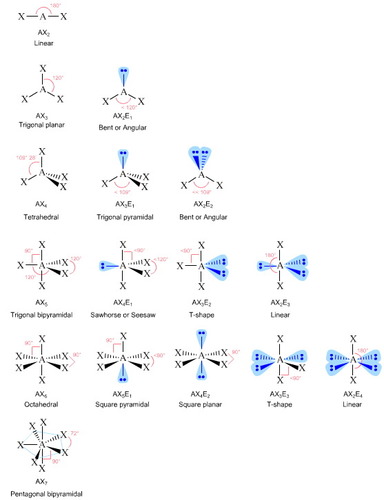
Key ideas:
electrons repel
valence electrons (bonding and nonbonding) are particularly close together at the end of a bond near a central atom
electrons can be thought of as "living in groups" of nonbonding electron lone pairs and covalent bonds. A bond of any order (single, double, triple) is a single group
The electronic geometry around an atom is therefore dictated by the mutual repulsion of electron groups near that atom
electrons organize themselves so as to minimize the repulsion between groups
86
lone pairs
"fatter" than bonding pairs
Consequences:
1. lone pairs locate themselves where there is the most space
2. Lone pairs push the bonding electrons away, distorting their geometry away from the ideal geometry for n identical electron groups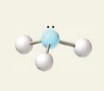
Consequences:
1. lone pairs locate themselves where there is the most space
2. Lone pairs push the bonding electrons away, distorting their geometry away from the ideal geometry for n identical electron groups
87
dipole
a pair of equal and opposite charges separated by a distance d
polar bonds can be thought of as little dipole vectors by convention in chemistry, these vectors point toward the negative (more electronegative) end of a bond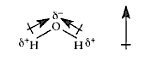
polar bonds can be thought of as little dipole vectors by convention in chemistry, these vectors point toward the negative (more electronegative) end of a bond
88
dipole moment
u=qd
measures the strength of a dipole
the overall dipole moment of a molecule is the vector sum of the bond dipoles
Nonzero dipole moment=polar
zero dipole moment=nonpolar
measures the strength of a dipole
the overall dipole moment of a molecule is the vector sum of the bond dipoles
Nonzero dipole moment=polar
zero dipole moment=nonpolar