Unit 4.4 Aldehydes and Ketones
Study these flashcardsFree · spaced repetition · iPhone, Android, Mac & web
All cards
1
What is an aldehyde?
An organic molecule with a terminal carbonyl (C=O) group
RCHO (aldehyde's on the end)
RCHO (aldehyde's on the end)
2
What is a ketone?
An organic molecule with a non-terminal carbonyl (C=O) group RCOR' (Ketones yn y canol)
3
How can aldehydes and ketones be formed?
The oxidation of primary and secondary alcohols respectively
4
What is used as the oxidising agent when forming carbonyls from alcohols?
Acidified potassium dichromate (K₂Cr₂O₇)
5
How is the oxidising agent represented in equations?
[O]
6
What complications arise when producing aldehydes from the oxidation of primary alcohols?
The aldehyde formed may be further oxidised in to a carboxylic acid
7
How can aldehydes be prevented from being further oxidised in to carboxylic acids?
- Use an excess of alcohol
- Distill the aldehyde as it's formed
- Distill the aldehyde as it's formed
8
What is formed from the reduction of aldehydes and ketones?
Primary and secondary alcohols respectively
9
What are the 2 reducing agents which may be used to reduce carbonyls?
LiAlH₄ (Lithium tetrahydridoaluminate) and NaBH₄ (Sodium tetrahydridoborate)
10
Which of the 2 reducing agents LiAlH₄ and NaBH₄ are stronger?
Lithium tetrahydridoaluminate
11
What are the conditions for carrying out a reduction using LiAlH₄ ?
Completely dry dissolved in ethoxyethane at room temperature. Once the reaction has reached completion, water is added to neutralise the excess LiAlH₄
12
How is the reducing agent represented in equations?
[H]
13
What is a hydroxynitrile?
A molecule with both an OH goup and a CN group bonded to a central carbon
14
How can hydroxynitriles be formed from carbonyls?
Nucleophilic addition
15
What suggest susceptibility to nucleophillic addition?
A strongly polar bond
16
How is the nucleophillic addition of a nitrile group carrried out on a carbonyl?
The carbonyl is treated with a solution of sodium or potassium cyanide in aqueous solution, to which a little sulphuric acid has been added
17
Why is HCN not used for the production of hydroxynitriles from carbonyls?
HCN is a highly toxic gas, and it is also only a weak acid in solution, meaning the reaction is slow
18
Describe the mechanism of reaction for the nucleophilic addition of HCN to a carbonyl
The lone pair of the CN⁻ is attracted towards the electron deficient central carbon and forms a bond. This induces the collapse of the C=O bond, which in turn provides the oxygen with the additional electron necessary to bond to an H+ ion
19
What happens to the chain length during the formation of a hydroxynitrile from a carbonyl?
The cyanide ion (CN⁻) lengthens the chain by one (ascending the homologous series)
20
What are the products formed from the hydrolysis (Addition of a water molecule) of hydroxynitriles?
A hydroxy acid (the N is substituted for an OOH), and ammonia
21
What is the general test for carbonyls?
The addition of a few drops of the unknown solution to a sample of Brady's reagent (2,4-DNPH). A positive test results in an orange crystalline precipitate
22
What is Brady's reagent?
2,4-DNPH (2,4-Dinitrophenylhydrazine) in a solution of Sulphuric acid and methanol
23
What is hydrazine?
N₂H₄
24
What can Brady's reagent be used to indicate?
The particular carbonyl present. This is done by purifying the precipitate, then measuring its melting point
25
What are the products from the reaction of 2,4-DNPH with a carbonyl
_______ 2,4-dinitrophenylhydrazone (the carbonyl's name goes in the blank space) and water
26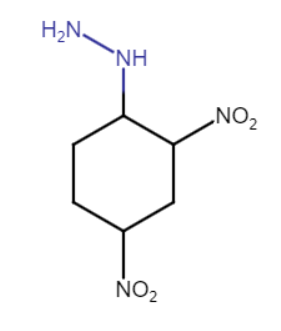
What does the structure of 2,4-dinitrophenylhydrazine look like?
27
What sort of reaction is that between 2,4-DNPH and a carbonyl?
Condensation reaction
28
On what basis may ketones be distinguished from aldehydes?
Aldehydes can be further oxidised in to carboxylic acids, whereas ketones cannot.
29
What are the 2 tests to distinguish between aldehydes and ketones?
By using Tollen's reagent or Fehling's reagent
30
What is Tollen's reagent?
Ammoniacal silver nitrate
31
How is Tollen's reagent prepared?
A drop of aqueous sodium hydroxide is added to a silver nitrate solution. A brown precipitate will form. Ammonia is then added dropwise until the precipitate redissolves, leaving a colourless solution
32
What does a positive test using Tollen's reagent look like
Either a silver mirror deposition occurs, or a black precipitate is formed
33
How does Tollen's reagent work?
The aqueous silver annions may be reduced by the aldehyde, producing elemental silver
Ag⁺ + e⁻ → Ag
Ag⁺ + e⁻ → Ag
34
What does the presence of the terminal hydrogen in an aldehyde allow the molecule to do?
It allows it to be readily oxidised, meaning aldehydes are effective reducing agents
35
What is Fehling's solution?
A solution containing complexed Cu²⁺ ions, appearing blue in colour
36
What does a positive test for Fehling's reagent look like?
A colour change from blue to red-orange
37
How does Fehling's test work?
The aldehyde reduces the Cu²⁺ to Cu⁺
38
What does the triiodmethane test identify?
The presence of a methyl carbonyl or a methyl alcohol
39
How can the triiodomethane test be conducted?
The addition of NaOH dropwise to aqueous I₂ solution until it turns colourless. A few drops of the unknown solution is then added.
40
What does a positive result for the triiodomethane test look like?
The formation of a primrose yellow precipitate