Unit 4.1 & 4.2 benzene and isomerism
Study these flashcardsFree · spaced repetition · iPhone, Android, Mac & web
All cards
1
How does carbon form 4 bonds?
It must promote an electron from 2s² to 2p³
2
What is a sigma (σ) orbital overlap?
An electron orbital overlap between 2 in-plane orbits (The hotdog)
3
What is a pi (π) orbital overlap?
An electron orbital overlap between 2 out-of-plane orbits (The buns)
4
What is an optical isomer?
A molecule with the same molecular formula, same structural formula, but a different arrangement of atoms in 3D space
5
What is a chiral centre?
A central carbon atom with 4 different groups bonded to it
6
What is the amine group?
NH₂
7
How are amines denoted?
By either -amine or amino-
8
What is an amino acid?
A hydrocarbon with both an amine group and a carboxylic acid group
9
What is an α-amino acid?
An amino acid where both the amine and the carboxylic groups are bonded to the same carbon
10
How is a chiral centre denoted?
With an asterisk
11
What are the 2 types of optical isomers?
Levorotatory and dextrorotatory (L and D)
12
How can you identify different optical isomers?
By passing plane polarised light through a sample. The plane of polarisation will be rotated in opposite directions depending on whether the sample is L or D
13
What happens during electrophilic attack?
An electrophile (a molecule with a region of positive charge) is attracted to a region of high electron density such as a C=C bond
14
What is a carbocation?
An organic ion containing a positively charged carbon atom formed as an intermediate during a reaction
15
What is the order of carbocation stability?
tertiary > secondary > primary
16
Explain carbocation stability
Secondary carbocations are more stable as there are more surrounding carbons which may shuttle electrons to stabilise the charge, whereas primary carbocations only have one adjacent carbon, which isn't enough to support the positive charge
17
What is the main product during electrophilic attack reactions and why?
Secondary products, as the secondary carbocation is stable enough to exist for long enough for the reaction to occur
18
What is often formed within a molecule after electrophilic attack?
A chiral centre
19
What proportion of synthesized molecules are L or D form
A 50:50 mixture is a formed, also known as equimolar, or a racemic mixture.
20
How can racemic mixtures be separated?
-Biologically: Using enzymes to breakdown one whilst leaving the other, then separating using traditional methods
-Chemically: Reacting the molecule with another chiral molecule, then separating using traditional methods
-Chemically: Reacting the molecule with another chiral molecule, then separating using traditional methods
21
What is benzene?
A ring shaped hydrocarbon with the formula C₆H₆, it is the simplest aromatic compound
22
What is an arene?
An aromatic hydrocarbon (one containing benzene)
23
Why was the Kekule model incorret?
The enthalpy change from the hydrogenation of benzene is less then 3 times that of cyclohexene
24
Describe the bonding in benzene
Each carbon forms 3 sigma bonds (2 C-C and a C-H), with the remaining orbitals forming a toroidal cloud of delocalised pi electrons above and below the plane
25
Why is benzene more stable than expected?
The delocalised pi electron cloud provides additional stability
26
What reactions does benzene undergo?
Electrophilic substitution
27
What is the name of the intermediate in the electrophilic substitution of benzene?
Wheland's intermediate
28
What happens during the nitration of benzene?
One (or more) of the hydrogen atoms on the benzene ring is replaced by a nitro group, NO₂, through electrophilic substitution
29
What are the reagents for the nitration of benzene?
Concentrated sulphuric acid and nitric acid (H₂SO₄ + HNO₃)
30
What happens to the nitration of benzene if it is carried out at a higher temperature?
Multiple nitration events occur per molecule, forming di-nitro and tri-nitro molecules
31
What is a halogen carrier?
A catalyst used to make an electrophillic halogen (a halogen cation)
32
What is formed when AlCl₃ and Cl₂ react?
A dynamic equilibrium (AlCl₃ + Cl₂ ⇌ AlCl₄⁻ + Cl⁺)
33
Why is a halogen carrier necessary for the halogenation of benzene?
To provide the halogen cations (the electrophiles)
34
What is resonance energy?
The difference between the expected energy level of a molecule and the observed energy
35
What is an alkyl group?
An alkane with a missing hydrogen (methyl, ethyl, ... )
36
What is alkylation?
The addition of an alkyl group on to a molecule
37
What is acylation?
The addition of an aldehyde
38
What is the Friedel-Crafts process for the alkylation of benzene?
The benzene is reacted with a chloroalkane in the presence of an aluminium chloride catalyst
39
What is the Friedel-Crafts process for the acylation of benzene?
The benzene is reacted with an acid chloride in the presence of a halogen carrier
40
How is the alkyl cation formed during the alkylation of benzene?
The reaction of the chloroalkane with AlCl₃
41
How is the H+ ion removed from the Wheland intermediary during the alkylation of benzene?
By the AlCl₄⁻, forming HCl
42
Why isn't chlorobenzene susceptible to electrophilic attack?
-There is no region of low electron density due to the electronegativity of chlorine, as the delocalised pi-electron cloud stabilises the dipole
- The chlorine-carbon bond is stronger than expected due to the overlap of the Cl p-orbitals with the pi-electron cloud (Haribo dummy)
- The chlorine-carbon bond is stronger than expected due to the overlap of the Cl p-orbitals with the pi-electron cloud (Haribo dummy)
43
What is the primary product during the alkylation of benzene?
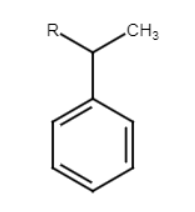
An alkylated benzene where the side chain is 1 smaller than the original chloroalkane, with a methyl group in position 1
44
Describe and explain the solubility of benzene
Benzene is water insoluble as the only interactions it can form are induced dipole-temporary-dipole interactions