Category Theory - New
Study these flashcardsFree · spaced repetition · iPhone, Android, Mac & web
All cards
1
Natural Transformation
Suppose C and B are categories and that S,T are functions from C to B.
We suppose $\tau$ is an assignment of every object $c \in C$ to an arrow $\tau_c : S(c) \to T(c)$ of B such that for every arrow, the diagram (*) commutes.
-----
Recall that a functor is a structure-preserving map between categories and therefore each determines a "copy" of the graph of C inside the graph of B (this copy will in general be distorted since non-faithful functions can map two objects of S to the same object in T).
The natural transformation identifies a collection of directed edges in the graph of B connecting vertices in S(C) to corresponding vertices in T(C) (those with the same pre-image).
If we consider a walk along the vertices of C, we can recreate this walk on the copies of C determined by S and T. The bridges identified by the natural transformation allow us to, at any step of the walk, choose to take that step on the copy determined by the other functor. No matter how many times we choose to do so, we will always be on the right vertex at the right step.
2
Definition: Universe
A set U satisfying:
1) $x \in u \wedge u \in U \Rightarrow x \in U$
2) $u,v \in U \Rightarrow \{ u,v \} , \langle u , v \rangle , ( u \times v ) \in U$
3) $x \in U \Rightarrow P(x) \in U$
4) If x is a set in U, the union of all sets contained in x is also in U.
5) All finite ordinals belong to U.
6) If $ f : a \to b $ is a surjective map with $ a \in U $ and $ b \subset U $, then $ b \in U $.
These requirements guarantee that normal mathematics can be carried out in U.
3
Small Sets, Small Functions, Small Categories, and Large Categories
Given a fixed universe, a small set is an element of U.
A function is small when its domain and codomain are both small.
A small category is one in which both its object and morphisms sets are small (not only the objects and arrows themselves, but the actual sets).
A large category is one in which both the object and morphism sets are classes (proper or not).
4
Class
A class is a subset $ C \subset U $ for the given universe U, whether it is constructible from the axioms of set theory (e.g., limited comprehension) or not.
5
Concrete Category
Many...
Many...
A pair $ \langle C , U \rangle $ where C is a category and U is a faithful functor $ U : C \to Set $.
Many large categories are concrete with U simply the forgetful functor.
-----
The category is effectively embedded in Set, and so we can for many purposes think of or treat it as such.
Many large categories are concrete with U simply the forgetful functor.
-----
The category is effectively embedded in Set, and so we can for many purposes think of or treat it as such.
6
ETAC and Duality
Significance of duality with respect to axioms and theorems.
Significance of duality with respect to axioms and theorems.
"Elementary Theory of an Abstract Category"
Define $ \Sigma $ as the set of all statements which can be made using fundamental categorical definitions, standard axioms or rules from first-order logic, and symbols representing objects and morphisms. This gives us an ETAC for a category C.
Given some statement $ \sigma \in \Sigma $, we can identify the dual of this statement (denoted $ \sigma^* $) by doing the following:
1) Inverting all occurrences of domain/codomain.
2) Inverting the order of morphism composition (and their target/source).
If $ \sigma $ is an axiom in category theory, so is its dual. Therefore, any theorem proven about the category C from the axioms (i.e., in the ETAC) also provides a proof for $ \sigma^* $.
7
Deriving a covariant functor from a hom-set.
Suppose C is a category and that C has small hom-sets. I.e., every $ hom(a,b) = \{ f : ( f : a \to b ) \in C \} $ is small.
Select some $ a \in C $. Holding a constant and varying in our selection of b, we define a functor $ C(a,-) $ mapping every object $ b \in C $ to the set $ Hom(a,b) $.
The arrow function of this functor sends any $ k : b \to b' $ to $ hom(a,k) : hom(a,b) \to hom(a',b') $ defined by mapping any $ f \in Hom(a,b) $ to $ k \circ f \in Hom(a,b')$.
---
The definition of the object function is clear, but the definition of the arrow function is less obvious. If k is a function from b to b' in C, $ C(a,-)(k) $ needs to produce a function between $ Hom(a,b) $ and $ Hom(a,b') $. If f is a function $ f : a \to b$, $ k \circ f $ is a function from a (to b) to b'. Therefore, left-composition of k with the elements of $ Hom(a,b) $ always yields an element of $ Hom( a , b' )$.
8
Deriving a contravariant functor from a hom-set.
Suppose C is a category with small hom-sets.
Select some element $ b \in C$. We write the defined function covariantly as $ C(-,b) : C^{op} \to Set $.
This sends every object $ a \in C $ to $ Hom(a,b) $ and every arrow $ g : a \to a' $ of C to the function $ Hom(g,b) : Hom(a',b) \to Hom(a,b) $ defined by $f \mapsto f \circ g $.
Select some element $ b \in C$. We write the defined function covariantly as $ C(-,b) : C^{op} \to Set $.
This sends every object $ a \in C $ to $ Hom(a,b) $ and every arrow $ g : a \to a' $ of C to the function $ Hom(g,b) : Hom(a',b) \to Hom(a,b) $ defined by $f \mapsto f \circ g $.
9
Categorical construction for sheaf of germs.
Suppose X is a topological space.
The toplogy on X is a poset under the standard containment operations.
Denote by $ \overline{C}(U) $ for any open set U the set of all continuous, real-valued functions $ h : U \to \mathbb{R} $.
The restriction of every such h to any $ V \subset U $ defines a function $ \overline{C}(U) \to \overline{C}(V) $.
C is then a contravariant functor between the topology (as a poset) and Set.
This is the SHEAF OF GERMS OF CONTINUOUS FUNCTIONS ON X.
We can similarly construct the sheaf of germs of smoothly differentiable functions on X.
-----
It is contravariant for the following reason: in the poset, the arrow is directed from V to U because V is contained in U. In the category with collections $ \overline{C}(U) $ as objects, the morphisms are the restriction maps which take us from $ \overline{C}(U) $ to $ \ overline{C}(V) $.
10
Comma Categories - General Construction
Suppose we have categories $E \to C \leftarrow D$ joined by functors $ T : E \to C $ and $ S : D \to C $, respectively.
The comma category $ ( T \downarrow S ) $ has as its objects all triples $ \angle e , d , f \rangle$ with $ e \in E $, $ d \in D $, and $ f : T(e) \to S(d) $. I.e., a pair of objects from each of E and D and a morphism in C which connects S(e) and T(d) in that order.
Its arrows are pairs of morphisms, one from each of E and D (recall these must translate an element $ \langle e , d, f \rangle$ to another $ \langle e' , d' , f' \rangle$). In such a pair $ \langle k , h \rangle $, the first morphism is an arrow $ k : e \to e' $ and the second an arrow $ h : d \to d' $ such that:
" $ f' \circ T(k) = S(h) \circ f $ "
-----
The object data tells us, "These are two elements from the categories E and D (in that order) and this is a directed edge taking the image of the first to the image of the second (under the functors on their respective categories." T(E) and S(D) provide distorted embeddings of the categories E and D in the graph of C. The directed edge f gives us a way to jump from a vertex of the embedding of E to that of D.
The arrow data tells us, "These are two edges joining e to e' and d to d' in each of E and D (respectively). They have corresponding embeddings $T(k),S(h)$ in C determined by the functors T and S, since all such edges must. Now, If I can walk from e to e' in E along k, I therefore know that I can walk from T(e) to S(e') along T(k) in C. The map f' allows me to walk to T(d'). However, I can likewise first walk from T(e) to S(d) and then get to the same destination via S(h)."
The goal is to build a category out of arrows describing relationships between different domains of the category. The objects connect the images of the two functors (domains of C), and the category encodes the relationship between the relations.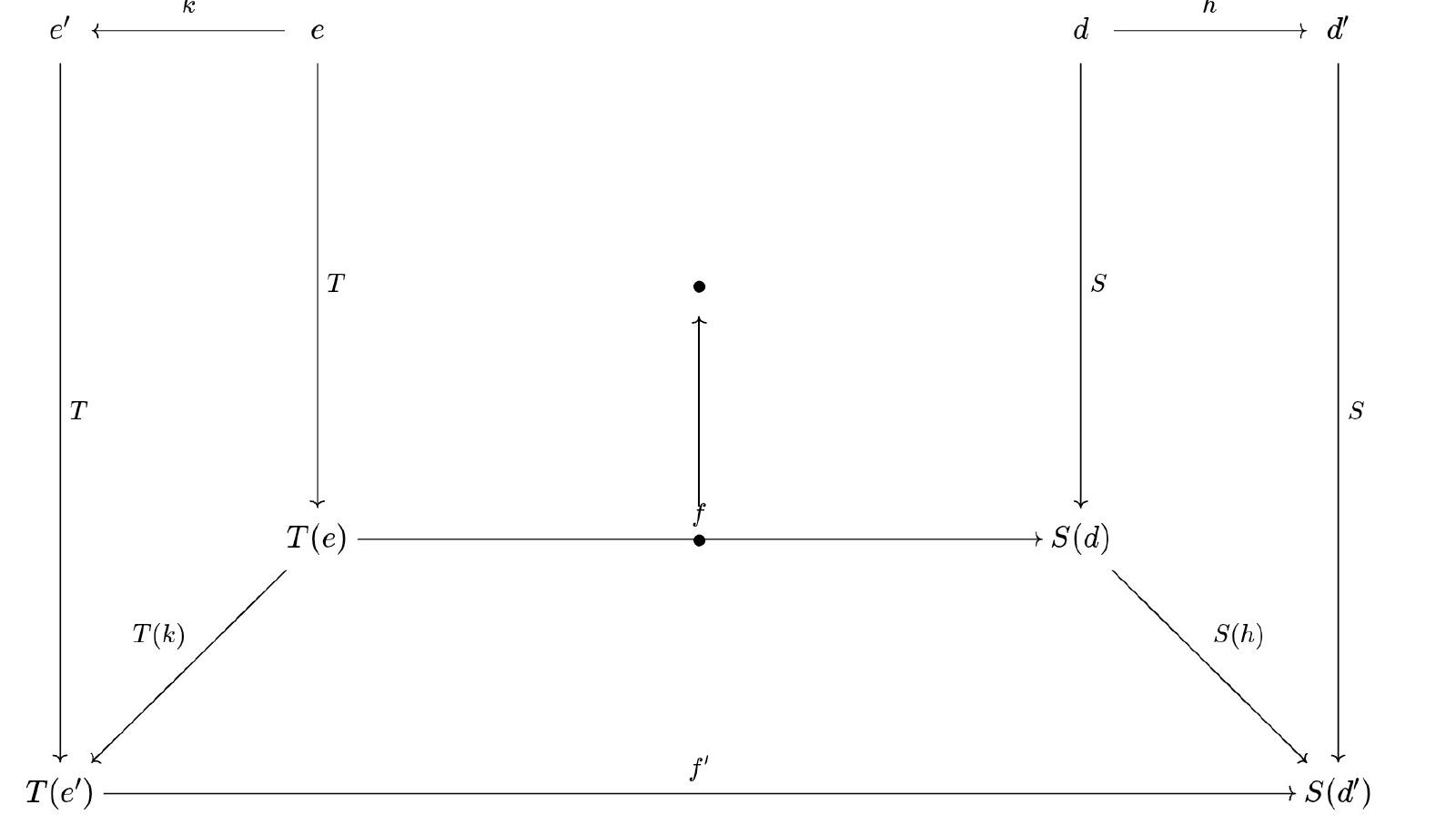
The comma category $ ( T \downarrow S ) $ has as its objects all triples $ \angle e , d , f \rangle$ with $ e \in E $, $ d \in D $, and $ f : T(e) \to S(d) $. I.e., a pair of objects from each of E and D and a morphism in C which connects S(e) and T(d) in that order.
Its arrows are pairs of morphisms, one from each of E and D (recall these must translate an element $ \langle e , d, f \rangle$ to another $ \langle e' , d' , f' \rangle$). In such a pair $ \langle k , h \rangle $, the first morphism is an arrow $ k : e \to e' $ and the second an arrow $ h : d \to d' $ such that:
" $ f' \circ T(k) = S(h) \circ f $ "
-----
The object data tells us, "These are two elements from the categories E and D (in that order) and this is a directed edge taking the image of the first to the image of the second (under the functors on their respective categories." T(E) and S(D) provide distorted embeddings of the categories E and D in the graph of C. The directed edge f gives us a way to jump from a vertex of the embedding of E to that of D.
The arrow data tells us, "These are two edges joining e to e' and d to d' in each of E and D (respectively). They have corresponding embeddings $T(k),S(h)$ in C determined by the functors T and S, since all such edges must. Now, If I can walk from e to e' in E along k, I therefore know that I can walk from T(e) to S(e') along T(k) in C. The map f' allows me to walk to T(d'). However, I can likewise first walk from T(e) to S(d) and then get to the same destination via S(h)."
The goal is to build a category out of arrows describing relationships between different domains of the category. The objects connect the images of the two functors (domains of C), and the category encodes the relationship between the relations.
11
$ ( b \downarrow C ) $
An instance of a comma category. The category of all objects "under b in C."
Objects are pairs $ \langle f , c \rangle $ where c is an object in the category C and f is a morphism $ f : b \to c $.
If we have two such pairs $ \langle f , c \rangle $ and $ \langle f' , c' \rangle $, morphisms are determined by arrows $ h : c \to c'$ in C.
Specifically, we define $ h : \langle f , c \rangle \to \langle f' , c' \rangle $ with $ ( h \circ f ) = f' $.
An object is an arrow C from b and an arrow is a triangle (cummutative) with apex b.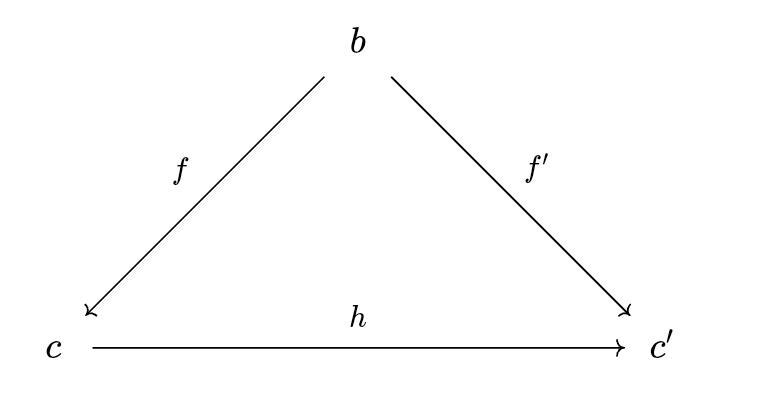
Objects are pairs $ \langle f , c \rangle $ where c is an object in the category C and f is a morphism $ f : b \to c $.
If we have two such pairs $ \langle f , c \rangle $ and $ \langle f' , c' \rangle $, morphisms are determined by arrows $ h : c \to c'$ in C.
Specifically, we define $ h : \langle f , c \rangle \to \langle f' , c' \rangle $ with $ ( h \circ f ) = f' $.
An object is an arrow C from b and an arrow is a triangle (cummutative) with apex b.
12
$ ( b \downarrow S ) $
If $ b \in C $ and $ S : D \to C $, is a functor, this category has as its object set all pairs $ \langle f , d \rangle $ for some $ d \in D $ and $ f : b \to Sd $.
Arrows $ h : \langle f , d \rangle \to \langle f' , d' \rangle $ are $ h : d \to d' $ such that $ f' = S \{ h \} \circ f $.
I.e., a category of the kind $ ( b \downarrow C ) $ restricted to the distorted embedding of a category D inside a category C as determined by a functor S.
Arrows $ h : \langle f , d \rangle \to \langle f' , d' \rangle $ are $ h : d \to d' $ such that $ f' = S \{ h \} \circ f $.
I.e., a category of the kind $ ( b \downarrow C ) $ restricted to the distorted embedding of a category D inside a category C as determined by a functor S.
13
Universal Arrows
Equivalently...
Equivalently...
Suppose $ S : D \to C $ is a functor and $ c \in C $. A universal arrow from c to S is a pair $ \langle r , u \rangle $ consisting of an object $ r \in D $ and an arrow $ u : c \to S \{ r \}$ in C satisfying the following:
For every pair $\langle d \in D , f: c \to S \{ d \} \rangle$, there exists a UNIQUE $ f : r \to d $ in D with $ S \{ f' \} \circ u = f$.
I.e., every arrow f of S factors uniquely through the universal arrow.
Equivalently, $ u : c \to S(r) $ is universal from c to S when $ \langle r , u ,\rangle $ is an initial object in the comma category $ ( c \downarrow S ) $ which has as its objects the arrows $ c \to S(d) $.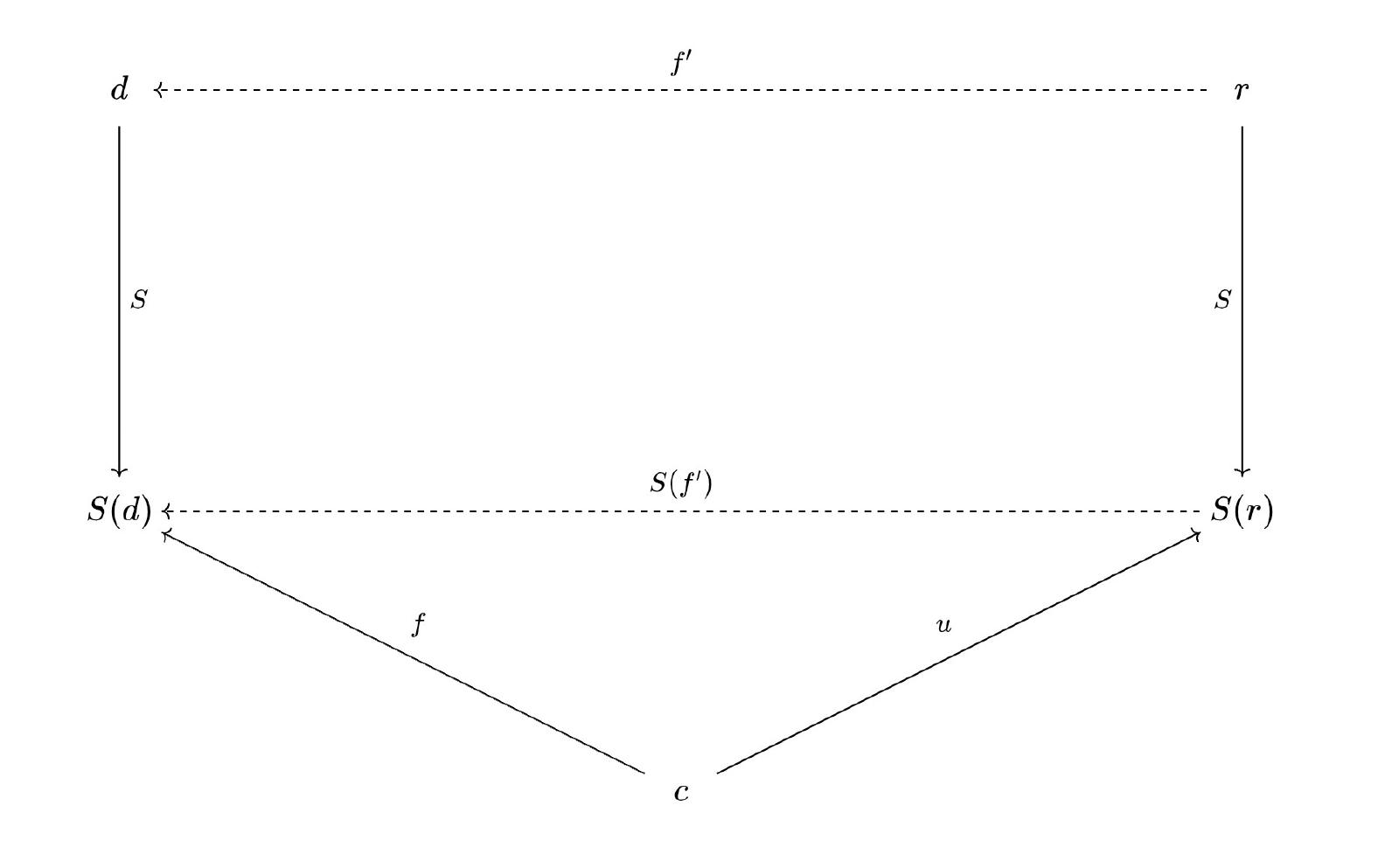
For every pair $\langle d \in D , f: c \to S \{ d \} \rangle$, there exists a UNIQUE $ f : r \to d $ in D with $ S \{ f' \} \circ u = f$.
I.e., every arrow f of S factors uniquely through the universal arrow.
Equivalently, $ u : c \to S(r) $ is universal from c to S when $ \langle r , u ,\rangle $ is an initial object in the comma category $ ( c \downarrow S ) $ which has as its objects the arrows $ c \to S(d) $.