midterm 3
Study these flashcardsFree · spaced repetition · iPhone, Android, Mac & web
All cards
1
red mark
affected area
2
blue mark
existing restoration
3
red mark with blue outline
defective restoration
4
Red dot at apex
abscess
5
jagged line (like fracture)
fractured tooth
6
outlined tooth and cross hatch
3/4 gold crown
7
X mark
missing tooth
8
Circle with arrow in a directions
impaction
9
two lines
to be extracted
10
single line through long axis
endodontic treatment
11
LeFort I
fracture occurs tranversely through the maxilla above the teeth, to the nose hole. Most common
12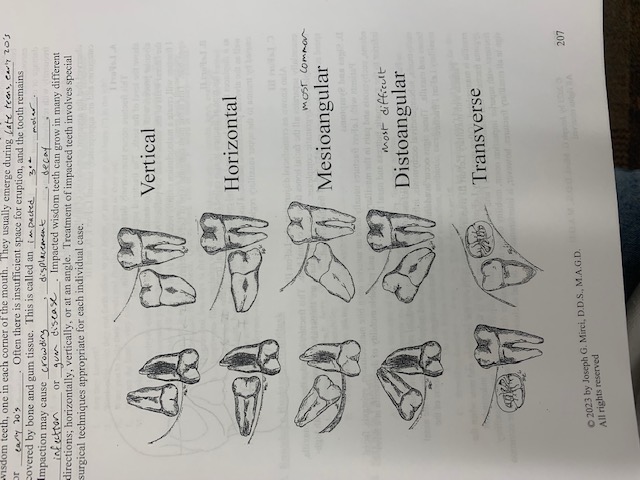
Image occlusion: name the hidden labels
13
LeFort II
Above nasal cavity. "pyramidal" fracture, NOT zygomatic fracture
14
LeFort III
Craniofacial disjunction, through the eye sockets.
15
Dental office stresses
Finance
Staff
Running a business
Service
Staff
Running a business
Service
16
Distoangular wisdom tooth is the hardest to remove, T/F
True
17
PPO means that the dentist receives a reduced fee for contracting with the insurance company to treat their patients
True
18
Dentist's prepay taxesCrania
True
19
Transverse impacted wisdom tooth the occlusal is adjacent to be distal contact of 2n molar
False
20
A ___ Molar has insufficient space for eruptpion and the tooth remains covered by bone and gum tissue
Impacted
21
Cranial Nerves
On
Occasion
Our
Trusty
Truck
Acts
Funny
Very
Good
Vehicle
Any
How
olfactory, optic, oculomotor, trochlear, trigeminal, abducens, facial, vestibulocochlear, glossopharyngeal
vagus, Accessory, Hypoglossal
Occasion
Our
Trusty
Truck
Acts
Funny
Very
Good
Vehicle
Any
How
olfactory, optic, oculomotor, trochlear, trigeminal, abducens, facial, vestibulocochlear, glossopharyngeal
vagus, Accessory, Hypoglossal
22
Trigeminal nerve (V) divisionsround raised
3, Ophthalmic, Maxillary, and mandibular
23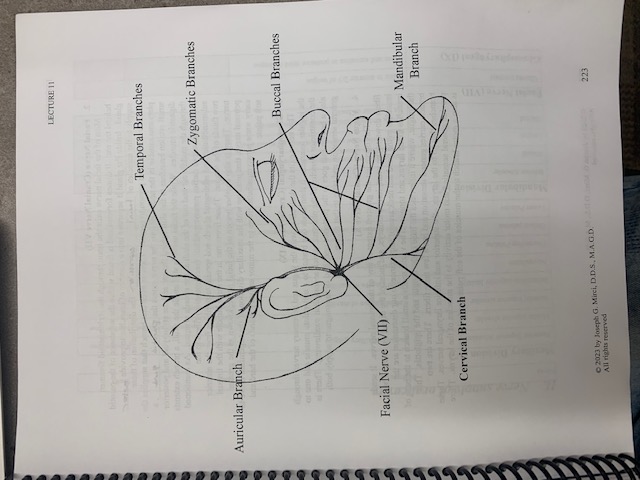
Image occlusion: name the hidden labels
24
Image occlusion: name the hidden labels
25
Image occlusion: name the hidden labels
26
Image occlusion: name the hidden labels
27
Image occlusion: name the hidden labels
28
Image occlusion: name the hidden labels
29
Image occlusion: name the hidden labels
30
fungiform
round raised on tongue.
31
vallate
13 V's in the back
32
filliform
tactile, in charge of filling the tongue
33
foliate
way back of the tongue
34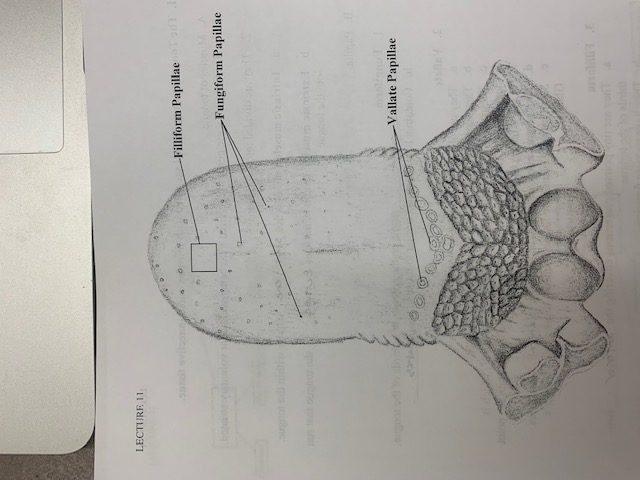
Image occlusion: name the hidden labels
35
Image occlusion: name the hidden labels
36
Image occlusion: name the hidden labels
37
4 muscles of masticationmental
Temporalis, masseter, medial and lateral pterygoid
38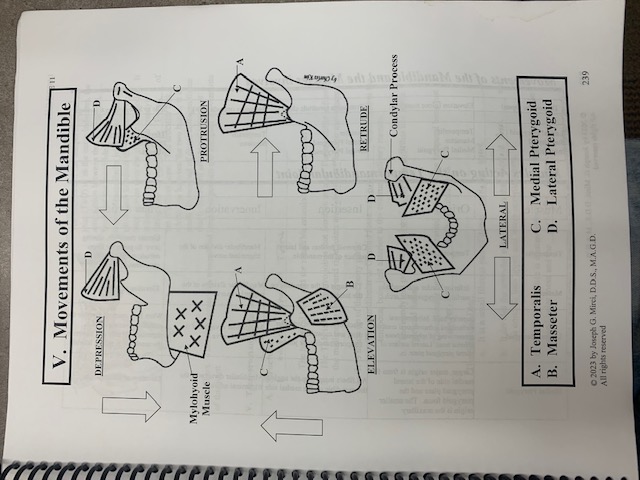
Image occlusion: name the hidden labels
39
Nerve supply to the mucosa of the lower lip
mental nerve
40
Which nerve has the greatest extent, in heart, kidneys, lungs, and digestive tract?
Vagus
41
Lesser and greater palatine nerves supply
soft and hard palate
42
which of the following muscles position the condyles in the most superior anterior position?
Masseters and medial pterygoids
43
Contraction of the posterior fibers of the temporalis muscle results in
retruding the mandible
44
Facial expression nerve
VII
45
Temporalis is a
elevator and retrudor
46
the TMJ ligament prevents the condyle from moving
inferiorally
47
2 movements of the mandible
Rotation and sliding
48
small motor branch of the inferior alveolar nerve?
Mylohyoid nerve
49
muscles of mastication are innervated by the___ cranial nerve
V
50
Dislocation of the TMJ is called
subluxation
51
macrodontia
teeth are too large for their arch
52
microdontia
teeth are too small for their arch
53
Taurodontism
hereditary disturbance of large pulp chambers
54
Turner's Teeth
hypocalcification from bacteria
55
Dens in Dente
tooth in a tooth
56
Peg laterals
Maxillary lateral incisor never takes shape
57
Mulberry molars
irregularly shaped molars (syphalis)
58
Hutchinson's incisors
notched incisors (syphalis)
59
Fused teeth
Gemination-split tooth germ
Fusion-joined at dentin
Concrescense- joined at cementum
Fusion-joined at dentin
Concrescense- joined at cementum
60
Root anomalies
Dilacerated-sharp bend or curve in root
extra roots
dwarf roots
extra roots
dwarf roots
61
Crown anomalies
Extra cusps
Lack of cusps
Lack of cusps
62
Supernumeraries/hyperdontia
extra teeth
extra teeth resulting in abnormalities
- Mesiodens (tooth in maxilla)
- Pardons (extra molar, distomolar or paramolar)
extra teeth resulting in abnormalities
- Mesiodens (tooth in maxilla)
- Pardons (extra molar, distomolar or paramolar)
63
Anodontia
too few teeth
64
Amelogenesis Imperfecta
hereditary hypocalcificaiton, chips easily
65
Enamel tufts vs spindles
tufts are small hypocalcified enamel at DEJ
Spindles are trapped odontoblasts
Spindles are trapped odontoblasts
66
Dentinogenesis Imperfecta
Gray, brown, yellow teeth due to transparent enamel, leaving dentin visible
67
interglobular dentin
dead tracts in poorly calcified areas
68
cementoma
hypercementomis with bone destruction
69
odontoma
tumerous growth of calcified tissue, can be complex or compound, big mass or small teeth
70
Tetraycycline staining
used during crown formation, yellow, brown, gray teeth
71
Erythroblastosis fetalis
discoloration due to childhood jaundice
72
Enamel Fluorosis
enamel hypocalcification due to excessive flouride
73
saliva composition
99.5% H2O .5% solute
74
most common supernumeraries
paramolars
75
Saliva pH and quantity
6.35-6.85
1-3 quarts
1-3 quarts
76
Parotid Glands
25% saliva
inferior and anterior to the ears
stenson ducts
carotid artery
inferior and anterior to the ears
stenson ducts
carotid artery
77
Submandibular Glands
50-60% of saliva
serious and mucous
inferior to tonguin submandibular fossa and wrapped around mylohyoid
Wharton's ducts
serious and mucous
inferior to tonguin submandibular fossa and wrapped around mylohyoid
Wharton's ducts
78
Sublingual
10% mouth saliva
superior to submandibular glands
Bartholin's ducts (only with more than 2)
lingual artery
mucous
superior to submandibular glands
Bartholin's ducts (only with more than 2)
lingual artery
mucous
79
palatine glands
in soft and hard palate
80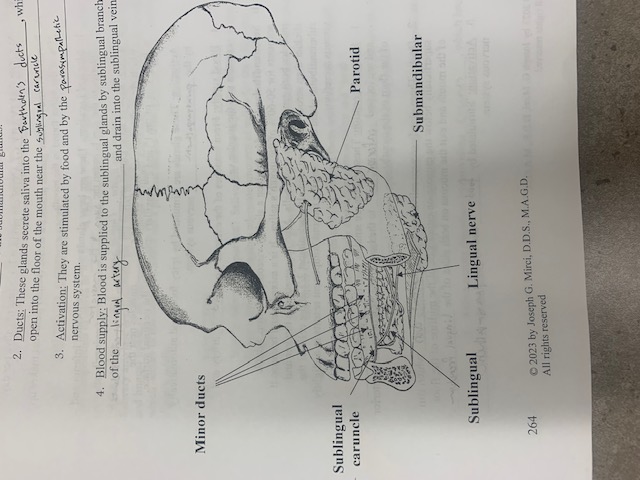
Image occlusion: name the hidden labels
81
Image occlusion: name the hidden labels
82
Image occlusion: name the hidden labels
83
lingual glands
Anterior (m)
Von Ebner (s)
Posterior (s)
Sublingual (m)
Von Ebner (s)
Posterior (s)
Sublingual (m)
84
Stenson's ducts
Wharton's ducts
Bartholin's ducts
Wharton's ducts
Bartholin's ducts
parotid
submandibular
sublingual
submandibular
sublingual