Normal Distribution
Study these flashcardsFree · spaced repetition · iPhone, Android, Mac & web
All cards
1
Purpose of inferential statistics
Uses statistics to estimate values of corresponding parameters
Allows to draw conclusions about population from the sample
Allows to draw conclusions about population from the sample
2
What is considered a small sample?
n < 30
3
What inferential statistics should be used for small samples?
t tests
4
What do parametric statistics assume?
That data has come from probability distribution
5
Purpose of parametric statistics
Makes inferences about parameters of distribution of the population from sample
6
Which 2 parameters is the normal distribution defined by?
Location (mean)
Scale (variance = standard deviation squared)
Scale (variance = standard deviation squared)
7
What does the normal distribution equate to?
A probability density function (area under the curve)
8
Describe the standard normal distribution
Bell shaped
Perfectly symmetrical
Mean = 0
Standard deviation = 1
Represents a normal against which samples are compared
Mathematical abstraction - assumes infinitely large sample size (ie. population)
Perfectly symmetrical
Mean = 0
Standard deviation = 1
Represents a normal against which samples are compared
Mathematical abstraction - assumes infinitely large sample size (ie. population)
9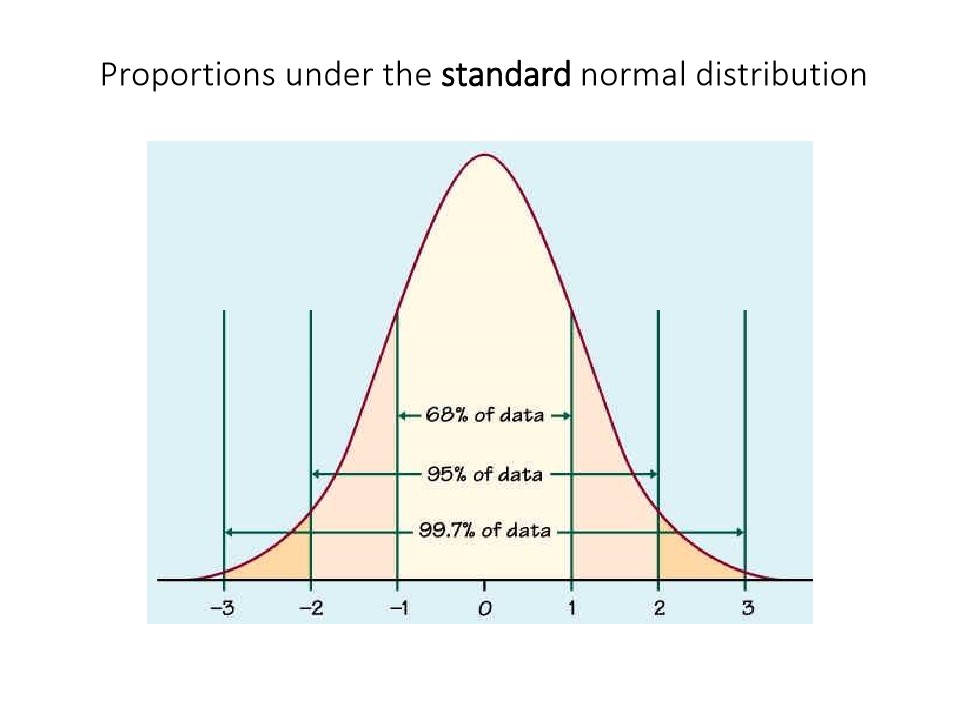
Image occlusion: name the hidden labels
10
What assumption is made about the sample?
That it is representative of the population
11
Define sampling variation
Variability between one sample and another
12
How is the distribution of sample means distributed?
Normally distributed
13
Outline central limit theorem
States that population with mean μ and a variance, the distribution of the sample means will have a mean equal to μ
Mean of the distribution of sample means will be equal to the population mean
States that in many situations, sample mean varies normally if sample size is reasonably large
Mean of the distribution of sample means will be equal to the population mean
States that in many situations, sample mean varies normally if sample size is reasonably large
14
How can a more accurate estimation of the population mean be obtained?
Increase sample size
15
Difference between standard error and standard deviation
SE = measures dispersion for a distribution of a statistic (eg. distribution of sample means)
= tell us how representative the sample mean is of the population mean
SD = measures dispersion for a distribution of a variable (eg. distribution of values of variable X)
= tell us how representative the sample mean is of the population mean
SD = measures dispersion for a distribution of a variable (eg. distribution of values of variable X)
16
The standard error will always be ___________ the standard deviation of a sample
- smaller than
- the same as
- larger than
17
The more values in a sample the _______ the standard error
- smaller
- larger
18
The ________ the standard error, the more confident we can be that the sample mean is close to the population mean
- smaller
- larger
19
For sample sizes >30 (large samples), the sample __________ is a good estimate of the population ____________
- standard error
- standard deviation
20
What might you do if there is evidence of a substantial skew in the data?
Transform data to form more normal distribution
21
In asymmetrical distributions, what will always be the peak?
Mode
22
In asymmetrical distributions, what measure of central tendency will be shifted towards the direction of the tail?
Mean
23
In asymmetrical distributions, where does the median lie?
Somewhere between the mode and median
24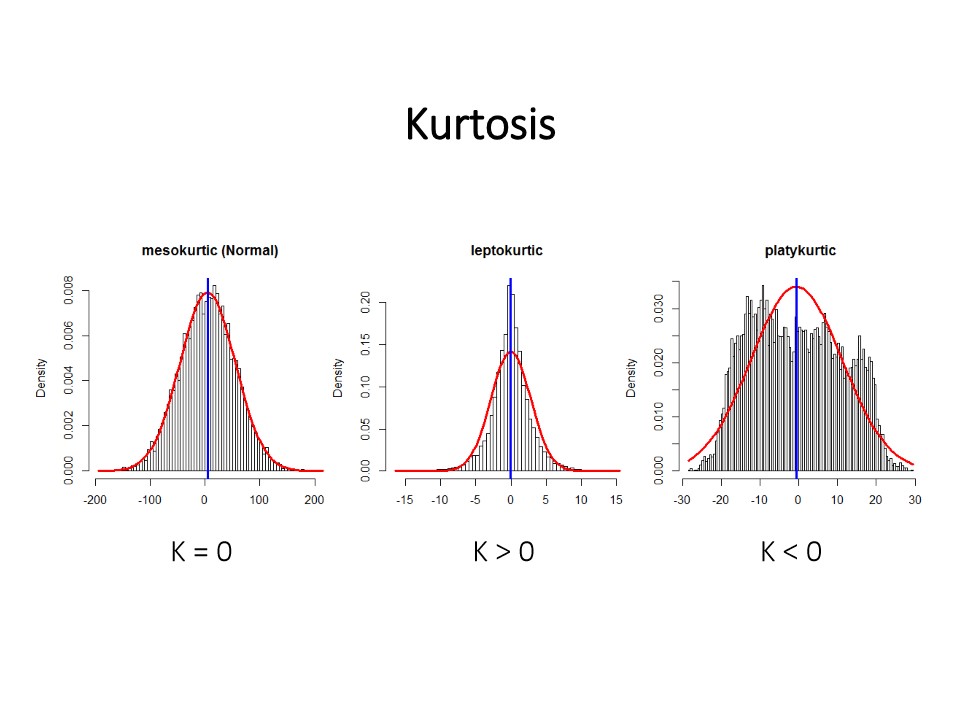
Image occlusion: name the hidden labels
25
What does a logaristmic transformation do to the data?
Compresses high scores
Expands low scores
Used to indicate that a very large difference in high scores needed before it is considered important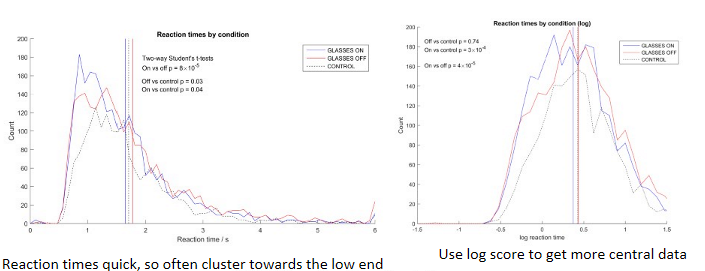
Expands low scores
Used to indicate that a very large difference in high scores needed before it is considered important
26
When are arcsine transformations used?
Used for proportions and percentage scores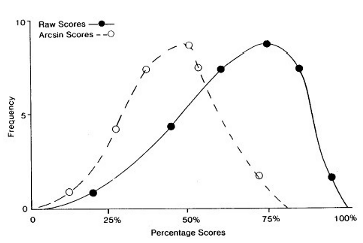
27
What do arcsine transformations do to the data?
Data tends to cluster at high end of range as opposed to 50%
Shifts all scores downwards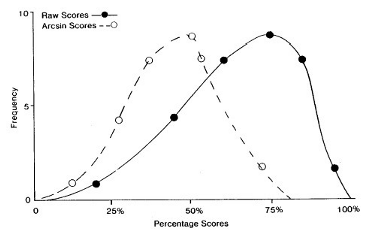
Shifts all scores downwards
28
Name the transformation that has the opposite effect to arcsine transformations
Square root transformation
Shifts lower scores upwards
Shifts lower scores upwards