Somatosensation + Pain - cutaneous receptors
Study these flashcardsFree · spaced repetition · iPhone, Android, Mac & web
All cards
1
Define accessory structures
Structural components of sense organs which may play an important role in:
- protection
- conduction
- concentration
- analysis
- sensitisation
- inhibition
BUT not directly involved in transduction processes
- protection
- conduction
- concentration
- analysis
- sensitisation
- inhibition
BUT not directly involved in transduction processes
2
The lamellae of the Pacinian corpuscle is an accessory structure
- True
- False
3
Define proprioception
Sense of limb positions
4
Define kinesthesis
Sense of limb movement
5
What senses do somatic sensory systems include?
Touch
Temperature
Pain
Body position
Temperature
Pain
Body position
6
Where are mechanoreceptors found?
Epidermis and dermis
7
State the 3 types of cutaneous receptors
Mechanoreceptors
Thermoreceptors
Nociceptores
Thermoreceptors
Nociceptores
8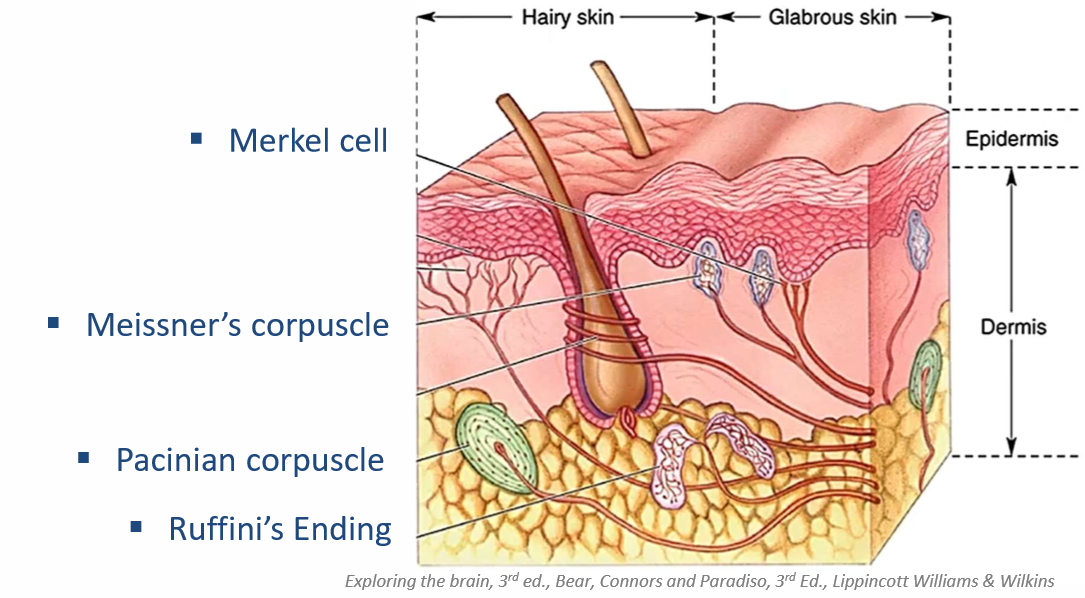
Image occlusion: name the hidden labels
9
What do mechanoreceptors respond to?
Mechanical stimulation
Produce depolarising receptor potential
Type of stimulation they respond to best depends on the accessory structures
Produce depolarising receptor potential
Type of stimulation they respond to best depends on the accessory structures
10
Define receptive field
Specific topographic location of sensory info assigned to a sensory neuron
Each receptor responds only to stimulation within its receptive field
Density of receptors in given part of body determines how well sensory system can resolve the detail of stimulation in that area
Each receptor responds only to stimulation within its receptive field
Density of receptors in given part of body determines how well sensory system can resolve the detail of stimulation in that area
11
How are receptive fields mapped?
Using a fine stimulus probe
Recordings are made from single sensory axons
Recordings are made from single sensory axons
12
State the 4 principle mechanoreceptive afferent systems
Slowly adapting type 1 afferents (SAI)
Rapidly adapting afferents (RAI)
Rapidly adapting Pacinian corpuscles (PC)
Slowly adapting type 2 afferents (SAII)
Rapidly adapting afferents (RAI)
Rapidly adapting Pacinian corpuscles (PC)
Slowly adapting type 2 afferents (SAII)
13
Descibe SAI
End in Merkel cells
Give tonic response to steady stimulus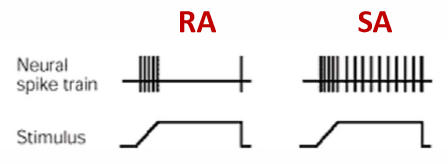
Give tonic response to steady stimulus
14
Describe RAI
End in Meissner's corpuscles
Respond to onset of stimulus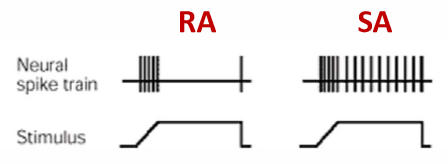
Respond to onset of stimulus
15
Describe SAII
End in Ruffini endings
Give tonic response to steady stimulus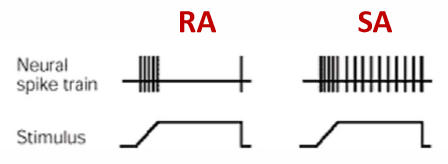
Give tonic response to steady stimulus
16
What do the 4 principle mechanoreceptive afferent systems innervate?
Glabrous (hairless) skin of hand
17
Define phase locking in terms of somatosensation
Receptor treats each period of the waveform as a new stimulus
18
What do rapidly adapting mechanoreceptors respond to?
Onset of stimulus
Sinusoidal mechanical stimuli with single AP for each cycle
Sinusoidal mechanical stimuli with single AP for each cycle
19
What is the intensity of the sinusoidal stimulus encoded by?
Number of sensory fibres that are active
NOT the frequency of firing
NOT the frequency of firing
20
Number of active fibres linearly related to...
Amplitude of vibration
21
Factfile: Type 1 - surface receptors
Small receptive field
Several hotspots
Branched innervation
Meissner's corpuscles
Merkel cells
Several hotspots
Branched innervation
Meissner's corpuscles
Merkel cells
22
Factfile: Type 2 - deep receptors
Large receptive field
Single hotspot
1:1 innervation
Pacianc corpuscle
Ruffini endings
Single hotspot
1:1 innervation
Pacianc corpuscle
Ruffini endings
23
Factfile: Pacinian corpuscle
Rapidly adapting
Deep receptor
Fire at onset and offset of stimulus
Best responds to 300Hz vibration
Help to perceive events through an object held in the hand
Deep receptor
Fire at onset and offset of stimulus
Best responds to 300Hz vibration
Help to perceive events through an object held in the hand
24
Structure: PC
20-70 concentric layers of cellular membrane (lamellae) alternating with fluid-filled spaces, with a terminal in the middle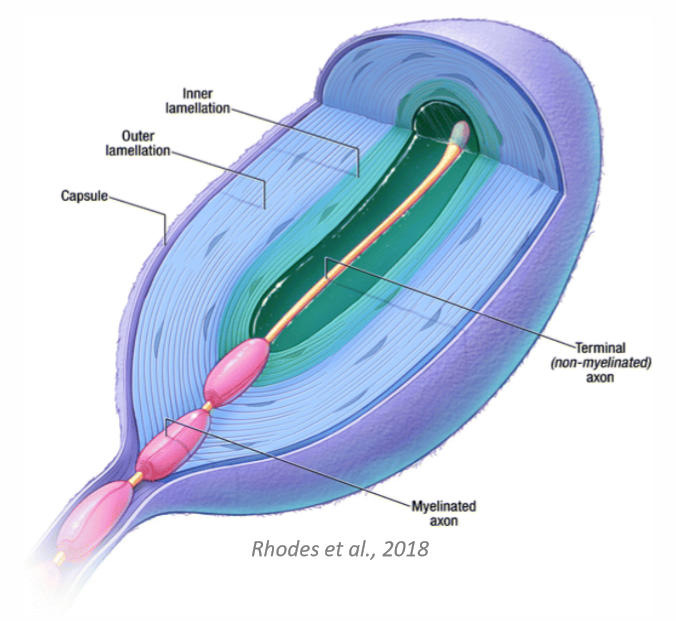
25
Where is it found: PC
Distributed widely: connective tissue in muscles, periosteum of bones and mesentery of abdomen
~350 in finger and ~800 in palm
~350 in finger and ~800 in palm
26
Receptive field: PC
RFs have central zone of maximal sensitivty surrounded by large continuous surface on fingers/palm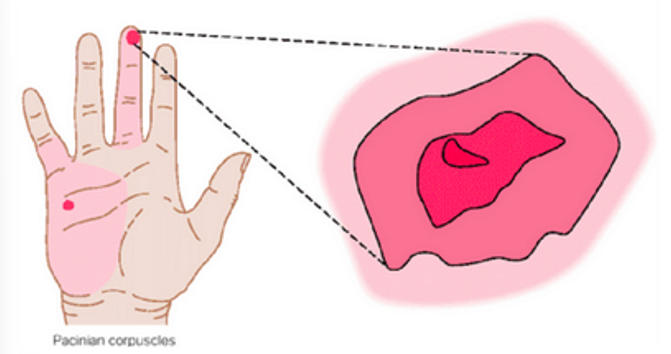
27
Describe the function of the lamellae
Respond to onset and offset of a step pulse
Receptor potential usually increases then decays (adapts) rapidly (in response to onset and offset)
De-sheathed nerve endings (no lamellae) = more prolongued responses (slowly adapting)
Receptor potential usually increases then decays (adapts) rapidly (in response to onset and offset)
De-sheathed nerve endings (no lamellae) = more prolongued responses (slowly adapting)
28
Factfile: Meissner's corpuscle
Rapidly adapting
Surface receptor
Branched innervation - up to 20 converge to form a single afferent
Density ~150/cm2
Most sensitive to low frequency vibrations (10-50 Hz)
Can respond to skin indenetations of <10micrometers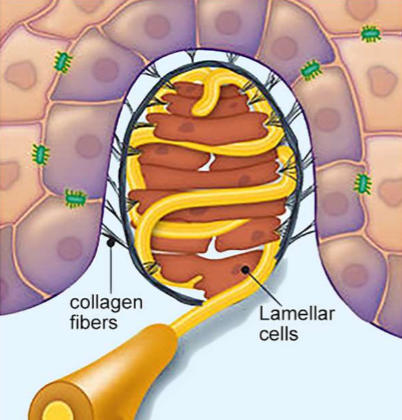
Surface receptor
Branched innervation - up to 20 converge to form a single afferent
Density ~150/cm2
Most sensitive to low frequency vibrations (10-50 Hz)
Can respond to skin indenetations of <10micrometers
29
Receptive field: Meissner's corpuscle
Small RFs with several hotspots
Fingertips: 2-3mm in diameter
Palm: 10mm in diameter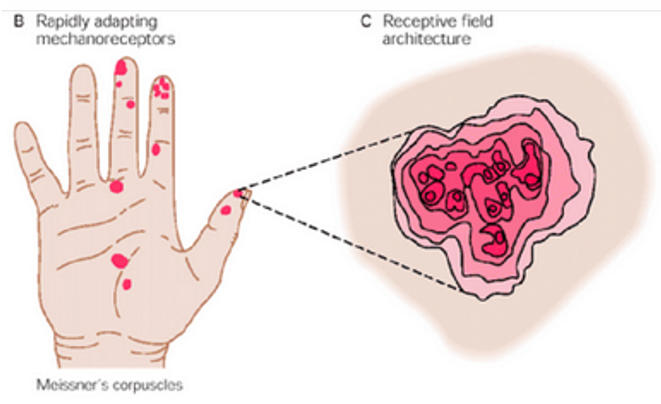
Fingertips: 2-3mm in diameter
Palm: 10mm in diameter
30
Define sensory threshold
Minimum intensity of stimulation required to generate AP in nerve
Eg. increase skin indentation until AP is generated to find threshold
Eg. increase skin indentation until AP is generated to find threshold
31
Rapidly adapting receptors have...
- higher touch thresholds than slowly adapting receptors
- lower touch thresholds than slowly adapting receptors
32
2 ways in which human vibration sensitivity can be altered
Change responsiveness of:
RAI
RAII
RAI
RAII
33
What does this graph show?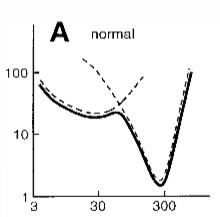
Solid line = threshold of human vibration sensitivity
Higher dashed line = sensitivity function of Meissner's corpuscles (RAI)
Dashed line with large dip = sensitivity function of Pacinian corpuscle (RAII)
Higher dashed line = sensitivity function of Meissner's corpuscles (RAI)
Dashed line with large dip = sensitivity function of Pacinian corpuscle (RAII)
34
Describe what happens when local anaesthetic is applied to the superficial layers of the skin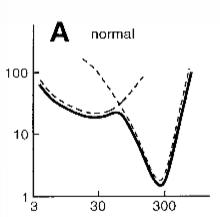
Reduces effectiveness of Meissner's corpuscles because they lie close to the surface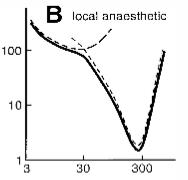
35
Describe what happens if the receptors are preadapted to a stimulation of 250 Hz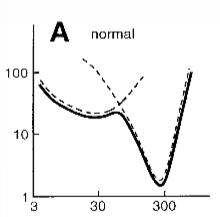
Reduces effectiveness of PC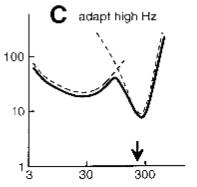
36
Describe what happens if the receptors are preadapted to a low frequency stimulus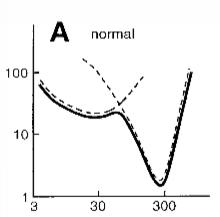
Reduces effectiveness of Meissner's corpuscles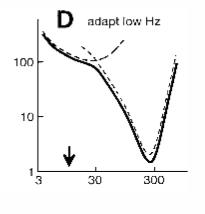
37
Factfile: Merkel cells
Slowly adapting
Superficial receptor
Single afferent nerve fibre branches to innervate up to 90 endings
Provide sharpest resolution of spatial pattern
Sensitive to points, edges, curvature
Can resolve spatial detail of 0.5mm
10 times more sensitive to dynamic stimuli
Spike discharge largely invariant (very good at discrimination)
Superficial receptor
Single afferent nerve fibre branches to innervate up to 90 endings
Provide sharpest resolution of spatial pattern
Sensitive to points, edges, curvature
Can resolve spatial detail of 0.5mm
10 times more sensitive to dynamic stimuli
Spike discharge largely invariant (very good at discrimination)
38
Structure: Merkel cells
Oval-shaped mechanoreceptors
Associated with SAI somatosensory nerve fibres
Not covered (shelled) so respond to pressures over long periods
Associated with SAI somatosensory nerve fibres
Not covered (shelled) so respond to pressures over long periods
39
Where it is found: Merkel cells
Densely present in fingertips
40
Receptive field: Merkel cells
Small, highly localised RFs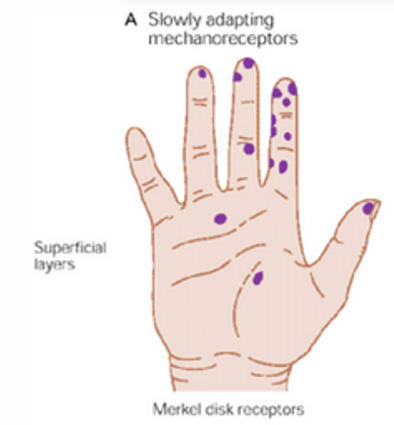
41
Describe the channel found on Merkel cells
Mechanosensitive channel called Piezo2
Pressure opens channel and depolarises cell
NET released by cell excites nerve terminal
Pressure opens channel and depolarises cell
NET released by cell excites nerve terminal
42
Other than Piezo2, what other structure is described as mechanosensitive?
SAI nerve terminal
43
Difference between SAI nerve terimnals and Merkel cells
SAI nerve terminals responsible for rapid and dynamic response to mechanical stimuli
Merkel cells responsible for sustained response
Merkel cells responsible for sustained response
44
What happens when Piezo2 is knocked out?
Merkel cells usually respond to touch with inward current (in mice)
This is abolished when Piezo2 is knocked out - no sustained response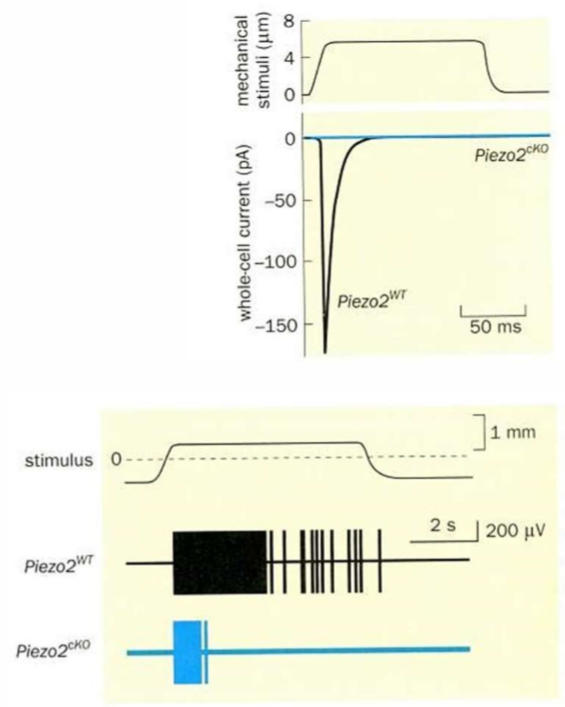
This is abolished when Piezo2 is knocked out - no sustained response
45
What can the SAI afferent firing rate encode?
Perceived stimulus magnitude
46
Where is Piezo2 expressed?
Dorsal root ganglion
Abeta, Adelta and C-fibre low threshold mechanoreceptors
Abeta, Adelta and C-fibre low threshold mechanoreceptors
47
Factfile: Ruffini endings
Slowly adapting
Deep receptor
Respond to most skin stretching in fingers
Important for generating awareness of finger and hand position
Involved in perception of object motion and shape of grasped objects
Deep receptor
Respond to most skin stretching in fingers
Important for generating awareness of finger and hand position
Involved in perception of object motion and shape of grasped objects
48
Receptive field: Ruffini endings
Large field with central zone of maximal sensitivity
Depending on location, excited by stretch of skin in specific directions (arrows)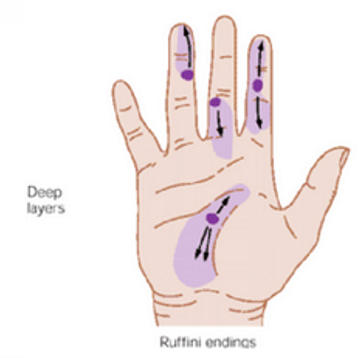
Depending on location, excited by stretch of skin in specific directions (arrows)
49
Distribution of RA and SAI
Most numerous receptors
Distributed preferentially on distal half of fingertips
Distributed preferentially on distal half of fingertips
50
Distribution of PC and SAII
Less common
Distributed more uniformly on hand
Little differentiation on distal and proximal regions
Distributed more uniformly on hand
Little differentiation on distal and proximal regions
51
Which area of the body is most densely innervated by mechanoreceptive nerve fibres?
Fingertips
52
Density of mechanoreceptive fibres in proximal phalanges
120/cm2
53
Density of mechanoreceptive fibres in palm
50/cm2
54
Define two-point limen
Smallest discriminable distance between 2 points of contact
55
Why does spatial resolution of stimuli on the skin vary throughout the body?
RF size and desnity of mechanoreceptors varies
56
Where is tactile acuity better
Hands and fingers > back
57
What test was used to examine the two-point limen?
Compass test devised by Weber
58
How are nerve responses to textures measured?
Hand immobilised
Receptive field of single receptor on finger stimulated by rotating drum with raised dots (braille patterns)
Dots cross medial, central and lateral portions of RF
Spaital event plots used to represent sequential APs discharged by individual receptors
Receptive field of single receptor on finger stimulated by rotating drum with raised dots (braille patterns)
Dots cross medial, central and lateral portions of RF
Spaital event plots used to represent sequential APs discharged by individual receptors
59
State which afferents are most accurate for reading braille from best to worst
Merkel cell
Meissner cell
Ruffini endings
Pascinian corpuscle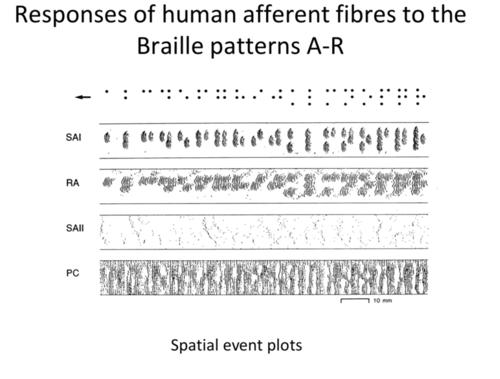
Meissner cell
Ruffini endings
Pascinian corpuscle
60
Why are Merkel cells and Merissner's corpuscles most accurate at reading braille?
Able to differentiate between dots and blank space when spacing of dots exceeds RF diameter
61
Why are PC the worst at reading braille?
RFs larger than the dot spacing
62
Areas with high tactile acuity are associated with...
- an increase in mobility of body parts and large RFs
- an increase in mobility of body parts and small RFs
- a decrease in mobility of body parts and large RFs
- a decrease in mobility of body parts and small RFs
63
Define free nerve ending
Unencapsulated
Do not end on/near specialised tissue
Do not end on/near specialised tissue
64
2 examples of free nerve endings
Thermoreceptors
Nociceptors
Nociceptors
65
Concentration of cold spots is far... than warmth spots
- lower
- higher
66
What is required to perceive the sensation of warmth?
Simultaneous activation of many receptors - spatial summation
67
Where are thermoreceptors found?
Dermis
Skeletal muscles
Liver
Hypothalamus
Skeletal muscles
Liver
Hypothalamus
68
State the 2 types of thermoreceptors needed to know
Trpv1
Trpm8
Trpm8
69
Describe Trpv1 thermoreceptors
Ca2+ and Na+
Channel activated by hot temp (>43C) and capsaicin
In all mammals but not birds
Channel activated by hot temp (>43C) and capsaicin
In all mammals but not birds
70
Describe Trpm8 thermoreceptors
Respond to menthol and cold temp (<28C)
71
What fibres are 'warm' receptors connected to?
Sub-population of C-fibres
72
What fibres are 'cold' receptors connected to?
Adelta and C-fibres
73
How many types of channels to thermoreceptive nerons express?
1
74
Outline paradoxical cold
Occurs because cold receptors also express Trpv1
Happens when heat (>45C) is applied to small regions of the skin to a single cold spot
Occurs because activity in cold fibre experienced as cold regardless of the physical nature of the stimulus - example of labelled line coding
Happens when heat (>45C) is applied to small regions of the skin to a single cold spot
Occurs because activity in cold fibre experienced as cold regardless of the physical nature of the stimulus - example of labelled line coding
75
Outline the firing properties of thermoreceptors
Modulate firing as a function of temp
At constant temp = tonic discharges
Cold and warm receptors fire continuously at low rates when skin is at normal temp of 34C
Firing rate does not increase/decrease monotonically if gradually warmed/cooled
Each thermal receptor class has peak firing at preferred skin temp
Code for skin temp involves comparing relative activity of different populations of thermal receptors and nociceptors
At constant temp = tonic discharges
Cold and warm receptors fire continuously at low rates when skin is at normal temp of 34C
Firing rate does not increase/decrease monotonically if gradually warmed/cooled
Each thermal receptor class has peak firing at preferred skin temp
Code for skin temp involves comparing relative activity of different populations of thermal receptors and nociceptors
76
State 3 types of nociceptors
Mechanical
Thermal
Polymodal
Thermal
Polymodal
77
State the 2 stages of pain
First, sharp pain
Second, dull, burning pain
Second, dull, burning pain
78
How can the second pain be abolished?
Block C-fibres
79
How can the first pain be abolished?
Block Adelta fibres
80
Factfile: mechanical nociceptors
Requires strong, painful tactile stimuli to respond (eg. pinch)
Excited by sharp objects that penetrate/squeeze/pinch skin
Mediate sensations of sharp/pricking pain
Firing rates increase with destructiveness of mechanical stimuli
Excited by sharp objects that penetrate/squeeze/pinch skin
Mediate sensations of sharp/pricking pain
Firing rates increase with destructiveness of mechanical stimuli
81
Factfile: thermal nociceptors
Excited by temp extremes and strong mechanical stimuli
One group excited by noxious heat, other by noxious cold
One group excited by noxious heat, other by noxious cold
82
Factfile: polymodal nociceptors
Respond to destructive mechanical, thermal and chemical stimuli
Activated by noxious mechanical stimuli (eg. pinch/puncture), noxious heat/cold and by irritant chemicals applied to skin
Stimulation results in slow, burning pain
Provide major sensory innervation of the tooth pulp
Activated by noxious mechanical stimuli (eg. pinch/puncture), noxious heat/cold and by irritant chemicals applied to skin
Stimulation results in slow, burning pain
Provide major sensory innervation of the tooth pulp
83
Which fibres respond to light touch, low-velocity stroking?
C-fibre tactile afferents
84
Where are C-fibre tactile afferents found?
Only in hairy skin
85
Describe research into the response of C-fibre tactile afferents to low-velocity touch
As stroke velocity incresaes, there is a non-linear relationship with AP firing
Similar non-linear relationship when pps asked to rate pleasantness as stroke velocity increases
Positive correlation between CT output and pleasantness of stimulation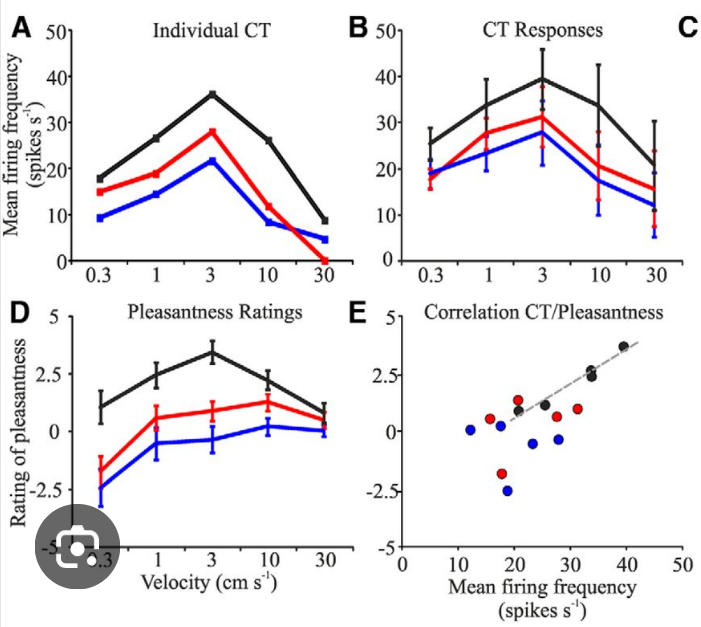
Similar non-linear relationship when pps asked to rate pleasantness as stroke velocity increases
Positive correlation between CT output and pleasantness of stimulation