Decision Making
Study these flashcardsFree · spaced repetition · iPhone, Android, Mac & web
All cards
1
Define prospects
Options to decide between
2
Define utility
Subjective value of a prospect
Amount of happiness/pleasure associated with it
Amount of happiness/pleasure associated with it
3
What does utilitarianism suggest about utility?
Optimal decisions maximise utility
4
Describe the utility function
Maps the relationship between an objective magnitude (usually money) of a prospect and its utility
5
Increases in utility ______ as monetary value increases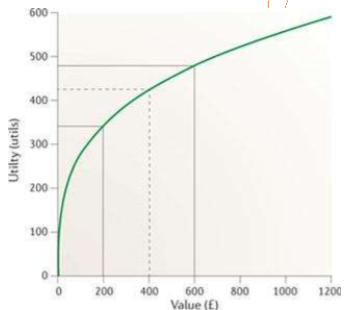
- diminish
- increase
6
What is the purpose of expected utility theory?
Allows us to compute the expected value of uncertain outcomes
7
What did Kringelbach find and when?
2005
Uncovered neural basis of expected utility
vmPFC (ventro-medial) receives info from the viscera (large organs in body) and all sensory modalities
OFC has reciprocal connections to amygdala and dorsolateral PFC (involved in executive functions)
vmPFC (especially OFC) may represent expected utility
Uncovered neural basis of expected utility
vmPFC (ventro-medial) receives info from the viscera (large organs in body) and all sensory modalities
OFC has reciprocal connections to amygdala and dorsolateral PFC (involved in executive functions)
vmPFC (especially OFC) may represent expected utility
8
What did de Araujo et al find and when?
2005
Pps smelt cheddar cheese
Labelled 'cheddar cheese' vs 'body odour'
Pps rated CC significantly more pleasant
vmPFC appears to represent subjective value of odours (more active with more pleasure)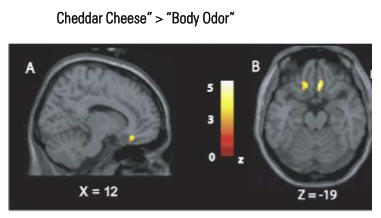
Pps smelt cheddar cheese
Labelled 'cheddar cheese' vs 'body odour'
Pps rated CC significantly more pleasant
vmPFC appears to represent subjective value of odours (more active with more pleasure)
9
What did Valentin et al find and when?
2007
Abstract symbols paired with orange juice or chocolate milk
Pps chose between symbols
Underwent sensory specific satiety manipulation (drank one drink to satiety)
vmPFC more strongly activated by symbol associated with still-valued drink compared to devalued drink
vmPFC activity time locked to moment of choice - responded to expected utility of prospect, rather than the prospect itself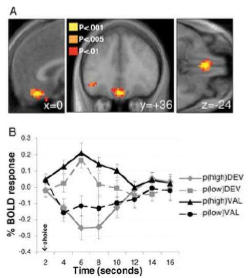
Abstract symbols paired with orange juice or chocolate milk
Pps chose between symbols
Underwent sensory specific satiety manipulation (drank one drink to satiety)
vmPFC more strongly activated by symbol associated with still-valued drink compared to devalued drink
vmPFC activity time locked to moment of choice - responded to expected utility of prospect, rather than the prospect itself
10
What did Tobler et al find and when?
2007
Measured BOLD signal
Brain appears to represent constructs associated with expected utility in the striatum
Measured BOLD signal
Brain appears to represent constructs associated with expected utility in the striatum
11
Describe the framing effect
The way a choice is described biases people's decisions
12
What did Tversky and Kahneman find and when?
1981
Pps more likely to gamble when the situation is framed as a loss
Eg. receive £50: keep £20 vs lose £30
Pps more likely to gamble when the situation is framed as a loss
Eg. receive £50: keep £20 vs lose £30
13
What did De Martino et al find and when?
2006
Original framing effect study by Tversky and Kahneman 1981
Replicated risk seeking under loss frame and risk avoidance under gain frame (framing effect)
Used fMRI
Activation in amygdala correlated with behavioural choice
Amygdala may code a correlate of expected utility
Original framing effect study by Tversky and Kahneman 1981
Replicated risk seeking under loss frame and risk avoidance under gain frame (framing effect)
Used fMRI
Activation in amygdala correlated with behavioural choice
Amygdala may code a correlate of expected utility
14
Criticism of De Martino et al's study
- Neuroimaging data is correlational not causational
15
What did Talmi et al find and when?
2010
Testesd twins with bilateral amygdala lesions
Showed intact framing effect
Suggests amygdala may not cause the framing effect
Testesd twins with bilateral amygdala lesions
Showed intact framing effect
Suggests amygdala may not cause the framing effect
16
Describe prospect theory
Losses loom larger than gains
Developed by Kahneman and Tversky 1979
Developed by Kahneman and Tversky 1979
17
Outline the lateralised readiness potential (LRP)
Recordings of electrical activity of motor cortex using EEG shows negative signal around 1s before voluntary movement
18
Outline the Simon Effect
Faster ipsilateral (same side of body) than contralateral responses to a lateralised stimulus
(eg. faster at choosing left button when stimulus is also on left)
(eg. faster at choosing left button when stimulus is also on left)
19
How are the Simon Effect and LRP related?
Simon effect expressed as an LRP in the cortical hemisphere opposite to stimulus location
Used as evidence for the lateralised stimulus activating the contralateral hemisphere/ipsilateral hand automatically (activation is stimulus-driven, unintentional and unavoidable)
Used as evidence for the lateralised stimulus activating the contralateral hemisphere/ipsilateral hand automatically (activation is stimulus-driven, unintentional and unavoidable)
20
Outline the difference between system 1 and system 2
System 1 = faster, habitual, automatic, unconscious
System 2 = slower, willed, controlled, conscious
System 2 = slower, willed, controlled, conscious
21
Outline an experiment that tests if one system has more control than the other
Method experiment 1:
Pps split into intuitive vs rational condition
Intuitive = "study of intuitive ability"
Asked to use intuition and personal sensitivity
Rational = "study of human rationality"
Asked to use rational thinking
Method experiment 2:
Pps read a problem
Pps asked questions from memory
Second memory task competed with judgement task for cognitive resources (memorise a number and rehearse while choosing one of 2 responses)
Choosing between the responses required evaluation of the problem
Cognitive load differed: rehearse 1 or 7 digit numbers
Results:
Experiment 1 = system 1 high in both condition, system 2 higher in rational > intuitive
Experiment 2 = system 1 high in both conditions, system 2 higher in low cognitive load > high cognitive load
Suggests intuitive and reflective decisions lead to different solutions to problems and decisions reflect independent contribution of both systems
System 1 always responds
System 2 responds more when evaluating something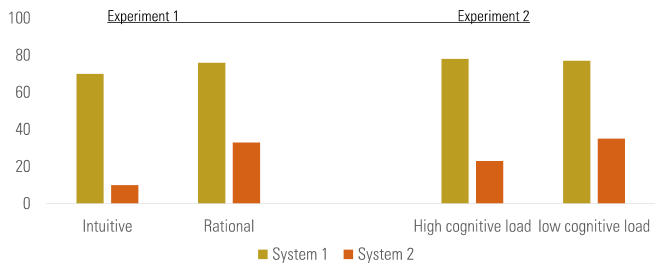
Pps split into intuitive vs rational condition
Intuitive = "study of intuitive ability"
Asked to use intuition and personal sensitivity
Rational = "study of human rationality"
Asked to use rational thinking
Method experiment 2:
Pps read a problem
Pps asked questions from memory
Second memory task competed with judgement task for cognitive resources (memorise a number and rehearse while choosing one of 2 responses)
Choosing between the responses required evaluation of the problem
Cognitive load differed: rehearse 1 or 7 digit numbers
Results:
Experiment 1 = system 1 high in both condition, system 2 higher in rational > intuitive
Experiment 2 = system 1 high in both conditions, system 2 higher in low cognitive load > high cognitive load
Suggests intuitive and reflective decisions lead to different solutions to problems and decisions reflect independent contribution of both systems
System 1 always responds
System 2 responds more when evaluating something
22
4 conclusions that can be made about the contribution of the dual system
Intuitive and reflective decisions can lead to different solutions to problems
Decisions often reflect independent contributions of both systems
System 1 associated with biases
System 2 associated with responses that are normatively correct
Decisions often reflect independent contributions of both systems
System 1 associated with biases
System 2 associated with responses that are normatively correct
23
Outline the experiment into touch typists
Experiment 1: cue indicated whether to type whole word, only LH letters ("LEFT") or only RH letters ("RIGHT")
Experiment 2: cue indicated whether to type whole word, only LH letters ("RED") or only RH letters ("GREEN")
DV = latency to type words
Results:
Latency to type increased with hand cues, but not with colour cues
Typing speed slowed down when paying attention to which hand to type with
Suggests disruption not a result of generic 'dual task' interference
Conclusions:
There are 2 systems
System 1 can directly use colour cues
System 2 has to monitor and inhibit the actions of system 1 to use the hand cue - slows typing
Suggests action of system 1 is encapsulated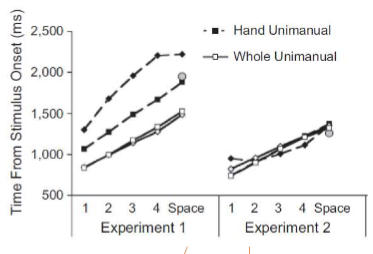
Experiment 2: cue indicated whether to type whole word, only LH letters ("RED") or only RH letters ("GREEN")
DV = latency to type words
Results:
Latency to type increased with hand cues, but not with colour cues
Typing speed slowed down when paying attention to which hand to type with
Suggests disruption not a result of generic 'dual task' interference
Conclusions:
There are 2 systems
System 1 can directly use colour cues
System 2 has to monitor and inhibit the actions of system 1 to use the hand cue - slows typing
Suggests action of system 1 is encapsulated
24
What do Kahneman and Frederick suggest about the dual system model?
System 2 monitors decions of system 1
System 2 either endorses or inhibits them
System 2 either endorses or inhibits them
25
What did Hommel argue and when?
2019
Dual system based on several misconceptions
Hommel argues that:
(1) Behaviour always a result of our goals and intentions rather than automatically activated by our environment. Stimuli can activate a goal but not make us do what we don't want to do
(2) People have multiple goals beyond those the experimenter wishes them to have. Experiments routinely neglect 'Chronic' goals such as the desire to respond efficiently (apparently, habitually or automatically)
(3) We can control our goals — when we imagine the outcome we wish we activate a process to achieve it
(4) We cannot control any processes — they are always automatic
Dual system based on several misconceptions
Hommel argues that:
(1) Behaviour always a result of our goals and intentions rather than automatically activated by our environment. Stimuli can activate a goal but not make us do what we don't want to do
(2) People have multiple goals beyond those the experimenter wishes them to have. Experiments routinely neglect 'Chronic' goals such as the desire to respond efficiently (apparently, habitually or automatically)
(3) We can control our goals — when we imagine the outcome we wish we activate a process to achieve it
(4) We cannot control any processes — they are always automatic
26
Define regret
Sense of sorrow/disappointment over something done or not done
27
4 things that regret involves
Recalling a past action
Conscious representation of actual and alternative outcome
Counterfactual thinking (comparison of the two)
Feeling of responsibility for the disappointing outcome
Conscious representation of actual and alternative outcome
Counterfactual thinking (comparison of the two)
Feeling of responsibility for the disappointing outcome
28
What type of decisions does regret typically apply to?
System 2
29
What is the dualist view?
Separates mind and brain
Suggests we can make decisions freely
Suggests we can make decisions freely
30
What did Searle suggest in 2008?
That dualism is obsolete
Advocates for 'biologically natural' view instead
Advocates for 'biologically natural' view instead
31
What is the biologically natural view?
Suggests mental phenomena are caused by neurophysiological processes in brain and they themselves are features of the brain
32
What did Gazzaniga find and when?
2005
Split brain experiment
Corpus callosum cut
Word presented to right visual field = correct verbal answer (left hemisphere dominant in visual processing)
Word presented to left visual field = incorrect verbal answer, but can draw it
Split brain experiment
Corpus callosum cut
Word presented to right visual field = correct verbal answer (left hemisphere dominant in visual processing)
Word presented to left visual field = incorrect verbal answer, but can draw it
33
What did Gazzaniga, Bogen and Sperry find and when?
1962
Split brain patient was able to use left hand to carry out automatic movements and that both hands worked well together when tasks were habitual
Split brain patient was able to use left hand to carry out automatic movements and that both hands worked well together when tasks were habitual
34
Define alien hand syndrome
Purposeful movement of hand that contradicts a stated goal (loss of ownership over limb)
Often seen in split-brain patients
Often seen in split-brain patients
35
What does alien hand syndrome challenge?
Challenges ideas of a non-physical basis for consciousness and free will, that are separate from the physical brain
Suggests conscious control of action is realised in the brain
Suggests conscious control of action is realised in the brain
36
What did Quiroga et al do and when?
2005
Intracranial electrodes inserted into 3 ppl with epilepsy
Looked at around 2000 pics of objects and ppl
Recorded activity of neurons in medial-temporal lobe
Found specific neurons responded to specific ppl
Intracranial electrodes inserted into 3 ppl with epilepsy
Looked at around 2000 pics of objects and ppl
Recorded activity of neurons in medial-temporal lobe
Found specific neurons responded to specific ppl
37
What are concept neurons?
Activated by a single familiar concept in an abstract, modality independent manner
38
What did Cerf et al do and when?
2010
12 pps
4 concept neurons for celebreties identified during screening
Neural representations of 4 corresponding images registered
Meaured spiking activity of concept neurons
Used to determine how close neural activity was to previously-identified neural representation of each image
Computer's decision determined what pps could see in the display
1. Pps viewed morphed image
2. Pps had to morph image into pure image (requires controlling neural activity fed into the computer algorithm)
12 pps
4 concept neurons for celebreties identified during screening
Neural representations of 4 corresponding images registered
Meaured spiking activity of concept neurons
Used to determine how close neural activity was to previously-identified neural representation of each image
Computer's decision determined what pps could see in the display
1. Pps viewed morphed image
2. Pps had to morph image into pure image (requires controlling neural activity fed into the computer algorithm)
39
What did Cerf et al find and when?
Pps were successful (often on first trial) at increasing firing rate of some neurons while, simultaneously decreasing the rate of others
Did this by focusing on one of the images within the morphed image (increased activity in the neuron associated with that celebrity and decreased the other)
Shows the mechanism whereby our thoughts and will control neural activity directly
Supports biological natural > dualist view
Did this by focusing on one of the images within the morphed image (increased activity in the neuron associated with that celebrity and decreased the other)
Shows the mechanism whereby our thoughts and will control neural activity directly
Supports biological natural > dualist view
40
Outline the problem with determinism
If all mental phenomena are realised in the brain, they must by goverend by the laws of physics (in physics, all phenomena are deterministic)
Leaves no place for free will
Leaves no place for free will
41
What does quantum mechanics show?
Shows we cannot predict with total certainty the outcome of even a simple experiment
Can only predict probability of a particular outcome
Can only predict probability of a particular outcome
42
How do quantum mechanics relate to brain function?
Currently not known whether or how quantum processes influence human brain function or behaviour
43
2 challenges in the study of free will
When pps are told to do something, whatever they do is not 100% voluntary
No direct measure of whether an action is free
No direct measure of whether an action is free
44
What did Libet et al do and when?
1983
Recoded EEG while pps made hand movement when they felt like doing so
Measured the LRP
Pps reported where a dot was on a clock face when they felt the urge to move their hand
Decision when to act is more free that the decision to act or how to act
Recoded EEG while pps made hand movement when they felt like doing so
Measured the LRP
Pps reported where a dot was on a clock face when they felt the urge to move their hand
Decision when to act is more free that the decision to act or how to act
45
What did Libet et al find and when?
Awareness of intention preceded actual finger movement by around 200ms
Readiness potential observed >500ms before action
300ms of neural activity between LRP and conscious awareness of intention to move
Libet concluded that intention could not be the cause of the movement
Readiness potential observed >500ms before action
300ms of neural activity between LRP and conscious awareness of intention to move
Libet concluded that intention could not be the cause of the movement
46
Criticism of Libet et al's experiment
Critics question the timing of the conscious intention, measured through subjective reports
47
What did Soon et al do and when?
2013
fMRI used to measure brain activity leading up to an abstract decision
Pps asked made 'spontaneous' choice to either add/substract pair of numbers
Pps reported their result and when they made the decision
fMRI used to measure brain activity leading up to an abstract decision
Pps asked made 'spontaneous' choice to either add/substract pair of numbers
Pps reported their result and when they made the decision
48
What did Soon et al find?
Pps decision to add or subtract could be decoded from brain activity better than chance
Successful decoding up to 4 sec before reported time of decision
Successful decoding up to 4 sec before reported time of decision
49
Criticism of Soon et al's experiment
Critics question whether decoding was successful because it discovered a pattern to the responses (pps may have tried to give even alternating response)
50
What do the findings from Libet's experiment suggest?
Suggests that free will is an illusion
Brain caused intention to move
Thoughts and actions driven by system 1
Brain caused intention to move
Thoughts and actions driven by system 1
51
What did Johansson et al do and when?
2008
40 pps
15 choice trials
Pps asked to pick most attractive face
In some trials, chosen picture switched using sleight of hand (shown the one they didn't select)
40 pps
15 choice trials
Pps asked to pick most attractive face
In some trials, chosen picture switched using sleight of hand (shown the one they didn't select)
52
What did Johansson et al find and when?
Non-manipulated trials: chosen rated higher than rejected, when presented a second time pps were highly consistent
Manipulated trials: rejected rated higher than chosen, when presented a second time pps only consistent 50% time (switch in preferred face?), in final rating of unpaired faces pps rated originally rejected face higher than pps in non-manipulated trials
Manipulation leads to increased perceived attractiveness for originally rejected face and decrease in rating of originally chosen face
Suggests system 2 endorsed the decisions of system 1 and even confabulated an explanation for the decision
Manipulated trials: rejected rated higher than chosen, when presented a second time pps only consistent 50% time (switch in preferred face?), in final rating of unpaired faces pps rated originally rejected face higher than pps in non-manipulated trials
Manipulation leads to increased perceived attractiveness for originally rejected face and decrease in rating of originally chosen face
Suggests system 2 endorsed the decisions of system 1 and even confabulated an explanation for the decision
53
6 parts to volitional action
= way of studying free will from psych perspective, operationalises psych meaning of free will
Actor is aware of their intention to act and their action
Action is internally generated
Actor is not coerced by their external environment
Actor is not coerced by their internal environment (eg. reflex, psychological compulsion)
Action integrates a range of info, including own goals and current context
Action is taken for a reason, deemed appropriate in current context to achieve a goal
Actor is aware of their intention to act and their action
Action is internally generated
Actor is not coerced by their external environment
Actor is not coerced by their internal environment (eg. reflex, psychological compulsion)
Action integrates a range of info, including own goals and current context
Action is taken for a reason, deemed appropriate in current context to achieve a goal
54
What did Khalighinejad et al find and when?
2018
Investigated reasoned volitional action
Condition A:
Pps observed dots moving in random motion
Once dots start moving in certain direction, button pressed to indicate direction (big reward)
BUT wait for dots to move in particular direction is long - can skip wait to get small reward instead
Decision to skip is volitional
Condition B:
Fixation cross in centre of the dots
If cross red, have to skip
Observed LRP for self-initiated actions (A) compared to externally triggered actions (B)
Results suggests LRP can be obseved even for action that truly reflect pps' goals and motivations (counters findings by Libet et al 1983)
Leaves the question: how do goals and motivations influence the LRP?
Investigated reasoned volitional action
Condition A:
Pps observed dots moving in random motion
Once dots start moving in certain direction, button pressed to indicate direction (big reward)
BUT wait for dots to move in particular direction is long - can skip wait to get small reward instead
Decision to skip is volitional
Condition B:
Fixation cross in centre of the dots
If cross red, have to skip
Observed LRP for self-initiated actions (A) compared to externally triggered actions (B)
Results suggests LRP can be obseved even for action that truly reflect pps' goals and motivations (counters findings by Libet et al 1983)
Leaves the question: how do goals and motivations influence the LRP?
55
What did Charles and Haggard find and when?
2019
Investigated volitional, non-coerced action
Had to identify direction the dots were moving
Instructed condition: had to report actual movement of dots
Free condition: could choose which direction to report
Had to report how free they felt the decision of direction was
Pps tended to follow dot motion even in free condition
Shows that sensory noise biased 'free' decisions
No correlation between freedom rating and degree of sensory biasing, suggests pps unaware of influence
When pps made choice opposite to dot motion, freedom rated high, even though they didn't know there was a bias (and that they were resisting it)
Suggests inhibitory control tightly linked to sense of freedom of choice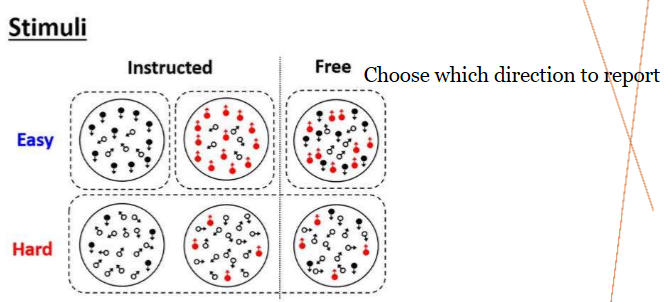
Investigated volitional, non-coerced action
Had to identify direction the dots were moving
Instructed condition: had to report actual movement of dots
Free condition: could choose which direction to report
Had to report how free they felt the decision of direction was
Pps tended to follow dot motion even in free condition
Shows that sensory noise biased 'free' decisions
No correlation between freedom rating and degree of sensory biasing, suggests pps unaware of influence
When pps made choice opposite to dot motion, freedom rated high, even though they didn't know there was a bias (and that they were resisting it)
Suggests inhibitory control tightly linked to sense of freedom of choice
56
Current evidence supports a dualist view
- True
- False
57
What do experiments into free will show?
Neural activity may cause actions without our consciours intention
Conscious experiences and reports may be misleading
Conscious experiences and reports may be misleading