Development - models of development
Study these flashcardsFree · spaced repetition · iPhone, Android, Mac & web
All cards
1
Define development
Progressive series of changes in structure, function, and behavior patterns that occur over the lifespan of a human being or other organism (APA definition)
Increase in complexity over time at cellular, multi-cellular, organims-environment and brain to mind level
Increase in complexity over time at cellular, multi-cellular, organims-environment and brain to mind level
2
How did Lerner et al define development?
Successive changes
Later changes influenced/limited by earlier changes
Later changes influenced/limited by earlier changes
3
State the 2 debates during the 17th century
Vitalists
Preformationists
Preformationists
4
What did vitalists argue?
That the functions of living organisms are determined by some sort of life force (called the engine of development) or principle
5
What did performationists argue?
That development consists of the emerging into mature form of the traits and capacities that exist in prototypical form in the germ cell (already has all necessary info for subsequent generations)
Eg. homunculus believed to exist in sperm leading to formation of human (argued by Hartsoeker who believed he could see a little human in the head of the sperm)
Eg. homunculus believed to exist in sperm leading to formation of human (argued by Hartsoeker who believed he could see a little human in the head of the sperm)
6
What are the 3 arguments for child development?
Nativism
Empricisim
Constructivism
Empricisim
Constructivism
7
Nativism is...
- Nature
- Nurture
8
Empiricism is...
- Nature
- Nurture
9
Outline nativism
Babies born with innate knowledge about how some core aspects of the world work (eg. objects, actions, numbers and space)
Argued by Spelke + Kinzler 2007
Argued by Spelke + Kinzler 2007
10
Outline empricism
Baby born aas a statistical learning machine
Sensitive to environment and extract info from it
By 3 months:
- >7million eye movement
- ~400 hours of face time
Argued by Aslin 2016
Sensitive to environment and extract info from it
By 3 months:
- >7million eye movement
- ~400 hours of face time
Argued by Aslin 2016
11
Outline constructivism
Biased to learn through interactions
Seek out info and test hypotheses
Interaction between genes and environment
Information constructed anew in the process of individual development
Seek out info and test hypotheses
Interaction between genes and environment
Information constructed anew in the process of individual development
12
Give 2 examples of constructivists
C.H. Waddington
Jean Piaget
Jean Piaget
13
What did C.H. Waddington do and when?
Coined the term epigenetic landscape
20th century
20th century
14
Defin epigenetic landscape
Visual metaphor that depicts development as a ball rolling down a hill with valleys of various depths and steepness, to convey the idea that some aspects of development are directed along certain general pathways and likely to occur under most circumstances but that the exact sequence of paths varies across individuals and can be altered by sudden environmental or genetic change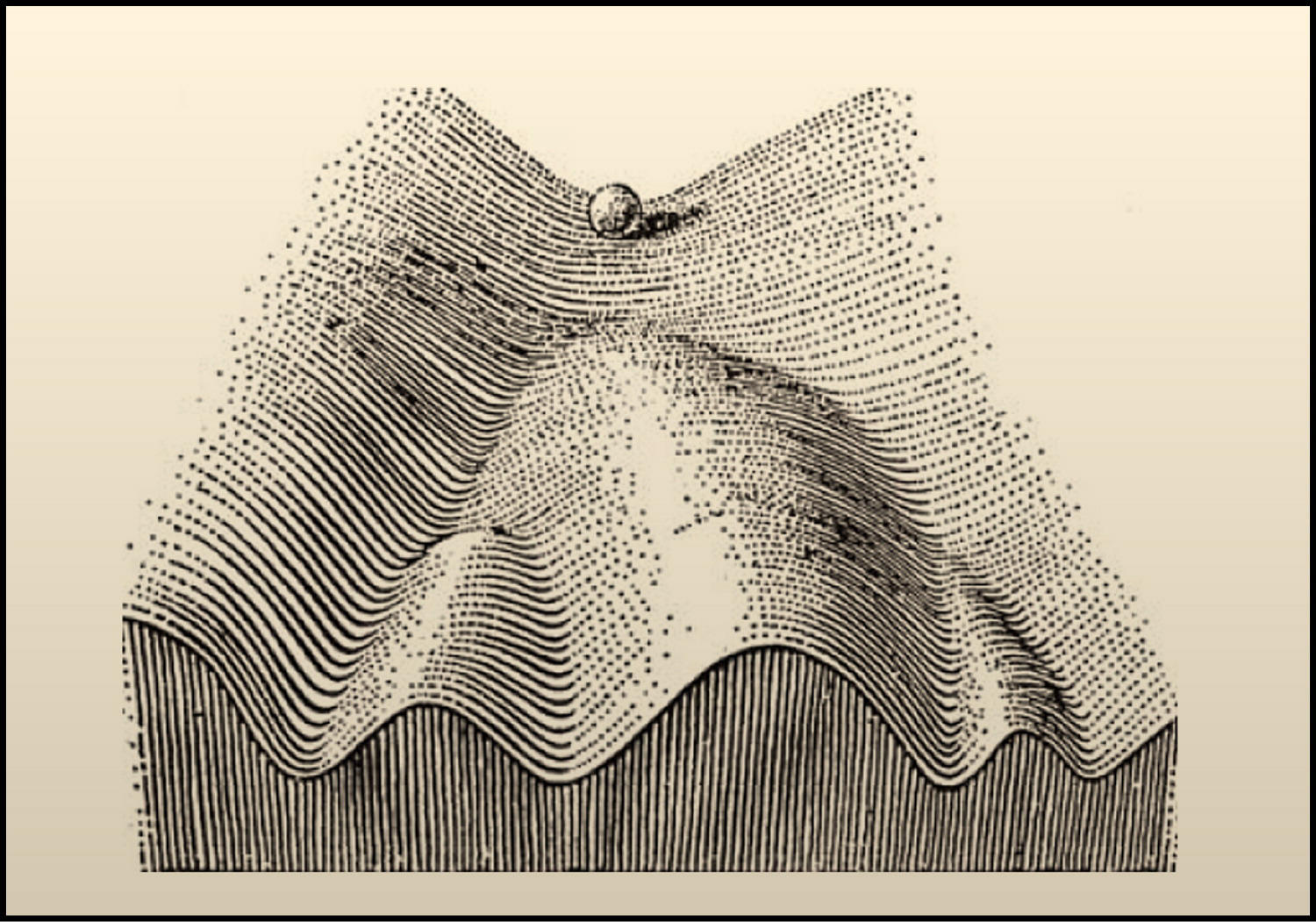
15
Outline one of the problems within the field of development
Lack of collaboration beteen neural and cognitive development
Recent arguments: important to include underlying genetics as well as social and physical environent to better understand development
Recent arguments: important to include underlying genetics as well as social and physical environent to better understand development
16
4 factors that influence brain function
Social + physical environment
Cognition + behaviour
Neuroanatomy + brain structure
Genetics/epigentics
Cognition + behaviour
Neuroanatomy + brain structure
Genetics/epigentics
17
What did Preyer assert and when?
Brain is developed only through activity, and only through that are the functions localised and associated in it
Late 19th century
Late 19th century
18
State the 3 key assumptions of development from a constructivist viewpoint
Development involves...
- Circular (bi-directional) causality
- Interactivity + brain networks (developing child interacts with dynamic social + physical envrionments)
- Self-organising + activity-dependent processes
- Circular (bi-directional) causality
- Interactivity + brain networks (developing child interacts with dynamic social + physical envrionments)
- Self-organising + activity-dependent processes
19
Outline circular causality
Develpment doesn't work linearly
Genes can affect NETs but also can happen the other way around
Genes can affect NETs but also can happen the other way around
20
Describe the relational developmental system theory
Lerner et al 2011
Argues that the active, developing individual is what drives their own development
Argues that the active, developing individual is what drives their own development
21
Describe the holistic person-context interaction theory
Development a result of inner and outer interactions
Inner interactions: genetics / brain / cognitive / behaviour
Outer interactions: physical world (niche construction) / social world (parent-child interaction)
Inner interactions: genetics / brain / cognitive / behaviour
Outer interactions: physical world (niche construction) / social world (parent-child interaction)
22
Piaget: which 2 processes drive change?
Assimilation and accommodation
23
How is Piaget's constructivist theory diffierent to empiricism?
Epiricism = environment shapes child's mind
Constructivism:
Knowledge constructed via child's actions upon the environment
Cognitive develpoment starts from innate knowledge (schemas)
Schemas allow for new knowledge to be learnt, building on from innate substrates
Cognition develops in distinct stages (each stage characterised by limitation on cognition which has to be overcome to progress to next stage)
Constructivism:
Knowledge constructed via child's actions upon the environment
Cognitive develpoment starts from innate knowledge (schemas)
Schemas allow for new knowledge to be learnt, building on from innate substrates
Cognition develops in distinct stages (each stage characterised by limitation on cognition which has to be overcome to progress to next stage)
24
State Piaget's 4 stages of development
0-2y = sensory-motor stage
2-6y = preoperational stage
7-11y = concrete operational stage
12y-adult = formal operation stage
2-6y = preoperational stage
7-11y = concrete operational stage
12y-adult = formal operation stage
25
Describe the sensori-motor stage
Infant understands world through its physical actions on it
26
Describe the preoperational stage
Child can mentally represent aspects of the world, but with limitations
27
Describe the concrete operational stage
Child can use 'operations' or mental actions to solve problems
28
Describe the formal operation stage
Ability to deal with hypothetical and abstract
29
Outline the 4 properties of Piaget's stages of development
Invariant sequence - can't skip stages
Hierarchical - each stage uses knolwedge from previous stage
Radical restructuring of though procceses at each stage - qualitative change
Concurrence - development is domain general
Hierarchical - each stage uses knolwedge from previous stage
Radical restructuring of though procceses at each stage - qualitative change
Concurrence - development is domain general
30
Define assimilation
Incorporating new info into existing knowledge structures
31
Define accommodation
Modifying old knowledge structures to fit new info
32
What happens if one fails to assimilate info?
Leads to accommodation - drives change to the next stage
33
4 main criticisms of Piaget's theory
Infants capable of more than suggested by Piaget
Piaget over-estimated abilities of children in formal operatoinal stage
Neglected changes in adolescence
Stage theories don't take into account individual differences between children and populations (studied his own chidren, middle-class, well-educated)
Piaget over-estimated abilities of children in formal operatoinal stage
Neglected changes in adolescence
Stage theories don't take into account individual differences between children and populations (studied his own chidren, middle-class, well-educated)
34
Define object permanence
Ability to mentally represent object even when it's not visible
35
In which stage does object permanence develop?
Sensori-motor
36
When do babies show natural search behaviour for fully occluded objects?
After 8months
BUT still show 'A-not B error' on a seasrch task
BUT still show 'A-not B error' on a seasrch task
37
Outline Piaget's A not B task
Infant observes as toy repeatedly put into well A and then covered
Trials repeated until infant consistently reaches for well A to receive toy
Then toy place into well B (with infant observing)
8month olds typically continue to reach for A even though they see if go into B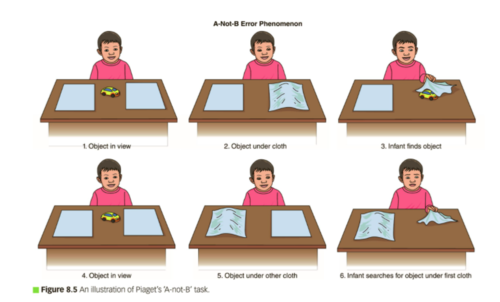
Trials repeated until infant consistently reaches for well A to receive toy
Then toy place into well B (with infant observing)
8month olds typically continue to reach for A even though they see if go into B
38
What does the "A not B task" require?
Executive integration of inhibiting prepotent response while holding memory of new location in working memory
Piaget suggested that it showed the capacity to hold a representation of an object, even when it is occluded
Piaget suggested that it showed the capacity to hold a representation of an object, even when it is occluded
39
3 criticisms of the "A not B task"
- Highly replicable BUT context dependent (age of success depends on number of repetitions and delay period)
- Evidence suggests error more due to inability to inhibit prepotent response than lack of object permanence
- Looking measures give different results to reaching tasks
- Evidence suggests error more due to inability to inhibit prepotent response than lack of object permanence
- Looking measures give different results to reaching tasks
40
What can be concluded from the "A not B task"
Representational capacity gradually develops
Changes linked to actions infants are able to perform at different points during the sensori-motor period
Changes linked to actions infants are able to perform at different points during the sensori-motor period
41
What did Baillargeon argue?
Using non-search procedures might show sophisticated understanding of objects in very young infants
42
Outline violation of expectation procedure
Infant habituated to one event
Second event presented that violates expectation
Infants expected to show surprise (longer looking)
Second event presented that violates expectation
Infants expected to show surprise (longer looking)
43
Describe Baillargeon's violation of expectation task
Infants shown screen that rotated away by 180degrees until habituated
Then wooden box placed in path of screen
Possible condition: screen stopped rotating at box
Impossible condition: screen rotated the full 180degrees
Infants showed suprise at impossible not possible condition (younger than Piaget suggested)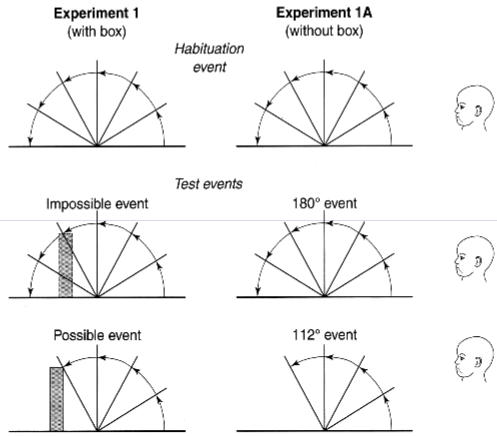
Then wooden box placed in path of screen
Possible condition: screen stopped rotating at box
Impossible condition: screen rotated the full 180degrees
Infants showed suprise at impossible not possible condition (younger than Piaget suggested)
44
At what age do infants show surprise to impossible events?
3.5 months