Visual Perception - 1
Study these flashcardsFree · spaced repetition · iPhone, Android, Mac & web
All cards
1
3 ways of measuring perception
Magnitude estimation + production tasks
Matching tasks
Detection + discrimination tasks
Matching tasks
Detection + discrimination tasks
2
Describe magnitude estimation + production tasks
Pps given standard stimulus with given value and asked to give corresponding value indicating their own perception
BUT can pps actually give accurate numberical values to indicuate the relative strength of their perceptual experience?
BUT can pps actually give accurate numberical values to indicuate the relative strength of their perceptual experience?
3
Outline magnitude estimation
Estimate magnitude given a reference stimulus
4
Outline magnitude production
Set stimulus to a value relative to a reference
5
What did Stevens do and when?
1956
Carried out magnitude estimation and production tasks (judging intensity of stimulus)
Created "Stevens' Power Law"
Carried out magnitude estimation and production tasks (judging intensity of stimulus)
Created "Stevens' Power Law"
6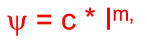
State Stevens' Power Law
7
Describe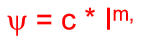
Ψ = subjective magnitude of sensation
C = constant
I = physical intensity of stimulus
m = constant specific to each modality
C = constant
I = physical intensity of stimulus
m = constant specific to each modality
8
Describe matching tasks
Set a stimulus to match a standard
Ask pp to choose stimulus that most nearly matches the standard
Ask pp to choose stimulus that most nearly matches the standard
9
Describe detection + discrimination tasks
Estimate sensitivity to weak stimuli
Aim is to find the threshold for detection
Aim is to find the threshold for detection
10
2 methods for finding threshold
Method of adjustment
Method of constant stimuli
Method of constant stimuli
11
Describe the method of adjustment
Adjust stimulus till it's just visible
12
Describe the method of constant stimuli
One stimulus presented at a time (eg. light flash)
Pp asked if they can see it
Repeat with may different intensities
Pp asked if they can see it
Repeat with may different intensities
13
Limitation of the method of constant stimuli
Prone to response bias
14
Define absolute threshold
Weakest level of stimulus that can be detected
15
Define difference threshold
Minimum detectable change
16
Define threshold
Intensity level require to make stimulus detectable on 50% of occasions
17
What are thresholds influenced by?
Context
18
Small change in luminance easier to detect in...
- Low intensity (dim) light
- High intensity (bright) light
19
What did Weber do and when?
1830s
Created Weber's law
Measured threshold for detecting light flashes
Varied intensity of stimulus and background
Created Weber's law
Measured threshold for detecting light flashes
Varied intensity of stimulus and background
20
What did Weber find?
Linear relationship between magnitude of difference threshold and original or background intensity
Require larger intensity change if original already has high intensity
Require larger intensity change if original already has high intensity
21
State the Weber Fraction
22
Describe
∆I = minimum detectable intensity change
I = background intensity
C = constant
I = background intensity
C = constant
23
What is Weber's law an example of?
Psychometric function
24
Define psychometric function
Relationship between properties of physical stimuli and a behavioual index of perception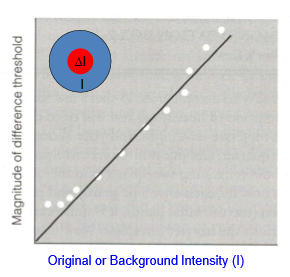
25
Under what condition does Weber's law not work and why?
When "I" (background intensity) approach 0
Due to internal neural noise unrelated to stimulus
Due to internal neural noise unrelated to stimulus
26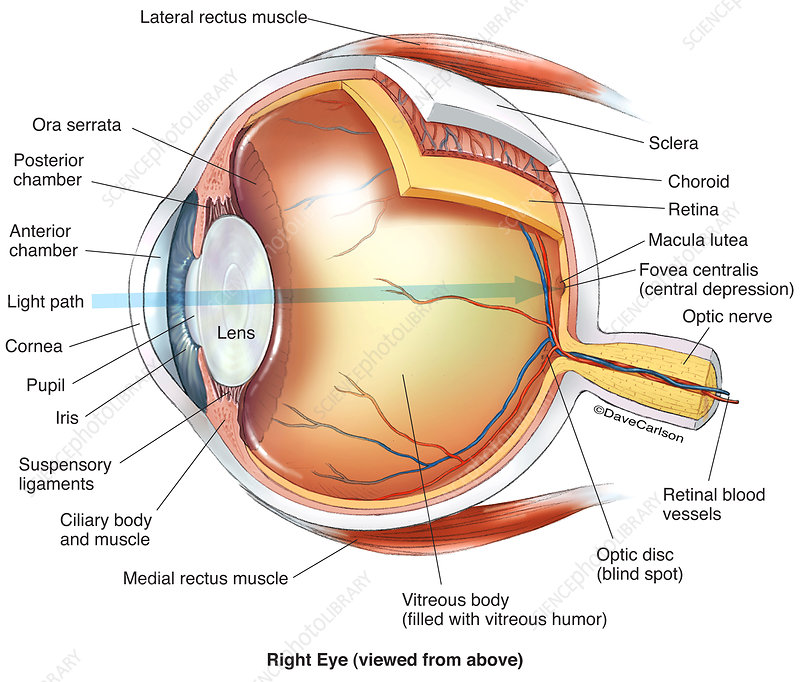
Image occlusion: name the hidden labels
27
Describe the sclera
Wall of eye
Tough except for clear, protuding front of eye
Tough except for clear, protuding front of eye
28
Describe the cornea
Acts as a fixed lens
Anterior chamber inside the cornea (filled with aqueous humour)
Anterior chamber inside the cornea (filled with aqueous humour)
29
Describe the iris
Ring of muscle
Controls size of pupil and hence light entering eye
Controls size of pupil and hence light entering eye
30
Describe the lens
Assists cornea in focusing image on retina
31
Define accommodation
Flattening lens to bring distant objects into focus
OR
Making lens rounder to bring near objects into focus
OR
Making lens rounder to bring near objects into focus
32
Describe ciliary muscles
Manipulates lens shape (see accommodation)
33
Describe the retina (briefly)
Thin section of neural tissue at back of eye
Responsible for encoding patterns of light and shade
Responsible for encoding patterns of light and shade
34
Describe the macula lutea
Found on retina
Fovea in the cnetre
Fovea in the cnetre
35
Describe the fovea
High density of cone cells
High acuity due to greater numbers and small receptive fields
High acuity due to greater numbers and small receptive fields
36
Define acuity
Ability to distinguish fine detail within an image
37
Define receptive field
Area of visual field from which cells receives light input
38
Describe the optic disc
Area of retina where nerve fibres exit eye, projecting to brain
No receptors here: blind spot
No receptors here: blind spot
39
Describe the pigment epithelium
Foudn outside photoreceptor layer at back of retina
Unreflective
Possibly helps by 'mopping up' stray light not absorbed by receptors, preventing it being reflected back into retina and blurring retinal image
Unreflective
Possibly helps by 'mopping up' stray light not absorbed by receptors, preventing it being reflected back into retina and blurring retinal image
40
State 5 types of cells in the retina
Photoreceptors
Bipolar cells
Ganglion cells
Horizontal cels
Amacrine cells
Bipolar cells
Ganglion cells
Horizontal cels
Amacrine cells
41
Factfile: cones
~6 million
Greatest density in fovea
Small receptive fields
3 types - sensitive to L/M/S wavelengths of light
Support colour vision
Greatest density in fovea
Small receptive fields
3 types - sensitive to L/M/S wavelengths of light
Support colour vision
42
Factfile: rods
~120 million
Found outside of fovea
Achromatic
Better sensitivity to low light compared to cones
Many rods activate a each ganglion cell
Found outside of fovea
Achromatic
Better sensitivity to low light compared to cones
Many rods activate a each ganglion cell
43
Describe how photoreceptors respond to light
High response to light in receptive field
44
Describe pathway of signal through cells in the retina
Photoreceptors transmit signals to bipolar cells
Transmit to ganglion cells then to brain
Transmit to ganglion cells then to brain
45
Fucntion of horizontal cells
Integrate info from several photoreceptors
46
Fucntion of amacrine cells
Form links to several different ganglion cells
47
What response do photoreceptors show?
Graded
48
How do ganglion cells encode visual info?
All-or-nothing activity
Binary response
Action potenitals
Binary response
Action potenitals
49
How to measure intensity of stimulus using action potentials
Firing rate (action potentials per second)
50
Describe why it is important for the visual system to adapt
Neural response would asymptote (level off)
We would be blind to further increases/decresases in luminance
Retinal ganglion cells have a range of only 0-200 spikes per second (in reality the range of illumination we can perceive is far greater than this)
Adaptation to the average luminance makes it easier to distinguish between light or similar luminance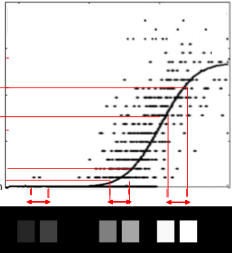
We would be blind to further increases/decresases in luminance
Retinal ganglion cells have a range of only 0-200 spikes per second (in reality the range of illumination we can perceive is far greater than this)
Adaptation to the average luminance makes it easier to distinguish between light or similar luminance
51
How to test range of light/dark adaptation
Pp adapted to high level of light
Measure sensitivity to flashes of light after moving into dark room
Measure sensitivity to flashes of light after moving into dark room
52
What did Hecht do and when?
1930s
Examined threshold for detecting light flashes
Examined threshold for detecting light flashes
53
What did Hecht find?
Red flashes: sensitivity to light increased by 2 log units (100x) in first 10mins in darkness but then plateaud
Red = long wavelength (requires cones)
Violet flashes: sensitivity to light increased by 2 log units (100x) in first 10mins in darkness and then improved by further 4 log units (10,000x) in darkness
Violet = short wavelength (rods more sensitive to violet > red)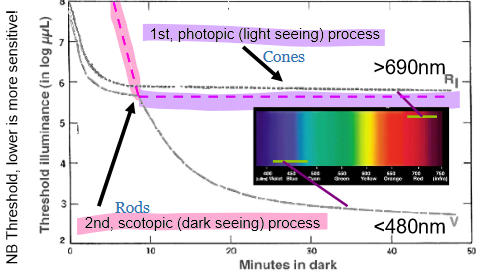
Red = long wavelength (requires cones)
Violet flashes: sensitivity to light increased by 2 log units (100x) in first 10mins in darkness and then improved by further 4 log units (10,000x) in darkness
Violet = short wavelength (rods more sensitive to violet > red)
54
What conclusions can be made from Hecht's experiment?
2 systems for dark adaptation:
1. Phototopic process
Adaptation occurs for 'light seeing' receptors (cones)
Dark adapts quickly but asymptotes after 10mins
2. Scototopic process
Adaptation for seeing in dark, driven by rods
Dark adapts less quickly but to far greater extenet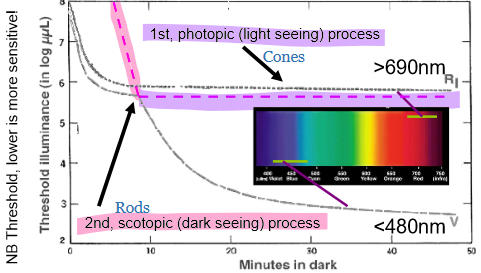
1. Phototopic process
Adaptation occurs for 'light seeing' receptors (cones)
Dark adapts quickly but asymptotes after 10mins
2. Scototopic process
Adaptation for seeing in dark, driven by rods
Dark adapts less quickly but to far greater extenet
55
What is the peak sensitvity of the scototopic process?
505nm
56
What is the peak sensitivity of the phototopic process?
550nm
57
In which species did trichromatic vision evolve?
Old world primates (ancestors of Homo sapiens)
Separately in new world primates
Separately in new world primates
58
What did Young do and when?
1807
Trichromatic theory
Showed that you cannot create all the visible wavelengths of light with only 2 primary colours - must be 3
Trichromatic theory
Showed that you cannot create all the visible wavelengths of light with only 2 primary colours - must be 3
59
What is metameric matching?
Matching appearance of any signle wavelength useing mixtures of 3 primary colours
60
Who provided evidence for the trichromatic theory and when?
Brown and Wald 1966
61
What did Brown and Wald find?
Physiological evidence for trichomacy
Used microspectophotometry
Found peak absorptions of cone cells clustered around short, medium and long wavelengths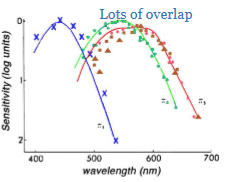
Used microspectophotometry
Found peak absorptions of cone cells clustered around short, medium and long wavelengths
62
Describe microspectophotometry
Shining thin monochomatic beam of light through individual receptors on a dissected retina
Then measure light absorption for different wavelengths
Then measure light absorption for different wavelengths
63
Why do long and medium wavelength cone functions overlap?
Most mammals have dicromatic vision (only long and short)
Human evolution: long wavelength split into long and medium
Helps to distinguish between ripe fruit and foliage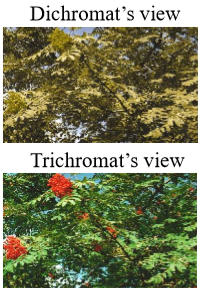
Human evolution: long wavelength split into long and medium
Helps to distinguish between ripe fruit and foliage
64
What did Hering suggest and when?
1870s
Opponent process theory
We perceive 4 primary colours
Red vs green
Blue vs yellow
Can't see reddish-green etc.
Agreed colour vision is trichromatic but later processes confom to our conscious perceptions of colour
Opponent process theory
We perceive 4 primary colours
Red vs green
Blue vs yellow
Can't see reddish-green etc.
Agreed colour vision is trichromatic but later processes confom to our conscious perceptions of colour
65
3 types of evidence for opponent process theory
Afterimages
Aftereffects
Simultaneous colour contrast
Aftereffects
Simultaneous colour contrast
66
What did De Valois et al find and when?
1960s
Studied cells in monkey lateral geniculate nuclei
Found colour opponent cells (+R-G, +B-Y)
Cells responded to green but inhibited by red
Suggests trichrimatic vision at receptor level
Opponent processing at later levels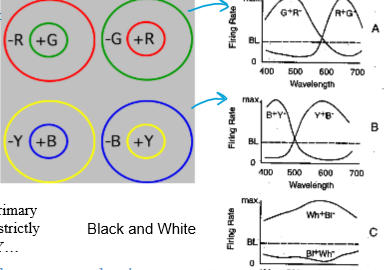
Studied cells in monkey lateral geniculate nuclei
Found colour opponent cells (+R-G, +B-Y)
Cells responded to green but inhibited by red
Suggests trichrimatic vision at receptor level
Opponent processing at later levels