Somatosensation + pain - lecture 3
Study these flashcardsFree · spaced repetition · iPhone, Android, Mac & web
All cards
1
Define plasticity
Capacity of nervous system to modify itself, functionally and structurally, in response to experience + injury
2
Give an example of plasticity
Cortical maps / cortical receptive fields
3
Describe an experiment that investigates modification of cortical receptive fields by injury
Monkey experiment
Regions of S-I sensitive to stimulation of hands mapped with electrodes
Digit 3 surgically removed
Cortex devoted to removed finger now responds to stimulation of adjacent digits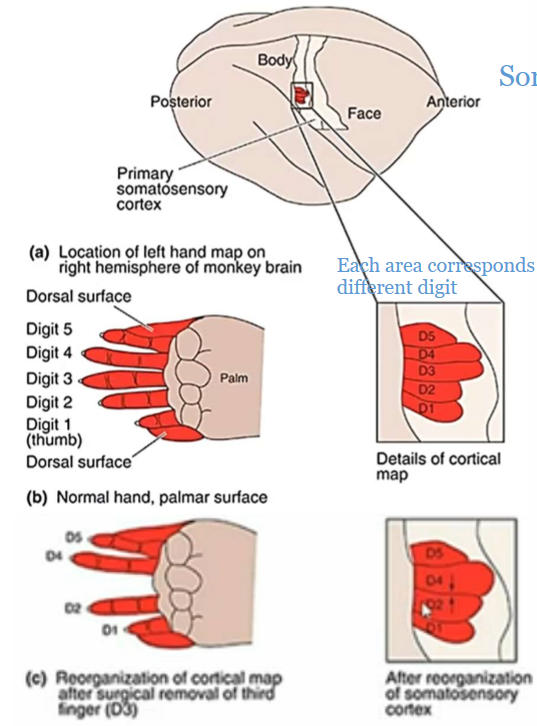
Regions of S-I sensitive to stimulation of hands mapped with electrodes
Digit 3 surgically removed
Cortex devoted to removed finger now responds to stimulation of adjacent digits
4
Describe an experiment that investigates modification of cortical receptive fields by experience
Monkey experiments
Trained to touch rotating disk with tips of the middle fingers (digits 2 and 3) to obtain food
Trained over several months
Cortex devoted to tips of these middle fingers (2 and 3) greatly expanded at the expense of adjacent proximal phalanges
Number of receptive fields in distal phalanges of middle fingers larger than before learning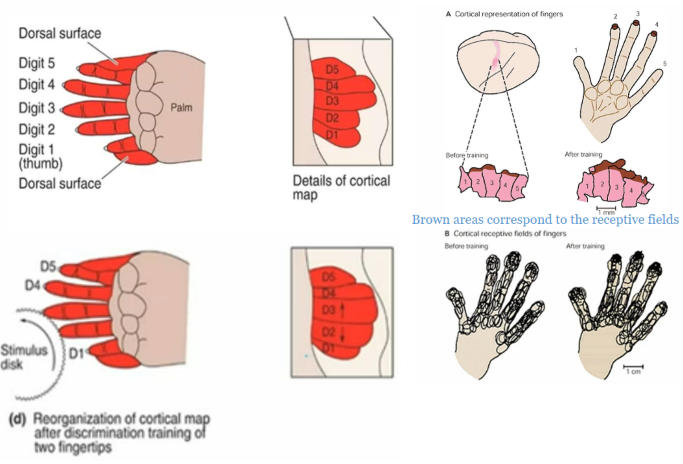
Trained to touch rotating disk with tips of the middle fingers (digits 2 and 3) to obtain food
Trained over several months
Cortex devoted to tips of these middle fingers (2 and 3) greatly expanded at the expense of adjacent proximal phalanges
Number of receptive fields in distal phalanges of middle fingers larger than before learning
5
What mechanisms underlie plasticity in S-I?
Afferent connections to neurons in the somatosensory cortex formed on the basis of correlated firing
Cells that fire together wire together
Cells that fire together wire together
6
What can we learn about plasticity from connecting adjacent digits?
Monkey experiment
Surgical connection of skin surfaces of 2 adjacent digits
Increases correlation of inputs from the skin surfaces of the adjacent digits
Large common area formed to represent parts of the fused digits
After separation:
Stimulation of surface of either of the 2 digits evoked responses in cortical cells within the large common area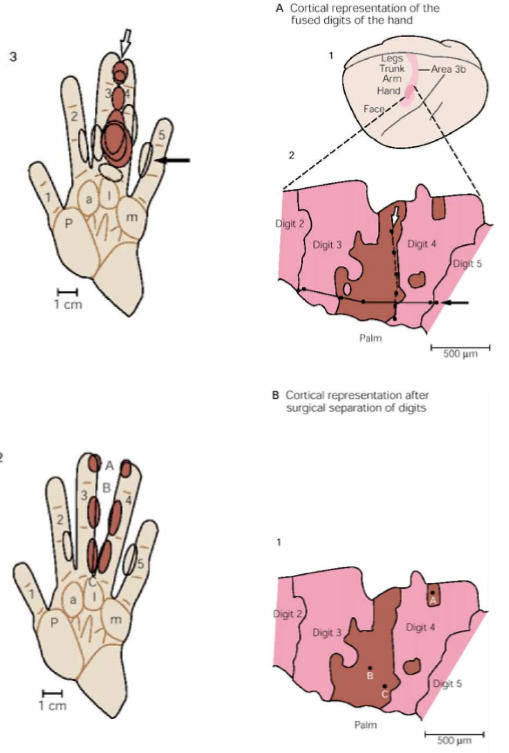
Surgical connection of skin surfaces of 2 adjacent digits
Increases correlation of inputs from the skin surfaces of the adjacent digits
Large common area formed to represent parts of the fused digits
After separation:
Stimulation of surface of either of the 2 digits evoked responses in cortical cells within the large common area
7
Describe phantom limb syndrome
Occurs after amputation of a limb
Vivid sensory experience of the missing limb
Vivid sensory experience of the missing limb
8
Explain what has occurred here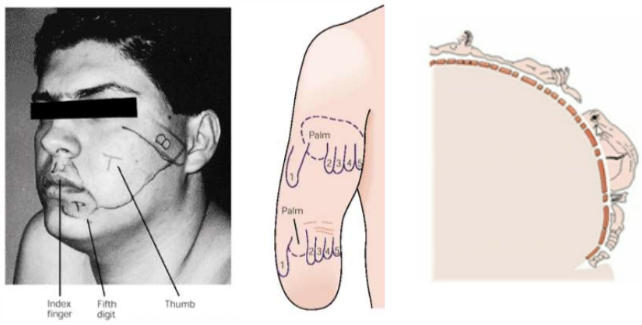
Amputation of lower arm
Complete map of fingers on face and upper arm 4 weeks after amputation
Area of sensory homunculus receiving inputs from hand next to regions devoted to face and arm
Hypothesis: sensory input from these areas in now innervating the hand area of the somatosensory thalamus/cortex
Greater the reorganisation = greater amount of pain felt
Complete map of fingers on face and upper arm 4 weeks after amputation
Area of sensory homunculus receiving inputs from hand next to regions devoted to face and arm
Hypothesis: sensory input from these areas in now innervating the hand area of the somatosensory thalamus/cortex
Greater the reorganisation = greater amount of pain felt
9
Define nociception
Physiological process that allows the nervous system to detect noxious stimuli
10
Define pain
Unpleasant sensory and emotional experience associate with actual or potential tissue damage, or described in terms of such damage
11
State the 5 phases of nociception
Transduction
Conduction
Transmission
Perception
Modulation
Conduction
Transmission
Perception
Modulation
12
What happens during the transduction phase?
Specific receptors (nociceptors) convert noxious stimuli into action potential
13
What happens during the conduction phase?
Action potential conducted to the spinal cord
14
What happens during the transmission phase?
Nociceptive signals relayed across synapses through the central nervous system until they reach higher brain regions
15
What happens during the modulation phase?
Adaptive process
Changes transmission of nociceptive input
Modulates nociceptive info relayed to the cortex
Changes transmission of nociceptive input
Modulates nociceptive info relayed to the cortex
16
State the 3 types of nociceptors
Mechanical
Thermal
Polymodal
Thermal
Polymodal
17
Describe and explain what is shown here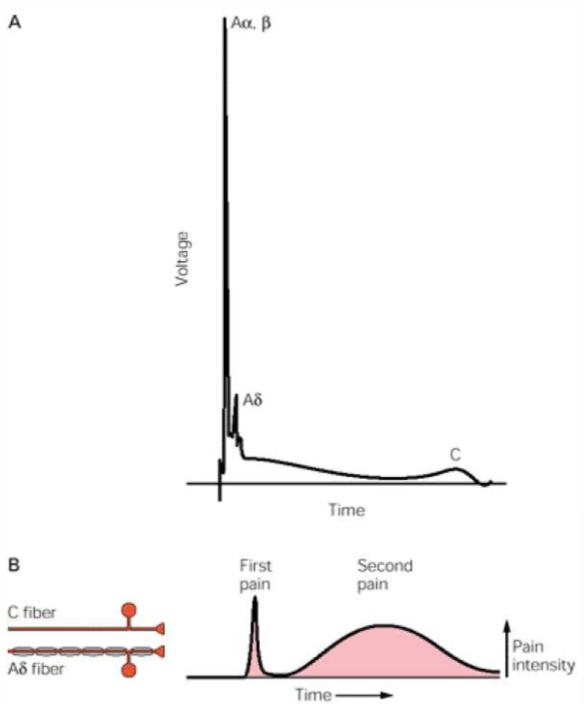
Often an initial sharp 'first' pain followed by more prolongued aching / burning 'second' pain
Fast sharp pain transmitted by Adelta fibres - carry info from thermal and mechanical nociceptors
Slow dull pain transmitted by C fibres - activated by polymodal nociceptors
Fast sharp pain transmitted by Adelta fibres - carry info from thermal and mechanical nociceptors
Slow dull pain transmitted by C fibres - activated by polymodal nociceptors
18
What activates thermal nociceptors?
Temp < 15C and > 43C
19
What occurs in the spinal cord in resposne to activation of nociceptors?/
Conduction phase
Made up of several laminae (layers)
Projection neurons in Lamina 1 receive direct input from myelinated Adelta nociceptive fibres and indirect input from unmyelinated C fibres
Lamina 5 neurons receive input from large diameter fibres (Abeta) from mechanoreceptors and input from other nociceptors (Adelta)
Made up of several laminae (layers)
Projection neurons in Lamina 1 receive direct input from myelinated Adelta nociceptive fibres and indirect input from unmyelinated C fibres
Lamina 5 neurons receive input from large diameter fibres (Abeta) from mechanoreceptors and input from other nociceptors (Adelta)
20
What kind of stimulus do Lamina 5 neurons respond to?
Innocuous stimuli at low intensity
Innocuous stimuli at high intensities
Known as wide-dynamic range neurons
Innocuous stimuli at high intensities
Known as wide-dynamic range neurons
21
Define referred pain
Pain perceived at a location other than the site of painful stimulus/origin
Occurs most commonly with pain from internal organs - felt in more superficial region
Occurs most commonly with pain from internal organs - felt in more superficial region
22
How does referred pain work?
Signals from inflamed visceral organ converge on projection neurons at dorsal horn of the spinal cord
Sensory input from distant somatic structure (eg. skin) converges on the same neurons
CNS cannot distinguish between superficial and deep pain - failure results in incorrect assignment of pain to healthy somatic area
Sensory input from distant somatic structure (eg. skin) converges on the same neurons
CNS cannot distinguish between superficial and deep pain - failure results in incorrect assignment of pain to healthy somatic area
23
What is the classical organisation of the nociceptive pathway (transmission)
Spinothalamic tract / anterolateral system
Spinoreticular tract
Spinomesencephalic tract
Spinoreticular tract
Spinomesencephalic tract
24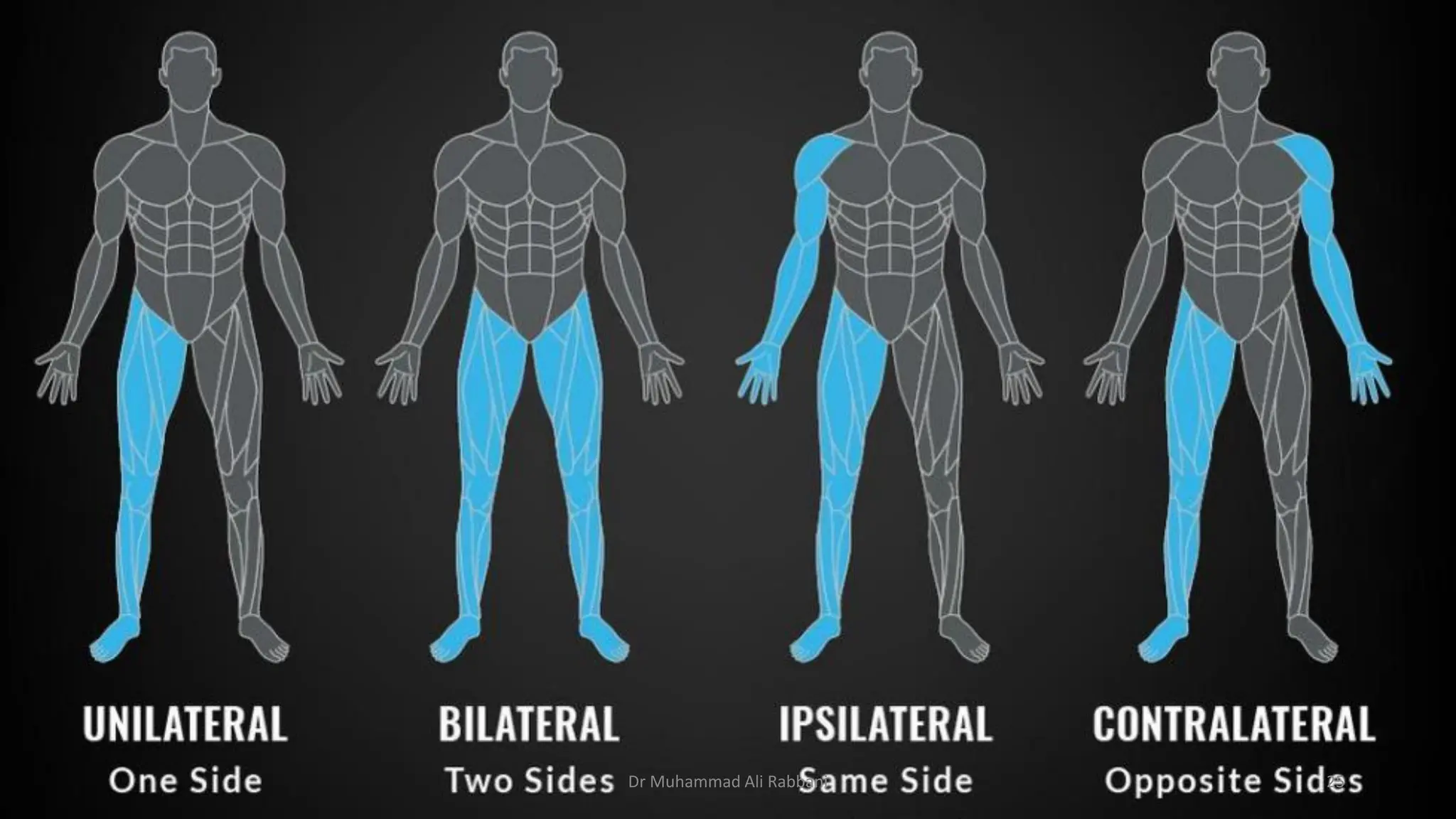
Image occlusion: name the hidden labels
25
What does anterolateral mean?
Occurring to the front and the side
26
Describe the spinothalamic tract / anterolateral system
Major ascending nociceptive pathway in spinal cord
Comprises of axons from neurons in laminae 1 and 4-7 of the dorsal horn
Axons ascend in contralateral, anterolateral white matter
Lesions reduce pain sensation from contralateral side of body (usually temporary)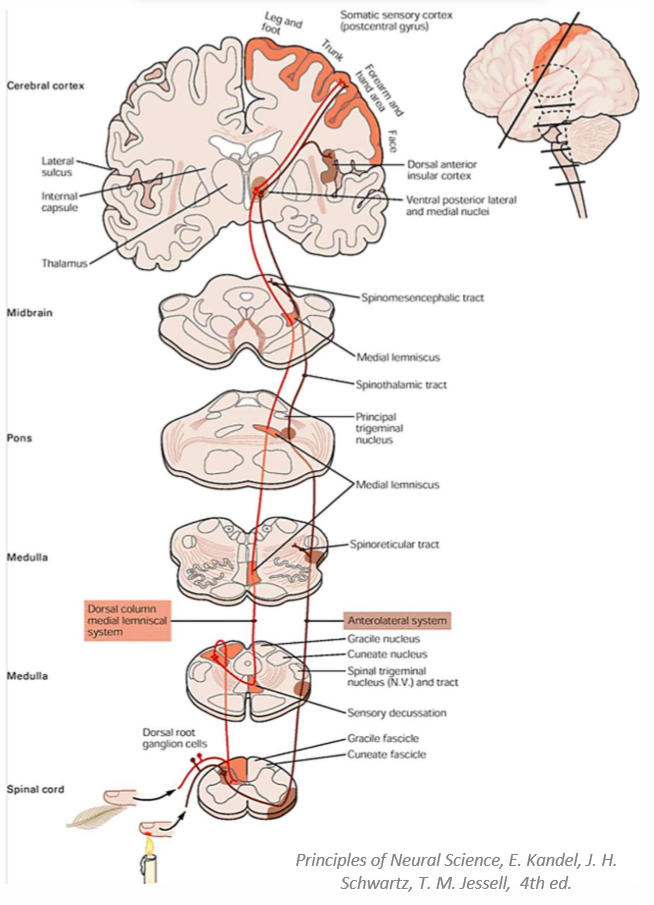
Comprises of axons from neurons in laminae 1 and 4-7 of the dorsal horn
Axons ascend in contralateral, anterolateral white matter
Lesions reduce pain sensation from contralateral side of body (usually temporary)
27
Describe the spinoreticular tract
Projects from laminae 7 and 8
Reaches reticular formation and thalamus
Some axons in this pathway do not cross in the mid-line (not shown in image)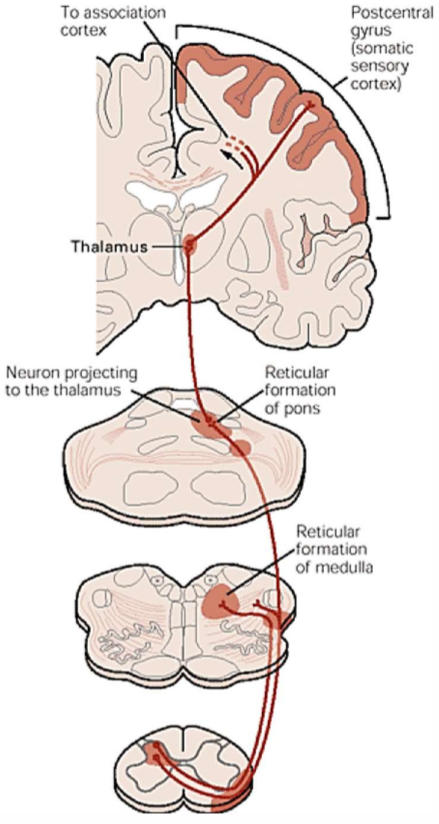
Reaches reticular formation and thalamus
Some axons in this pathway do not cross in the mid-line (not shown in image)
28
Describe the spinomesencephalic tract
Projects from laminae 1 and 5
Via anterolateral quadrant of spinal cord, reaches mesencephalic reticular formation and periaqueductal gray
Via spinoparabrachial tract, projects to parabrachial nucleus, which projects to amygdala (not shown in image)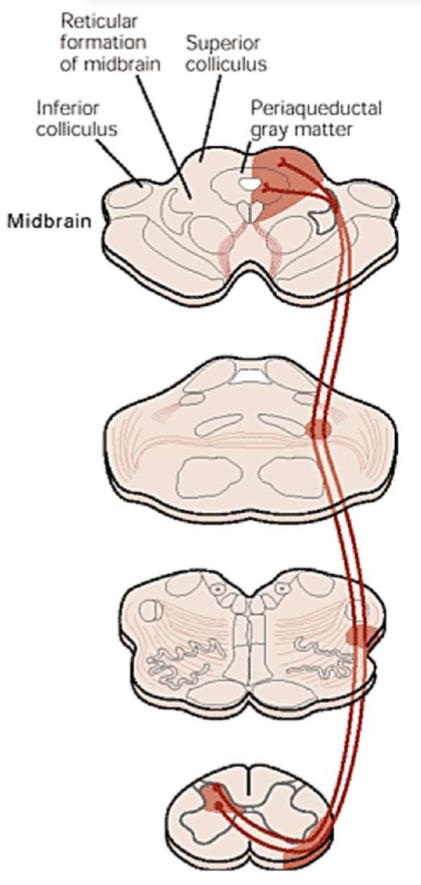
Via anterolateral quadrant of spinal cord, reaches mesencephalic reticular formation and periaqueductal gray
Via spinoparabrachial tract, projects to parabrachial nucleus, which projects to amygdala (not shown in image)
29
Name 4 types of spinal cord lesions
Brown-Sequard syndrome
Syringomeylia
Posterior column syndrome
Complete transection
Syringomeylia
Posterior column syndrome
Complete transection
30
Describe Brown-Sequard syndrome
Hemi-section through spinal column
Affects spinothalamic tract and DC-ML system on same side of spinal cord
Contralateral loss of pain and temperature sense
Ipsilateral loss of tactile and limb position sense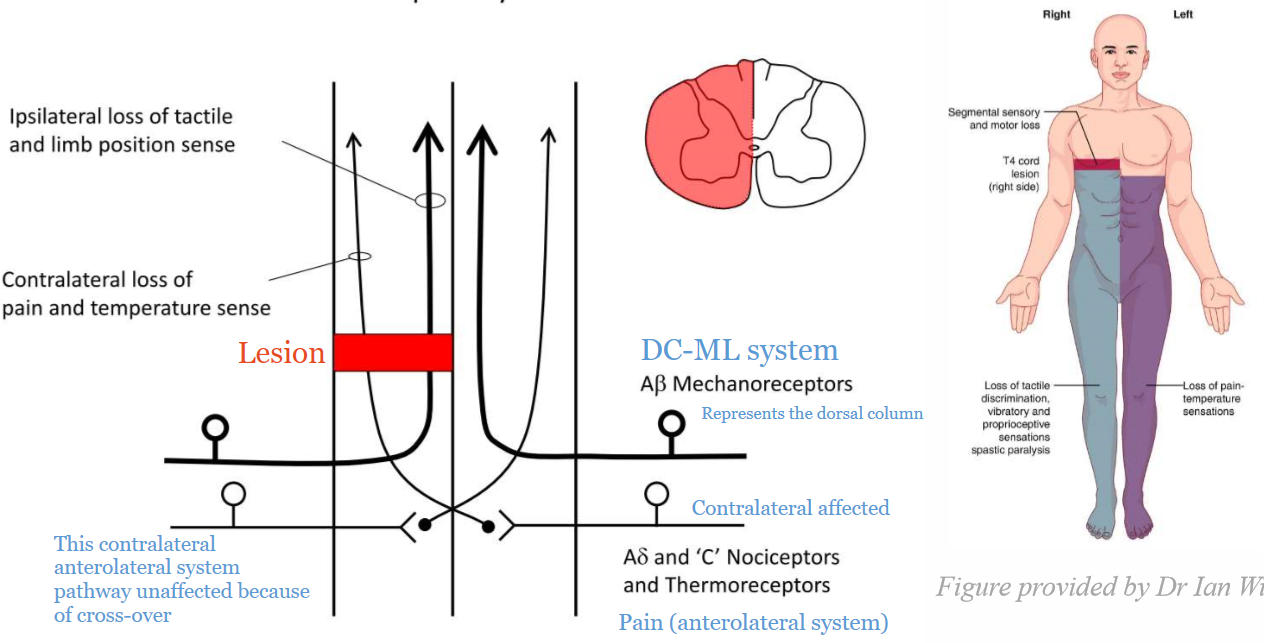
Affects spinothalamic tract and DC-ML system on same side of spinal cord
Contralateral loss of pain and temperature sense
Ipsilateral loss of tactile and limb position sense
31
Describe Syringomyelia
Caused by fluid-filled cavity within spinal cord (usually cervical)
Disrupts decussating fibres of anterolateral system BUT does not affect the asceding fibres of the DC-ML system
Loss of pain and temperature sensation in upper limbs and trunk BUT preservation of touch and pressure sensation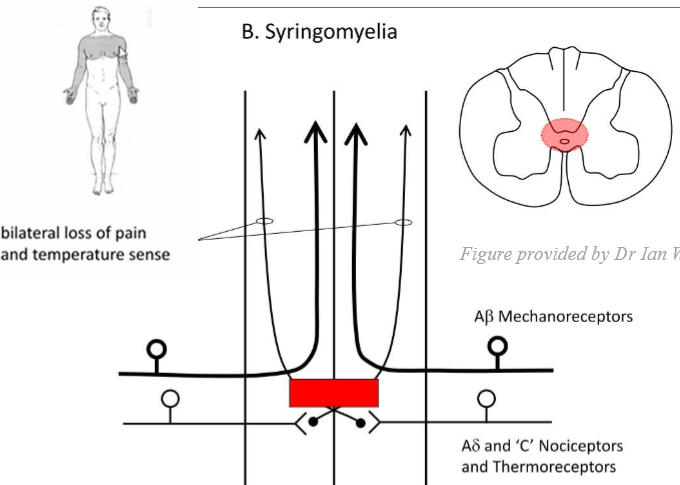
Disrupts decussating fibres of anterolateral system BUT does not affect the asceding fibres of the DC-ML system
Loss of pain and temperature sensation in upper limbs and trunk BUT preservation of touch and pressure sensation
32
Describe posterior column sydrome
Results in bilateral absence of touch below level of lesion
Loss of proprioceptive feedback below site of lesion leading to characteristic stamping gait
Loss of proprioceptive feedback below site of lesion leading to characteristic stamping gait
33
Describe complete transection
Impairment of all sensory modalities below level of transection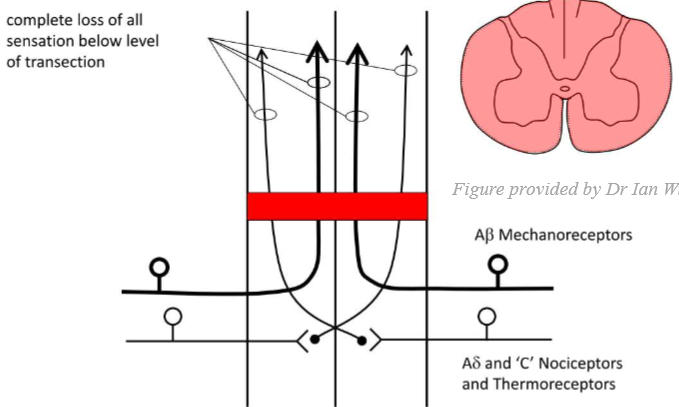
34
Why is nociception important?
Warns of injury that should be avoided/treated
35
What are the 2 aspects of nociceptive info?
Sensory-discriminative: location, modality, intensity
Motivational-affective: how upleasant / upsetting, what to do about it
Motivational-affective: how upleasant / upsetting, what to do about it
36
Which pathway is the sensoroy-discriminative feature of nociception a part of?
Spinothalamic pathway
Info about location and type of pain (green)
Info about location and type of pain (green)
37
Which pathway is the motivation-affective feature of nociception a part of?
Spinoreticular pathway
Spinomesencephalic pathway
Info about affective, motivational, aversive responses, fear behaviours (pink)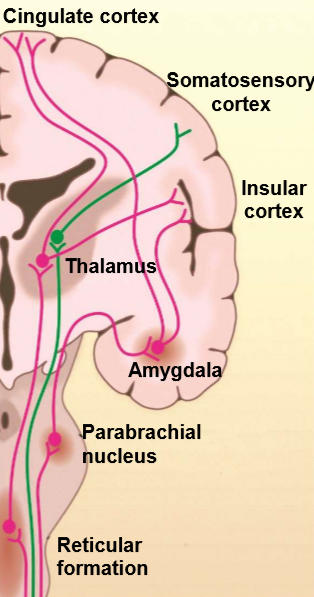
Spinomesencephalic pathway
Info about affective, motivational, aversive responses, fear behaviours (pink)
38
Describe where pain is processes?
No primary 'pain' cortex
Primary S-I and secondary S-II cortex for sensory-discriminative property of nociception (damage causes unpleasant feeling without localisation, quality or intensity)
ACC and insular cortex for emotional aspects of pain (damage causes pain symbolia - no unpleasantness)
ACC part of the limbic system
Insular cortex process info on internal statte of body - contributes to autonomic component of overall pain resonse
Primary S-I and secondary S-II cortex for sensory-discriminative property of nociception (damage causes unpleasant feeling without localisation, quality or intensity)
ACC and insular cortex for emotional aspects of pain (damage causes pain symbolia - no unpleasantness)
ACC part of the limbic system
Insular cortex process info on internal statte of body - contributes to autonomic component of overall pain resonse
39
What is the gate control theory?
Mechanism in the dorsal horn of the spinal cord that acts like a gate that inhibits the transmission of nociceptive info from body to brain
Melzack and Wall 1965
Modulatory control of nociception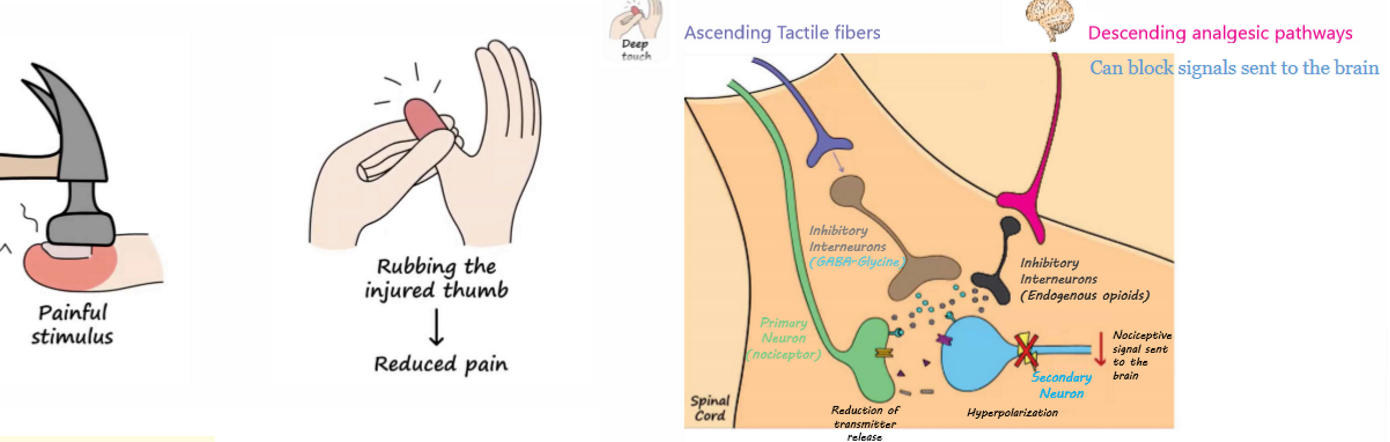
Melzack and Wall 1965
Modulatory control of nociception
40
Pain cannot be modulated
- True
- False
41
Which systems modulates pain?
Descending systems found in the:
- Periaqueductal gray matter of the mid-brain
- Raphe nuclei
- Locus coeruleus
- Other nuclei of the rostral medulla
- Periaqueductal gray matter of the mid-brain
- Raphe nuclei
- Locus coeruleus
- Other nuclei of the rostral medulla
42
Describe stimulation-induced analgesia
Electrical stimulation of the periaqueductal grey (PAG) can produce sufficient analgesia to perform abdominal surgery without anaesthesia
Other, non-painful, sensations left intact
PAG thought to control nociceptive gate in the dorsal horn by integrating inputs from the cortex, thalamus and hypothalamus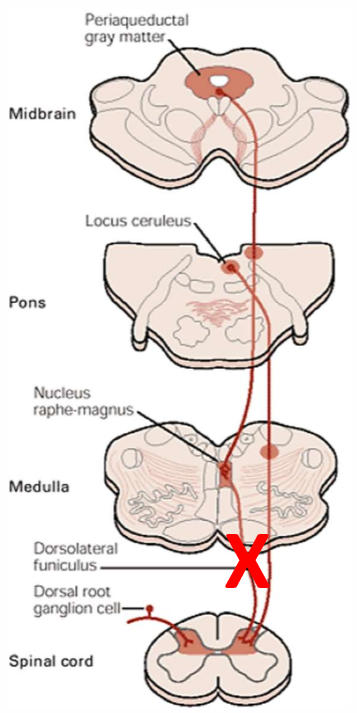
Other, non-painful, sensations left intact
PAG thought to control nociceptive gate in the dorsal horn by integrating inputs from the cortex, thalamus and hypothalamus
43
What blocks stimulation-induced analgesia
Bilateral transection of the dorsolateral funiculus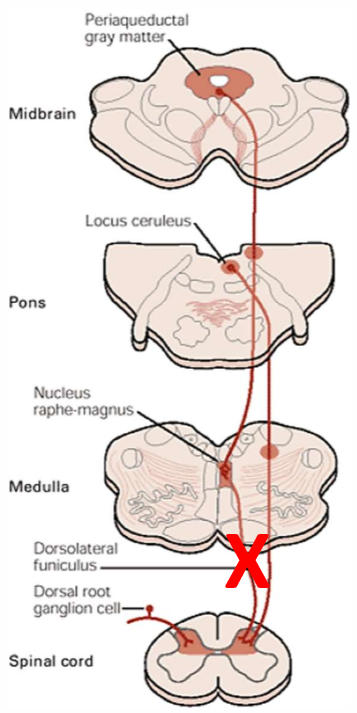
44
Name 2 effective alagesic agents
Opiates eg. morphine and codeine
Microinjections of low doses of morphine/other opiates into PAG of rat brain produces powerful analgesia by inhibiting firing of nociceptive neurons in the dorsal horn
Microinjections of low doses of morphine/other opiates into PAG of rat brain produces powerful analgesia by inhibiting firing of nociceptive neurons in the dorsal horn
45
Describe 2 ways of blocking morphine-induced analgesia
Injection of opiate antagonist: naloxone
Injected into PAG or serotonergic nucleus raphe magnus
Bilateral transection of dorsal lateral funiculus
Indicates that morphine also produces analgesia by activating descending inhibitory pathways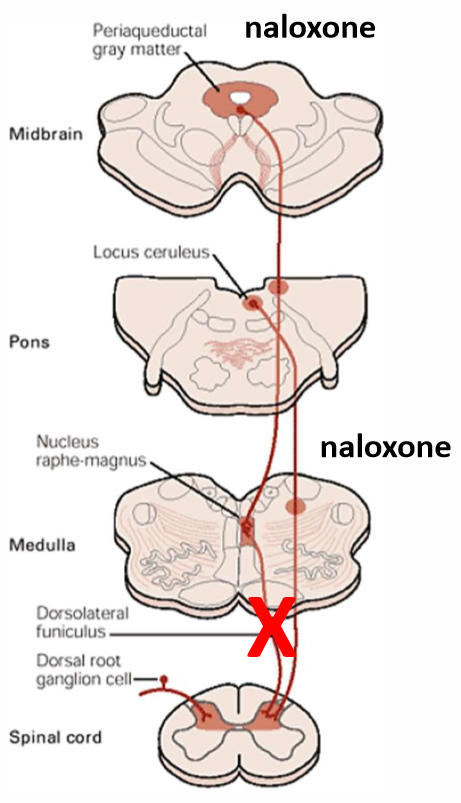
Injected into PAG or serotonergic nucleus raphe magnus
Bilateral transection of dorsal lateral funiculus
Indicates that morphine also produces analgesia by activating descending inhibitory pathways
46
Define placeba analgesia
Administration of substance known to be non-analgesic produces analgesic response when the subject is told that it is a pain killer
Traditionally believed pain modulation circuits to act on entire body
BUT recent evidence suggests opioid medication of pain can be targeted to one or 2 parts of the body
Traditionally believed pain modulation circuits to act on entire body
BUT recent evidence suggests opioid medication of pain can be targeted to one or 2 parts of the body
47
Give an example of a study that investigated placebo analgesia
Capsaicin applied to distal regions of all 4 limbs
Pps asked to report magnitude of pain at each site
Expectations introduced by application of placebo cream - pps told it was a powerful local anaesthetic
Placebo analgesia only occurred on the treated part
Spatially specific placebo resopnse abolished when intravenous infusion of naloxone (opioid antagonist) - suggests it was mediated by one of the endogenous opioid systems
Somatotopic organisation of PAG (in rats) has been found - stimulation of different areas produced analgesia in different cutaneous regions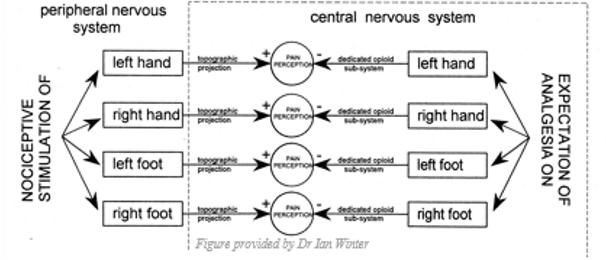
Pps asked to report magnitude of pain at each site
Expectations introduced by application of placebo cream - pps told it was a powerful local anaesthetic
Placebo analgesia only occurred on the treated part
Spatially specific placebo resopnse abolished when intravenous infusion of naloxone (opioid antagonist) - suggests it was mediated by one of the endogenous opioid systems
Somatotopic organisation of PAG (in rats) has been found - stimulation of different areas produced analgesia in different cutaneous regions