Genetics - chimps to humans
Study these flashcardsFree · spaced repetition · iPhone, Android, Mac & web
All cards
1
How many chromosomes do humans have?
46
2
How many chromosomes do chimps have?
48
3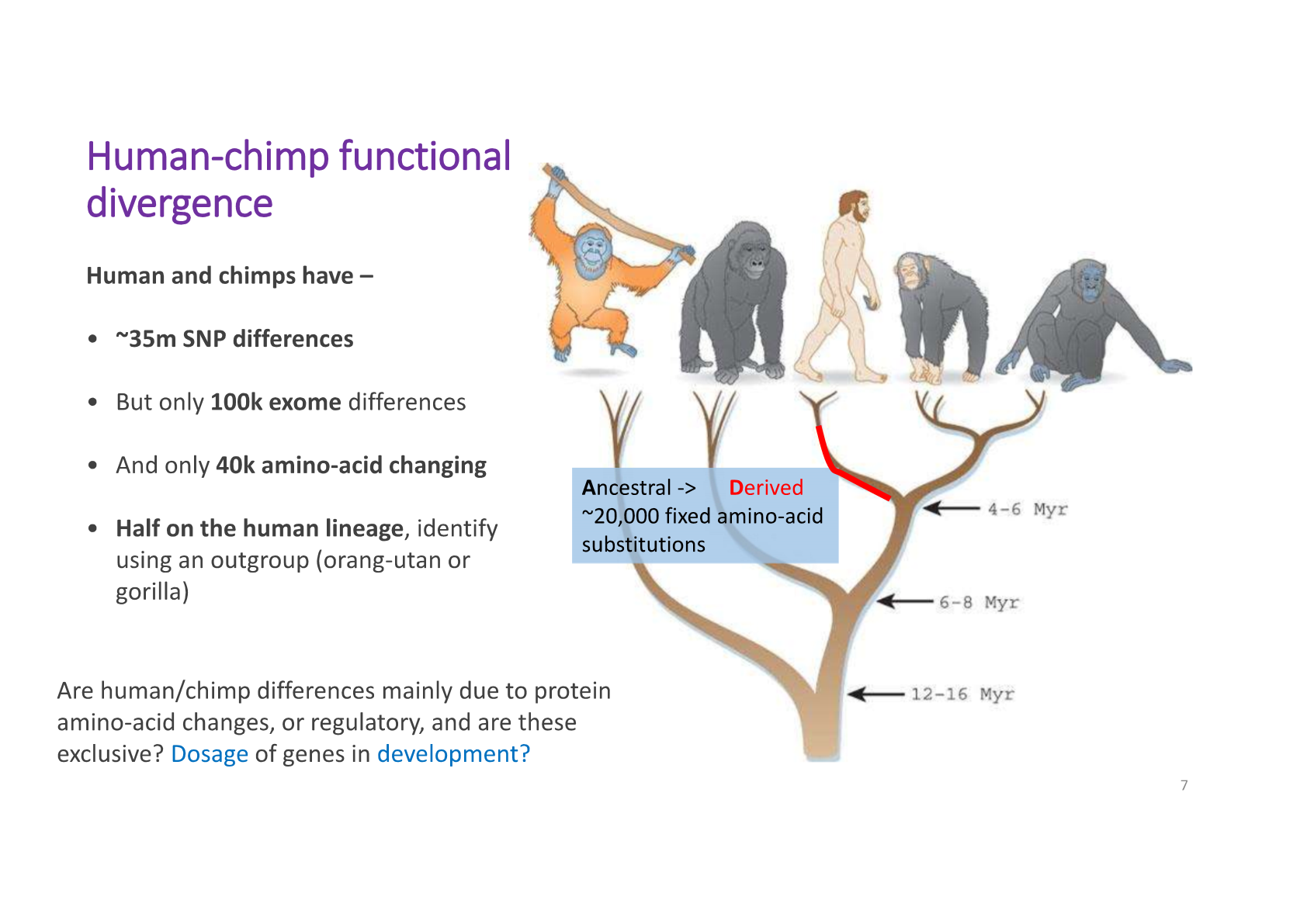
Image occlusion: name the hidden labels
4
Name 3 biological process categories with an excess of positively selected genes in humans
Immunity and defense
Gametogenesis/fertilisation/sperm mobility
Chemosensory perception/olfaction
Gametogenesis/fertilisation/sperm mobility
Chemosensory perception/olfaction
5
Which tissue has been found to have the highest number of genes postively selected for?
Testes
Aids fertility/sperm competition?
OR less purifying selection - only expressed in 1 sex so invisible to evolution half of the time
Aids fertility/sperm competition?
OR less purifying selection - only expressed in 1 sex so invisible to evolution half of the time
6
Outline 3 possible models explaining the sudden genetic switch in Upper Paleolithic behaviour
No switch, gradual accumulation of many small changes
One switch
Two switches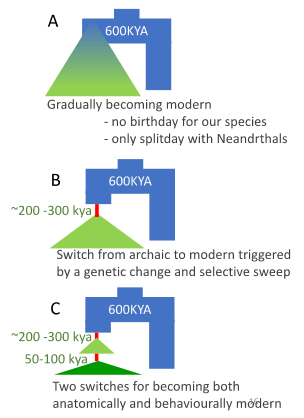
One switch
Two switches
7
1 method for idenitfying switch to modernity
Autosomal gene trees
8
What did Mallick et al find and when?
2016
Analysed 40 genomes
Diverse populations
Result imply shared ancestor more than 100kya
Humanity not defined by a single gene
No evidence of sudden switch in gene pool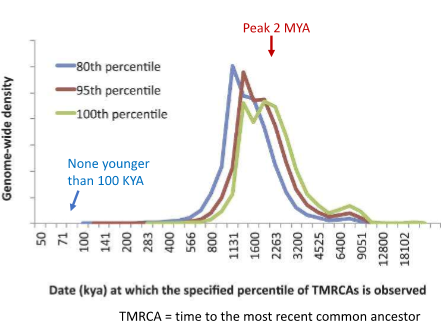
Analysed 40 genomes
Diverse populations
Result imply shared ancestor more than 100kya
Humanity not defined by a single gene
No evidence of sudden switch in gene pool
9
Limitations of studying ancient DNA
- DNA decay, associated with humidity and thermal fluctuations
- Older harder to analyse due to diffusion of DNA molecules
- Older harder to analyse due to diffusion of DNA molecules
10
Outline the relationships between Neanderthals, Denisovans and modern humans
Neanderthals and Denisovans are sister taxa
Diverged from modern humans together
Interbred with humans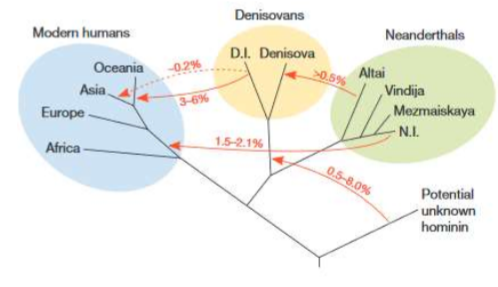
Diverged from modern humans together
Interbred with humans
11
What makes modern humans different to Denisovans and Neanderthals?
Over 12,000 bp where humans carry derived alleles and D and N carry ancestral allele
BUT most likely neutral
Very few fixed aa changes
BUT many more differences in high frequency alleles - potentially involved in regulation
BUT most likely neutral
Very few fixed aa changes
BUT many more differences in high frequency alleles - potentially involved in regulation
12
What genetic change might indicate selection?
High frequency nonsynonymous differences
13
Which processes seem to have undergone human specific changes?
Brain growth
Cellular features of neurons
Craniofacial phenotype
Life history traits
Cellular features of neurons
Craniofacial phenotype
Life history traits
14
What did Slon et al find and when?
2018
'Denny' had N mother and D father
Mixing common?
'Denny' had N mother and D father
Mixing common?
15
What did Simonti et al find and when?
2016
Found some N gene variants in present humans can increase risk of depression, skin lesions, blood clots and other disorders
Likely to only be a small effect
Found some N gene variants in present humans can increase risk of depression, skin lesions, blood clots and other disorders
Likely to only be a small effect
16
What did Fu et al find and when?
2016
Decrease in N ancestry in modern humans
Suggests natural selection against introgressed genes
Decrease in N ancestry in modern humans
Suggests natural selection against introgressed genes
17
What did Sankararaman et al find and when?
2014
N ancestry not uniformally distributed across each chromosome
Lower density in X chromosome
Evidence for male hybrid sterility
Testis expressed genes 5x lower than N content
55,000 years of purifying selection reducing N X proportion?
Might explain why modern humans are unique
N ancestry not uniformally distributed across each chromosome
Lower density in X chromosome
Evidence for male hybrid sterility
Testis expressed genes 5x lower than N content
55,000 years of purifying selection reducing N X proportion?
Might explain why modern humans are unique
18
Outline the 2 genes found to be significantly depleted in N and D sequences
Amylase gene cluster - starch enzyme
FOXP2 - language
FOXP2 - language
19
When did admixture between modern humans and N and D occur?
After modern humans left Africa
20
Introgression is...
- Adaptive
- Maladaptive