Visual Perception - 2
Study these flashcardsFree · spaced repetition · iPhone, Android, Mac & web
All cards
1
Define receptive field
Regions of the visual field in which light stimulation causes the receptor to respond
2
Do retinal gangion cells and visual cortical neurons have receptive fields?
Yes, despite not resopnding to light (response driven by photoreceptors)
3
Define centre-surround antagonism
Light around a cell's RF has opposite effect to light in cell's RF centre
Cells respond to relative stimulation of centre vs periphery rather than overall light stimulation
Retina responds poorly to large uniform regions of light
Cells respond to relative stimulation of centre vs periphery rather than overall light stimulation
Retina responds poorly to large uniform regions of light
4
Who first demonstrated centre-surround antagonism and when?
Hartline and Graham 1930s in a horseshoe crab
Kuffler 1950s in the vertabrete eye of a cat
Kuffler 1950s in the vertabrete eye of a cat
5
Define on-centre cell
Excitatory inputs at centre of cell and inhibitory inputs in surround
6
Define off-centre cell
Inhibitory inputs at centre of cell and excitatory inputs in surround
7
Name 3 phenomena that can be explained by centre-surround antagonism
Simultaneous brightness contrast
Mach bands in stepped-intensity patterns
Mach bands in stepped-intensity patterns
8
Name the illusion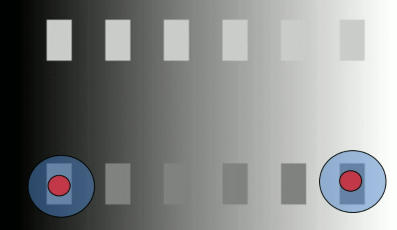
Simultaneous brightness contrast
9
Describe the simultaneous brightness contrast illusion
Blue represents surround of retinal ganglion cell
Red represents centre of retinal ganglion cell
Our perception is the relative contrast between the centre and surround of RF
Eg the right ganglion cell
Dark centre with lighter surround
Firing will be inhibitied so rectangle will look darker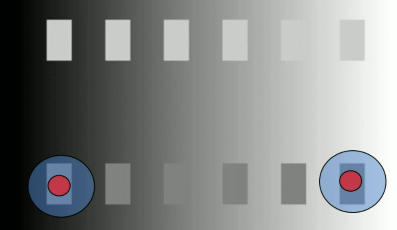
Red represents centre of retinal ganglion cell
Our perception is the relative contrast between the centre and surround of RF
Eg the right ganglion cell
Dark centre with lighter surround
Firing will be inhibitied so rectangle will look darker
10
Name the illusion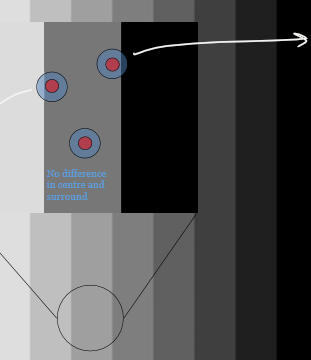
Stepped-intensity patterns
11
Describe the stepp-intensity pattern illusion
All centre cells = medium grey
Left ganglion cell: more light hitting surround > centre = inhibition of responses
Right ganglion cell: surround darker > centre = cell activated
Changes in brightness - makes it look like there are edges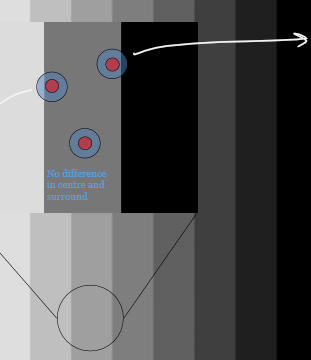
Left ganglion cell: more light hitting surround > centre = inhibition of responses
Right ganglion cell: surround darker > centre = cell activated
Changes in brightness - makes it look like there are edges
12
What kind of info do ganglion cells transmit?
Mostly contrast at edges
13
Name 2 other visual processes influenced by contrast
Orientation
Colour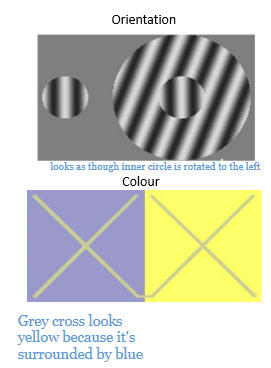
Colour
14
State the 3 principles for visual neurons
Neurons are 'tuned to' or 'selective for' specific visual features
Principle of univariance
Principle of adaptive independence
Principle of univariance
Principle of adaptive independence
15
State 2 examples of a feature that neurons are 'tuned to'
Particular wavelengths of light
Particular orientation of a bar
Particular orientation of a bar
16
Describe how neurons might be tuned to a particular orientation
Bars of different orientations presented to a cell's RF
Cell tuned to 45degrees in this example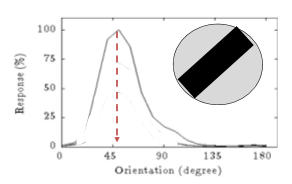
Cell tuned to 45degrees in this example
17
Describe the principle of univariance
Cells responses vary along a single dimension - firing rate can increase/decrease
BUT multiple factors can influence firing rate (eg. orientation, salience)
So cannot use firing rate in isolation to understand what is in the cell's RF
Response of a single neuron is ambiguous (seen in image)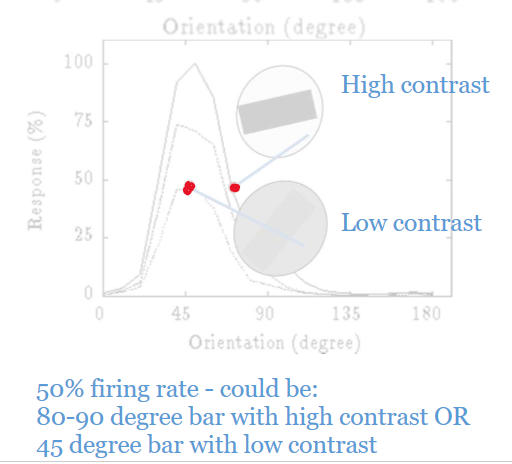
BUT multiple factors can influence firing rate (eg. orientation, salience)
So cannot use firing rate in isolation to understand what is in the cell's RF
Response of a single neuron is ambiguous (seen in image)
18
How does the visual system clarify / understand the info using the firing rates of visual cells?
Pattern coding
Compare output of several cells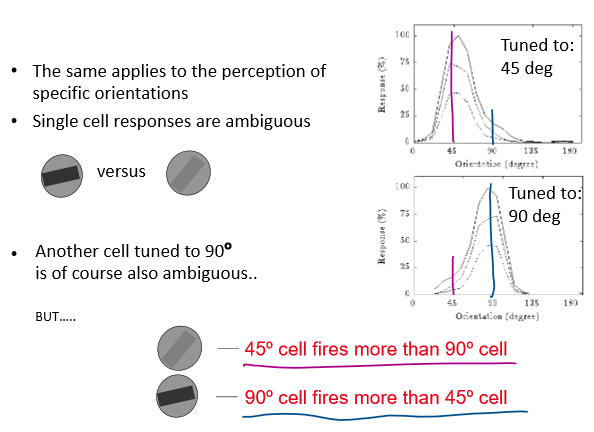
Compare output of several cells
19
Define pattern coding
Relative responses of mechanisms tuned to different features provide an unambiguous signal (eg. relative response ratio of S/M/L wavelength cones in colour vision)
This arises for orientation, depth, motion etc.
Combinging responses of multiple cells
This arises for orientation, depth, motion etc.
Combinging responses of multiple cells
20
How could we work out what sort of pattern coding operates in human vision?
Neurons selective for 1 stimulus can be selectively adapted without other neurons being adapted
Leads to perceptual distortions
Can use this to make inferences about underlying neurophysiology
Leads to perceptual distortions
Can use this to make inferences about underlying neurophysiology
21
Describe the principle of adaptive independence
Individual mechanisms can be adapted independently
Neurons selective for 1 stimulus can be selectively adapted without other neurons being adapted
Useful for revealing visual mechanisms
Can independently adapt cells tuned to certain features (without affecting other cells)
Neurons selective for 1 stimulus can be selectively adapted without other neurons being adapted
Useful for revealing visual mechanisms
Can independently adapt cells tuned to certain features (without affecting other cells)
22
State and describe 2 perceptual distortions that can be explained by adaptive independence
Afterimages - perception of clear images on blank background after stimulation of eye has ceased
Aftereffects - adaptation to stimulus alters our perception of a second stimulus
Adapting to stimulus often leads ot negative afterimages/aftereffects
Aftereffects - adaptation to stimulus alters our perception of a second stimulus
Adapting to stimulus often leads ot negative afterimages/aftereffects
23
Describe ganglion cells' repsonses to orientation
Respond equally to an edge/line of any orientation
24
How do we perceive the orientation of a line using ganglion cells?
Outputs of several ganglion cells combiend with neighbouring RFs
Responses summated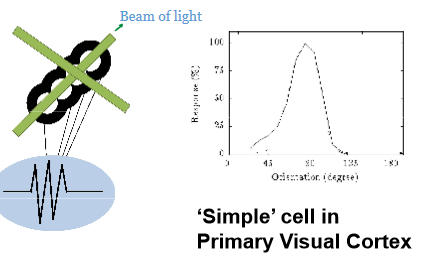
Responses summated
25
Describe and explain one way of revealing mechanisms behind orientation coding
Use perceptual effects of adaptation
Adapt pp to lines orientated 10-15degrees from vertical
Causes misperceptiono f second patch of vertical lines (appear to be tilted in opposite direction to adapted stimulus) - negative tilt aftereffect
Sharp peak in aftereffects arise at 10-15degres separation between adapting and testing angles
Suggest orientation units in visual system tuned to orientation 10-15 degrees apart might mutually inhibit each other
Tilt aftereffects may reflect inhibitory interactions between neighbouring regions in V1 (helps to finetune perception of line's orientation)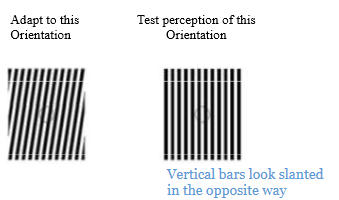
Adapt pp to lines orientated 10-15degrees from vertical
Causes misperceptiono f second patch of vertical lines (appear to be tilted in opposite direction to adapted stimulus) - negative tilt aftereffect
Sharp peak in aftereffects arise at 10-15degres separation between adapting and testing angles
Suggest orientation units in visual system tuned to orientation 10-15 degrees apart might mutually inhibit each other
Tilt aftereffects may reflect inhibitory interactions between neighbouring regions in V1 (helps to finetune perception of line's orientation)
26
Explain what the tilt aftereffects reveals about orientation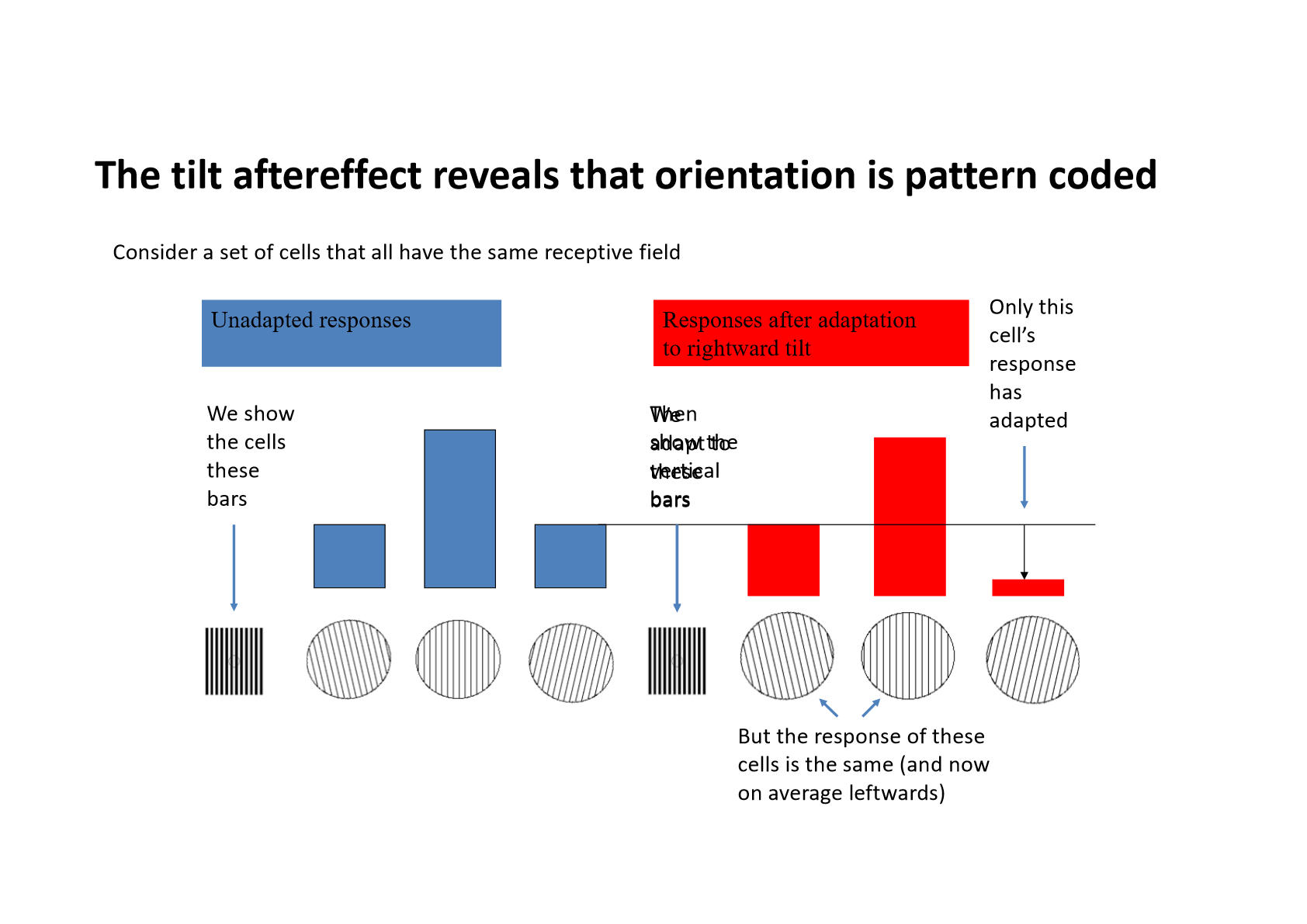
Reveals that orientation is pattern coded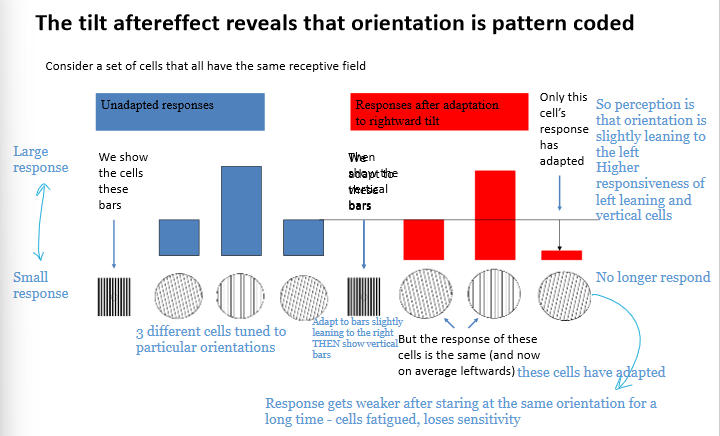
27
What did Hubel and Wiesel find and when?
1959
Made recordings from primary visual cortex in macaques
Found within functional units of cortex, known as 'hypercolumns' cells in neighbouring regions tended to code orientations 10-15degrees apart
Neighbouring orientation columns in V1 'tuned to' orientations 10-15 degrees apart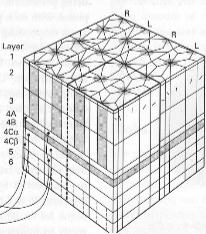
Made recordings from primary visual cortex in macaques
Found within functional units of cortex, known as 'hypercolumns' cells in neighbouring regions tended to code orientations 10-15degrees apart
Neighbouring orientation columns in V1 'tuned to' orientations 10-15 degrees apart
28
What might our perception of orientation depend on?
Relative firing of several orientation-sensitive neurons coding a particular area of the visual field
Type of pattern coding
Type of pattern coding