HA - cold macroenvironments
Study these flashcardsFree · spaced repetition · iPhone, Android, Mac & web
All cards
1
Factfile: 35C
Mild hypothermia
Shivering
Numb hands
Reduced manual dexterity
Shivering
Numb hands
Reduced manual dexterity
2
Factfile: 33-34C
Moderate hypothermia
Intense shivering
Confused
Lack of muscle coordination
Intense shivering
Confused
Lack of muscle coordination
3
Factfile: 32C
Severe hypothermia
Shivering fails and stops
Collapse and semi-conscious
Shivering fails and stops
Collapse and semi-conscious
4
Factfile: 30C
Unconscious
Pulse and breathing barely detectable
Pulse and breathing barely detectable
5
At what body temp does death occur as a result of hypothermia?
28C
6
Describe the effect of wind
Enhances rate of heat loss
Blows away layer of warm air around the body
Blows away layer of warm air around the body
7
Effect of wind chill in -30C
No wind chill = little danger for properly clothed person
With wind chill:
50kmph = -49C
Exposed skin freezes in 30sec
With wind chill:
50kmph = -49C
Exposed skin freezes in 30sec
8
What poses a greater threat to humans than wind chill?
Cold, wet macroenvironments
9
Why are cold, wet macroenvironmnets so dangerous?
Water has 25x the thermal conductivity of air
Thus, heat is lost 25x faster
Insulative clothing not always effective in the event of precipitation
Thus, heat is lost 25x faster
Insulative clothing not always effective in the event of precipitation
10
Oultine research into the effects of cold, wet macroenvironments
18 male pps
5 hour simulated hike in 5C with 1 hour dry and 4 hours rain with moderate wind
11 pps did NOT finish
After 2 hours rain: shivering, loss of strength/dexterity
2 pps hypothermic
5 hour simulated hike in 5C with 1 hour dry and 4 hours rain with moderate wind
11 pps did NOT finish
After 2 hours rain: shivering, loss of strength/dexterity
2 pps hypothermic
11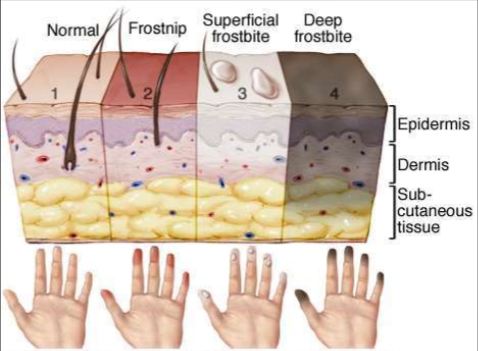
Image occlusion: name the hidden labels
12
State the 2 methods of avoiding hypothermia
Limit heat loss
Increase heat production
Increase heat production
13
Which strategy is easier and less costly to reduce heat loss?
Prevention (limiting heat loss > increasing heat production)
14
5 factors that complicate human adaptation
Frequency of cold
Duration of cold
Predictability of cold
Degree of exposure to wind chill
Degree of exposure to water
Duration of cold
Predictability of cold
Degree of exposure to wind chill
Degree of exposure to water
15
2 examples of cultural adaptations to cold macroenvironments
Clothing
Housing
Housing
16
How is clothing adaptive in cold macroenvironments?
Traps layer of still air close for insulation
Stops wind from disrupting insulation
Removes sweat from skin
Stops wind from disrupting insulation
Removes sweat from skin
17
What is used to measure the effect of clothing?
Clo
18
1 clo = ?
Insulation allowing person at rest to maintain thermal equilibrium at 21C in normally ventilated room
19
How is housing adaptive to cold macroenvironments?
Thick insulation minimises radiative and convective heat losses
Low SA:V (round)
Bedding has similar properties to clothes
Behaviour: sleep in family groups to share body heat
Low SA:V (round)
Bedding has similar properties to clothes
Behaviour: sleep in family groups to share body heat
20
How are igloos adaptive to cold macroenvironments?
Long entrance (chambered)
Raised sleeping area reduces drafts and benefits from warmer air
Warm air and blocked wind creates a warm macroenvironment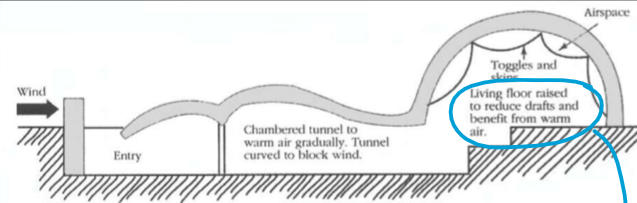
Raised sleeping area reduces drafts and benefits from warmer air
Warm air and blocked wind creates a warm macroenvironment
21
4 examples of behavioural adaptation to cold macroenvironments
Movement
Modifying SA:V by huddling together
Eating
Activity sheduling
Modifying SA:V by huddling together
Eating
Activity sheduling
22
How is moving adaptive in cold macroenvironments?
Increases metabolism through activity
Stamping feet and swinging arms sends blood to extremeties
Stamping feet and swinging arms sends blood to extremeties
23
How is eating adaptive in cold macroenvironments?
Thermic effect of food
Fat/protein more energy dense (requires more energy to digest, producing heat)
Vitamin C raises skin temp
Alcohol has short term benefits but long term problems
Fat/protein more energy dense (requires more energy to digest, producing heat)
Vitamin C raises skin temp
Alcohol has short term benefits but long term problems
24
How is activity scheduling adaptive in cold macroenvironments?
Avoid wind and water
Physical work during cold periods to generate heat
Physical work during cold periods to generate heat
25
Oultine Inuit dietary adaptations
High protein and high fat increase metabolic heat production
Few plants except during short summer, micronutrients gathered from other sources
Marine mammals very important
Fat is prized and eaten whenever possible
Fat soluble micronutrients eg. vitamin A and D
Organ meats (especially raw) = vitamin C
Healthy and varied diet for the environment
Few plants except during short summer, micronutrients gathered from other sources
Marine mammals very important
Fat is prized and eaten whenever possible
Fat soluble micronutrients eg. vitamin A and D
Organ meats (especially raw) = vitamin C
Healthy and varied diet for the environment
26
State 2 of the observed genetic adaptations to the Inuit diet
Nonsense mutation in the TBC1D4 gene
Variation in fatty acid desaturase genes
Variation in fatty acid desaturase genes
27
How is a mutation in the TBC1D4 gene adaptive in Inuit populations?
Affects glucose metabolism of native Greenland Inuit
Nonsense mutation in TBC1D4 gene, allele frequency = 17%
Associated with reduced glucose uptake in muscles, thus increasing risk of type 2 diabetes
BUT adaptation to high lipid diet, sparing glucoes availability for the brain
Nonsense mutation in TBC1D4 gene, allele frequency = 17%
Associated with reduced glucose uptake in muscles, thus increasing risk of type 2 diabetes
BUT adaptation to high lipid diet, sparing glucoes availability for the brain
28
How is variation in fatty acid desaturase genes adaptive in Inuit populations?
Variants of fatty acids desaturase (FADS) genes involved in fatty acid metabolism
Likely an adaptation to high levels of omega-3 polyunsaturated fatty acids (PUFAs) from a high fat, marine diet
Results in lower body mass and reduced stature
Likely an adaptation to high levels of omega-3 polyunsaturated fatty acids (PUFAs) from a high fat, marine diet
Results in lower body mass and reduced stature
29
What is a nonsense mutation?
DNA sequence change gives rise to a stop codon rather than a codon specifying an aa
Presence of new stop codon results in shortened protein, likely non-functional.
Presence of new stop codon results in shortened protein, likely non-functional.
30
2 biological adaptation to cold macroenvironments
Reduce heat loss
Metabolic adaptation to preserve and generate heat
Metabolic adaptation to preserve and generate heat
31
4 biological adaptations to reducing heat loss
Subcutaneous fat
Body size/shape: Bergmann and Allen's Rules
Vasoconstriction
Horripilation
Body size/shape: Bergmann and Allen's Rules
Vasoconstriction
Horripilation
32
3 metabolic adaptations to cold macroenvironments
Increased basal metabolism
Voluntary and involuntary metabolism
Brown fat activation
Voluntary and involuntary metabolism
Brown fat activation
33
How might body fat be adaptive to cold macroenvironments?
Subcutaneous fat acts as an inuslator - BUT muscle mass is better
34
Evidence for adaptiveness of body fat
Human populations in cold regions, Korean free divers and Polar Bears do not have very elevated subcutaneous fat
So little/no evidence for body fat adaptations in cold macroenvironments
So little/no evidence for body fat adaptations in cold macroenvironments
35
3 cranial adaptations to cold macroenvironments
Larger, more globular cranial vault
Flatter / broader faces
Taller, narrower noses
Minimises SA:V
Flatter / broader faces
Taller, narrower noses
Minimises SA:V
36
How is nose shape adaptive to climate?
Width of the nares correlated with temp and absolute humidity (but not relative humidity)
Some nose shape aspects potentially driven by local climate adaptation
Has complex evolutionary history, possibly involved other non-neutral evolutionary processes (sexual selection)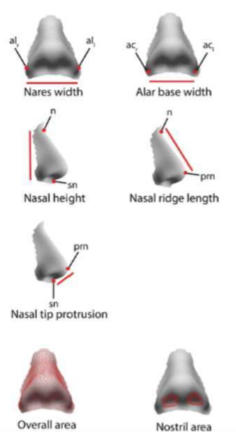
Some nose shape aspects potentially driven by local climate adaptation
Has complex evolutionary history, possibly involved other non-neutral evolutionary processes (sexual selection)
37
Define vasoconstriction
Diverting blood from shell to core
38
How is vasoconstriction adaptive in cold macroenvironments?
Blood redirected to visceral organs
Extremeties have high SA:V causing high heat loss through surface
Extremeties have high SA:V causing high heat loss through surface
39
Danger of vasoconstriction
Too much/prolonged vasoconstriction can lead to frostbite
40
Outline the hunting response
Cold induced vasodilation (CIVD)
Occurs 5-10mins after cold exposure
Increased with frequent cold exposure
Skin temp < 10C
Waves of vasodilation/vasoconstriction to the extremeties
Helps maintain normal function and prevent frostbite/tissue death
Humans have limited CIVD compared to other species
Occurs 5-10mins after cold exposure
Increased with frequent cold exposure
Skin temp < 10C
Waves of vasodilation/vasoconstriction to the extremeties
Helps maintain normal function and prevent frostbite/tissue death
Humans have limited CIVD compared to other species
41
3 ways in which horripilation is adaptive to cold macroenvironments
Contraction of arrector pili muscles at base of hair follicles
Traps insulative air next to skin
Not very effective in humans
Traps insulative air next to skin
Not very effective in humans
42
When is heat production activated?
When insulative heat mechanisms are insufficient
43
How is metabolism adaptive to cold macroenvironments?
Non-shivering thermogenesis = increase in metabolic heat production (above the basal metabolism) that is not associated with muscle activity
Plasticity in basal metabolic rate
Involuntary muscle contractions (shivering)
Plasticity in basal metabolic rate
Involuntary muscle contractions (shivering)
44
Define metabolic rate
Amount of energy expended at rest
Increased by:
- Cold exposure and acclimatisation
- Populations indigenous to cold environments relative to predictions from body surface area, mass and fat-free mass
Increased by:
- Cold exposure and acclimatisation
- Populations indigenous to cold environments relative to predictions from body surface area, mass and fat-free mass
45
Define basal metabolism
Number of calories your body needs to accomplish its most basic (basal) life-sustaining functions
46
Name the hormone important in influencing metabolic rate
Thyroxine
47
How is involuntary muschle contraction adaptive in cold macroenvironments
Induced by cutaneous cold receptors
Starts in trunk/proximal, moves to extremeties
Can double/triple basal metabolic rate
May generate up to 1,200kJ/hr
Regulated by negative feedback loop
Starts in trunk/proximal, moves to extremeties
Can double/triple basal metabolic rate
May generate up to 1,200kJ/hr
Regulated by negative feedback loop
48
State the 3 types of adipose tissue
White
Beige/Brite
Brown
Beige/Brite
Brown
49
Describe white adipose tissue
Low mitochrondial density
One large lipid droplet
Main functions = energy storage, endocrine
One large lipid droplet
Main functions = energy storage, endocrine
50
Describe beige / brite adipose tissue
Medium mitchodrial density
Few to many lipid droplets
Main functions = thermogenesis? endocrine?
Few to many lipid droplets
Main functions = thermogenesis? endocrine?
51
Describe brown adipose tissue
High mitochodrial density
Numerous lipid droplets
Main functions = thermogenesis, endocrine
Numerous lipid droplets
Main functions = thermogenesis, endocrine
52
Outline the importance of brown adipose tissue
Important role in infants but also found in adults
Primary function = thermoregulation
Primary function = thermoregulation
53
Name the protein found in brown adipose tissue
Expressed uncoupling protein 1 (UCP1)
54
Outline the expressed uncoupling protein 1 (UCP1)
Releases heat instead of producing ATP
55
How is brown adipose tissue adaptive to cold macroenvironments?
BAT mass increased in animals fed high fat diets (high fat in Arctic diets)
Evidence of long-term adaptation affecting brown fat cells (same thing as BAT) in indigenous populations from cold climates (signs of selection near TBX15, involved in development and differentiation of brown fat cells)
Evidence of long-term adaptation affecting brown fat cells (same thing as BAT) in indigenous populations from cold climates (signs of selection near TBX15, involved in development and differentiation of brown fat cells)
56
Name a gene found to be adaptive to cold environments
TRPM8 (depends on the allele of this gene)
57
Outline how variations of the TRPM8 gene are adaptive to cold macroenvironments
Senses moderate cold
Several signs of positive selection in Eurasian populations in last 25,000 years
Rare in Africa, more common outside
Frequencies strongly correlate with latitude
Associated with migraines - potential costs of cold adaptation?
Several signs of positive selection in Eurasian populations in last 25,000 years
Rare in Africa, more common outside
Frequencies strongly correlate with latitude
Associated with migraines - potential costs of cold adaptation?
58
Evidence of cold acclimatisation in Korean and Japanese free divers
0C air and 10C water in winter
30% increase in basal metabolic rate in winter
Non-shivering thermogenesis
Blunted/delayed shivering response
Can torelate core temp of 35C
Insulative cold acclimatisation involves peripheral blood flow
30% increase in basal metabolic rate in winter
Non-shivering thermogenesis
Blunted/delayed shivering response
Can torelate core temp of 35C
Insulative cold acclimatisation involves peripheral blood flow
59
Evidence of cold acclimatisation in pps exposed to 10 days of cold exposure
More cold tolerant
Time to shivering delayed
Increased BAT activation - evidence of plasticity in response to cold
Beter vasoconstrictive response and heat conservation at body shell
Maintenance of optimal blood perfusion to the skin
Time to shivering delayed
Increased BAT activation - evidence of plasticity in response to cold
Beter vasoconstrictive response and heat conservation at body shell
Maintenance of optimal blood perfusion to the skin
60
Outline the single stressor model of cold adaptation
Macroenvironment: arctic (seasonal intense cold, predictable), high altitude (diurnal cold, predictable), arid habitats (diurnal cool, predictable)
Leads to behavioural/cultural buffer: clothing, housing, bedding, activity scheduling, alcohol/drug use, fire/cooking
Essential resources: clothing, bedding, housing
Potentially leads to biological buffer: body form (SA:V), subcutaneous fat, vasoconstriction, CIVD (cold induced vasodilation), shivering
Demographic effects: infants, some occupational groups
Leads to behavioural/cultural buffer: clothing, housing, bedding, activity scheduling, alcohol/drug use, fire/cooking
Essential resources: clothing, bedding, housing
Potentially leads to biological buffer: body form (SA:V), subcutaneous fat, vasoconstriction, CIVD (cold induced vasodilation), shivering
Demographic effects: infants, some occupational groups
61
Define blood perfusion
Process of oxygenated blood being delivered to the body's tissues