HA - hot macroenvironments
Study these flashcardsFree · spaced repetition · iPhone, Android, Mac & web
All cards
1
4 ways in which body heat is lost / gained through the skin
Conduction
Convection
Radiation
Evaporation
Convection
Radiation
Evaporation
2
Define conduction and describe its role in heat exchange with the environment
Transfer of heat between 2 solid objects in physical contact
Very minor role in human thermoregulation
Heat loss / gain proportionate to surface area
Very minor role in human thermoregulation
Heat loss / gain proportionate to surface area
3
Define convection and describe its role in heat exchange with the environment
Gain/loss of heat through air/water contact with body
Convection currents: warm air rises and cool air moves in to replace it
Exchange rapid if skin warm and air cold
Convection currents: warm air rises and cool air moves in to replace it
Exchange rapid if skin warm and air cold
4
Define radiation and describe its role in heat exchange with the environment
Exchange of electromagnetic energy between objects close to each other
High ambient temperature: radiant heat may be gained from the sun, ground and surrounding surface
Rate of thermal exchange affected by temperature, reflectance and surface area
High ambient temperature: radiant heat may be gained from the sun, ground and surrounding surface
Rate of thermal exchange affected by temperature, reflectance and surface area
5
Define evaporation
Heat loss through conversion of liquid to a gas on the body surface eg. sweating
6
4 factors that affect rate of heat loss by evaporation
Surface area
Vapour pressure of surroundings
Surface temperature
Amount of liquid present on surface
Vapour pressure of surroundings
Surface temperature
Amount of liquid present on surface
7
In ambient conditions, what is the only method of losing heat?
Evaporation - especially when exercising
8
Factfile: hot, dry macroenvironments
Deserts and savannahs
Extremely high temp - air temp up to 58C, ground temp up to 93C
High rates of heat gain from solar radiation during day
Heat causes rapid movement as hot air rises, increasing convective heat gain
Limited water restricts plant growth and natural shade
Wide temperature fluctuations, heat radiates away at night, leading to rapid cooling
Extremely high temp - air temp up to 58C, ground temp up to 93C
High rates of heat gain from solar radiation during day
Heat causes rapid movement as hot air rises, increasing convective heat gain
Limited water restricts plant growth and natural shade
Wide temperature fluctuations, heat radiates away at night, leading to rapid cooling
9
Factfile: hot, humid macroenvironments
Tropical rainforests
Moist air and clouds restrict solar radiative heat gain during the day
Abundant water and shade, lower daily temp variation
Less convective and radiative heat gain
Humidity slows evaporation, limits cooling
Higher humidity increases how hot it feels and increases risk of heat injury
Moist air and clouds restrict solar radiative heat gain during the day
Abundant water and shade, lower daily temp variation
Less convective and radiative heat gain
Humidity slows evaporation, limits cooling
Higher humidity increases how hot it feels and increases risk of heat injury
10
What is the temperature homeostasis for humans?
36-38C for bodily functions
11
Humans reach heat stress relatively ______
- Slowly
- Quickly
12
5 symptoms of heat stress
Elevated skin and core body temp
Inadequate sweating
Dehydration
Dizziness and mental confusion
Nausea and collapse
Inadequate sweating
Dehydration
Dizziness and mental confusion
Nausea and collapse
13
What is the threshold temp for death in humans?
42C
14
What core temp qualifies as heat stroke?
Body temp above 41C
15
Heat stroke consequences
Untreated = brain damage followed by death
Treated = mortality rate still at around 30%
Therefore, the dangers of heat stroke acts as a selective pressure, leading to adaptations
Treated = mortality rate still at around 30%
Therefore, the dangers of heat stroke acts as a selective pressure, leading to adaptations
16
2 categories of adaptation
Behaviour and culture
Biological
Biological
17
Categories of behavioural and cultural adaptations to heat stress
Activity scheduling
Housing
Clothing
Housing
Clothing
18
Categories of biological adaptations to heat stress
Vascular responses
Sweat glands
Body mass
Sweat glands
Body mass
19
How is activity scheduling adaptive?
Limit activity during hottest time to reduce heat generation
20
How is housing adaptive in hot, dry environments?
Thick walls delay heat absorption (day) and loss (night)
High heat capacity building materials
Minimal SA:V
Whitewashed to reflect sun
High heat capacity building materials
Minimal SA:V
Whitewashed to reflect sun
21
How is housing adaptive in hot, wet environments?
Air circulation
Air vents
Air vents
22
What is evaporative cooling?
Passive cooling of structures through evaporation
Very effective
Very effective
23
How is evaporative cooling adaptive in hot, dry environments?
Courtyard houses have pools/fountains
Water evaporates, removing heat and cooling air
Window screens keep sun out and wetting screens cools house as water evaporates
Water evaporates, removing heat and cooling air
Window screens keep sun out and wetting screens cools house as water evaporates
24
How is clothing adaptive in hot, dry environments?
Inhibits convective heating from hot winds
Permeable to water to allow for evaporative cooling
Light, reflective colours reduce radiative heat gain
Dark colours protect better against sunburn
Loose clothes promote convection
Permeable to water to allow for evaporative cooling
Light, reflective colours reduce radiative heat gain
Dark colours protect better against sunburn
Loose clothes promote convection
25
How is clothing adaptive in hot, humid environments?
As little clothing as possible
26
Cultural adaptations more effective in...
- Dry heat
- Humid heat
27
How are vascular responses adaptive to heat stress?
Peripheral vasodilation
Heat transferred away from body (core to shell to environment)
Heat transferred away from body (core to shell to environment)
28
Limitations of the vascular responses to heat stress
- Strain on cardiovascular system
- Increased HR and BP
- Blood pools in peripheral veins, slowing return to heart
- If air temp > body temp, heat absorbed into body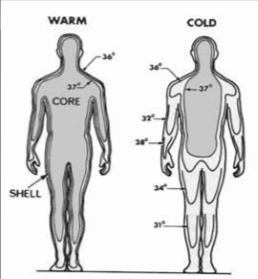
- Increased HR and BP
- Blood pools in peripheral veins, slowing return to heart
- If air temp > body temp, heat absorbed into body
29
State the 2 type of sweat glands
Apocrine
Eccrine
Eccrine
30
Outline aprocrine sweat glands
Associated with hair follicles
Armpits and groin
Secrete fluid rick in lipids and proteins
Rich substrate for bacteria, leading to smell
Not very involved in cooling response
Armpits and groin
Secrete fluid rick in lipids and proteins
Rich substrate for bacteria, leading to smell
Not very involved in cooling response
31
Outline eccrine sweat glands
All over body
Secrete water and salt
Secrete water and salt
32
Humans have ______ density of eccrine sweat glands than other mammals
- lower
- higher
33
How much heat is lost from 1 litre of sweat?
2,400kJ of stored heat energy
Up to 2-3 litres of sweat/hr
Up to 2-3 litres of sweat/hr
34
In what conditions is sweating ineffective?
> 75% humidity
Dehydration still a risk
Dehydration still a risk
35
Outline the cooling mechanisms in hot, humid environments
Vasodilation
High SA:V
- BUT overall cooling mechanisms ineffective
High SA:V
- BUT overall cooling mechanisms ineffective
36
2 aspects of acclimatisation to dry heat
Increased sweating - initiated at lower temp and starts in limbs
Increased plasma volume (haemodilution) - reservoir for sweat
Increased plasma volume (haemodilution) - reservoir for sweat
37
The result of acclimatisation to dry heat
Reduced sodium ion losses (lower sweat salt content)
Reduced skin and core temp
Reduced HR and skin blood flow
Reduced skin and core temp
Reduced HR and skin blood flow
38
How quick is acclimatisation to dry heat, and how quickly is it lost?
Occurs within 10-14 days
Lost in few days/weeks
Lost in few days/weeks
39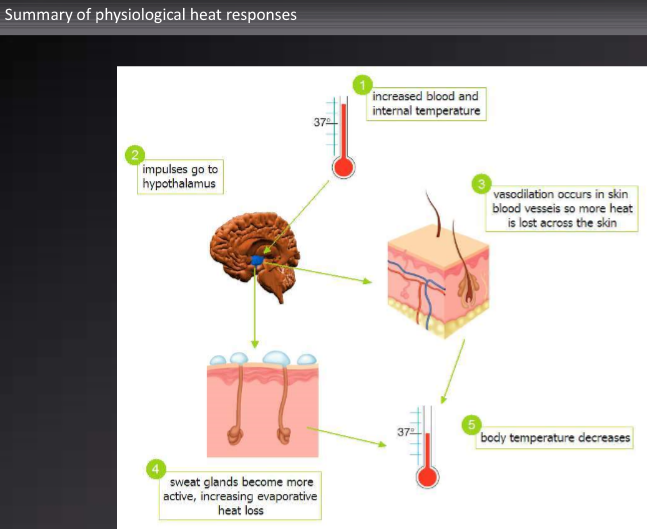
Image occlusion: name the hidden labels
40
Outline Bergmann's Rule
Individuals who inhabit warmer regions will have smaller body mass than individuals in colder regions
41
Higher mass =
- less heat produced
- more heat produced
42
Smaller body =
- smaller SA:V
- larger SA:V
43
Larger SA:V =
- less heat exchange with environment, less heat lost
- more heat exchange with environment, more heat lost
44
Outline research into Bergmann's Rule
Pre 1950:
- Humans show evidence of Bergmann's rule
After 1953:
- Reduced association of human body mass with annual temp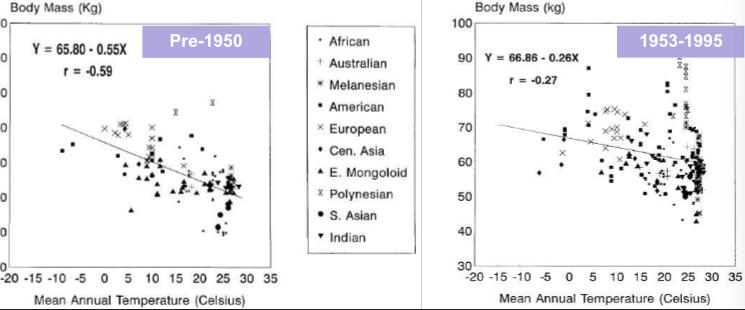
- Humans show evidence of Bergmann's rule
After 1953:
- Reduced association of human body mass with annual temp
45
Shorter extremeties =
- lower SA:V, reduced heat retention
- lower SA:V, more heat retention
- higher SA:V, reduced heat retention
- higher SA:V, more heat retention
46
Outline Allen's Rule
Shorter extremeties (eg. limbs, ears) = reduced SA:V = more heat retention
47
What did Trinkaus find and when?
1981
Neanderthal limb proportions associated with mean annual temp
Warmer = longer tibia/femur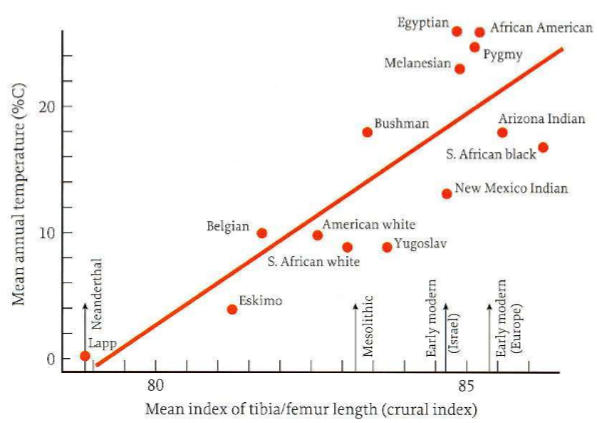
Neanderthal limb proportions associated with mean annual temp
Warmer = longer tibia/femur
48
What did Weaver and Ingram find and when?
1969
Pigs from same litters
Raised at 5/20/35 C
Cold group:
- More body hair
- Greater body mass
- Shorter limbs
- Shorter tails, ears
Intermediate group = intermediate morphology
Suggests adaptations plasticity > genetics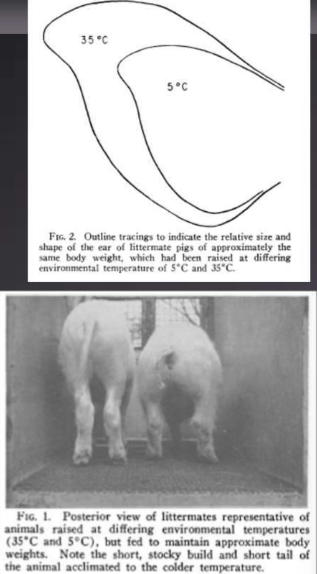
Pigs from same litters
Raised at 5/20/35 C
Cold group:
- More body hair
- Greater body mass
- Shorter limbs
- Shorter tails, ears
Intermediate group = intermediate morphology
Suggests adaptations plasticity > genetics
49
Interpret these graphs.
Does it suggest climate-related changes in body mass and limb proportions are a result of plasticity or genetics?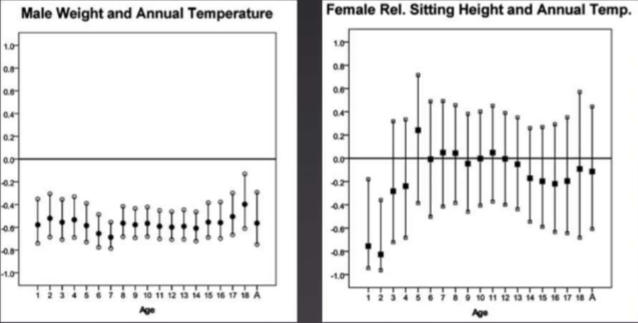
Does it suggest climate-related changes in body mass and limb proportions are a result of plasticity or genetics?
Shows climate related changes
Especially in infancy
Plasticity: infants are smaller, more affected by heat stress so have to adapt faster
Not necessarily plasticity - genetics may also play a role
Especially in infancy
Plasticity: infants are smaller, more affected by heat stress so have to adapt faster
Not necessarily plasticity - genetics may also play a role
50
Outline Ruff's cylinder model
Human body can be modelled as a cylinder
SA:V changes little with height
Pelvic breadth key to heat dissipation
SA:V changes little with height
Pelvic breadth key to heat dissipation
51
Evidence for Ruff's cylinder model
Correlate latitude with stature and pelvic breadth
Far stronger postitive relationship between latitude and pelvic breadth than with stature
Higher latitude = colder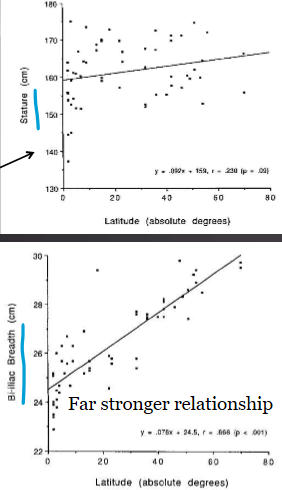
Far stronger postitive relationship between latitude and pelvic breadth than with stature
Higher latitude = colder
52
3 significant thermoregulatory advantages in bipedalism for large-brained, tropical primates
1. Dramatic reduction in direct solar radiation exposure
2. Higher distribution of body surfaces (higher wind speeds and lower air temp further from the ground) - increases rate of heat dissipation via convection
3. Greater airflow and lower relative humidity above surface vegetation increases sweat evaporation - also as a result of hair loss?
2. Higher distribution of body surfaces (higher wind speeds and lower air temp further from the ground) - increases rate of heat dissipation via convection
3. Greater airflow and lower relative humidity above surface vegetation increases sweat evaporation - also as a result of hair loss?
53
Outline the single stressor model for dry heat
Macroenvironment: deserts, savannahs (both = intense midday heat, cold nights)
Leads to behavioural/cultural buffer: shading, housing, activity scheduling, evaporative cooling (essential resources include water, clothing)
Potentially progresses to biological buffer: SA:V, vasodilation, perspiration
Impact of demographic effects: infants, elderly, ppl with cardiovascular problems (less able to physically adapt)
Leads to behavioural/cultural buffer: shading, housing, activity scheduling, evaporative cooling (essential resources include water, clothing)
Potentially progresses to biological buffer: SA:V, vasodilation, perspiration
Impact of demographic effects: infants, elderly, ppl with cardiovascular problems (less able to physically adapt)
54
Evaluate single stressor models
+ Simplifies, allows focus of one stressor
- Environments often multi-stress
- Environments often multi-stress
55
Outline the single stressor model: humid heat
Macroenvironments: rainforests (little diurnal change)
Leads to behavioural/cultural buffer: ventilation, minimise clothing (essential resources include raised houses)
Potentially progresses to biological buffer: vasodilation, perspiration only somewhat effective
Impact of demographic effects: infants, elderly, ppl with cardiovascular problems
Leads to behavioural/cultural buffer: ventilation, minimise clothing (essential resources include raised houses)
Potentially progresses to biological buffer: vasodilation, perspiration only somewhat effective
Impact of demographic effects: infants, elderly, ppl with cardiovascular problems