HA - high altitude environments
Study these flashcardsFree · spaced repetition · iPhone, Android, Mac & web
All cards
1
State the 9 stresses found in high altitude environments
Hypoxia (reduced oxygen availability)
Cold
Aridity
High insolation
Temperature variation
Low productivity
Soil erosion
Extreme topography
ENSO (recurring climate pattern involving changes in the temperature of waters in the central and eastern tropical Pacific Ocean)
Cold
Aridity
High insolation
Temperature variation
Low productivity
Soil erosion
Extreme topography
ENSO (recurring climate pattern involving changes in the temperature of waters in the central and eastern tropical Pacific Ocean)
2
How many ppl live >2500m?
140 million
3
Define hypoxia
Low oxygen levels in the blood and tissues
4
At what altitude does oxygen availability in the body decrease?
Around 2,100m
Leads to short and long term adaptation
Leads to short and long term adaptation
5
Describe the death zone
8000m plus
Adaptation no longer works
Adaptation no longer works
6
Why does hypoxia occur at high altitude?
Lower barometric pressure
Fewer oxygen molecules in each breath compared to sea level
NOT a reducted in oxygen concentration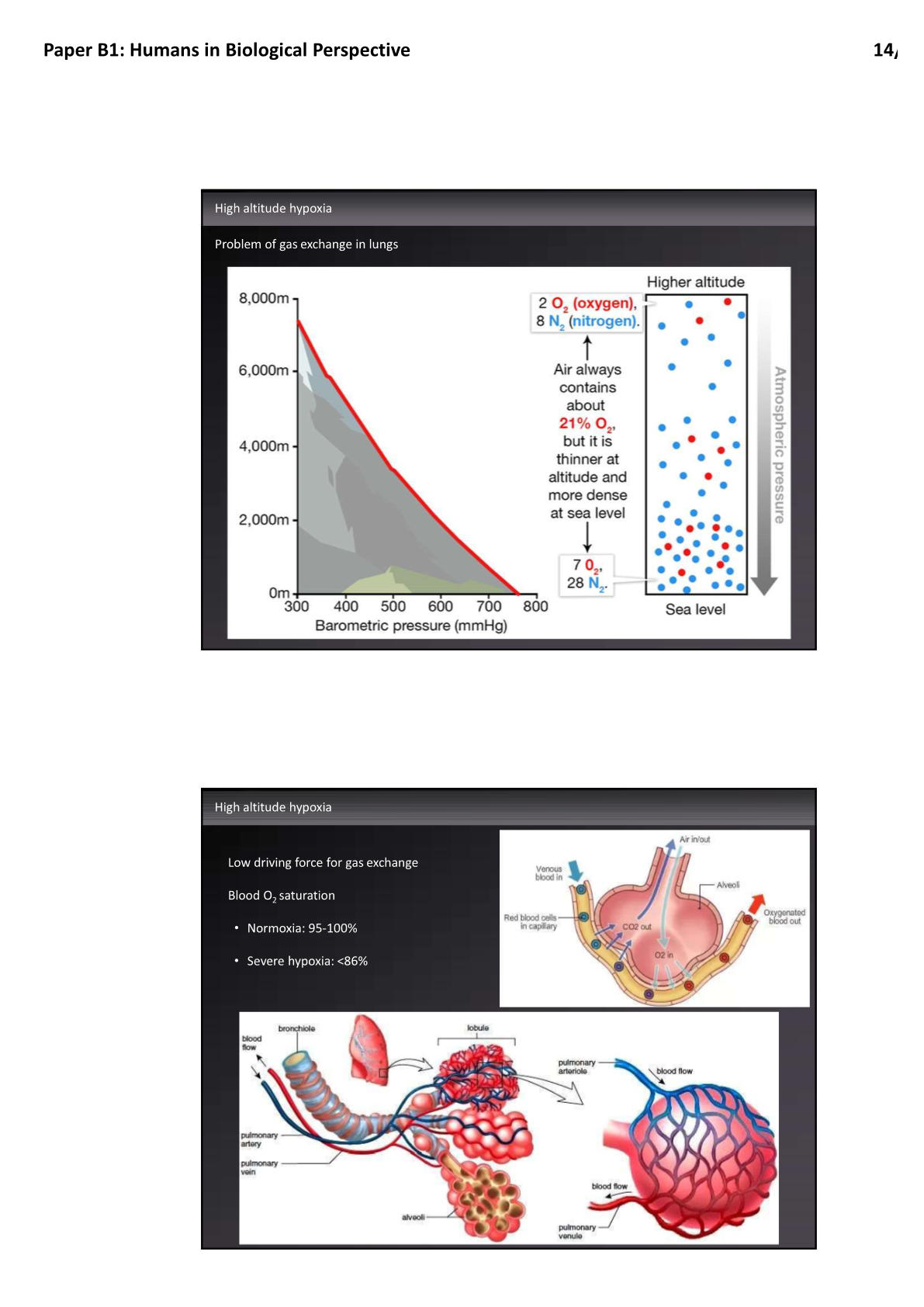
Fewer oxygen molecules in each breath compared to sea level
NOT a reducted in oxygen concentration
7
Define normoxia
Oxygen 95-100%
8
Define severe hypoxia
<86%
9
How does hypoxia affect blood oxygen saturation?
Reduces oxygen diffusion gradient
Reduces rate of oxygen diffusion into blood
Reduced blood oxygen saturation
Reduces rate of oxygen diffusion into blood
Reduced blood oxygen saturation
10
State the 2 physiological responses to high altitude hypoxia
Adaptations to increase oxygen availability in body
Acute mountain sickness
Acute mountain sickness
11
Define erythrocytosis
Increased/extra RBC production
Higher concentration of RBC - leads to increased blood viscosity
Higher concentration of RBC - leads to increased blood viscosity
12
State the 4 adaptations to increase oxygen availability in the body
Rapid breathing
Increase heart rate
Increased Hb production
Erythrocytosis
Increase heart rate
Increased Hb production
Erythrocytosis
13
5 symptoms of acute mountain sickness
Dizziness
Headaches
Weakness
Loss of appetite/impaired digestion
Change in blood acidity, leading to nausea, vomiting
Headaches
Weakness
Loss of appetite/impaired digestion
Change in blood acidity, leading to nausea, vomiting
14
Individual responses to high altitude hypoxia...
- universal
- somewhat variable
- highly variable
15
State the 2 potential consequences of hypoxic stress
Pulmonary oedema
Cerebral oedema
Cerebral oedema
16
What is an oedema?
Fluid build up
17
Outline pulmonary oedema
Increased HR and BP leads to progressive flooding of pulmonary alveoli
Inhibits oxygen transport further
Effectively drowning
Difficulty breathing, cough, chest congestion, wheezing, headache
Inhibits oxygen transport further
Effectively drowning
Difficulty breathing, cough, chest congestion, wheezing, headache
18
Outline cerebral oedema
Fluid accumulation and swelling in the brain
Affects <1% ppl asceding to 4000m
Confusion, amnesia, hallucinations, disorientation, headache, vomiting
Affects <1% ppl asceding to 4000m
Confusion, amnesia, hallucinations, disorientation, headache, vomiting
19
3 types of adaptation to high altitude hypoxia
Cultural
Behavioural
Biological
Behavioural
Biological
20
Cultural adaptations to high altitude hypoxia
Oxygen tanks - limited and impractical
No other cultural adaptations
No other cultural adaptations
21
Behavioual adaptations to high altitude hypoxia
Descend
Minimise physical activity
Minimise physical activity
22
Biological adaptations to high altitude hypoxia
Targets amount and efficiency of oxygen transport
Respiration
Cardiovascular
Tissue-level
Genetics
Plasticity
Respiration
Cardiovascular
Tissue-level
Genetics
Plasticity
23
When does acclimatisation occur?
2-3 days (1 day per 1000m)
Additional improvements with time
Additional improvements with time
24
How is respiration adaptive to high altitude hypoxia?
Increased ventilation rate and deapth
High lung capacity and working volume
High lung capacity and working volume
25
How is cardiovascular adaptive to high altitude hypoxia?
Increased HR and cardiac output
High pulmonary BP
Diversion of blood to vital organs
High pulmonary BP
Diversion of blood to vital organs
26
Define angiogenesis
Production of new blood vessels
27
What is myoglobin?
Allows for temporary storage of oxygen in the muscle
28
How is tissue-level adaptive to high altitude hypoxia?
Erythrocytosis and increased Hb content (carries more oxygen)
Denser capillary networks (angiogenesis) - maximises blood flow and oxygen delivery
Muscle develop higher myoglobin content
Decreased mitochondrial density
Denser capillary networks (angiogenesis) - maximises blood flow and oxygen delivery
Muscle develop higher myoglobin content
Decreased mitochondrial density
29
Name 3 long term native high-altitude populations
Andes
Ethiopian highlands
Tibetan plateau
Ethiopian highlands
Tibetan plateau
30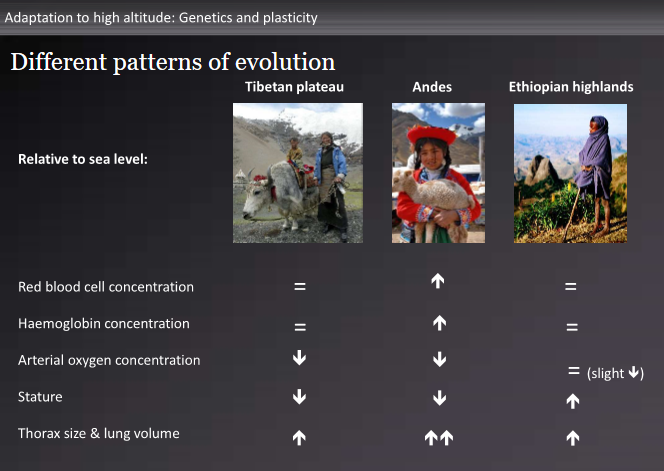
Image occlusion: name the hidden labels
31
Image occlusion: name the hidden labels
32
Image occlusion: name the hidden labels
33
Image occlusion: name the hidden labels
34
Image occlusion: name the hidden labels
35
Image occlusion: name the hidden labels
36
Image occlusion: name the hidden labels
37
Image occlusion: name the hidden labels
38
Image occlusion: name the hidden labels
39
Image occlusion: name the hidden labels
40
Image occlusion: name the hidden labels
41
Image occlusion: name the hidden labels
42
Image occlusion: name the hidden labels
43
Image occlusion: name the hidden labels
44
Image occlusion: name the hidden labels
45
Image occlusion: name the hidden labels
46
Image occlusion: name the hidden labels
47
Image occlusion: name the hidden labels
48
What is the danger of erythrocytosis?
Chronic mountain sickness
49
Outline the difference between hypoxaemia and hypoxia
Hypoxemia = low oxygen levels in your blood
Hypoxia = low oxygen levels in your tissues
Hypoxia = low oxygen levels in your tissues
50
Outline chronic mountain sickness (CMS)
Characterised by:
- Erythrocytosis increases blood viscosity (requires stronger heart contractions leading to hypertension and decreased efficiency of oxygen transportation)
- Hypoxaemia
- Pulmonary hypertension
- Potential heart failure
Prevalent in Andeans but very low risk in Tibetans
Only treatment = descend to lower altitude
- Erythrocytosis increases blood viscosity (requires stronger heart contractions leading to hypertension and decreased efficiency of oxygen transportation)
- Hypoxaemia
- Pulmonary hypertension
- Potential heart failure
Prevalent in Andeans but very low risk in Tibetans
Only treatment = descend to lower altitude
51
Why does erythrocytosis not lead to selection for adaptations to high altitude?
Erythrocytosis can cause death after reproductive period (genes already passed on)
52
Evidence of adaptations in high altitude populations affecting birth/pregnancy
Slow foetal growth and low birth weight as a result of reduced oxygen availability
Relatively large placenta with high SA:V to increase oxygenation
Birth weight less affected by high altitude in high altitude natives
Reduced uterine artery blood flow causes foetal growth restriction at high altitude
Uterine artery blood flow explains 1/3 variation in birth weight
Relatively large placenta with high SA:V to increase oxygenation
Birth weight less affected by high altitude in high altitude natives
Reduced uterine artery blood flow causes foetal growth restriction at high altitude
Uterine artery blood flow explains 1/3 variation in birth weight
53
Evidence of genetic adaptations in Tibetans
Higher nitritc oxide in Tibetans than lowland natives
Nitric oxide acts as a vasodilator
May reduce pulmonary hypertension
Nitric oxide acts as a vasodilator
May reduce pulmonary hypertension
54
Evidence of plasticity to high altitude
Andeans and acclimatised non-Andeans have similar nitric oxide concentration and pulmonary BP at high altitude
55
What can cause foetal growth restriction at high altitude?
Reduced uterine artery blood flow
Uterine artery blood flow explains 1/3 variation in birth weight
Uterine artery blood flow explains 1/3 variation in birth weight
56
Evidence of genetic adaptation in Andeans
Mutations in PRKAA1 and EDNRA associated with increased birth weight among high altitude Andeans
PRKAA1 mutation associated with increased uterine artery blood flow among Andean women in pregnancy
PRKAA1 mutation associated with increased uterine artery blood flow among Andean women in pregnancy
57
Describe growth at high altitude
Slow prolonged growth at high altitude
Late growth spurt
Short adult stature
Potentially adaptive: small = reduced oxygen requirement?
High altitude population 8-10cm shorter than lowland, BUT only 1-2cm directly relates to altitude
Late growth spurt
Short adult stature
Potentially adaptive: small = reduced oxygen requirement?
High altitude population 8-10cm shorter than lowland, BUT only 1-2cm directly relates to altitude
58
Describe evidence for developmental plasticity at high altitude
Accelerated growth of chest, lungs and right ventricle during childhood/adolesence
Greater surface area in lungs
Larger lung volumes in high altitude natives and acclimatisation from birth/during growth
Greater surface area in lungs
Larger lung volumes in high altitude natives and acclimatisation from birth/during growth
59
What is a missense mutation?
Single base pair substitution alters the genetic code in a way that produces an amino acid that is different from the usual amino acid at that position
60
Potential gene found to be involved in height
Missense mutation FBN1 in Peruvians (Andes)
Decreasees height by 2.2cm when homozygous
Under positive selection
BUT more common on coast>highlands
Suggests that it is NOT related to oxygen adaptations
Decreasees height by 2.2cm when homozygous
Under positive selection
BUT more common on coast>highlands
Suggests that it is NOT related to oxygen adaptations
61
Differences in limb proportions in high altitude populations
High altitude children smaller than lowland and different limb proportions
Children grew more in lowlands, despite poverty
Largest differences in lower leg and arm, hands and feet
Tibia length significantly lower in children with low blood oxygen saturation
Height, chest circumference, sitting height, tibia length and ankle diameter greatest in fatter children, independent of ethnicity oxygen saturation
Body fat has less impact on growth when oxygen is sufficient
Children grew more in lowlands, despite poverty
Largest differences in lower leg and arm, hands and feet
Tibia length significantly lower in children with low blood oxygen saturation
Height, chest circumference, sitting height, tibia length and ankle diameter greatest in fatter children, independent of ethnicity oxygen saturation
Body fat has less impact on growth when oxygen is sufficient
62
Define hypoxia inducible factors
Transcription factors (n=3) that respond to hypoxia at the cellular level
63
Example of a hypoxia inducible factor
EPAS1
64
Describe EPAS1
Hypoxia inducible factor
Important gene for high altitude adaptation in Tibetans
Inherited from interbreeding with Denisovans >40,000 kyr
Tibetans have less Hb (lower Hb associated with Tibetan EPAS1 gene):
- Avoids clots and strokes when blood thickens
- Use oxygen more efficiently
Important gene for high altitude adaptation in Tibetans
Inherited from interbreeding with Denisovans >40,000 kyr
Tibetans have less Hb (lower Hb associated with Tibetan EPAS1 gene):
- Avoids clots and strokes when blood thickens
- Use oxygen more efficiently
65
Evidence for adaptation to high altitude in Sherpas
Sherpas vs European native lowlanders before and during hypoxic exposure
Sherpas:
- Lower capacity for FA oxidation in skeletal muscle biopsies (less reliance on fat, prioritise carbs)
- Greater efficiency of oxygen use
- Improved muscle energetics
- Protection against oxidative stress
Advantages partly related to PPARA allele: Sherpas>lowlanders
Sherpas:
- Lower capacity for FA oxidation in skeletal muscle biopsies (less reliance on fat, prioritise carbs)
- Greater efficiency of oxygen use
- Improved muscle energetics
- Protection against oxidative stress
Advantages partly related to PPARA allele: Sherpas>lowlanders
66
Evidence for epigenetics in high altitude plasticity
Differentially methylated regions
Methylation associated with early life exposure (prenatal and developmental):
- HIF pathway
- RBC production
- BP
- Fractional exhaled nitric oxide
Significant association between EPAS1 methylation and genotype
Methylation associated with early life exposure (prenatal and developmental):
- HIF pathway
- RBC production
- BP
- Fractional exhaled nitric oxide
Significant association between EPAS1 methylation and genotype
67
Describe the HIF pathway
HIF1A = hypoxia inducible factor
Encodes HIF1alpha transcription factor
Enough oxygen: HIF1alpha degraded
NOT enough oxygen: HIF1alpha moves into nucleus, associates with HIF1beta, leading to transcription of various genes
Encodes HIF1alpha transcription factor
Enough oxygen: HIF1alpha degraded
NOT enough oxygen: HIF1alpha moves into nucleus, associates with HIF1beta, leading to transcription of various genes
68
Describe the type of adaptations seen in traditional high altitude populations
Biological
No cultural / behavioural responses
No cultural / behavioural responses
69
Describe acute mountain sickness
Visitors who don't adapt
Temporary adverse reaction to hypoxia
Headache, nausea, vomiting, fatigue, breathlessness
Temporary adverse reaction to hypoxia
Headache, nausea, vomiting, fatigue, breathlessness
70
Who can suffer from chronic mountain sickness?
Even well-adapted high altitude ppl can lose their adaptations and become ill
71
Outline an explanation for evidence of biological adaptation in Andean and Tibetan populations
Lived at high altitudes for around 11,000 years
Long enough for natural selection to take effect and select for traits advantageous in countering hypoxia
European and Han high altitude residents have not had enough time in hypoxic environments for natural selection to have occurred
Long enough for natural selection to take effect and select for traits advantageous in countering hypoxia
European and Han high altitude residents have not had enough time in hypoxic environments for natural selection to have occurred
72
What does the admixture model suggest?
Some populations have low and high altitude ancestry
Suggests ppl with high proportion of Native American ancestry will exhibit more beneficial responses to acute hypoxia IF it has a genetic basis
Suggests ppl with high proportion of Native American ancestry will exhibit more beneficial responses to acute hypoxia IF it has a genetic basis
73
What do hypoxia inducible factors cause in resonse to hypoxia?
Immediate increase in breathing rate
Increase RBC no. after a week
New blood vessel growth - angiogenesis
More oxygen efficient pathway for producing metabolic energy
Increase RBC no. after a week
New blood vessel growth - angiogenesis
More oxygen efficient pathway for producing metabolic energy
74
Evidence for biological difference in high altitidue populations
Andean lowlanders have larger lung volume than European sea-level natives
Suggests Andeans have larger lung volume regardless of current altitude
Suggests Andeans have larger lung volume regardless of current altitude
75
Evidence for biological adaptation in Tibetans > upward migrants
Elevate blood flow to brain more than upward migrants
76
Why is growth decreased at high altitudes?
Higher oxygen demands during growth and pregnancy
77
Describe a potential morphological adaptation observed in Andeans
Growth in chest size accelerated
Positive correlation between chest dimensions and lung volumes in Andeans
Positive correlation between chest dimensions and lung volumes in Andeans
78
What is the danger with a reduced birth weight at high altitudes?
Low birth weight = higher infant mortality
79
Evidence for heavier babies in high altitude populations > upward migrants
Andean and Tibetan women produce babies 8-10% heavier than European and Han women at the same altitude
Suggets better oxygen transport to foetus
Evidence of reorgansied blood flow during pregnancy in Andean and Tibetan women:
- Enhances oxygen delivery to foetus
- More growth
- Heavier birth weights
Suggests selection in highland women
Suggets better oxygen transport to foetus
Evidence of reorgansied blood flow during pregnancy in Andean and Tibetan women:
- Enhances oxygen delivery to foetus
- More growth
- Heavier birth weights
Suggests selection in highland women
80
Outline the developmental adaptation hypothesis
Highland populations distinctive due to hypoxic exposure during development
Causes structural and functional modifications to normal processes
Suggests adaptation due to developmental exposure to hypoxia > natural selection
Causes structural and functional modifications to normal processes
Suggests adaptation due to developmental exposure to hypoxia > natural selection
81
Outline research into the developmental adaptation hypothesis
Compared European children living at high and low altitude with no ancestral exposure to high altitude
Slightly greater vital capacity in high altitude sample (less than Andean highlanders)
Oxygen metabolism lower at high altitudes prior to adolescence (after = same as sea level)
Suggests development essential in achieving complete adaptation (adolescene is a critical period)
BUT evidence for Andean children having larger developmental response than European children
Slightly greater vital capacity in high altitude sample (less than Andean highlanders)
Oxygen metabolism lower at high altitudes prior to adolescence (after = same as sea level)
Suggests development essential in achieving complete adaptation (adolescene is a critical period)
BUT evidence for Andean children having larger developmental response than European children
82
Define vital capacity
Total volume of air exhaled after maximal inhalation
Larger VC might:
- More oxygen molecules per breath
- Greater surface area for oxygen diffusion into blood
Andean VC consistently substantially larger than sea-level
Larger VC might:
- More oxygen molecules per breath
- Greater surface area for oxygen diffusion into blood
Andean VC consistently substantially larger than sea-level