Development - perinatal development in a social world
Study these flashcardsFree · spaced repetition · iPhone, Android, Mac & web
All cards
1
Define perinatal
Period of time from conception, through pregnancy and up to 1 year after birth
2
Define social from a zoological perspective
Living together in groups, typically in hierarchical system with complex communication
3
Define social cues in the human sense
Cues that are human-generated, either visual or auditory, which originate from conspecifics (same species)
4
What did Adolphs suggest and when?
2009
Ability to attibute simple cues to complex social states is what defines humans
Though to be a contributing factor to the developmnet of our culture and civilisation
Ability to attibute simple cues to complex social states is what defines humans
Though to be a contributing factor to the developmnet of our culture and civilisation
5
What did Horner & Whiten find and when?
2005
Chimps only engage in social learning and cooperation when they obtain food rewards
Do not try to reengage with others
Chimps only engage in social learning and cooperation when they obtain food rewards
Do not try to reengage with others
6
What did Warneken et al find and when?
2006
Children engage in social cooperative activities and expect others to cooperate with them
Children engage in social cooperative activities and expect others to cooperate with them
7
A larger proportion of the brian is devoted to the ... in apes compared to monkeys
- Parietal lobe
- Temporal lobe
- Frontal lobe
- Occipital lobe
- Cerebellum
8
What did Dunbar suggest and when?
2003
Increased brain size driven by demands of living in complex social groups
More competitiors
Importance of keeping track of social relationships
Increased brain size driven by demands of living in complex social groups
More competitiors
Importance of keeping track of social relationships
9
What does social group size correlate with?
Size of prefrontal cortex
Positive correlation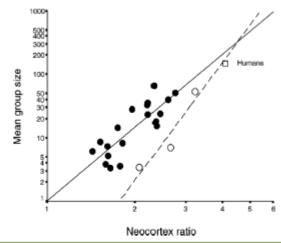
Positive correlation
10
Describe the effects evolution has had on the neocortex
Rapid expansion in the size of the neocortex as a result of evolution has led to it becoming increasingly folded
Cortex area in humans = 2,400cm2
Cortex area in cats = 100cm2
Cortex area in humans = 2,400cm2
Cortex area in cats = 100cm2
11
Describe developmental plasticity
Brain re-wires itself and modifies its connections
Can reorganise itself in terms of function and structure
Can reorganise itself in terms of function and structure
12
What would be the result of the brain being too plastic?
Only most recent input would matter
13
What would be the result of the brain not being plastic enough?
Slow time-course of adapting to a new/changing input
14
Describe the 'trade off' seen in developmental plasticity
Don't want too much/too litte
We explore our environment to gather new experience
Compare this to what has already been learned to become an efficient user of that info
We explore our environment to gather new experience
Compare this to what has already been learned to become an efficient user of that info
15
State and describe a test that can be used to assess binocular vision
Interocular transfer
The ability of an aftereffect to be produced by stimulation through only one eye but to be experienced by looking only through the other eye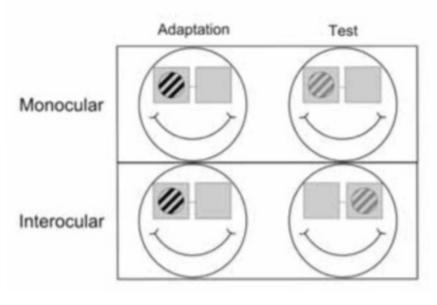
The ability of an aftereffect to be produced by stimulation through only one eye but to be experienced by looking only through the other eye
16
Describe a study that provides evidence for sensitive periods of developmental plasticity
Banks et al 1975
Children with esotropia (one eye facing inwards, affecting binocular vision)
Tested children's binocular vision using interocular transfer of the tilt-aftereffect
Sensitive period for development of binocular vision begins several months after birth and peaks between 1-3y
Operated on at an earlier age = scored higher on interocular transfer (correlated with better binocular vision)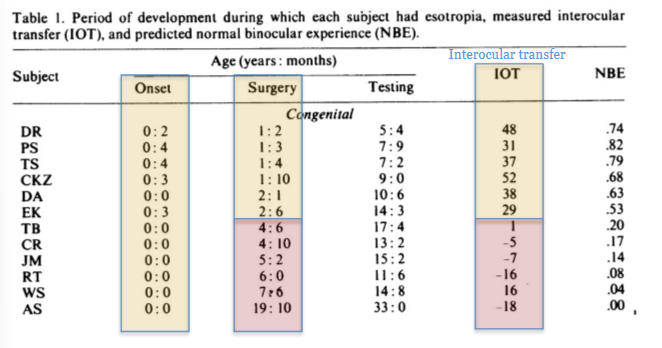
Children with esotropia (one eye facing inwards, affecting binocular vision)
Tested children's binocular vision using interocular transfer of the tilt-aftereffect
Sensitive period for development of binocular vision begins several months after birth and peaks between 1-3y
Operated on at an earlier age = scored higher on interocular transfer (correlated with better binocular vision)
17
What did Lock and James suggest and when?
17-19th century
Infants equipped with basic sensory mechanisms (eg. vision/touch) and powerful statistical brain that is highly skilled at detecting and learning associations between those sensory inputs
Children continue to learn more associations until their minds become more like adult minds
Infants equipped with basic sensory mechanisms (eg. vision/touch) and powerful statistical brain that is highly skilled at detecting and learning associations between those sensory inputs
Children continue to learn more associations until their minds become more like adult minds
18
Assumptions of the 'black slate' approach
Adults should always be better at cognitive tasks than adults
Skills and knowledge only acquired after birth
Skills and knowledge only acquired after birth
19
Describe the prevalent view of infant abilitiy in the 1950s
Opthamology textbooks: infants as basically blind
Audiology textbooks: infants as essentially deaf
Parenting advice was to limit bodily contact with the infant to avoid spoiling them
Viewing windows at American hospitals for relatives to view the infants without coming into contact with them
Audiology textbooks: infants as essentially deaf
Parenting advice was to limit bodily contact with the infant to avoid spoiling them
Viewing windows at American hospitals for relatives to view the infants without coming into contact with them
20
8 challenges associated with understanding and working with infantssumpot
- Hard to understand development during pregnancy
- Have to use tools that are safe for infants/foetuses
- Cannot ask infants to do what you want
- Short period of alertness (feeding and sleeping interrupt)
- Cannot ask them for feedback
- Brain structure constantly changing
- Still know little about the brain in infancy
- Development of brain specialisation due to genes and enviro even harder to separate during early development
- Have to use tools that are safe for infants/foetuses
- Cannot ask infants to do what you want
- Short period of alertness (feeding and sleeping interrupt)
- Cannot ask them for feedback
- Brain structure constantly changing
- Still know little about the brain in infancy
- Development of brain specialisation due to genes and enviro even harder to separate during early development
21
Describe a study that counters 'blank slate' approach (adults > infants assumption)
Infants can outperform adults
Pascalis et al 2002
Investigated development of specialisation for faces
6 and 9m babies shows human and monkey faces
6m can discriminate between monkey faces
9m cannot (same as adults)
Pascalis et al 2002
Investigated development of specialisation for faces
6 and 9m babies shows human and monkey faces
6m can discriminate between monkey faces
9m cannot (same as adults)
22
Counter to 'blank slate' approach (learning only after birth assumption)
Foetuses begin to respond to sounds in the womb after 20weeks gestation
Audiroty learning begins during pregnancy (likely 3rd trimester)
Audiroty learning begins during pregnancy (likely 3rd trimester)
23
Describe evidence for infants being able to acquire auditory knowledge before birth
Newborns can detect parent's voice > stranger's voice
Foeuses show preference to melody they have already been exposed to
Mampe et al 2009 - Newborns' crying melody shaped by native language
Foeuses show preference to melody they have already been exposed to
Mampe et al 2009 - Newborns' crying melody shaped by native language
24
Describe studies that have investigated visual cognition in newborns
Farroni et al 2002 - able to follow gaze of others and track face as it moves
Farroni et al 2005 - sensitive to structure of face within first hour of life
Farroni et al 2005 - sensitive to structure of face within first hour of life
25
Describe a study that investigated the earliest signs of human interaction
Castiello et al 2010
Ultrasound study looking at twins
Foetuses began reaching for twin by 14th week gestation
Reduced number of movements towards themselves, reaches to twin increased
By 18th week spent more time contacting twin than themselves / wall of uterus
Ultrasound study looking at twins
Foetuses began reaching for twin by 14th week gestation
Reduced number of movements towards themselves, reaches to twin increased
By 18th week spent more time contacting twin than themselves / wall of uterus
26
Define the human adult 'social brain' network
Responds to social stimuli
Includes:
- Lateral fusiform face gyrus
- Amygdala
- Frontal cortical regions (inferior frontal gyrus and medial prefrontal cortex)
- Superior temporal sulcus
- Temporo-parietal junction
- Portions of parietal cortex
Includes:
- Lateral fusiform face gyrus
- Amygdala
- Frontal cortical regions (inferior frontal gyrus and medial prefrontal cortex)
- Superior temporal sulcus
- Temporo-parietal junction
- Portions of parietal cortex
27
What did Farroni et al find and when?
2013
0-6 day old infants
Measured haemodynamic response in brain
Increased activity in dynamic social condition (face) > dynamic non-social condition (arm)
Magnitude of the response to the social stimulus increased with age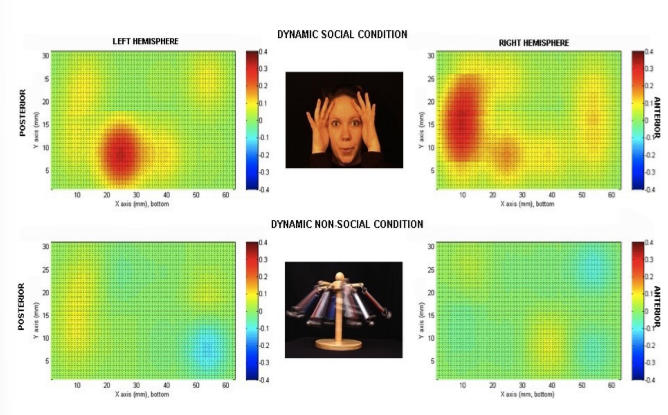
0-6 day old infants
Measured haemodynamic response in brain
Increased activity in dynamic social condition (face) > dynamic non-social condition (arm)
Magnitude of the response to the social stimulus increased with age
28
What did Belin et al find and when?
2000 and 2002
Identified voice-sensitive temporal regions
Suggests we have functional specialisation to voice
Stronger in right hemisphere:
- Anterior, central and posterior STS
- Superior temporal gyrus/sulcus
Identified voice-sensitive temporal regions
Suggests we have functional specialisation to voice
Stronger in right hemisphere:
- Anterior, central and posterior STS
- Superior temporal gyrus/sulcus
29
What did Blasi et al find and when?
2011
Infants also have voice-sensitive temporal regions
3-6m old
Right superior temporal gyrus
Right middle temporal gyrus
Infants also have voice-sensitive temporal regions
3-6m old
Right superior temporal gyrus
Right middle temporal gyrus
30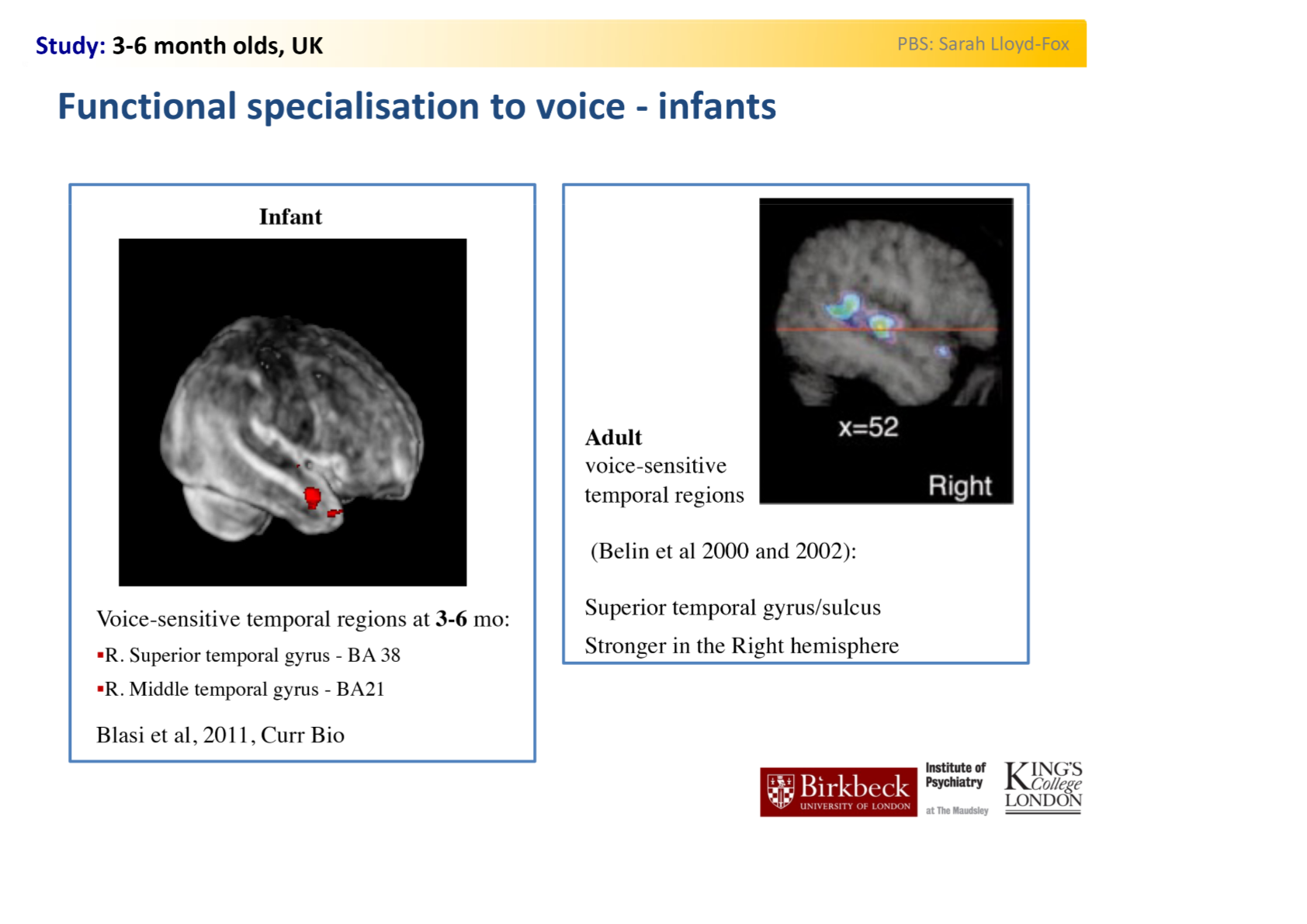
Image occlusion: name the hidden labels
31
What did Lloyd-Fox et al do and when?
2016
Analysed longitudinal data of visual social brain responses
Specialisation across the first 2 years of life in The Gambia
Measured using fNIRS
Shown visual-social (silent), then auditory social, then auditory non-social stimuli
Visual stimulus = social videos of adutls moving eyes or performing hand games
Aditory stimulus = non-speech adult vocalisations (auditory social condition) or common environmental sounds (auditory non-social condition)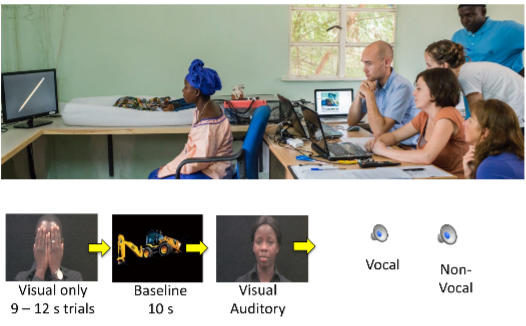
Analysed longitudinal data of visual social brain responses
Specialisation across the first 2 years of life in The Gambia
Measured using fNIRS
Shown visual-social (silent), then auditory social, then auditory non-social stimuli
Visual stimulus = social videos of adutls moving eyes or performing hand games
Aditory stimulus = non-speech adult vocalisations (auditory social condition) or common environmental sounds (auditory non-social condition)
32
What did Lloyd-Fox et al find?
0-8m:
Stronger response to auditory non-social > social stimuli
9-24m:
Stronger resopnse to auditory social > non-social stimuli
More posterior activity in visual social > non-social condition
Larger haemodynamic response to visual social condition in 12-16m > 4-13m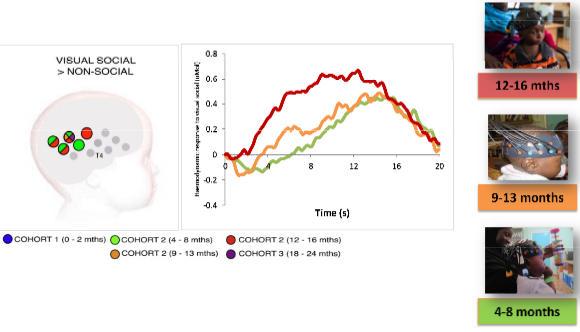
Stronger response to auditory non-social > social stimuli
9-24m:
Stronger resopnse to auditory social > non-social stimuli
More posterior activity in visual social > non-social condition
Larger haemodynamic response to visual social condition in 12-16m > 4-13m
33
State 3 ways of measuring early social action perception and action production in infants
Brain measure = fNIRS
Behavioural measure = actions (eg grasping)
Eye tracker = record eye movements while viewing actions of screen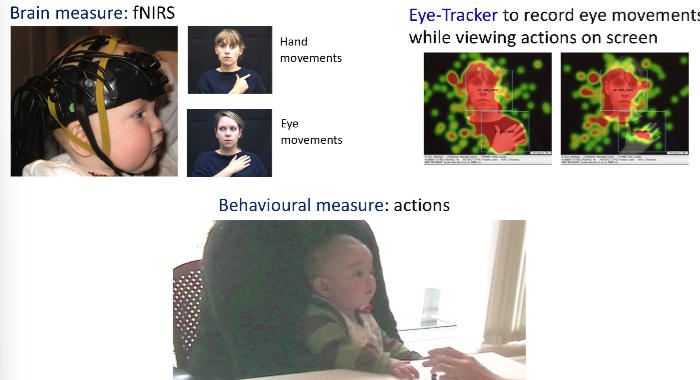
Behavioural measure = actions (eg grasping)
Eye tracker = record eye movements while viewing actions of screen
34
Describe the findings of a study that copmared brain and behaviour in infants
Describe the findings of a study that copmared brain and behaviour in infants
Lloyd-Fox et al 2013
4-6m olds
Brain activation not correlated with:
- Looking behaviour
- Gross motor skills
- Age
- Gender
Brain activation in social brain network during perception of hand movements associated with infant's own manual motor skills
More skilled fine motor control = increased activation in social brain network when watching hand movements
4-6m olds
Brain activation not correlated with:
- Looking behaviour
- Gross motor skills
- Age
- Gender
Brain activation in social brain network during perception of hand movements associated with infant's own manual motor skills
More skilled fine motor control = increased activation in social brain network when watching hand movements
35
What did Sommerville et al do and when?
2005
3m old
Introduced to reaching task with sticky mittens
Infants watched reaching events presented by puppet
Habituation phase: actor reaches for one of 2 toys
Test phase: toy position swapped then shown new goal event (reached for different toy) and new path event (reach for same toy but different location)
Infants performed reaching task (playing with toys with sticky mittens) before or afterthe visual task which showed goal directed actions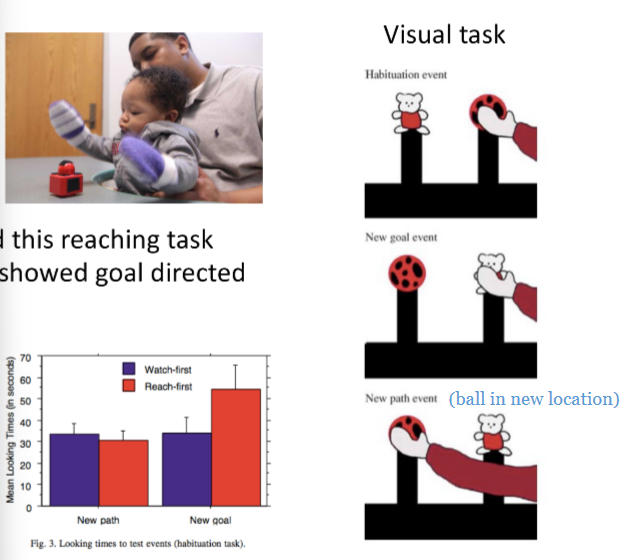
3m old
Introduced to reaching task with sticky mittens
Infants watched reaching events presented by puppet
Habituation phase: actor reaches for one of 2 toys
Test phase: toy position swapped then shown new goal event (reached for different toy) and new path event (reach for same toy but different location)
Infants performed reaching task (playing with toys with sticky mittens) before or afterthe visual task which showed goal directed actions
36
What did Sommerville et al find and when?
Infants with sticky mitten experience before visual task showed understanding of visual discrimination task
Infants who had sticky mitten experience before looked significantly longer at new goal > new path event
Infants with sticky mitten experience after looked at new goal and new path event equally
Suggests reaching production affects reaching perception (possibly bidirectional but unsure)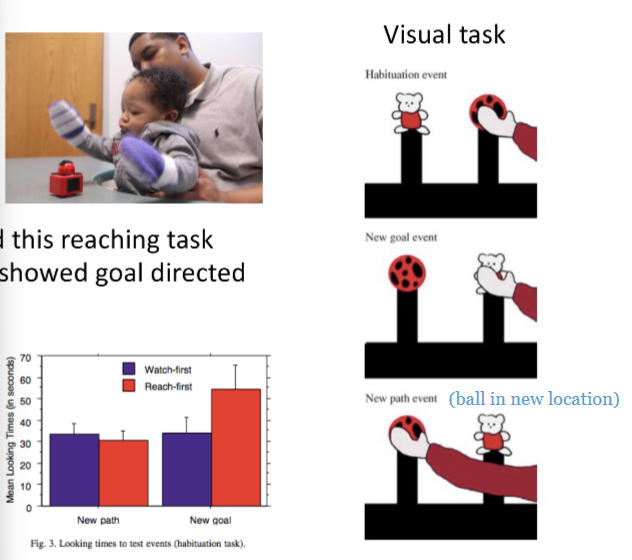
Infants who had sticky mitten experience before looked significantly longer at new goal > new path event
Infants with sticky mitten experience after looked at new goal and new path event equally
Suggests reaching production affects reaching perception (possibly bidirectional but unsure)
37
Define developmental cascades
Processes in which early learning experiences (positively) affect later development
Eg. walking and fine motor skills associated with later language development in toddlerhood
Eg. walking and fine motor skills associated with later language development in toddlerhood
38
Which age is a critical window of vulnerability to socio-economic and health challenges?
Conception to 2y
39
What fraction of children do not reach average developmental milestones?
1/3