Personality
Study these flashcardsFree · spaced repetition · iPhone, Android, Mac & web
All cards
1
What did Freud suggest about personality?
Motivation is at the centre of personality
Motives shaped by early childhood experiences
Motives shaped by early childhood experiences
2
What does Freud suggest are the 3 classes of motives?
Self-preservation
Libidinal
Aggressive
Libidinal
Aggressive
3
Limitations of Freud's claims
- Lacks empiricism
- Not falsifiable
- Not falsifiable
4
What did Murray suggest?
Need to understand ppl's motivations to understand their behaviour
Blended psychoanalytic ideas with theories of motivation
Blended psychoanalytic ideas with theories of motivation
5
What did Murray do?
Developed a system of psychogenic needs (achievement, dominance, play etc.)
Developed the Thematic Apperception Test (TAT) to measure the psychogenic needs
TAT developed to assess latent dynamics of personality: internal conflicts, unconscious drives and motives
Developed the Thematic Apperception Test (TAT) to measure the psychogenic needs
TAT developed to assess latent dynamics of personality: internal conflicts, unconscious drives and motives
6
Evaluate Murray's TAT
- No reliability in this measure relating to the psychogenic needs he outlined
7
What did Theophrastus do?
Created a list of character sketches
Suggestsed character sketches rely on language
The Grumbler
Suggestsed character sketches rely on language
The Grumbler
8
What did Allport do?
Studied personality from lexical approach - if something is important, we will have a word for it
Went through English dictionary
Found ~18,000 words were possible person descriptors
Went through English dictionary
Found ~18,000 words were possible person descriptors
9
What did Cattell do?
Developed comprehensive system of personality trait dimensions using factor analysis
Aimed to identify how ppl think, feel and behave across different contexts
Gathered as much data as possible and constructed theory around the data
Found 16 possible personality factors
Aimed to identify how ppl think, feel and behave across different contexts
Gathered as much data as possible and constructed theory around the data
Found 16 possible personality factors
10
Define traits
Constructs used to explain why ppl remain stable and consistent in their action across diverse situations
11
Outline the Big 5
Openness to experience
Conscientiousness
Extraversion
Agreeableness
Neuroticism
Conscientiousness
Extraversion
Agreeableness
Neuroticism
12
2 examples of measures of the Big 5
Big 5 Inventory (BFI)
NEO-Five Factor Inventory
NEO-Five Factor Inventory
13
What did Mischel suggest?
Critiqued personality:
- Personality does not reliably predict behaviour
- Situations are stronger determinants of behaviour
- Personality does not reliably predict behaviour
- Situations are stronger determinants of behaviour
14
What factors does McAdams suggest determine behaviour?
Social context:
Family
Class
Race
Culture
Family
Class
Race
Culture
15
What did Buss do?
Created person-environment fit theory
16
Describe the person-environment fit theory
Individuals select and create social and physical environments that reinforce and reflect aspects of their psychological qualities
17
What are the 3 aspects of the person-environment fir theory?
Selection
Evocation
Manipulation
Evocation
Manipulation
18
Outline selection (person-environment fit theory)
Individuals choose certain environments and avoid others
19
Outline evocation (person-environment fit theory)
Individuals unintentionally elicit responses (changes) from the environment
20
Outline manipulation (person-environment fit theory)
Individuals alter their environments to fit their needs
21
Important life outcomes: conscientiousness
Occupational attainment:
+ive correlation
Perform better within interviews and within job itself
Mortality:
-ive correlation
Risk averse, compliant
More likely to reach out for help with medical concern
+ive correlation
Perform better within interviews and within job itself
Mortality:
-ive correlation
Risk averse, compliant
More likely to reach out for help with medical concern
22
Important life outcomes: extraversion
Occupational attainment:
+ive correlation
Seek out jobs involving social interaction, business, hospitals etc.
Mortality:
-ive correlation
Larger social networks so better social support
+ive correlation
Seek out jobs involving social interaction, business, hospitals etc.
Mortality:
-ive correlation
Larger social networks so better social support
23
Important life outcomes: agreeableness
Occupational attainment:
+ive correlation
Teaching, hospitals
Mortality:
-ive correlation
+ive correlation
Teaching, hospitals
Mortality:
-ive correlation
24
Important life outcomes: neuroticism
Occupational attainment:
-ive correlation
Mortality:
+ive correlation
Associated with anxiety, depression, psych distress
Psych stress can weaken immune system (cortisol)
-ive correlation
Mortality:
+ive correlation
Associated with anxiety, depression, psych distress
Psych stress can weaken immune system (cortisol)
25
What are the 2 views of personality traits?
Genotypic view
Phenotypic view
Phenotypic view
26
Oultine genotypic view
Personality traits are endogenous and inherited basic tendencies that are largely indepenedent from culture
Traits are biologically based, should be universal
Traits remain stable over time
Cultural differences indicate genetic differences between cultures
Traits are biologically based, should be universal
Traits remain stable over time
Cultural differences indicate genetic differences between cultures
27
Outline phenotypic view
Personality traits are observable, behavioural regularities that reflect both genetic dispositions and characteristic adaptations to the sociocultural context
Traits reflect observable expressions of behaviour
Can't make assumptions about genetic vs cultural basis of personality
Traits reflect observable expressions of behaviour
Can't make assumptions about genetic vs cultural basis of personality
28
Define analogous traits
Fixed
BUT can change over time
Eg. hair colour
BUT can change over time
Eg. hair colour
29
3 ways of investigating personality origins
Behavioural genetics
Cross-cultural comparisons
Personality stability throughout lifespan
Cross-cultural comparisons
Personality stability throughout lifespan
30
What did Plomin find?
Twin studies
Personalities of adopted children largely unrelated to adoptive parents
Openness:
MZ ~0.6
DZ ~0.24
Used to support genotypic view
BUT MZ not 1.0 so environment must also play a part
Personalities of adopted children largely unrelated to adoptive parents
Openness:
MZ ~0.6
DZ ~0.24
Used to support genotypic view
BUT MZ not 1.0 so environment must also play a part
31
Limitation of Plomin's twin study
- Adoptive parents heavily screened (financially stable, stable job etc.), so can't apply to low SES families
32
What did McCrae do?
English language measures of Big 5 translated and administered to ppl in different cultures
Factor analyses of translated measures revealed personality structure very similar to Big 5
Suggests Big 5 has cross cultural validity
Factor analyses of translated measures revealed personality structure very similar to Big 5
Suggests Big 5 has cross cultural validity
33
Criticisms of McCrae's findings
- Measure designed to maximise differences between traits from English persepctive
- Ethnocentric, fails to account for cultural differences, test should be made in relation to the culture the pps belong to
- Critics favour emic (ie. indigenous) over imposed-etic (ie. imported) approaches to personality
- Ethnocentric, fails to account for cultural differences, test should be made in relation to the culture the pps belong to
- Critics favour emic (ie. indigenous) over imposed-etic (ie. imported) approaches to personality
34
What did De Raad et al find?
Only 3 factors of personality description fully replicable across language (extraversion, agreeableness, conscientiousness)
Gender, honesty and humility are prominent factors affecting personality
Gender, honesty and humility are prominent factors affecting personality
35
Outline the plaster hypothesis
Personality traits arise from biological processes and reach maturity in early adulthood, at which point personality is set like plaster
36
Outline social investment theory
Ppl establish psych commitments to social institutions in form of social role (eg. work, marriage, family, community)
These roles encourage certain behaviours that enhance certain traits
Occurs throughout middle adulthood, contributing to personality change
These roles encourage certain behaviours that enhance certain traits
Occurs throughout middle adulthood, contributing to personality change
37
What did McAdams do?
Created a hierarchal model of personality
38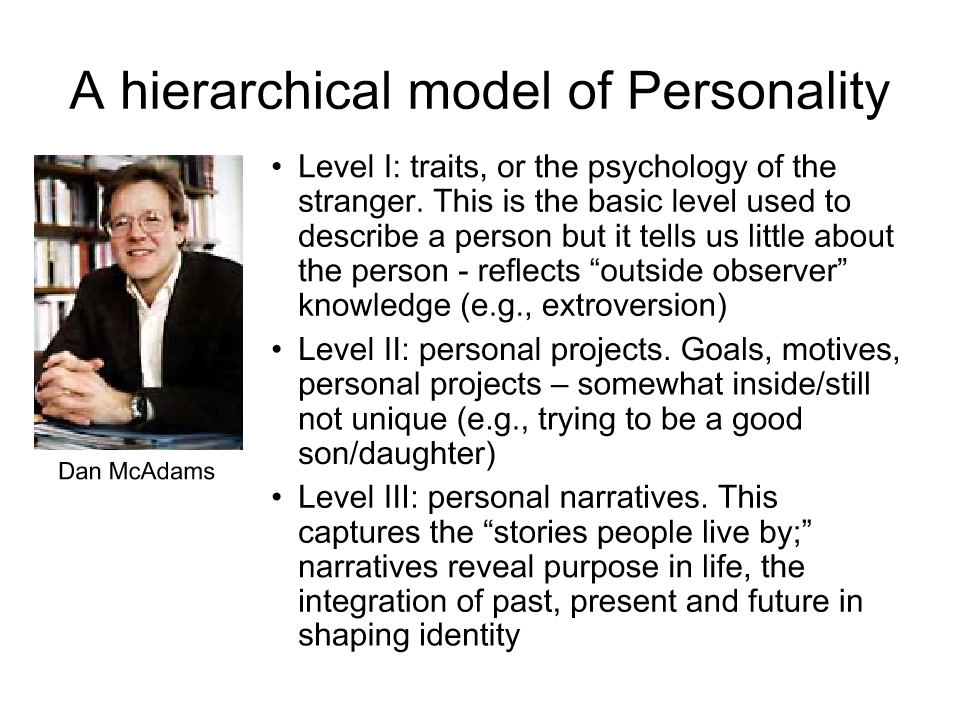
Image occlusion: name the hidden labels
39
Describe level 3: life narratives
Defines adult sense of identity
Represents the way in which ppl describe themselves to others
Constantly changing as persepctive of oneself change
Can vary by culture
Represents the way in which ppl describe themselves to others
Constantly changing as persepctive of oneself change
Can vary by culture
40
Limitations of the hierarchal model of personality
- Entirely subjective
- Can't be empirically measured
- Can't be falsified
- Can't be empirically measured
- Can't be falsified
41
What did Brian Little suggest?
Studied level 2 personality (personal projects)
Personal projects cannot be directly inferred from observation of ppl's acts
Embedded within daily ecology
Well-being related to extent which ppl engage in personal projects that are meaningful, supported by other and realistic
Intrapersonal projects
Personal projects cannot be directly inferred from observation of ppl's acts
Embedded within daily ecology
Well-being related to extent which ppl engage in personal projects that are meaningful, supported by other and realistic
Intrapersonal projects
42
Define intrapersonal prjects
Trying to change/deal with aspects of one's own personality (eg. be more assertive)
43
Which traits predict increased longevity
High E and C
High E = more social support
High E = more social support
44
Which traits predict poorer health and describe their effects
Low A = poorer physical health and earlier mortality
Low C = smoking, poor diet, lack of exercise
High N = anxiety disorders
High N and low E = depression
Low C = smoking, poor diet, lack of exercise
High N = anxiety disorders
High N and low E = depression
45
Examples of traits predicting outcome of relationships
High N = negative predictor of status but only in men (vulnerable men not deserving of status?)
High N and low A = negative relationship outcomes, conflict, abuse, breaking up
Negative emotions increase relationship distress
High N and low A = negative relationship outcomes, conflict, abuse, breaking up
Negative emotions increase relationship distress
46
Example of trait predicting political beliefs
Low O associated with conservative beliefs
47
Examples of traits predicting behaviour
High E and A = volunteering, leadership roles
Low C and N = antisocial behaviour
Low C = behaviour problems in adolescent males
Low C and N = antisocial behaviour
Low C = behaviour problems in adolescent males