Behavioural Genetics
Study these flashcardsFree · spaced repetition · iPhone, Android, Mac & web
All cards
1
What are the 5 methods of studying behavioural genetics?
Selective breeding of animals
Twin studies in humans
Candidate gene association studies
Genome-wide association studies (GWAS)
Genome-wide complex trait analysis (GCTA)
Twin studies in humans
Candidate gene association studies
Genome-wide association studies (GWAS)
Genome-wide complex trait analysis (GCTA)
2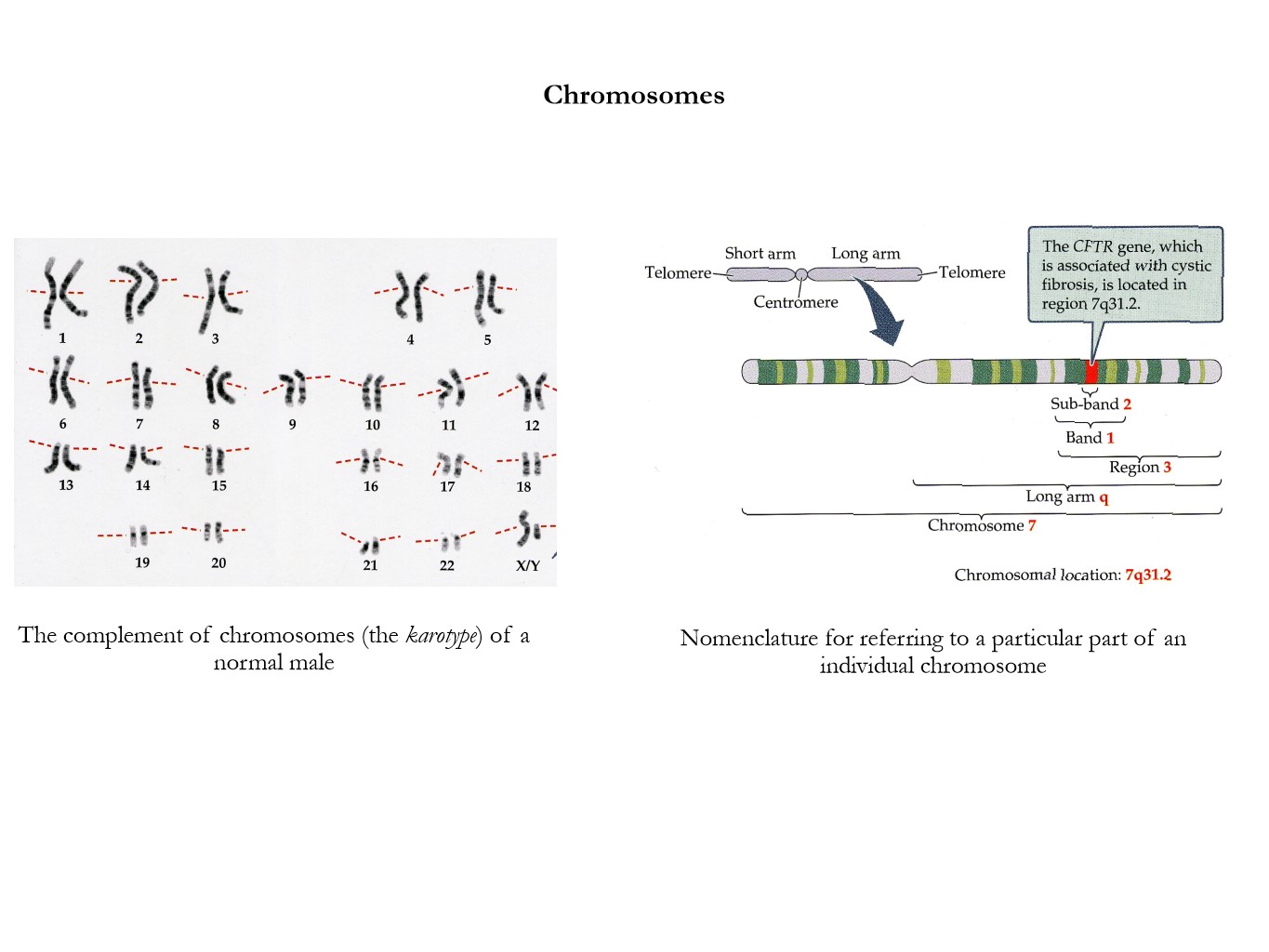
Image occlusion: name the hidden labels
3
Example of selective breeding of animals
DeFries 1978
Field mice
More anxious = less running, more defacation
Don't like bright daylight in open areas
Selected for high activity (bred high activity mice) = less defacation
Selected for low activity = high defacation
Field mice
More anxious = less running, more defacation
Don't like bright daylight in open areas
Selected for high activity (bred high activity mice) = less defacation
Selected for low activity = high defacation
4
Why might some genes be advantageous when heteroxygous?
Can be beneficial to be a carrier
Unaffected but still have some benefits
Eg. sickle cell anaemia
Heterozygous = not anaemic but protected from malaria
Unaffected but still have some benefits
Eg. sickle cell anaemia
Heterozygous = not anaemic but protected from malaria
5
Limitations of heritability studies
- Tells us about variance, not proportion of a characteristic being due to genes
- Only tells us about a specific population at a given time
- Doesn't tell us about the resemblance of offspring and parents (correlation does not equal heritability)
- Only tells us about a specific population at a given time
- Doesn't tell us about the resemblance of offspring and parents (correlation does not equal heritability)
6
Heritability evidence for intelligence
Knopik 2017, Flint 2020
Average across a number of studies:
MZ = 0.86
DZ = 0.60
Suggests heritability ~0.50
Average across a number of studies:
MZ = 0.86
DZ = 0.60
Suggests heritability ~0.50
7
What are the 4 codons in DNA?
Adenine
Thymine
Cytosine
Guanine
Thymine
Cytosine
Guanine
8
What does the aa sequence code for?
Proteins or STOP/termination codons
9
Describe the process of genetic replication
DNA helicase
H bonds broken between bases and the 2 strands separate
Free DNA nucleotides form H bonds with complementary bases (A to T and C to G) on both template strands
DNA polymerase forms phosphodiester bonds
Result is 2 daughter molecules, each an exact replica of parent DNA
H bonds broken between bases and the 2 strands separate
Free DNA nucleotides form H bonds with complementary bases (A to T and C to G) on both template strands
DNA polymerase forms phosphodiester bonds
Result is 2 daughter molecules, each an exact replica of parent DNA
10
Define intron
Non coding section with gene
11
Define exon
Coding section within gene
12
What does VNTR stand for?
Variable Number Tandem Repeat
13
Describe what Val194Gly (T+581G) means
It's a recorded variation in the gene
194th aa
Glycine replaces valine (most common aa in population goes first)
581st nucleotide from the beginning of the gene can be T or G
Single nucleotide altered = SNP
194th aa
Glycine replaces valine (most common aa in population goes first)
581st nucleotide from the beginning of the gene can be T or G
Single nucleotide altered = SNP
14
Define SNP
Single nucleotide polymorphism
15
What is DRD4
The gene that encodes the D4 receptor for dopamine
16
Describe the D4 receptor protein
G-protein coupled receptor
Polymorphic: 1-7 fold repeats of a 48 base pair sequence in the 3rd cytoplasmic domain (VNTR)
Number of repeats in the VNTR affects the sodium dependent affinity for clozapine
Similar to D2 but has an affinity for clozapine (used to treat SCZ)
Polymorphic: 1-7 fold repeats of a 48 base pair sequence in the 3rd cytoplasmic domain (VNTR)
Number of repeats in the VNTR affects the sodium dependent affinity for clozapine
Similar to D2 but has an affinity for clozapine (used to treat SCZ)
17
Difference between DRD4.4 and DRD4.7 receptors
No. of repeats affects sodium dependent affinity for clozapine
DRD4.4 = lower dissociation constants for clozapine in absence of sodium chloride
DRD4.7 = no salt dependence
When 50% receptors are occupied: low dissociation constant means that the drug has high affinity for the receptor and fewer molecules of the drug are required to occupy 50% of the receptors.
DRD4.4 = lower dissociation constants for clozapine in absence of sodium chloride
DRD4.7 = no salt dependence
When 50% receptors are occupied: low dissociation constant means that the drug has high affinity for the receptor and fewer molecules of the drug are required to occupy 50% of the receptors.
18
Describe the process of transcription and translation
DNA strands separated by DNA helicase
Complementary RNA bases form complementary base pairs, forming H bonds
RNA polymerase forms phosphodiester bonds
Exons and introns transcribed to produce premRNA
Introns removed
Exons spliced back together forming mRNA
Leaves nucleus and binds to ribosome
Ribosome translates mRNA, one triplet at a time
Builds chain of aa, forming protein
Peptide bonds form between aa
Complementary RNA bases form complementary base pairs, forming H bonds
RNA polymerase forms phosphodiester bonds
Exons and introns transcribed to produce premRNA
Introns removed
Exons spliced back together forming mRNA
Leaves nucleus and binds to ribosome
Ribosome translates mRNA, one triplet at a time
Builds chain of aa, forming protein
Peptide bonds form between aa
19
Define alternative splicing
Exons from the same gene are joined in different combinations, leading to different, but related, mRNA transcripts
These mRNAs can be translated to produce different proteins with distinct structures and functions — all from a single gene
These mRNAs can be translated to produce different proteins with distinct structures and functions — all from a single gene
20
Describe what transcription factors do
General transcription factors - bind to core promoter regions
Sequence-specific transcription factors - can activate / repress transcription of specific genes
Sequence-specific transcription factors - can activate / repress transcription of specific genes
21
Example of transcription factor and the effect of mutation
FOXP2 (mutation = intellectual disability + autism)
22
Histone + DNA = ?
Chromatin
23
What is DNase I(i)
Enzyme
Splits DNA wherever it can access it
Reveals sites where transcription factors can act (called DNase I hypersensitive sites)
Specific to particular cell types
Splits DNA wherever it can access it
Reveals sites where transcription factors can act (called DNase I hypersensitive sites)
Specific to particular cell types
24
Name the gene which encodes the serotonin transporter
SLC6A4
25
Where is an important polymorphism in SLC6A4 found?
In the promoter region (not the gene itself)
26
Effect of natural polymorphism in SLC6A4
44bp deletion = lower transcription, less serotonin transporter protein, more serotonin available
Associated with susceptibility to stress
Associated with susceptibility to stress
27
Potential candidate genes
DRD4 - gene for D4 receptor for dopamine
COMT - gene for an enzyme that metabolises dopamine and other catecholamines (eg. epinephrine, noredrenaline)
SLC6A4 - gene for serotonin transporter
OXTR - gene for oxytocin receptor
COMT - gene for an enzyme that metabolises dopamine and other catecholamines (eg. epinephrine, noredrenaline)
SLC6A4 - gene for serotonin transporter
OXTR - gene for oxytocin receptor
28
Candidate gene association study example
Garcia et al 2010
No. of repeats in dopamine D4 receptor gene associated with infidelity and sexual promiscuity
7+ repeats compared to 7- = more likely to be exploratory / risk taking, more likely to have one night stands, more likely to be unfaithful
No. of repeats in dopamine D4 receptor gene associated with infidelity and sexual promiscuity
7+ repeats compared to 7- = more likely to be exploratory / risk taking, more likely to have one night stands, more likely to be unfaithful
29
Specific limitation of candidate genes
Johnson 2017
25 historically most popular candidate genes associated with SCZ no more strongly associated with SCZ than non-candidate set of genes
25 historically most popular candidate genes associated with SCZ no more strongly associated with SCZ than non-candidate set of genes
30
Describe the basic features of genome wide association studies
No hypothesis created
Look for association between genes and behaviours/psych conditions
Look for association between genes and behaviours/psych conditions
31
Describe the basic method for genome wide association studies
DNA obtained from >1000 pps whose behaviour on some trait has been measured
Genomes probed at ~1 million SNPs
Genomes probed at ~1 million SNPs
32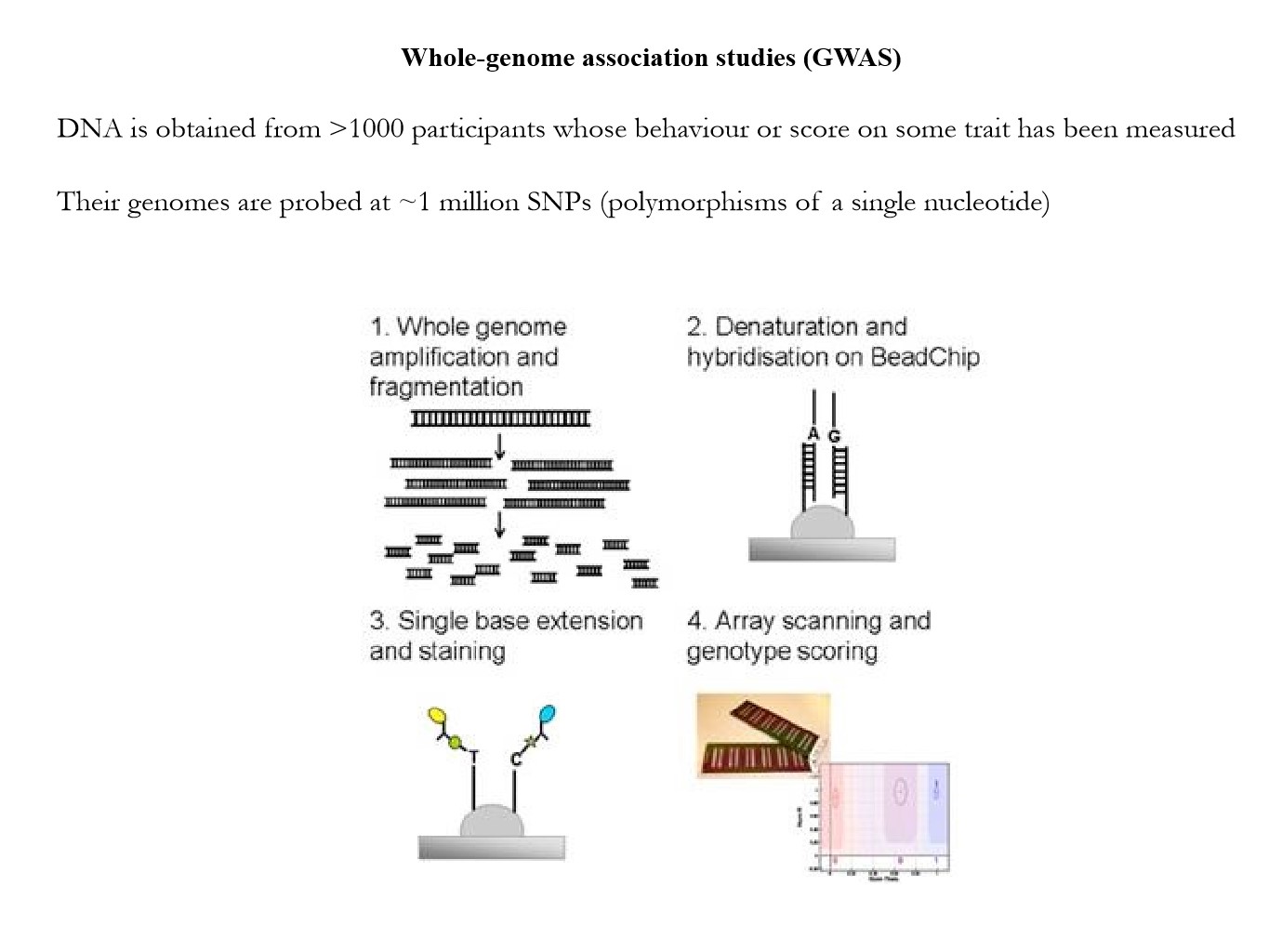
Image occlusion: name the hidden labels
33
What is a microarray?
Chip consists of a small glass plate encased in plastic
On the surface, each chip contains thousands of short, synthetic, single-stranded DNA sequences, which together add up to the normal gene in question, and to variants (mutations) of that gene that have been found in the human population
On the surface, each chip contains thousands of short, synthetic, single-stranded DNA sequences, which together add up to the normal gene in question, and to variants (mutations) of that gene that have been found in the human population
34
Explain how microarrays are used in genome wide association studies
Many short probe pieces of DNA on BeadChip
Each piece of DNA specific to sequence immediately adjacent to polymorphic site
Single-stranded, complementary DNA from pp will bind to probe
Differently labelled nucleotides are added and the probe sequence will extend itself according to complementary nucleotide in pp's sequence
Stops one nucleotide before a SNP
Laser scanning system records proportions of alternative labelled nucleotides at each probed locus
Presented as a Manhattan plot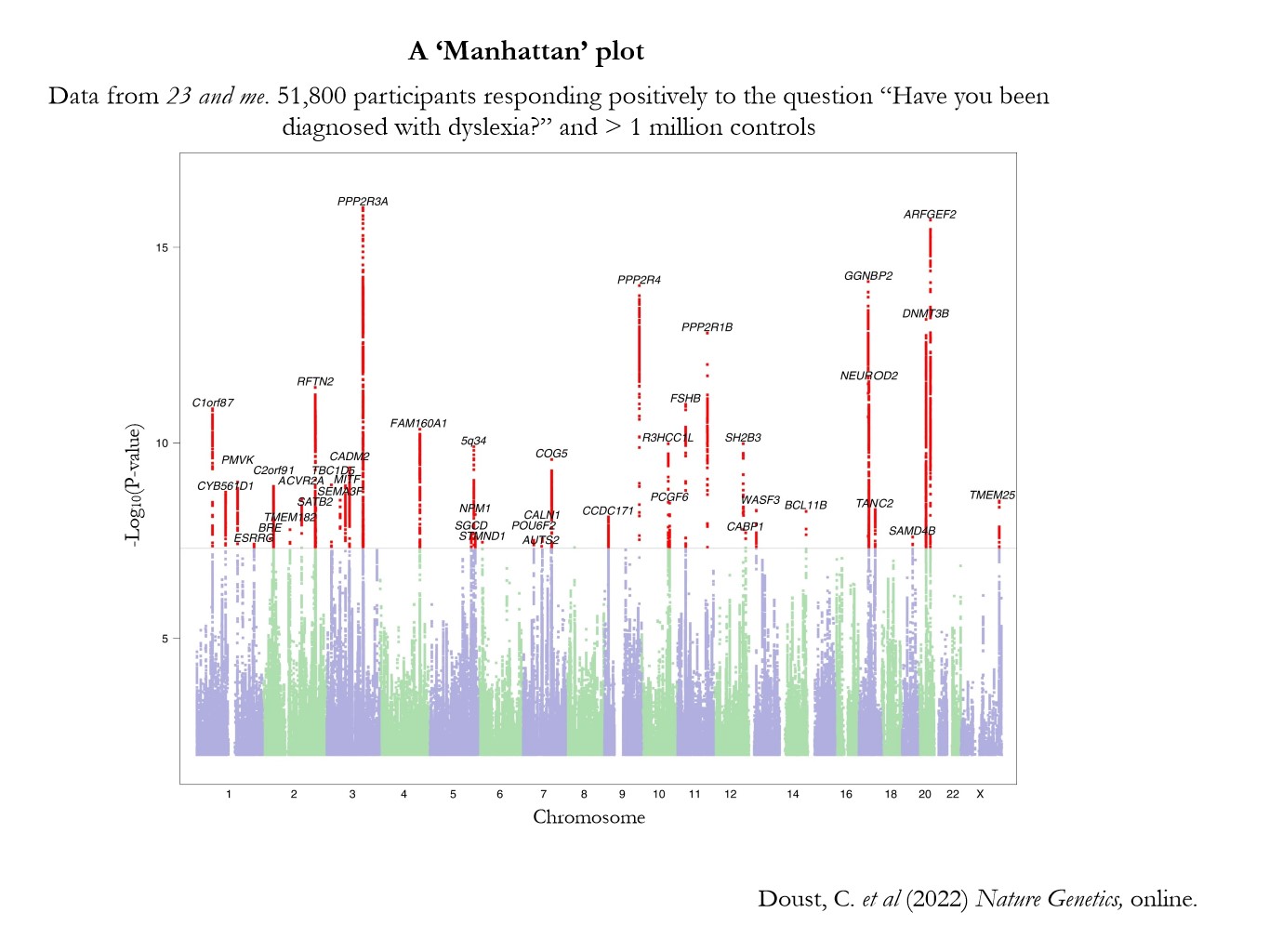
Each piece of DNA specific to sequence immediately adjacent to polymorphic site
Single-stranded, complementary DNA from pp will bind to probe
Differently labelled nucleotides are added and the probe sequence will extend itself according to complementary nucleotide in pp's sequence
Stops one nucleotide before a SNP
Laser scanning system records proportions of alternative labelled nucleotides at each probed locus
Presented as a Manhattan plot
35
GWAS evidence so far
+ Savage 2018 - 270,000 pps, 205 genomic loci have tiny but significant associations with intelligence
- No single gene accounts for even 0.25% of variance in intelligence/personality
- No common allele that is present in most SCZ/autism although a few significant 'susceptible loci' have been identified
- No single gene accounts for even 0.25% of variance in intelligence/personality
- No common allele that is present in most SCZ/autism although a few significant 'susceptible loci' have been identified
36
What are genome wide complex trait analyses used for?
Make a direct estimate of heritability of a trait
Uses data from GWAS
Calculate how much variance in phenotype is accounted for by all the SNPs tested in GWAS
Uses data from GWAS
Calculate how much variance in phenotype is accounted for by all the SNPs tested in GWAS
37
How does genome wide complex trait analysis work?
Calculate genetic similarity between each possible pair of pps
Pairs of pps rank ordered in terms of genetic similarity
Look at correlation between the rank order of genetic similarity with the rank order of phenotypic similarity
Pairs of pps rank ordered in terms of genetic similarity
Look at correlation between the rank order of genetic similarity with the rank order of phenotypic similarity
38
Evidence for GCTA
+ Davies 2011, estimate of heritability is 40% for variation in crystallized intelligence and 51% for variation in fluid intelligence
+ Most studies suggest SNP based heritability of intelligence is >0.25, similar to twin studies
- SNPs account for <10% variance in neuroticism and extraversion, different to twin studies, variation not due to SNPs, could be due to polymorphisms in the number of copies of a given gene
+ Most studies suggest SNP based heritability of intelligence is >0.25, similar to twin studies
- SNPs account for <10% variance in neuroticism and extraversion, different to twin studies, variation not due to SNPs, could be due to polymorphisms in the number of copies of a given gene
39
Image occlusion: name the hidden labels
40
Examples of chromosomal abnormalities
Down syndrome
William's syndrome
Balanced translocation
William's syndrome
Balanced translocation
41
Outline Down syndrome
1/1000 births
Most common form of intellectual disability - avergae IQ = 55
Anatomical features (eg. protuding tongue)
Due to presence of extra copy of chromosome 21 (trisomy 21)
Most common form of intellectual disability - avergae IQ = 55
Anatomical features (eg. protuding tongue)
Due to presence of extra copy of chromosome 21 (trisomy 21)
42
Outline William's syndrome
Aortic stenosis (narrowing of aortic valve in heart)
Wide mouth
Severely impaired visuo-spatial processing
Often verbally skilled and particularly friendly
Due to deletion of 1.5 to 2.5Mb (Megabases - equal to 1mill bases) at 7q11.23
Wide mouth
Severely impaired visuo-spatial processing
Often verbally skilled and particularly friendly
Due to deletion of 1.5 to 2.5Mb (Megabases - equal to 1mill bases) at 7q11.23
43
Outline balanced translocation
Part of 1 chomosome exchanged with another (usually between non-homologous chromosomes, not during meiosis like crossing over)
Example:
Family carrying the translocation disproportionately likely to exhibit a major psychiatric illness
Breakpoint at 1q42.2 disrupts D1SC1 gene (disordered in SCZ 1)
BUT we now know alterations in D1SC1 are not a cause of SCZ in wider population
Example:
Family carrying the translocation disproportionately likely to exhibit a major psychiatric illness
Breakpoint at 1q42.2 disrupts D1SC1 gene (disordered in SCZ 1)
BUT we now know alterations in D1SC1 are not a cause of SCZ in wider population
44
Outline features of the x chromosome
Carries a disproportionate number of genes that have a role in the eye / brain
Some conditions are sex linked (only occur/more servere in males), inherited from mother
Example:
Fragile X syndrome, colour blindness
Some conditions are sex linked (only occur/more servere in males), inherited from mother
Example:
Fragile X syndrome, colour blindness
45
Outline X chromosome inactivation
Each female has 2 X chromosomes
Only one is expressed in any cell in the body
Most genes on the other chromosome are inactivated
Inactivation occurs early within the emryo
Initial inactivation is random
Only one is expressed in any cell in the body
Most genes on the other chromosome are inactivated
Inactivation occurs early within the emryo
Initial inactivation is random
46
What is the current explanation for X chromosome inactivation?
Dosage compensation - if both X expressed in women, but only one on men, adjustments would be needed
Mollen suggests - advantage in segregating different versions of protein in different cells, eg. trichromatic colour vision
Mollen suggests - advantage in segregating different versions of protein in different cells, eg. trichromatic colour vision
47
Define additive genetic effect
Phenotype resulting from additive alleles depends on the number of alleles that are present
Regulates intensity of phenotype
eg more more alleles for melanin = darker skin
Not dominant vs recessive
Regulates intensity of phenotype
eg more more alleles for melanin = darker skin
Not dominant vs recessive
48
Define non-additive genetic effect
Genes in which there is no summation of the effects of the genes
Not all members of the gene pair will be expressed - dominant vs recessive
Not all members of the gene pair will be expressed - dominant vs recessive
49
Problems in estimating heritability from twin studies
Non additive genetic variance
Random X chromosome inactivation in female twins
Assortative mating
Differences in similairty of environments
Random X chromosome inactivation in female twins
Assortative mating
Differences in similairty of environments
50
Explain limitation of twin studies: non-additive genetic variance
Non-additivity of alleles for the same locus:
Heterozygosity can be advantageous or a disadvantage at a particular locus
MZ twins always share same alleles at a given locus but DZ don't always
Non-additivity of alleles at different loci:
Effect of allele at one locus may depend on allele present at different locus (epistasis) - again it will always be the same for MZ twins, unlike DZ
Assume that genes are independent and additive in their effects
This assumption of simple additivity underestimates differences between MZ and DZ in their genetic similarity (so MZ and DZ twins are more genetically different than was assumed)
Heterozygosity can be advantageous or a disadvantage at a particular locus
MZ twins always share same alleles at a given locus but DZ don't always
Non-additivity of alleles at different loci:
Effect of allele at one locus may depend on allele present at different locus (epistasis) - again it will always be the same for MZ twins, unlike DZ
Assume that genes are independent and additive in their effects
This assumption of simple additivity underestimates differences between MZ and DZ in their genetic similarity (so MZ and DZ twins are more genetically different than was assumed)
51
Explain limitation of twin studies: random X chromosome inactivation in female twins
MZ = identical genomes, different epxression
Many instances where one MZ twin has an X-linked condition, but not the other
Many instances where one MZ twin has an X-linked condition, but not the other
52
Explain limitation of twin studies: assortative mating
Assumes ppl mate randomly
If parents choose each other for similarity/dissimilarity then DZ twins will share > or < 50% genes
If parents choose each other for similarity/dissimilarity then DZ twins will share > or < 50% genes
53
Explain limitation of twin studies: differences in similarity of environments
Assumes environment is shared to same degree in MZ and DZ
Identical twins have special bond and more likely to develop their attitudes to the world together
Identical twins have special bond and more likely to develop their attitudes to the world together
54
Other problems (other than twin studies) with using GWAS to estimate heritability of a phenotype
- Larger the GWAS study, the poorer the phenotypic data is likely to be
- Rarely report test-retest reliability
- If a measure has low reliability, it can't be expected to correlate with the genome and show high heritability
- Rarely report test-retest reliability
- If a measure has low reliability, it can't be expected to correlate with the genome and show high heritability