Primatology - technology + culture
Study these flashcardsFree · spaced repetition · iPhone, Android, Mac & web
All cards
1
Define culture
Behavioural practice that is shared among members of a group
Performed repeatedly over a period of time
Performed repeatedly over a period of time
2
Define tradition
All group-typical behaviour patterns
Shared by members of animal communities
Reliant on socially learned and trnasmitted info
Shared by members of animal communities
Reliant on socially learned and trnasmitted info
3
State 4 aspects of animal culture
Tool use
Social-sexual
Communication
Feeding
Social-sexual
Communication
Feeding
4
Outline the method of exculsion used to find cultural variants
Compare study sites
List all behaviours
Exclude those explained by:
- genetic differences
- ecological differences
- universal behaviours
List all behaviours
Exclude those explained by:
- genetic differences
- ecological differences
- universal behaviours
5
What did Whiten et al find and when?
1999
Method of exclusion
Among chimp groups across parts of Africa
39 cultural variants in social, sexual and feeding domains
Method of exclusion
Among chimp groups across parts of Africa
39 cultural variants in social, sexual and feeding domains
6
What did Van Schaik et al find and when?
2003
Method of exclusion
24 cultural variants in orang-utans
Social and feedings domains
Size of cultural repertoire associated with opportunities for cultural learning
Method of exclusion
24 cultural variants in orang-utans
Social and feedings domains
Size of cultural repertoire associated with opportunities for cultural learning
7
Outline the 4 conceptual issues with the method of exclusion
Ecological pressures can drive cultural adaptive behaviour
Genetics influence animals' predisposition for social learning
Animals modify their environment, also via culture (niche construction)
Universal behaviour can also be culture (eg. nest building)
Genetics influence animals' predisposition for social learning
Animals modify their environment, also via culture (niche construction)
Universal behaviour can also be culture (eg. nest building)
8
Other methods of finding cultural variants (other than method of exclusion)
Within site
Compare neighbourhood populations
Same habitat, same sub-species
Compare neighbourhood populations
Same habitat, same sub-species
9
What did Luncz et al find and when?
2012
Nut cracking behaviour in 3 neighbouring chimp communities
Stone and wooden tool use varies between neighbouring communities
Nut cracking behaviour in 3 neighbouring chimp communities
Stone and wooden tool use varies between neighbouring communities
10
What did Luncz and Boesch find and when?
2014
Investigated nut cracking behaviour in chimps
Traditions perpetuate and remain through generation
Tradition: stone tool use decreases, wood increases
Conformity: new immigrants conform to new group's tradition
Investigated nut cracking behaviour in chimps
Traditions perpetuate and remain through generation
Tradition: stone tool use decreases, wood increases
Conformity: new immigrants conform to new group's tradition
11
What did Koops find and when?
2015
Investigated ant dipping tool length among different chimp species
Ant dipping tool length varies widely across:
- Chimp study site
- Type of ants
- Dipping location
Variation within same population between 2 communities - suggests evidence for traditions
Investigated ant dipping tool length among different chimp species
Ant dipping tool length varies widely across:
- Chimp study site
- Type of ants
- Dipping location
Variation within same population between 2 communities - suggests evidence for traditions
12
What does the counting socially learned skills approach reveal?
Reveals ecological correlations for most cultural elements
13
What did Schuppli and van Schaik find and when?
2019
Culture is widespread and pervasive
Culture drives local adaptations
Studied orang-utans (compared sociable and non-sociable species)
Compared method of exclusion to social learned skills
Culture is widespread and pervasive
Culture drives local adaptations
Studied orang-utans (compared sociable and non-sociable species)
Compared method of exclusion to social learned skills
14
Which method is used to determine cultural repertoire?
Method of exclusion
15
Outline the 3-factor model
Koops et al 2014
Environment, sociality and cognition
Considers influence of environment, socialilty and cognition on culture (esp. material culture)
More social learning opportunities found to correlate with a larger cultural repertoire
Environment, sociality and cognition
Considers influence of environment, socialilty and cognition on culture (esp. material culture)
More social learning opportunities found to correlate with a larger cultural repertoire
16
Compare the environmental opportunity vs necessity hypothesis
Opposing arguments with differing explanations for how material culture emerges
Environmental opportunity: when situations present themselves (eg lots of resources available), cultural traditions can emerge
Necessity: cultural traditions emerge when needed
Environmental opportunity: when situations present themselves (eg lots of resources available), cultural traditions can emerge
Necessity: cultural traditions emerge when needed
17
What did Koops et al do and when?
2014
Compared opportunity to necessity in chimps
Ant dipping increases when more ants available
Nut cracking increases when more nut trees available
Supports opportunity hypothesis
Suggests environmental opportunity is main driver of material culture
Compared opportunity to necessity in chimps
Ant dipping increases when more ants available
Nut cracking increases when more nut trees available
Supports opportunity hypothesis
Suggests environmental opportunity is main driver of material culture
18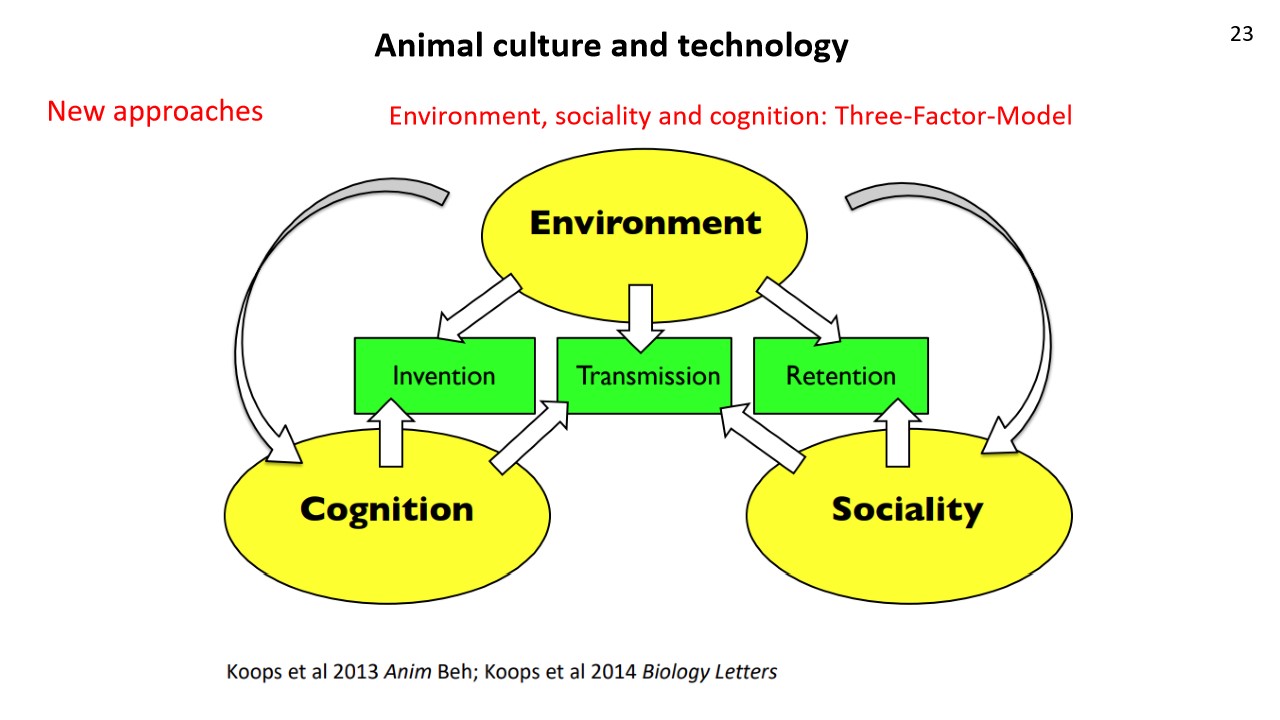
Image occlusion: name the hidden labels
19
Define individual learning
Acquiring info/skills without other's influence
Trial-error
Takes time
Trial-error
Takes time
20
Define social learning
Learning influenced by observation of/interaction with another individual or its products
Fast process
Fast process
21
State the 4 types of social learning
Imitation
Emulation
Facilitation
Teaching
Emulation
Facilitation
Teaching
22
Outline imitation
Copy behaviour of role model
23
Outline emulation
Understanding goals of action (observational learning)
24
Outline facilitation
Increase level of effort as result of other's presence
25
Outline teaching
Active modification of actions by the role model to improve performance
26
At what point does an innovation become cultural/tradition?
When it becomes fixed within the population
27
Describe the 3 types of social learning transmission
Horizontal social transmission - within same generation
Vertical social transmission - between parents and offspring
Oblique social transmission - between generations (not necessarily kin)
Vertical social transmission - between parents and offspring
Oblique social transmission - between generations (not necessarily kin)
28
Example of unfixed innovation
Leca et al 2010
Dental flossing in Japanese macaque
One 1 individual
Over long period of time
Did not spread in group or to next generation
Dental flossing in Japanese macaque
One 1 individual
Over long period of time
Did not spread in group or to next generation
29
Example of fixed innovation
Leca et al 2010
Sweet potato washing in Japanese macaques
Sweet potato washing in Japanese macaques
30
Why is culture vs nature counterintuitive?
Culture is natural
Shouldn't be presented as a dichotomy as they overlap
Culture exists once opportunity, needs and skills are present
Culture exists in many animals
Shouldn't be presented as a dichotomy as they overlap
Culture exists once opportunity, needs and skills are present
Culture exists in many animals
31
6 ways in which human culture is unique
Cumulative culture - techniques gradually improved
Ratchet effect - building on what our predecessors invented
Active teaching (not necessarily unique to humans)
Language
Strong power of normativity
Cultural and biological evolution - dual inheritance
Ratchet effect - building on what our predecessors invented
Active teaching (not necessarily unique to humans)
Language
Strong power of normativity
Cultural and biological evolution - dual inheritance
32
3 behaviours that culture can affect
Nesting sites
Tool use
Foraging techniques
Tool use
Foraging techniques
33
What was the old view about culture?
That it is only present in humans
Separates humans from other organisms
NOT TRUE
Separates humans from other organisms
NOT TRUE
34
In what areas of chimp life has culture been found?
Tool use
Grooming styles
Foraging techniques
Grooming styles
Foraging techniques
35
What is the core criterion for culture?
Behaviour that spreads between multiple individuals
36
Outline the 3 phases to social learning
Infant's initial relationship with mother
Progressive expansion of juvenile's social network
Adult dispersal to new groups and ranges
Progressive expansion of juvenile's social network
Adult dispersal to new groups and ranges
37
Describe cultural evolution through Darwinian selection processes
Inheritance = social learning
Variation = in culturally transmitted behavioural elements
Selection = relative fitness of these behavioural elements
Variation = in culturally transmitted behavioural elements
Selection = relative fitness of these behavioural elements
38
Other than culture itself, what was suggested to be exclusive to humans
Cumulative culture
BUT found in chimp exploration and tool use
BUT found in chimp exploration and tool use
39
Culture always increases genetic diversity
- True
- False