Electrophysiology
Study these flashcardsFree · spaced repetition · iPhone, Android, Mac & web
All cards
1
What electrical activity does one electrode pick up?
Electrical activity from thousands/10s of thousands of neurons
Behind layers of tissue
Behind layers of tissue
2
What is the most likely source of EEG activity?
Electrical activity associated with post-synaptic dendritic currents generated in cortical pyramidal cells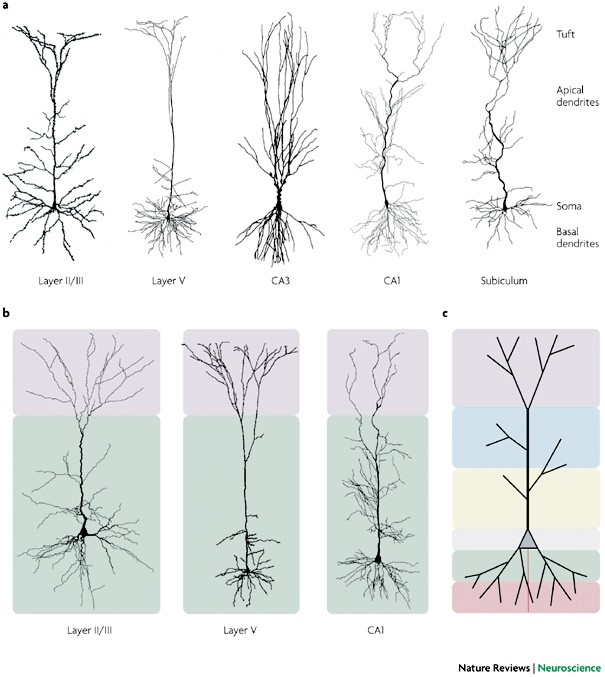
3
Define primary current
Summed current from local activity (the elcetrical activity generated by post-synaptic dendritic current)
4
Define secondary current
Volume conducted
Brain tissue and skull act as an electrically conductive medium where electric waves propogate (send/spread out)
This propogating electical activity = secondary current
Brain tissue and skull act as an electrically conductive medium where electric waves propogate (send/spread out)
This propogating electical activity = secondary current
5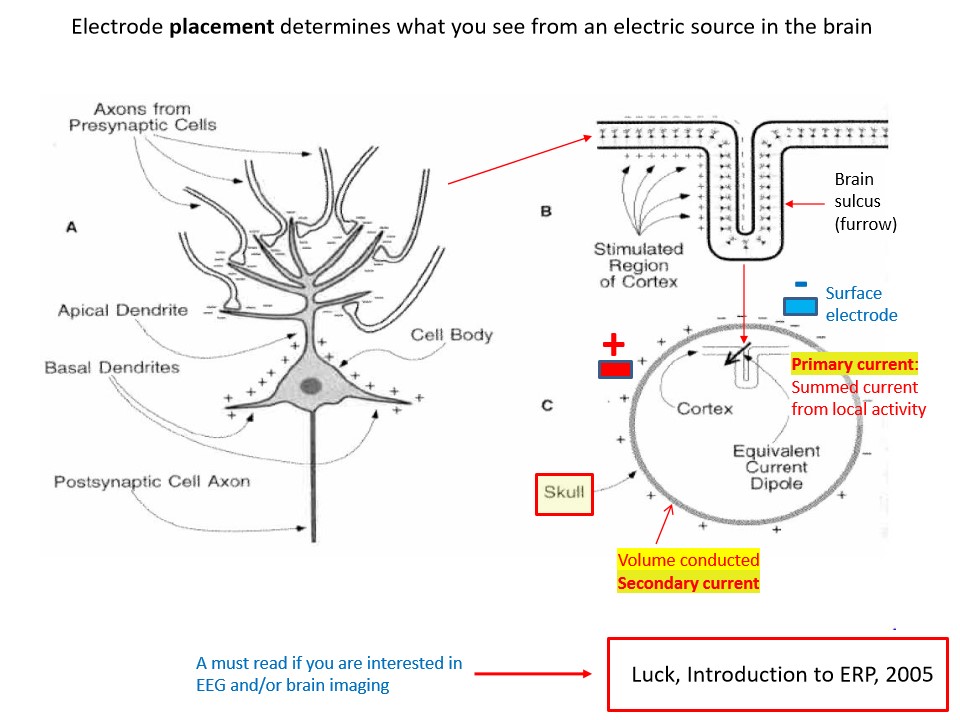
Image occlusion: name the hidden labels
6
What is EEG signal normally measured in?
Microvolts
7
Evaluate EEGs
+ Technology relatively cheap and easy to maintain
+ Electrode placement is standardised (international 10-20 electrode system)
+ High temporal resolution
- Poor spatial resolution, impossible to know where exactly electrical data recorded occurred in the brain
- 'Inverse problem' = don't know which areas are responible for a particular EEG topography
- 'Forward problem' = computing scalp recorded EEG when we know the locations of the within brain current generators (+ potentially solvable)
+ Electrode placement is standardised (international 10-20 electrode system)
+ High temporal resolution
- Poor spatial resolution, impossible to know where exactly electrical data recorded occurred in the brain
- 'Inverse problem' = don't know which areas are responible for a particular EEG topography
- 'Forward problem' = computing scalp recorded EEG when we know the locations of the within brain current generators (+ potentially solvable)
8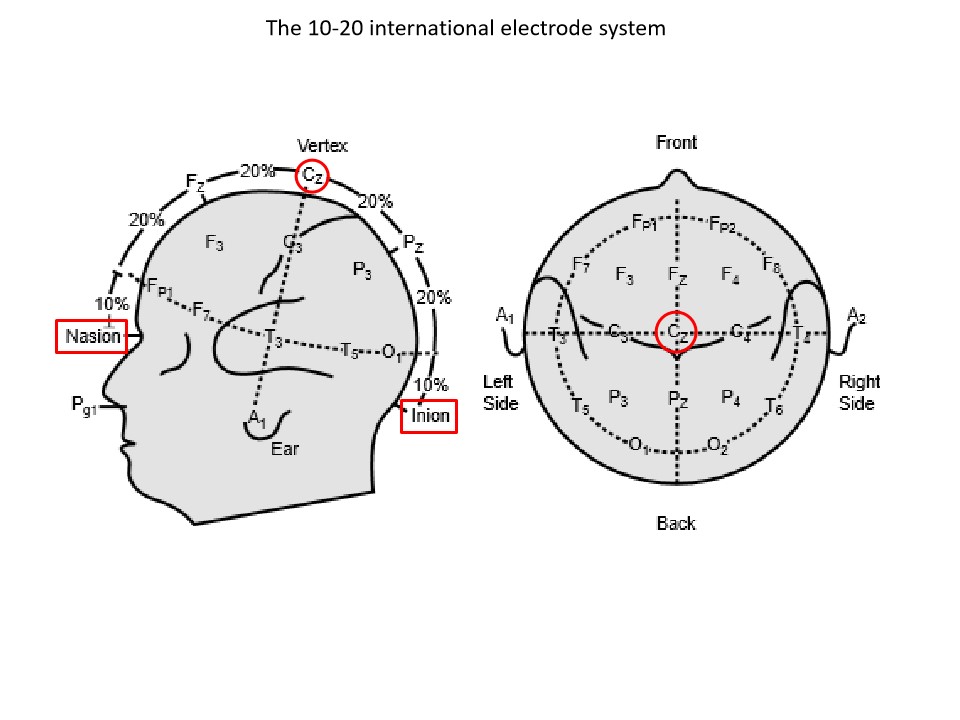
Image occlusion: name the hidden labels
9
Which electrode acts as the reference electrode?
Cz (middle and top of scalp)
10
Why is signal processing important
Noise
11
Define noise
Any measured activity unrelated to the task at hand/signal of interest
12
Define event-related potential (ERP)/evoked potential (EP)
EEG modulation affected by the stimulus
13
Define single-trial data/epoch/sweep
EEG data recorded to a single stimulus presentation
14
6 factors that may cause noise
Physiological artefacts (eye blinking)
Movement artefacts
Mental activity unrelated to task (unrelated thoughts)
External noise (electric noise from nearby lift, fan etc.)
Trial by trial fluctuations in brain activity
Sweating
Movement artefacts
Mental activity unrelated to task (unrelated thoughts)
External noise (electric noise from nearby lift, fan etc.)
Trial by trial fluctuations in brain activity
Sweating
15
How to cope with noise?
Experimental condition is presented many times
16
What is the simplest way to enhance signal quality?
Average EEG signal in response to many presentations of stimulus
17
Define averaged ERP
Averaged EEG data
Grand-average ERP = all pps' data averaged together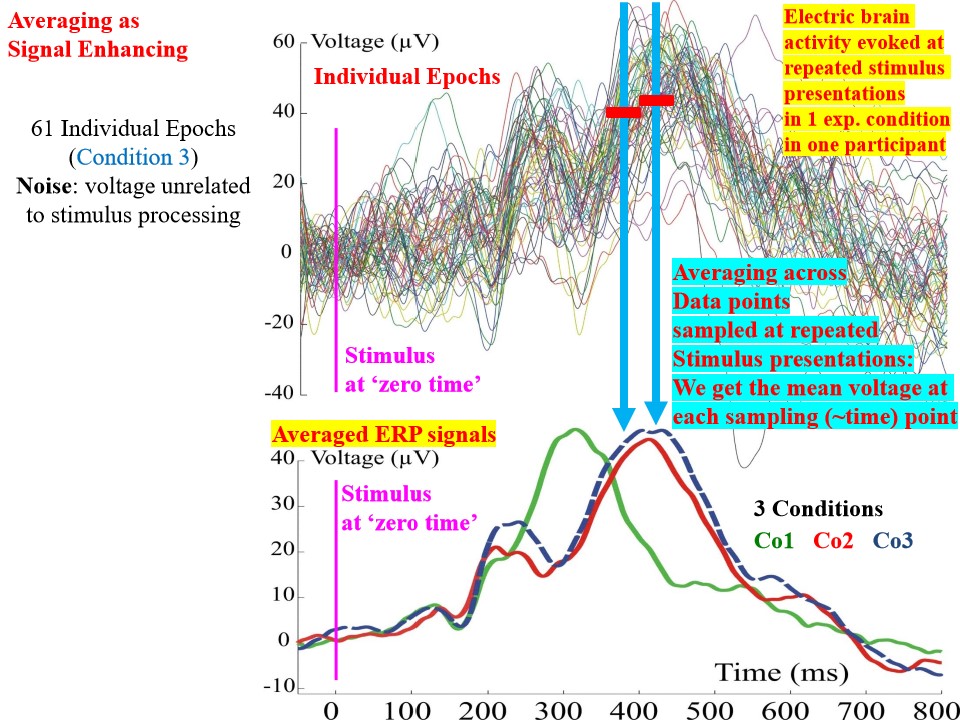
Grand-average ERP = all pps' data averaged together
18
What are EEG and ERP waves defined by?
Polarity (-ive or +ive)
Magnitude of the amplitude (range)
Timing (latency in ms)
Scalp topography (distribution of voltage across scalp)
Magnitude of the amplitude (range)
Timing (latency in ms)
Scalp topography (distribution of voltage across scalp)
19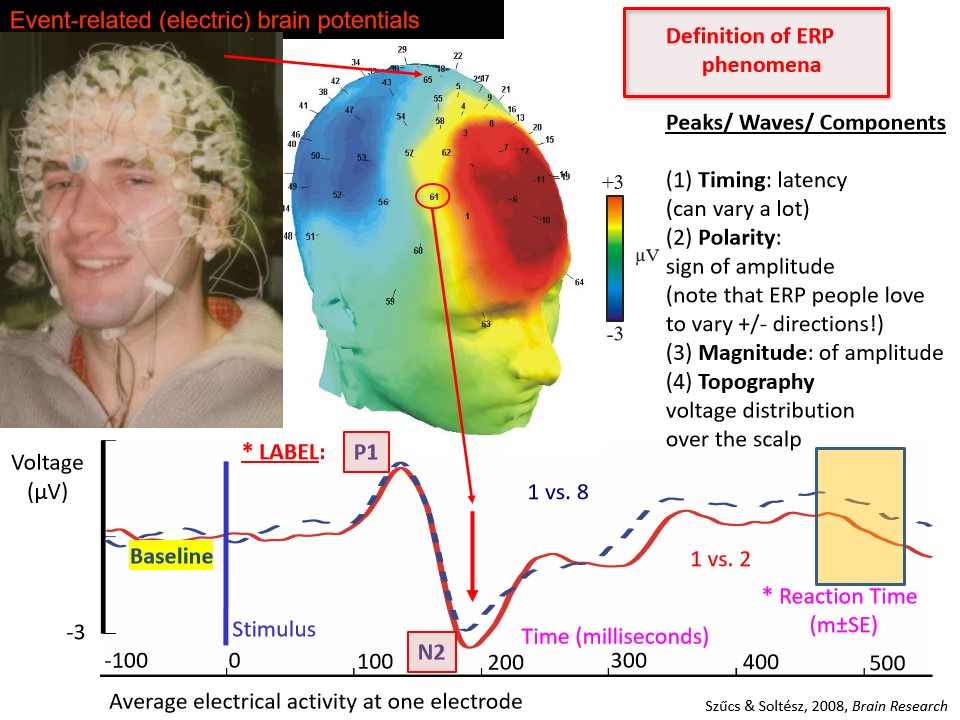
Image occlusion: name the hidden labels
20
Define P1
Positive ERP component that occurs approximately 100 ms after stimulus presentation
21
Define N2
Maximal negative deflection in the ERP occurring between 180 and 391 ms post-stimulus
22
Difference between EEG and ERP
EEG = primary recordings on all channels
ERP = recording time locked to an event
ERP = recording time locked to an event
23
What is one of the most typical sources of noise?
Ocular (eye-related) artefacts
Eye movement
Blinking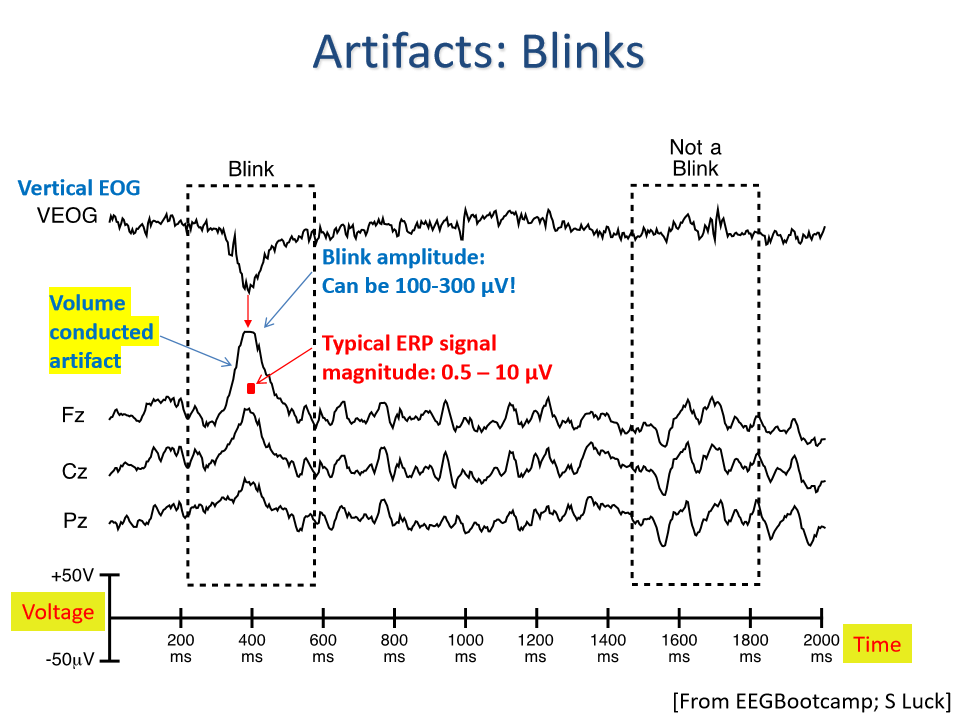
Eye movement
Blinking
24
Define EOG electrodes
Electro-oculagram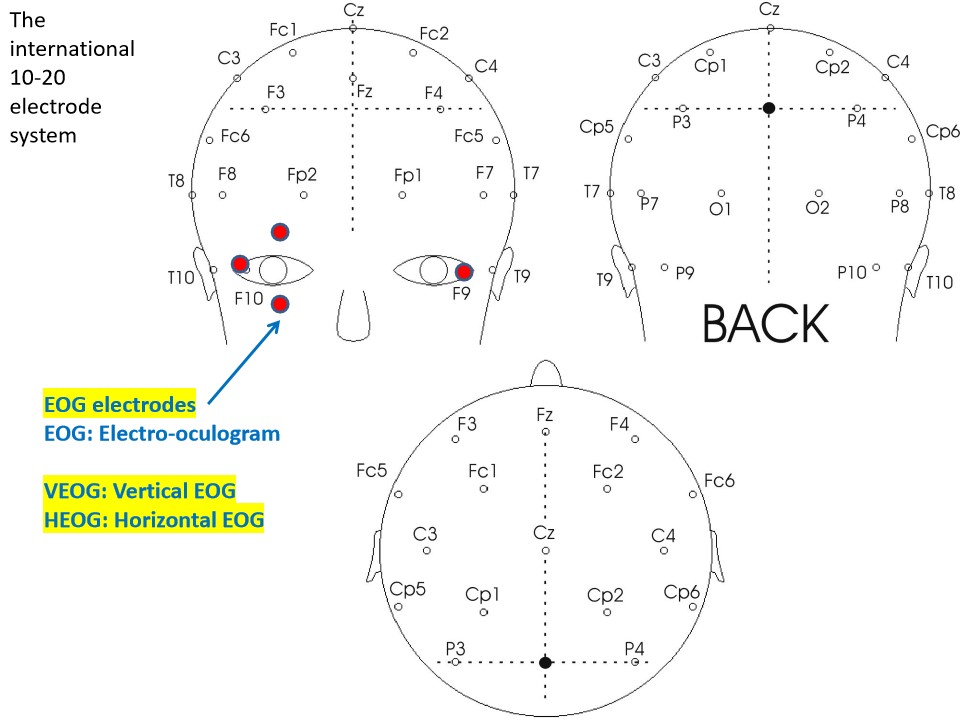
25
Outline the superposition problem
No foolproof way to recover underlying components from observed waveforms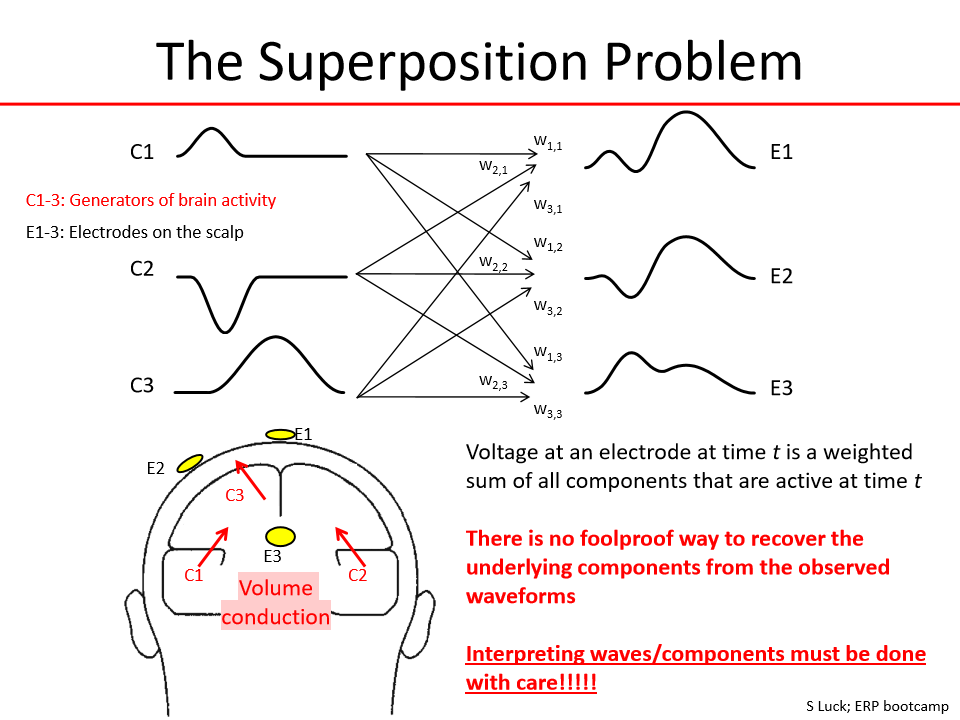
26
Define inverse problem
Difficult to tell what neural activity in the brain produced a particular EEG topography
Unsolvable with known accuracy
We can't know which brain areas are responsible for the recorded electrical activity
Unsolvable with known accuracy
We can't know which brain areas are responsible for the recorded electrical activity
27
Outline equivalent current dipoles
Technique for interpreting source localisation of EEG signals
Generators of signals often represented as 'equivalent current dipole'
Describes summed electrical activity of many neurons
Generators of signals often represented as 'equivalent current dipole'
Describes summed electrical activity of many neurons
28
Outline 3 alternative electromagnetic techniques other than scalp EEG
Intracranial EEG
Magnetoencephalography (MEG)
fMRI
Magnetoencephalography (MEG)
fMRI
29
Difference between oxy and deoxy Hb in fMRI
OxyHb repulses from magnetic field (diamagnetic)
DeoxyHb attracted to magnetic field (paramagnetic)
DeoxyHb attracted to magnetic field (paramagnetic)
30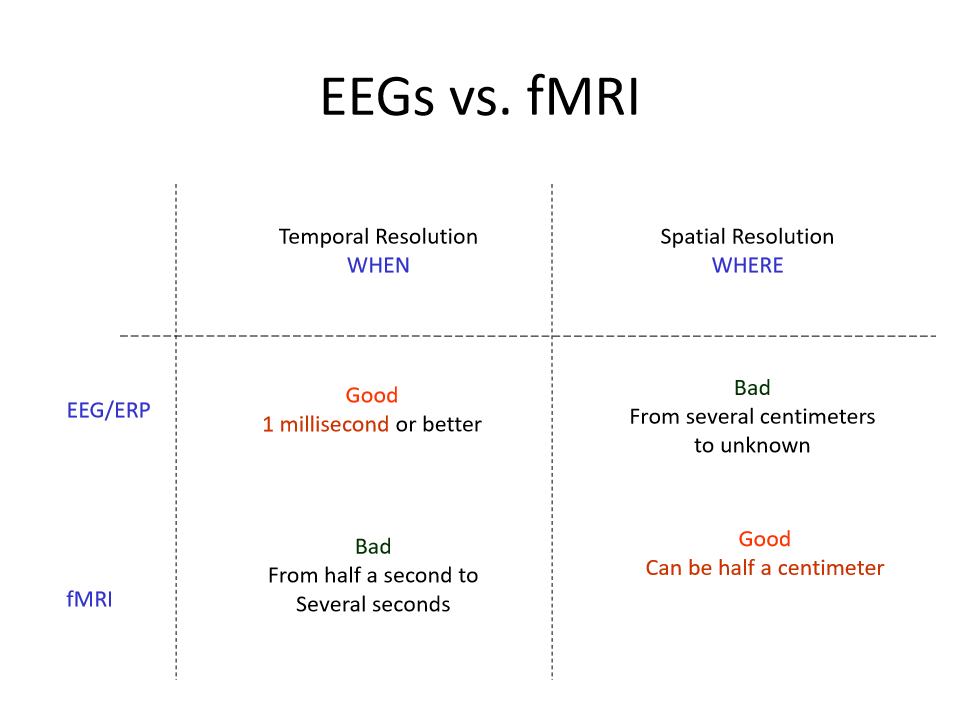
Image occlusion: name the hidden labels
31
Define mismatch negativity (MMN)
Automatic acoustic change detection
Elicited in a passive oddball paradigm
Reflects amplitude difference between deviants (eg. 10% ga) and standards (eg. 90% ba)
Elicited in a passive oddball paradigm
Reflects amplitude difference between deviants (eg. 10% ga) and standards (eg. 90% ba)
32
Define passive oddball paradigm
Pps not consciously attending stimuli
33
Strengths of MMN
+ Study acoustic processing without contamination of attention
+ Can be used in non-verbal pps (babies/coma)
+ Can be used in non-verbal pps (babies/coma)
34
Evidence for the effects of visual attention on ERPs
Hylliard and Anllo-Vento 1998
Attention modulates amplitude of ERPs
Contralateral to stimulation
Attending stimuli = more positive amplitude compared to unattended stimuli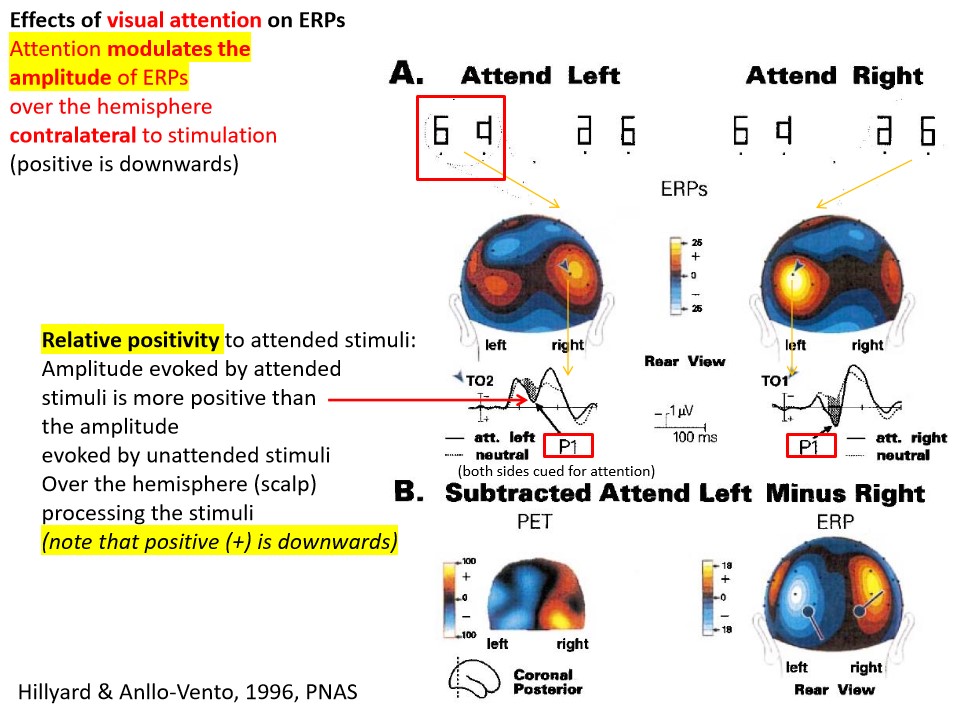
Attention modulates amplitude of ERPs
Contralateral to stimulation
Attending stimuli = more positive amplitude compared to unattended stimuli
35
Outline P300
Positive wave
Latency of 200-700ms (appears ~200-700ms after stimulus presentation) - increases with task difficulty
Also called P300 complex - probably sum of overlapping waves with similar amplitudes and latencies
Latency of 200-700ms (appears ~200-700ms after stimulus presentation) - increases with task difficulty
Also called P300 complex - probably sum of overlapping waves with similar amplitudes and latencies
36
What does the P300 family of waves include?
P300
P3b
P3a
P3b
P3a
37
Outline P3b
Occurs in conscious oddball tasks such as active categorisation paradigms (attending to stimuli)
Amplitude modulated by subjectively perceived frequency of task-relevant stimuli
Smaller wave = subjectively percieved probability of events
Larger wave = P300 amplitude
Usually assumed to reflect categorisation and working memory processes related to task-relevant stimuli
Amplitude modulated by subjectively perceived frequency of task-relevant stimuli
Smaller wave = subjectively percieved probability of events
Larger wave = P300 amplitude
Usually assumed to reflect categorisation and working memory processes related to task-relevant stimuli
38
Outline P3a
Occurs in conscious oddball tasks
Appears when improbable, unexpected, task-irrelevant distractor stimuli are presented
More frontal topography than P3b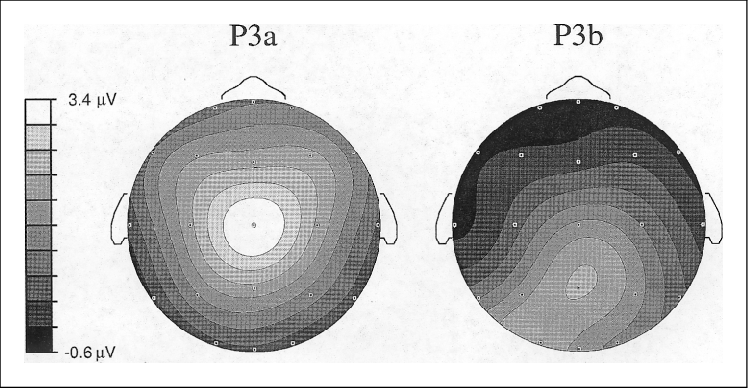
Appears when improbable, unexpected, task-irrelevant distractor stimuli are presented
More frontal topography than P3b
39
Outline N400
Negative polarity
Latency ~400ms
Appears when pps encounter semantically unexpected stimuli
Magnitude of amplitude depends on degree of semantic anomaly
Latency ~400ms
Appears when pps encounter semantically unexpected stimuli
Magnitude of amplitude depends on degree of semantic anomaly
40
What do the P300 and N400 have in common?
Both associated with high cognitive function
41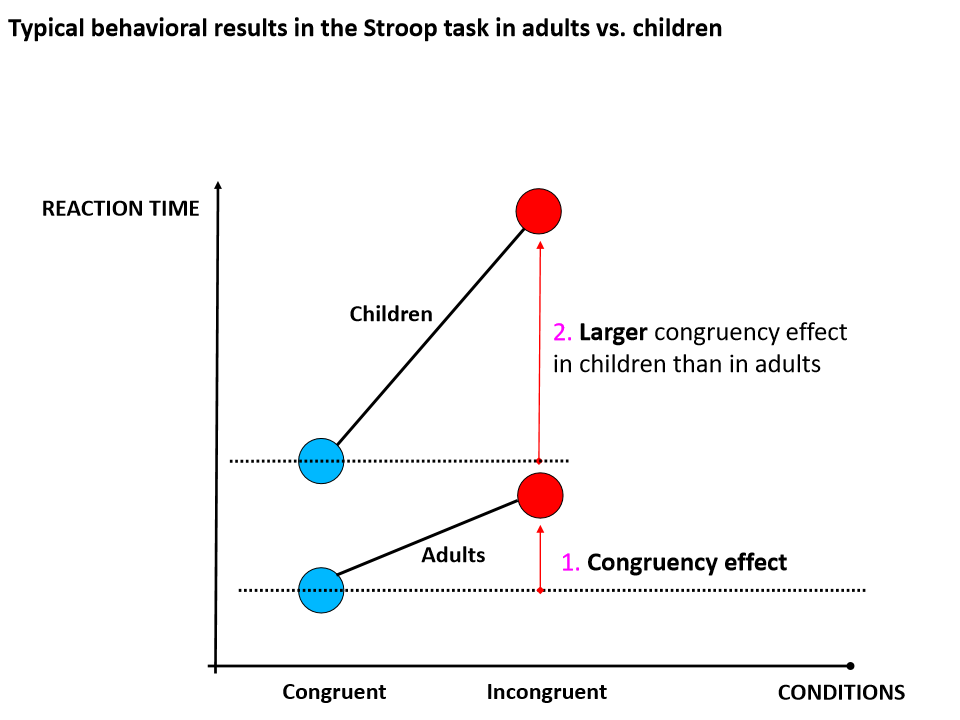
Image occlusion: name the hidden labels
42
2 potential explanations for why children are slower at stroop task than adults
Worse resolution of perceptual conflict, stimulus perception disturbed
More confused when responding (motor conflict)
More confused when responding (motor conflict)
43
Outline the lateralised readiness potential (LRP)
Type of motor potential
Marker of movement preparation in motor cortex
Can be detected even before a movement happens
Used to observe unconscious/latently planned movement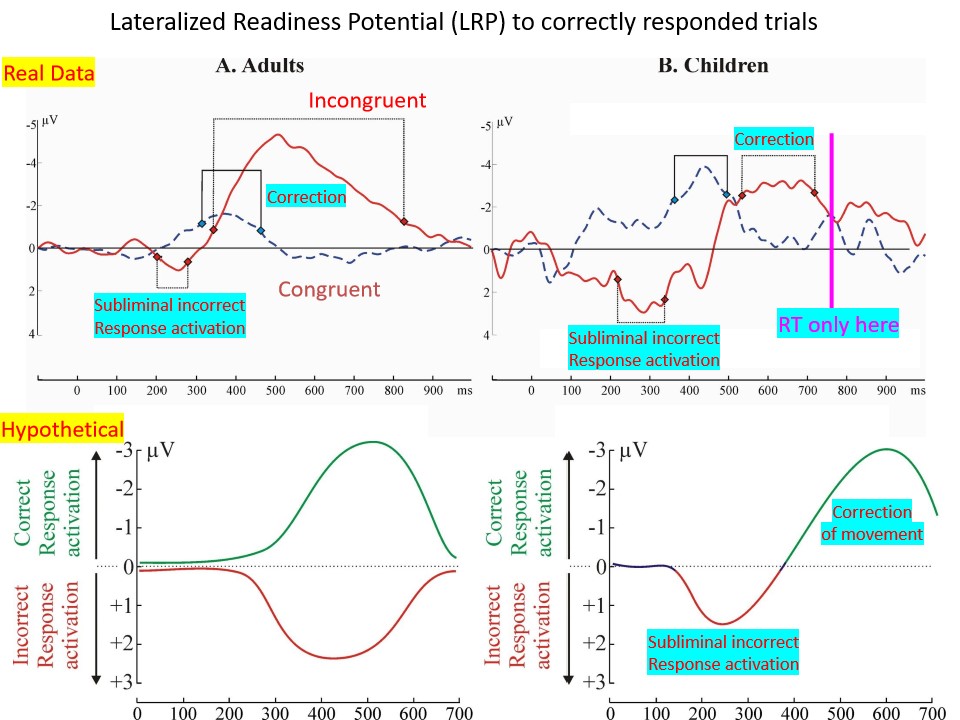
Marker of movement preparation in motor cortex
Can be detected even before a movement happens
Used to observe unconscious/latently planned movement
44
Outline a study that investigated the congruency effect
Choose which animal is larger in real life (animals shown as different sizes on the screen)
Size decision is fast, semantic decision is slow
Measured LRP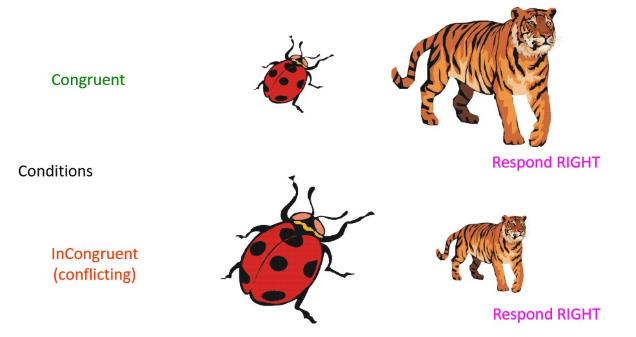
Size decision is fast, semantic decision is slow
Measured LRP