Social Cognition
Study these flashcardsFree · spaced repetition · iPhone, Android, Mac & web
All cards
1
Define social cognition
Understanding self and other
Including agency and intention
Including agency and intention
2
Define social interaction
Sending and receiving info signals
3
Evidence for evolutionary argument of social interaction
Waggle dance of bees - direction of food
Alarm calls
Facial expressions
Primates:
Grooming - forms social bonds
Coalitions - 2+ males direct aggression to others
Alliances - co-operative behaviours (eg. food sharing)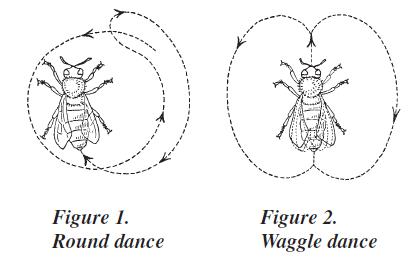
Alarm calls
Facial expressions
Primates:
Grooming - forms social bonds
Coalitions - 2+ males direct aggression to others
Alliances - co-operative behaviours (eg. food sharing)
4
Outline the social intelligence hypothesis
Humans have high intelligence because living in social groups drove evolution of cognitive mechanisms
Supported by evidence of human only skills:
Language
Social transmission of info (education, culture)
Mental inference (persuasion, deception) - allowed ppl to work up social hierarchy
Supported by evidence of human only skills:
Language
Social transmission of info (education, culture)
Mental inference (persuasion, deception) - allowed ppl to work up social hierarchy
5
3 methods for investigating whether there are selcetive neural responses for social info
Single cell recordings
Brain lesion patients
fMRI
Brain lesion patients
fMRI
6
4 social informational processing mechanisms
Face perception
Detection of biological motion
Imitation
Mental state inference
Detection of biological motion
Imitation
Mental state inference
7
4 types of evidence for face perception being involved in social informational processing
Single cell recordings in macaque superior temporal sulcus
Prosopagnosia
FFA
Human neonatal face preferences
Prosopagnosia
FFA
Human neonatal face preferences
8
What did Johnson et al find and when?
1991
Developmental trajectory for facial recognition
Neonates = face preference
5 weeks = no preference
10 weeks = face preference returns (but not for face-like schematic image of 3 dots) - potentially learning individual and specific faces
19 weeks = no preference (they no longer look like real faces, just random shapes)
Suggests over the first 2 months of life, we are learning individual faces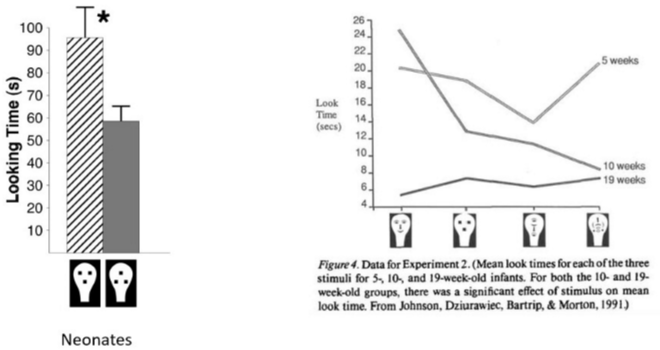
Developmental trajectory for facial recognition
Neonates = face preference
5 weeks = no preference
10 weeks = face preference returns (but not for face-like schematic image of 3 dots) - potentially learning individual and specific faces
19 weeks = no preference (they no longer look like real faces, just random shapes)
Suggests over the first 2 months of life, we are learning individual faces
9
What did Scherf et al find and when?
2007
fMRI
Children, adolescents and adults shown faces, buildings and objects
Children = low activation in FFA, OFA and STS to faces
Adolescents = similar to adults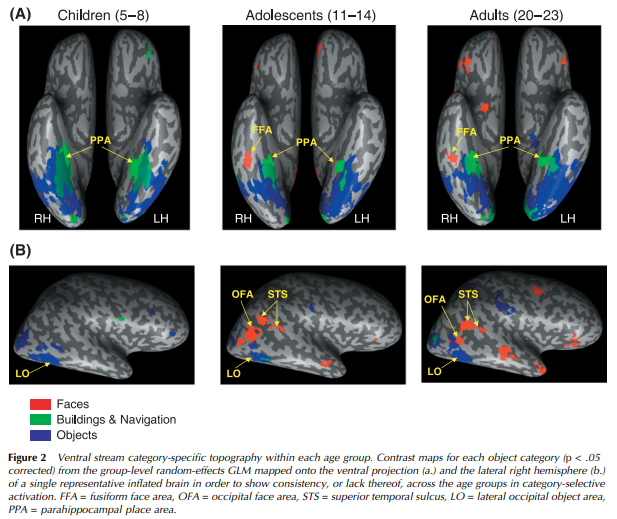
fMRI
Children, adolescents and adults shown faces, buildings and objects
Children = low activation in FFA, OFA and STS to faces
Adolescents = similar to adults
10
2 potential neurocognitive mechanisms for face processing
Innate peripheral perception-action system
General mechanisms of learning, memory and attention
General mechanisms of learning, memory and attention
11
Outline the innate peripheral perception-action systems
Specific sensory stimuli elicit neural response (innate releasing mechanism)
Neural activation elicits specific, inflexible motor action (fixed action pattern)
Neural activation elicits specific, inflexible motor action (fixed action pattern)
12
Method of investigating detection of biological motion
Point-light displays (Johansson)
Discern human motion
No form info available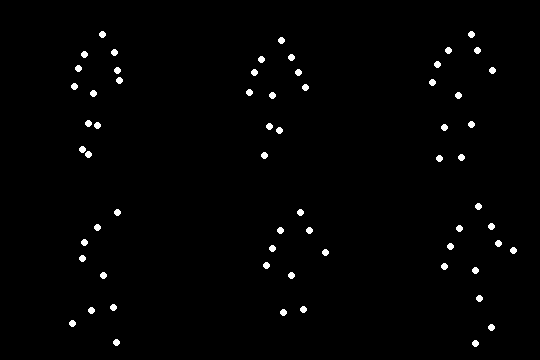
Discern human motion
No form info available
13
What did Oram and Perret do and when?
1994
Single unit recordings in macaque superior temporal sulcus (STS)
Different STS cell types tuned to different features of moving bodies
Suggests potential evolutionary origin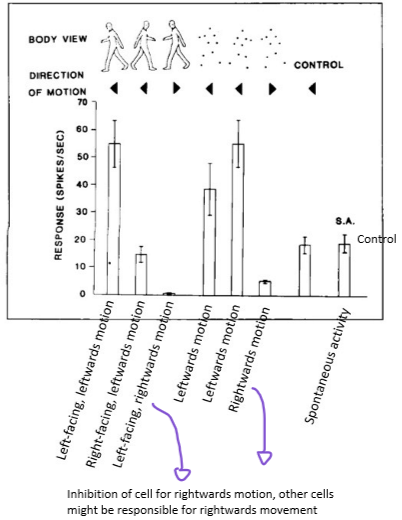
Single unit recordings in macaque superior temporal sulcus (STS)
Different STS cell types tuned to different features of moving bodies
Suggests potential evolutionary origin
14
What did Fox and McDaniel do and when?
1982
Point light displays of bio and non-bio motion
2m old babies = no preference for bio motion compared to 4 and 6m
4m = preference for bio movement
2 and 4m = no preference for bio motion of hands coming to grasping (cognitive capacity required for intention reading of grasp - may develop at 6m)
6m = preference for grasp over non-bio
Point light displays of bio and non-bio motion
2m old babies = no preference for bio motion compared to 4 and 6m
4m = preference for bio movement
2 and 4m = no preference for bio motion of hands coming to grasping (cognitive capacity required for intention reading of grasp - may develop at 6m)
6m = preference for grasp over non-bio
15
What did Simion et al do and when?
2008
1-3 day olds
Shown point light displays of walking hen (bio), random animation (non-bio), hen walking upside down (inverted bio)
Preference for bio and upright motion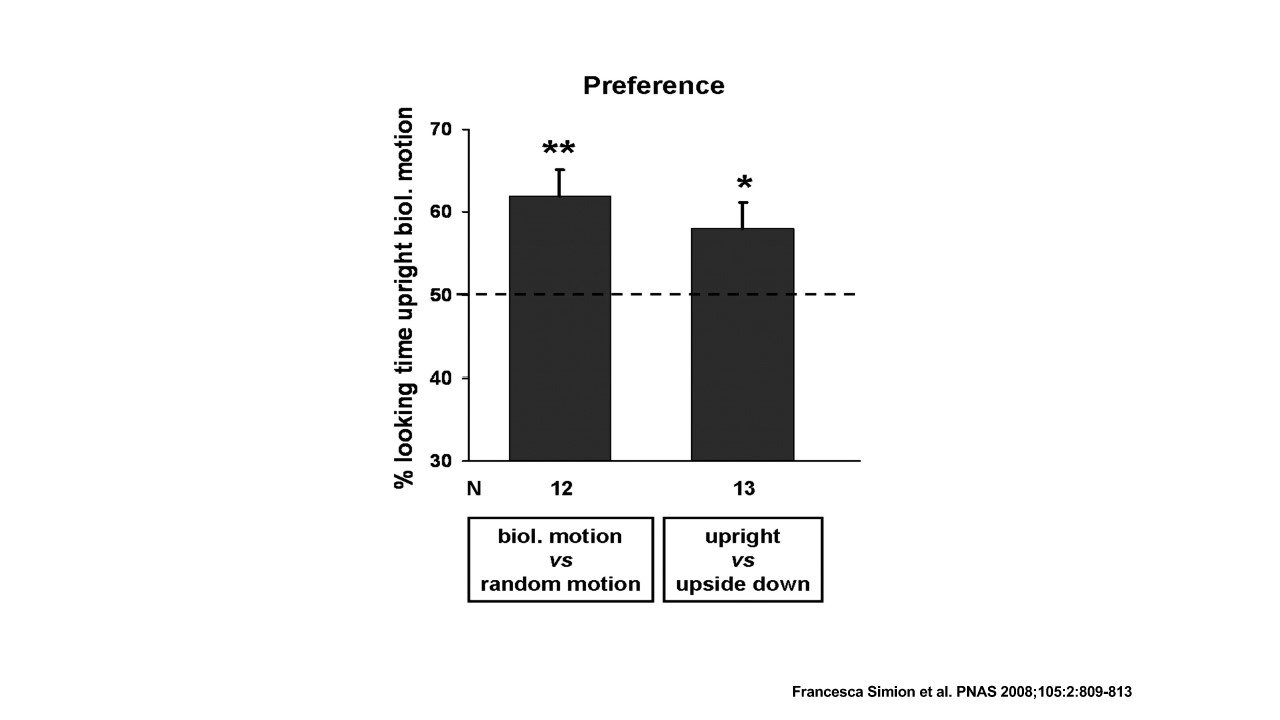
1-3 day olds
Shown point light displays of walking hen (bio), random animation (non-bio), hen walking upside down (inverted bio)
Preference for bio and upright motion
16
What did Furuhata and Shirai do and when?
2015
Point light displays of walker turning around and bending down as if looking at target
9m = didn't follow
12m = followed attentional orientation indicated by action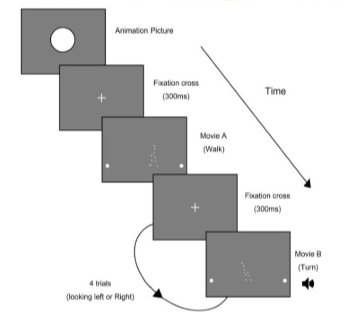
Point light displays of walker turning around and bending down as if looking at target
9m = didn't follow
12m = followed attentional orientation indicated by action
17
Define imitation
Match visual stimulus of other's movement to visual stimulus of own movement
18
What does the process of imitation require?
Detecting correspondence between self and other and between modalities
Visual input about observed person requires matching to own kinaesthetic experience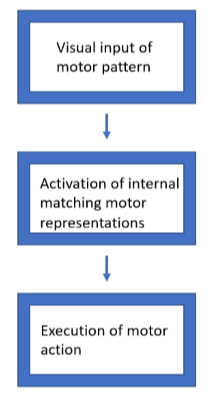
Visual input about observed person requires matching to own kinaesthetic experience
19
Who discovered mirror neurons?
Rizzolatti et al
20
Evidence for discovery of mirror neurons
Rizzolatti et al
Macaque monkeys
Single cell recordings
In ventral premotor area F5
Activated when observing action and execution of same action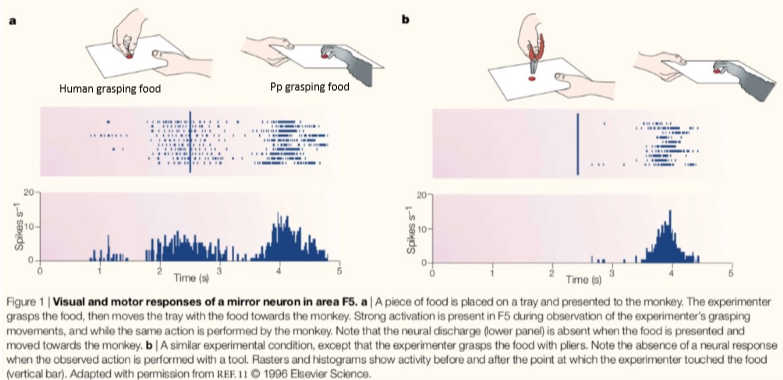
Macaque monkeys
Single cell recordings
In ventral premotor area F5
Activated when observing action and execution of same action
21
What are the 2 theoretical claims for the function of F5 neurons?
Action understanding
Imitation
Imitation
22
Define Occam's razor
Given the data, we should slect the explanation which requires the least assumptions to be made
Similar to parsimony
Similar to parsimony
23
Outline the action understanding theory
Purpose of MN is to provide understanding of other's actions
Important for social interaction
Helps to understand what others might be thinking
Important for social interaction
Helps to understand what others might be thinking
24
Criticisms of the action understanding theory
Doesn't follow Occam's razor:
- Nothing in data suggests MN could help intention understanding
- Only observation is that MN activated during observation and execution of same action
- Infering intention reading goes beyond the data
- Nothing in data suggests MN could help intention understanding
- Only observation is that MN activated during observation and execution of same action
- Infering intention reading goes beyond the data
25
Outline imitation as a MN theory
MN allow us to imitate
Requires detecting response between visual input of observed action and stored internal representations of actions
Requires detecting response between visual input of observed action and stored internal representations of actions
26
Define domain specific ability
Cognitive ability, specific to a task and under control of a specific function of mind and/or brain
Eg. facial recognition
Eg. facial recognition
27
Define domain general ability
Cognitive ability, influences performance over a wide range of situations and tasks
Eg. general intelligence
Eg. general intelligence
28
Outline the 2 contratsing theories for the evolution of MN
Domain specific - MN innately specified to condutct sensori-motor learning
Domain general - MN gain properties over development, through acquiring representations which encode visual and motor aspects of an action
Domain general - MN gain properties over development, through acquiring representations which encode visual and motor aspects of an action
29
What did Meltzoff and Moore find and when?
1977
Data appeared to show immediate imitation of actions in 1-2 day olds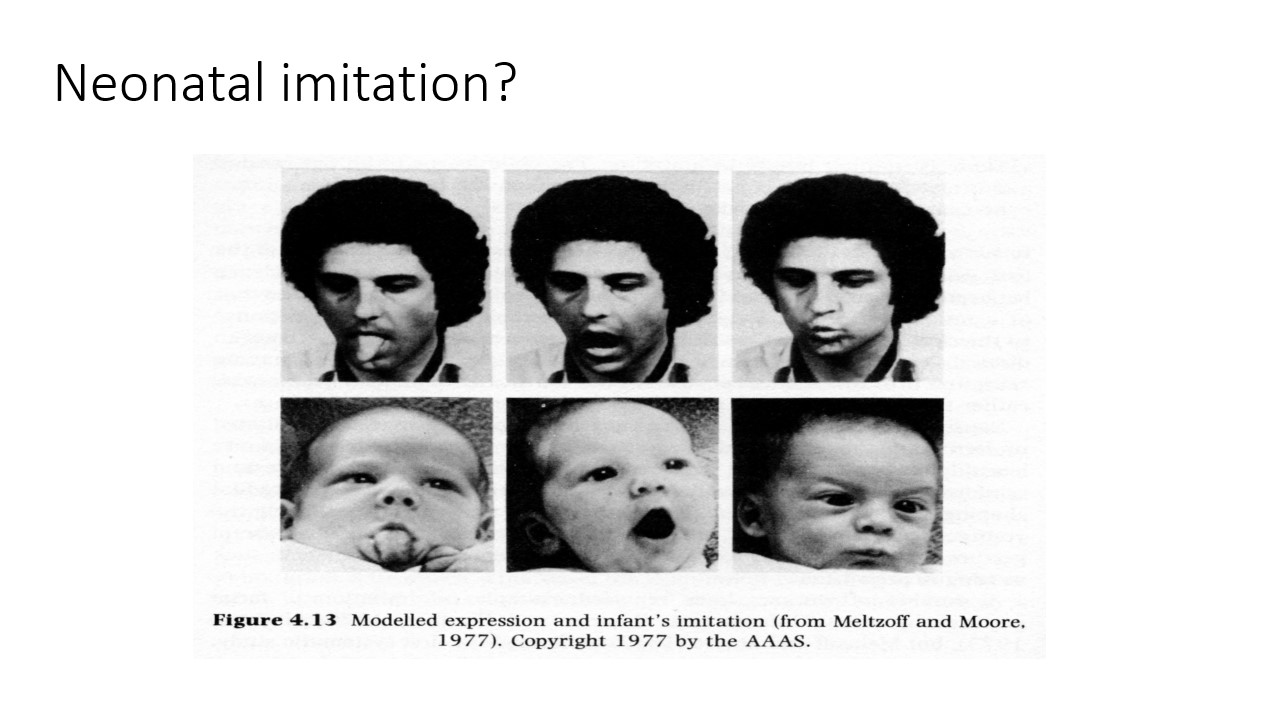
Data appeared to show immediate imitation of actions in 1-2 day olds
30
Outline the 'like me' hypothesis
Developed by Meltzoff to outline processes involved in neonatal imitation
Innate equivalence of Active Intermodal Matching model
Provides starting point for representing self-other agency (basis of social cognitive development)
Equivalence detector - this object is like me
Predicts that any gesture can be translated from observational input to imitative output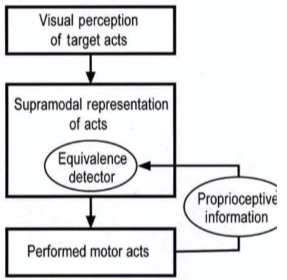
Innate equivalence of Active Intermodal Matching model
Provides starting point for representing self-other agency (basis of social cognitive development)
Equivalence detector - this object is like me
Predicts that any gesture can be translated from observational input to imitative output
31
What did Ainsfeld find and when?
1991
Meta anlysis
Enormous variation in neonatal imitation studies
Variation in:
Duration of modelling
Actions to be modelled
Attrition rates
No. of infants
Age range
Only tongue protusion showed reliable imitation
Evidence for mouth open, considerably weaker
Meta anlysis
Enormous variation in neonatal imitation studies
Variation in:
Duration of modelling
Actions to be modelled
Attrition rates
No. of infants
Age range
Only tongue protusion showed reliable imitation
Evidence for mouth open, considerably weaker
32
Criticism of Meltzoff's theory
- Only TP reliable (Ainsfeld 1991), challenges social informational processing function, TP may be reliable due to feeding?
33
What does the Active Intermodal Matching model state about MN?
Any gesture can be translated from observation input to imitative output
34
What is the Occam's razor explanation for Ainsfeld's 1991 findings?
Only TP reliable
Observational input acts as a releasing stimulus for a fixed action pattern
Observational input acts as a releasing stimulus for a fixed action pattern
35
Outline the longitudinal study into imitation
Oostenbroek et al 2016
~100 infants
Tested at 1, 3, 6 and 9 weeks
Tongue protusion, mouth opening, happy/sad face
Control used non-social objects (don't have to use strangers)
Red = frequency of producing modelled gesture
No imitation observed in any condition, even TP
Suggests TP is not special and is not a fixed action pattern elicited by a releasing stimulus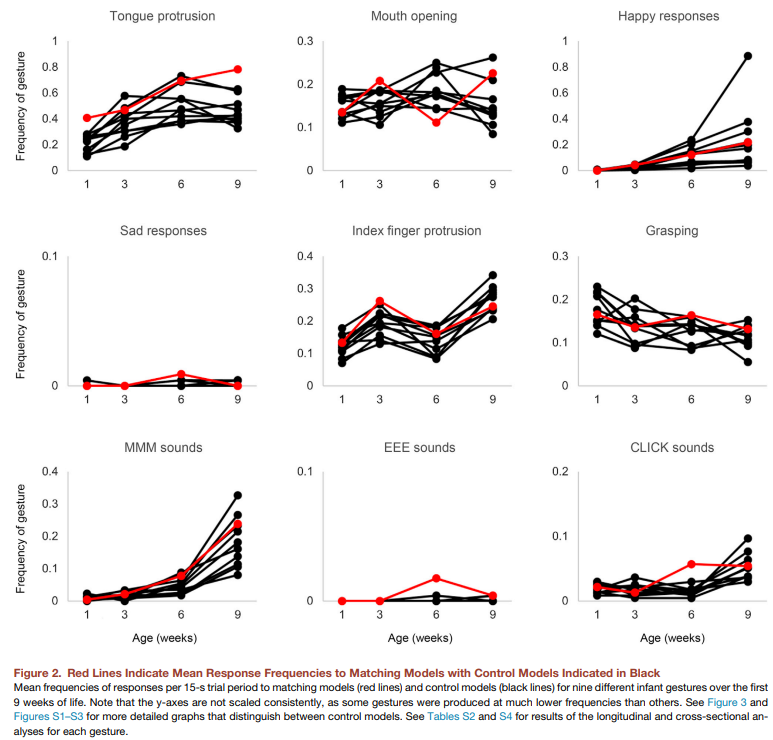
~100 infants
Tested at 1, 3, 6 and 9 weeks
Tongue protusion, mouth opening, happy/sad face
Control used non-social objects (don't have to use strangers)
Red = frequency of producing modelled gesture
No imitation observed in any condition, even TP
Suggests TP is not special and is not a fixed action pattern elicited by a releasing stimulus
36
What did Redshaw et al find and when?
2020
Correlated scores on social cognitive skills known to emerge during this time period with TP scores
Found only very weak correlation
Suggests TP in neonated has little to do with development of social cognition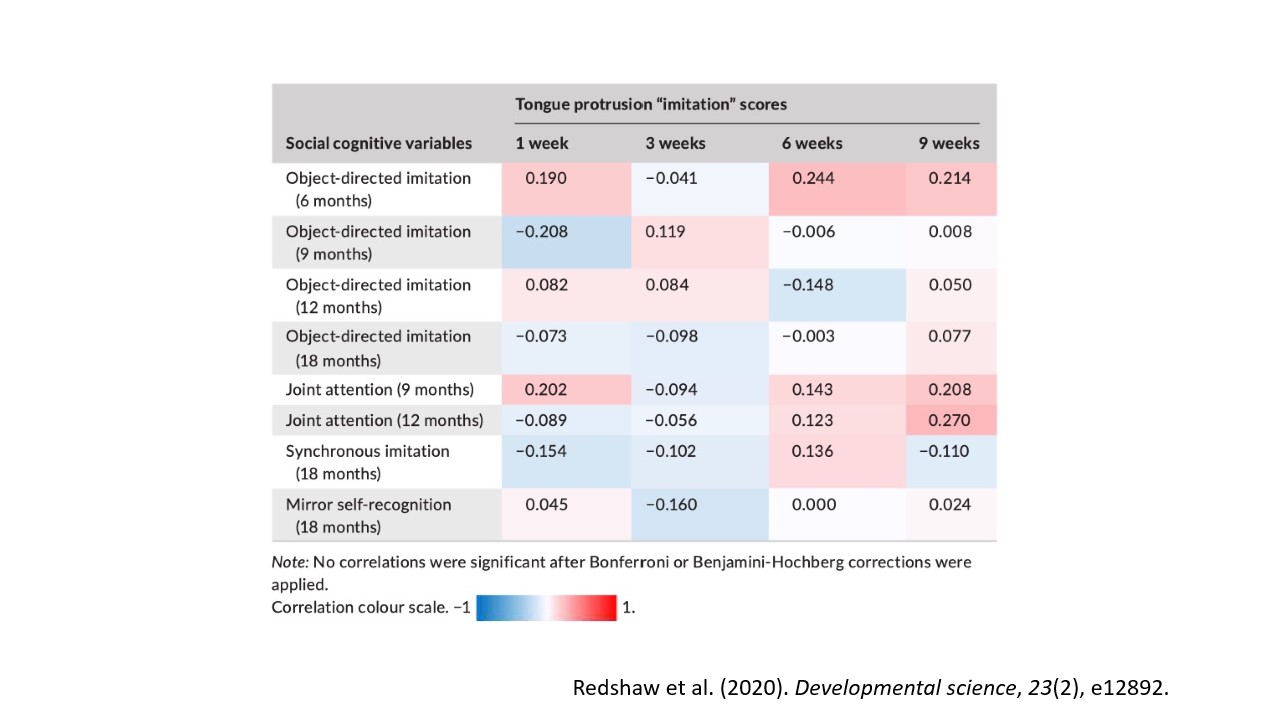
Correlated scores on social cognitive skills known to emerge during this time period with TP scores
Found only very weak correlation
Suggests TP in neonated has little to do with development of social cognition
37
What did Jones find and when?
2007
Longitudinal study
Data suggests reliably imitation of gestures emerges after 6-8m
Some only appear after 16-18m
Data implies TP last to develop
Suggests true imitation has long developmental trajectory
Neonatal responses (eg. Meltzoff) likely due to arousal rather than innate, primitive mechanisms for social cognition and imitation
Longitudinal study
Data suggests reliably imitation of gestures emerges after 6-8m
Some only appear after 16-18m
Data implies TP last to develop
Suggests true imitation has long developmental trajectory
Neonatal responses (eg. Meltzoff) likely due to arousal rather than innate, primitive mechanisms for social cognition and imitation
38
Outline mental state inference
Ability to discern mental states in others - allows for deception, persuasion, manipulation
Not directly observable
Includes "theory of mind" || notes:Behaviour mostly driven by mental states (beliefs/desires)
Not directly observable
Includes "theory of mind" || notes:Behaviour mostly driven by mental states (beliefs/desires)
39
Outline the 2 opposing views for the origin of theory of mind
Develops with experience (attention to social learning info, learning, memory)
Innately endowed (module for computation of other's mental states) - requires acceptance that very sophisticated mechanisms were developed by evolution
Innately endowed (module for computation of other's mental states) - requires acceptance that very sophisticated mechanisms were developed by evolution
40
How can ToM be assessed?
False belief tasks
Violation of expectation procedures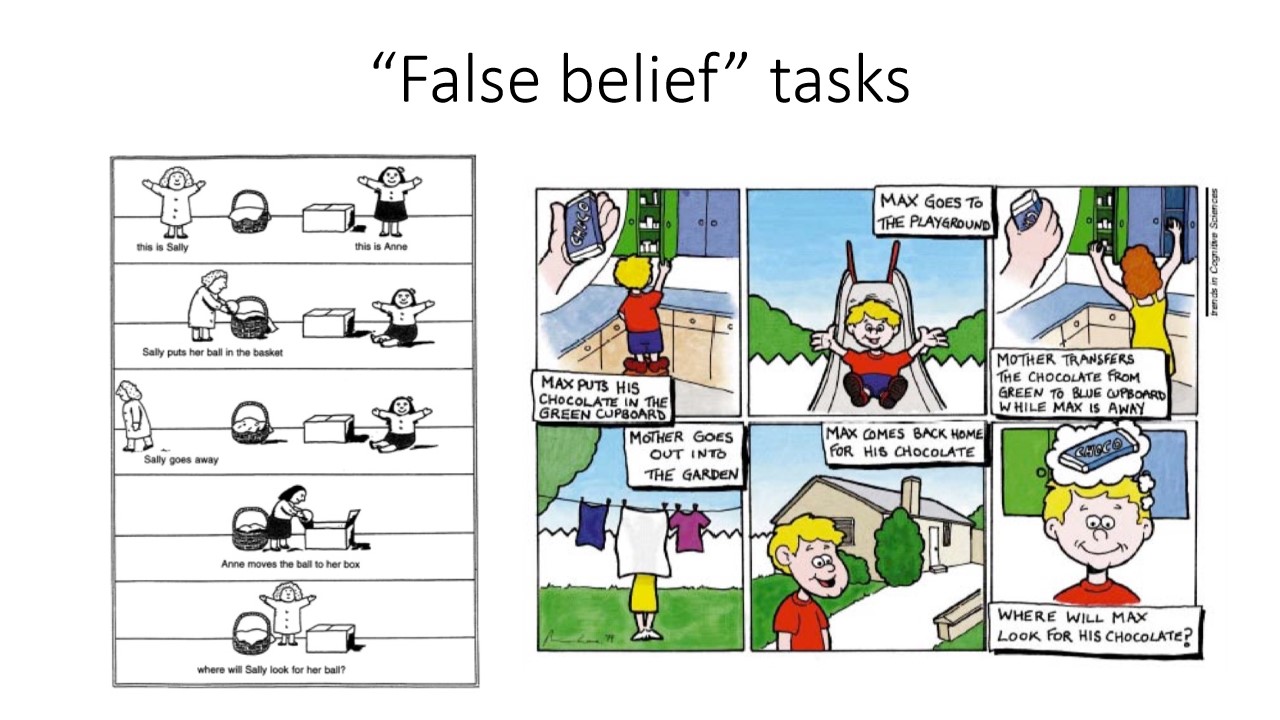
Violation of expectation procedures
41
Explain why we might see a 3-4y transition in ToM
3y = fail
4y = pass
Mental state inference requires sufficient experience
OR
Task demands make it hard for 3y to complete successfully (not due to lack of mental state inference)
- Maintain story sequence in mind (working memory)
- Inhibit knowledge of new location of object
- Inhibit prepotent response to say new location
4y = pass
Mental state inference requires sufficient experience
OR
Task demands make it hard for 3y to complete successfully (not due to lack of mental state inference)
- Maintain story sequence in mind (working memory)
- Inhibit knowledge of new location of object
- Inhibit prepotent response to say new location
42
Onishi and Baillargeon method and when?
2005
Violation of expectation task
15m
Shown:
Person put object in green box
Reach into green box
Creates expectation that ppl reach for things where they were last hidden
Split into 4 groups
Group A - adult sees yellow box move towards green box (true belief: toy still in green) - TBg
Group B - adult sees toy move from green to yellow (true belief: now in yellow) - TBy
Group C - adult doesn't see toy move from green to yellow (adult false belief: still in green) - FBg
Group D - adult sees toy move from green to yellow. Doesn't see toy move back to green (adult false belief: toy in yellow) - FBy
Test trials:
1/2 infants in each of 4 groups see adult reach into green
Other half see yellow reach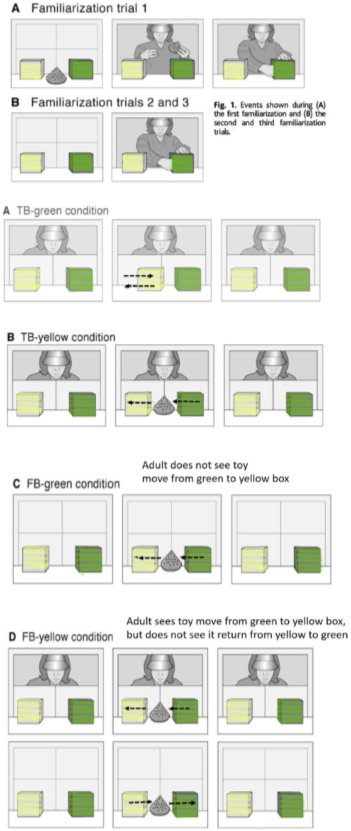
Violation of expectation task
15m
Shown:
Person put object in green box
Reach into green box
Creates expectation that ppl reach for things where they were last hidden
Split into 4 groups
Group A - adult sees yellow box move towards green box (true belief: toy still in green) - TBg
Group B - adult sees toy move from green to yellow (true belief: now in yellow) - TBy
Group C - adult doesn't see toy move from green to yellow (adult false belief: still in green) - FBg
Group D - adult sees toy move from green to yellow. Doesn't see toy move back to green (adult false belief: toy in yellow) - FBy
Test trials:
1/2 infants in each of 4 groups see adult reach into green
Other half see yellow reach
43
Outline Onishi and Baillargeon's hypothesis
Infants would demonstrate ToM if they increased their looking times in trials that violated the belief expectation formed during induction trials
44
Onishi and Baillargeon results
15m babies looked reliably longer at test trials that violated expectation based on belief understanding
Results in false belief consistent with true belief condition
Suggests false belief understanding might be innate
Goes against 3-4y transition for ToM shown by other false belief tasks with confounds (required other cognitive skills)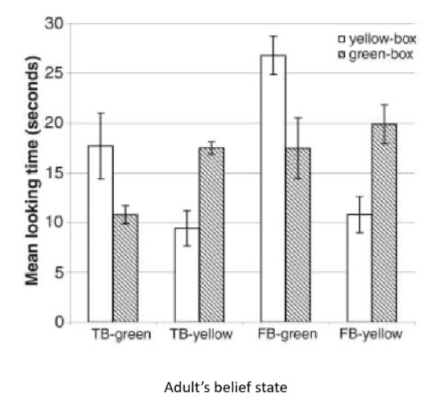
Results in false belief consistent with true belief condition
Suggests false belief understanding might be innate
Goes against 3-4y transition for ToM shown by other false belief tasks with confounds (required other cognitive skills)
45
Who criticised Onishi and Baillargeon's study and when?
Heyes 2014
46
Criticisms of Onishi and Baillargeon's study
- True belief conditions, adult and infant beliefs match, responses may be driven by own beliefs
- Heyes = In TB green and FB green: infants familiarised with 3 reaches to green. 1/2 see reach to yellow / green. Yellow reaches more novel than green for babies in both condition so more surprise at yellow reach
- Heyes = In TB yellow and FB yellow: during belief induction, attention drawn to yellow. Test display of yellow reach less novel than green reach. Not about inference of adult's intentions. Attention drawn to green is surprising
- Heyes = FB green had attention drawn to yellow but still showed surprise at yellow reach. Heyes suggests this is not due to ToM. FB green only group to not see adult in belief induction. Adult appears in test, could interfere with processing just before toy moved to yellow. Unable to form memory of induction trials. Only have memory of familiarisation trials (3 green reaches, so yellow novel in test trial)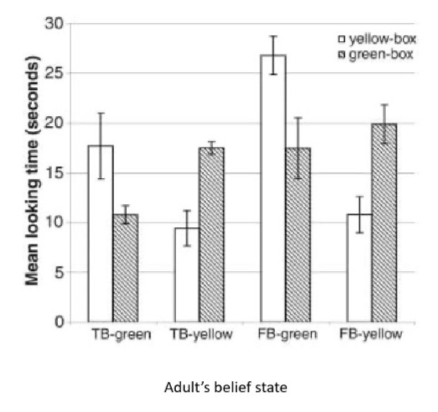
- Heyes = In TB green and FB green: infants familiarised with 3 reaches to green. 1/2 see reach to yellow / green. Yellow reaches more novel than green for babies in both condition so more surprise at yellow reach
- Heyes = In TB yellow and FB yellow: during belief induction, attention drawn to yellow. Test display of yellow reach less novel than green reach. Not about inference of adult's intentions. Attention drawn to green is surprising
- Heyes = FB green had attention drawn to yellow but still showed surprise at yellow reach. Heyes suggests this is not due to ToM. FB green only group to not see adult in belief induction. Adult appears in test, could interfere with processing just before toy moved to yellow. Unable to form memory of induction trials. Only have memory of familiarisation trials (3 green reaches, so yellow novel in test trial)