A5 - Gene Expression
Study these flashcardsFree · spaced repetition · iPhone, Android, Mac & web
All cards
1
Define stem cells
Unspecialised cells that develop into other types of cell
2
Name the process whereby a stem cell becomes specialised
Differentiation
3
Where are stem cells found?
Embryos
Adult tissues
Adult tissues
4
What are the 4 types of stem cells?
Totipotent
Pluripotent
Mutlipotent
Unipotent
Pluripotent
Mutlipotent
Unipotent
5
Which stem cells are found in embryos
Totipotent
Pluripotent
Pluripotent
6
Which stem cells are found in adult mammals
Multipotent
Unipotent
Unipotent
7
Describe totipotent stem cells
Can mature into any type of body cell
Including placenta
Only present in 1st few embryo divisions
Including placenta
Only present in 1st few embryo divisions
8
Describe pluripotent stem cells
Can mature into any body cell
Lost ability to become placenta cells
Lost ability to become placenta cells
9
Describe multipotent stem cells
Can differentiate into a few different types of cell
10
Describe unipotent stem cells
Can only differentiate into 1 type of cell
11
Give an example of a unipotent stem cell
Cardiomyocytes (heart cells)
12
How do stem cells differentiate?
Certain genes are expressed and others are switched off
Expressed proteins determine cell structure and processes
Cannot be reversed
Expressed proteins determine cell structure and processes
Cannot be reversed
13
Name a modified stem cell
Induced Pluripotent stem cell (iPS)
14
Describe iPS
Specialised adult body cells are reprogrammed to become plutipotent
Express Pluripotent transcription factors so Pluripotent genes expressed
Express Pluripotent transcription factors so Pluripotent genes expressed
15
How is an iPS made?
Protein transcription factor introduced using modified virus, containing genes for protein transcription factor
Incorporates PTF genes into host DNA
Incorporates PTF genes into host DNA
16
Strengths and weaknesses of using stem cells
+ iPS = reduced chance of rejection because own patient's cells can be used
- Embryonic requires destroying a potential life
+ Could use unfertilised egg which is stimulated to divide
- Stem cells could divide uncontrollably and cause a tumour
- Embryonic requires destroying a potential life
+ Could use unfertilised egg which is stimulated to divide
- Stem cells could divide uncontrollably and cause a tumour
17
Define transcription factor
When activated, these proteins bind to promotor region of a gene, stimulating RNA polymerase to transcribe target gene
18
Define promoter region
1 or more bases found before a gene that controls expression of that gene
19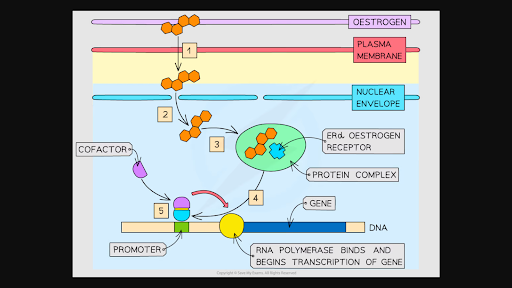
Image occlusion: name the hidden labels
20
Describe process of transcription stimulated by oestrogen
Oestrogen = lipid soluble so passes through phospholipid bilayer and nuclear envelope
Oestrogen binds to complementary ERalpha receptor (an inactive transcription factor)
ERalpha receptor changes shape and is released from protein complex
Cofactor binds to ERalpha receptor
Allows ERalpha receptor to bind to promoter region
Stimulates RNA polymerase to transcribe target gene
Oestrogen binds to complementary ERalpha receptor (an inactive transcription factor)
ERalpha receptor changes shape and is released from protein complex
Cofactor binds to ERalpha receptor
Allows ERalpha receptor to bind to promoter region
Stimulates RNA polymerase to transcribe target gene
21
Name the process where mRNA is prevented from being expressed
RNAinterference (RNAi)
22
What are the 2 types of RNA that prevent expression of a gene?
siRNA
miRNA
miRNA
23
Describe siRNA
scissor - cuts up RNA
Perfect complementary match to mRNA sequence
Has enzyme attached (RNA hydrolase)
Hydrolyses mRNA before it can be translated
Perfect complementary match to mRNA sequence
Has enzyme attached (RNA hydrolase)
Hydrolyses mRNA before it can be translated
24
Describe miRNA
mites mRNA from being read - prevents ribosome from translating mRNA
Pairing is imperfect so can work on many different mRNA
Binds to mRNA and prevents ribosome binding
miRNA has protein attached (RIS complex)
Pairing is imperfect so can work on many different mRNA
Binds to mRNA and prevents ribosome binding
miRNA has protein attached (RIS complex)
25
Define epigenetics
Inheritable changes in gene function without change to DNA base sequence
26
What are the 2 types of epigenetics?
Methylation
Acetylation
Acetylation
27
Describe methylation
Mutes expression
Addition of methyl group to cytosine base on DNA
Inhibits function of RNA polymerase
No transcription of gene
Addition of methyl group to cytosine base on DNA
Inhibits function of RNA polymerase
No transcription of gene
28
Describe acetylation
Activates expression
Addition of acetyl group to leucine (aa) in histone tail
Unwinds DNA
Increases chance of transcription
Addition of acetyl group to leucine (aa) in histone tail
Unwinds DNA
Increases chance of transcription
29
How could epigenetics affect cancer likelihood?
Methylation of tumour suppressor gene
Acetylation of oncogenes
Increase chance of cancer
Acetylation of oncogenes
Increase chance of cancer